DD
MM
YYYY

PAGES

DD
MM
YYYY

spot_img

PAGES

Home Blog Page 3349

SBM Intelligence Raises Concern That Binance Bribery Claim Could Deter Foreign Investment in Nigeria

0

SBM Intelligence, an Africa-focused market/security Intel gathering and strategic consulting firm, has expressed concern that Binance bribery claim could deter foreign investments in Nigeria.

In its analysis of the Binance saga and its impact on the Nigerian economy, the firm noted that the circumstances that led to the detention of Binance executives could undermine Nigeria’s attractiveness to foreign investments.

The consulting firm further urges the government to thoroughly investigate the matter and punish anyone found guilty.

SBM Intelligence said,

“Accusations of bribery involving high-profile government officials like those in the Tinubu Administration can further damage the country’s reputation and that of the administration itself. Such allegations can undermine investors’ trust in the government’s integrity and ability to conduct fair and transparent business dealings.

“When government officials are perceived as corrupt or willing to engage in unethical behavior, it can deter foreign investment, undermine the rule of law, and hinder efforts to combat poverty and inequality. No matter the allegations against Binance, it is essential to remember that the story of one foreign business will serve as a cautionary tale to others. If Nigeria is tagged as a country where company officials can be solicited for bribes and then detained indefinitely, convincing investors to invest will become exceedingly challenging”.

The consulting firm further urged the Nigerian government to resolve its issue with Binance as quickly, fairly, and diplomatically, adding that it would be in their best interest.

Backstory

Recall that in February this year, the Central Bank of Nigeria (CBN) governor Yemi Cardoso alleged that over $26 billion in illicit flows passed through Binance last year. 

This led the Nigerian government to block Binance operations in the country, as well as other crypto firms to avert what it considers continuous manipulation of the forex market and illicit movement of funds.

In line with this, the Government detained at least two senior executives of Binance, Najeem Anjarwalla and Tigran Gambaryan, both of whom were charged with fraud and not adhering to regulations, among others.

In a recent disclosure, Binance accused some top government officials of demanding $150m in crypto to settle the criminal charge levied against them. Binance Chief Executive Officer, Richard Teng, made the bribery allegation in a blog post published by the New York Times.

However, Nigerian lawmakers knocked Binance over bribery allegations. The Minister of Information and National Orientation, Mohammed Idris, in a statement, dismissed the claims as baseless, stating that it is an attempt by Binance to evade accountability for alleged criminal activities.

The minister said,

“This claim by Binance CEO lacks an iota of substance. It is nothing but a diversionary tactic and an attempted act of blackmail by a company desperate to obfuscate the grievous criminal charges it is facing in Nigeria. We would like to remind Binance that it will not clear its name in Nigeria by resorting to fictional claims and mudslinging media campaigns. The only way to resolve its issues will be by submitting itself to unobstructed investigation and judicial due process.”

The government, therefore, pledged to address the legal issues surrounding Binance operations in the country.

The International Monetary Fund (IMF) has urged Nigeria to establish a robust regulatory framework for cryptocurrency trading platforms, emphasizing the need for anti-money laundering controls and platform supervision. This call comes amid allegations by Binance’s new CEO that Nigerian government officials took bribes, which Binance has refuted, stating inaccuracies in the report. The situation has raised concerns about the impact on Nigeria’s investment climate and the future of cryptocurrency regulation in the country.
As Predicted in July 2023, Nigeria Reinstates Fuel Subsidy at Scale

1

On July 28, 2023, I wrote that “Nigeria will either pause the full floating of its currency or return back to fuel subsidy” because using basic economics, Nigeria cannot handle both at the same time due to the heterogeneous nature of the economy, across regions. In other words, full removal of fuel subsidy will annihilate the northern region’s economy, as costs of logistics will skyrocket even as comparative advantages remain muted. 

When the government announced the policy, I posited that it was going to be reversed since there was no basis for it to even work. Nigeria is a one-city supply chain country, on global logistics. Yes, Lagos runs the show, and more than 90% of imported shipped items used in Nigeria come via Lagos. 

If you remove fuel subsidies, you give Lagos an asymmetric comparative advantage as production cost will become unusually cheaper in Lagos than other parts of the nation, even as Lagos retains most of its current advantages in other dimensions. Who will go to Sokoto, Uyo, Okigwe, etc to set up a factory considering that energy cost is a key component of production in our generator-run economy?

But if Nigeria has a working railway system, you can do that. You can also do that if you have a diversified deep seaport system which would have reduced cost for the east-northern corridor for imports via Cross River and Akwa Ibom states. We do not feel the fuel pricing imbalance because of the petroleum equalization fund which is a “magic fund” which is used to pay transporters to ensure fuel prices are largely uniform across Nigeria. 

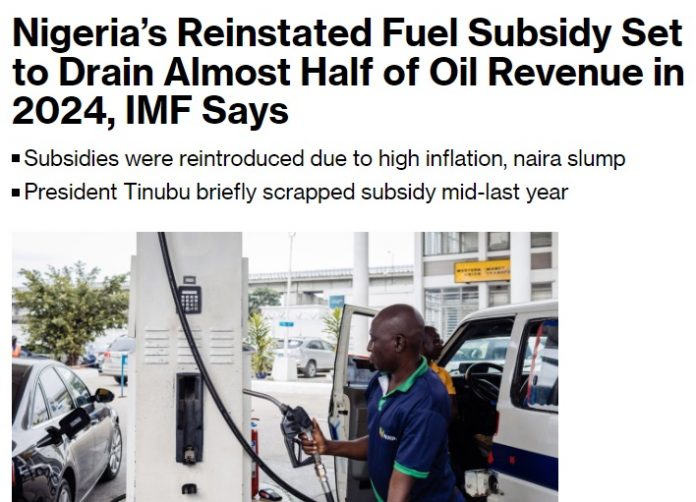
You want to remove that without providing options? You do not understand the geography of Nigeria.  Good People, Bloomberg just made it clear that Nigeria has since reintroduced fuel subsidy.  I am happy the experts are seeing what I saw in July 2023. 

From Bloomberg: “Nigeria’s reintroduction of a gasoline subsidy months after it was scrapped is expected to guzzle almost half of its projected oil revenue this year, according to the International Monetary Fund. The implicit subsidy will cost Africa’s largest crude producer an estimated 8.43 trillion naira ($5.9 billion) of its projected 17.7 trillion naira of oil revenue, the IMF said in a report published on Thursday. Its forecasts are similar to Bank of America’s, which projects it could cost Nigeria between $7 billion and $10 billion this year if it imports between 18 and 25 billion liters of gasoline…”

The Meteoric Rise of Mistral AI, as Solana’s DePIN Boosts Ecosystem

0

In the dynamic world of artificial intelligence, few stories are as compelling as the meteoric rise of Mistral AI. The Paris-based startup, known for its work on open-source large language models, has announced a significant increase in its valuation, reaching a staggering $6 billion from a previous $2 billion just six months prior. This valuation leap marks a new chapter in the AI industry, reflecting the growing importance and potential of generative AI services.

Mistral AI’s journey began with a vision to compete against established players like OpenAI and Anthropic. The company’s focus on an open-source approach to large language models has distinguished it within the tech community, garnering the attention and support of heavyweight investors. The recent fundraising round is set to be around, but less than, $600 million, indicating strong investor confidence in Mistral AI’s direction and potential.

The investment landscape for AI startups is often turbulent, with many players vying for a position of dominance. Mistral AI’s valuation increase is a testament to its strategic growth and the robustness of its technology. The company has attracted a diverse group of investors, including General Catalyst and Lightspeed Venture Partners, who are reportedly looking to participate in this round. Notably, DST, led by Yuri Milner, is a new name entering the fray, signaling a broader interest in Mistral AI’s offerings.

This funding round follows a previous $415 million round at a $2 billion valuation, highlighting the rapid pace at which Mistral AI is evolving. The company’s investor list boasts over 36 current backers, featuring prominent names like Andreessen Horowitz, Redpoint, and Headline, as well as strategic partners such as Databricks, Nvidia, Salesforce, Snowflake, and Microsoft, which recently became one of Mistral AI’s significant backers.

Mistral AI’s valuation surge is not just about numbers; it’s about the company’s potential to shape the future of AI. With its open-source philosophy, Mistral AI is contributing to a more collaborative and accessible AI ecosystem. The company’s European roots also underscore Paris’s growing reputation as a hub for AI research and development, joining the ranks of other notable tech entities in the region.

As Mistral AI continues to raise funds and expand its influence, the tech world watches with keen interest. The company’s success story is a beacon for other startups and a clear indicator of the vibrant and competitive nature of the AI industry. With its eyes set on the future, Mistral AI is poised to play a pivotal role in the evolution of generative AI services, driving innovation and opening new possibilities for the global tech community.

Solana’s development of DePIN key factor in boosting its Ecosystem

The blockchain ecosystem is witnessing a significant evolution with the development of Decentralized Physical Infrastructure Networks (DePIN), and Solana is at the forefront of this innovative movement. The integration of DePIN within Solana’s framework is not just a technological advancement but also a strategic enhancement that could potentially boost its market capitalization significantly.

DePIN represents a paradigm shift in how physical infrastructure is managed and deployed. It leverages blockchain technology to create a decentralized network of resources, enabling more efficient, cost-effective, and rapid deployment compared to traditional centralized models. This approach aligns with the ethos of blockchain, which is to decentralize and distribute control, thereby reducing reliance on single points of failure and creating a more resilient infrastructure.

Solana, known for its high throughput and low transaction costs, provides an ideal environment for DePIN projects. The migration of Helium, a significant DePIN project, from its own Layer 1 to Solana in Q2 2023, marked the beginning of Solana’s dominance in the DePIN space. This move brought with its category leaders like Hivemapper and Render, likened to the FAANGs of DePIN, contributing to a combined Fully Diluted Valuation (FDV) of over $10 billion and a market cap of $4 billion.

The potential market for DePIN is vast, with Messari estimating the total addressable market (TAM) to be over $2.2 trillion, with expectations to reach $3.5 trillion by 2028. Such projections are based on the assumption that a significant portion of physical infrastructure will be token-incentivized, which may lead to exaggerated figures. However, it underscores the ambitious nature of the DePIN initiative and its potential impact on the crypto ecosystem.

Solana’s role in this development is crucial. Its technical advantages, such as state compression technology, significantly reduce the cost of minting non-fungible tokens (NFTs) that represent real-world hardware, a key aspect of DePIN projects. Furthermore, Solana’s growing ecosystem attracts DePIN projects at various stages of their lifecycle, from nascent to mature.

The development of DePIN on Solana has opened new opportunities for the blockchain community. It has enabled the deployment of heavy-asset services with more flexible and decentralized node deployment. The success of Helium Mobile’s launch of the cheapest telecom package in the United States has brought renewed attention to DePIN and its implementation possibilities.

As the DePIN ecosystem continues to grow, with over 650 projects spanning six subsectors, including compute, AI, wireless, sensors, energy, and services, Solana’s market cap stands to benefit from the increased activity and value generated by these projects. The DePIN model, which uses hardware to provide resource allocation that may involve bandwidth and computing power, replaces the need for centralized intermediaries with token incentives. This not only fosters a more decentralized service delivery but also encourages participation and investment from the community.

In conclusion, Solana’s development of DePIN is a key factor that could significantly influence its market cap. By providing a robust platform for DePIN projects, Solana is positioning itself as a leader in the next wave of blockchain innovation. The success of DePIN on Solana could herald a new era of decentralized infrastructure, with far-reaching implications for the blockchain industry and beyond.

Candy Jets Embraces Bitcoin Lightning Payments

0

In a groundbreaking move that signals a shift in the luxury travel industry, Candy Jets, a premier private jet charter service, has announced its partnership with CoinCorner to accept Bitcoin Lightning payments. This strategic alliance not only places Candy Jets at the forefront of technological innovation but also marks a significant milestone in the adoption of cryptocurrency in high-end service markets.

The integration of Bitcoin Lightning payments—a layer built on top of Bitcoin that enables cheap and instant transactions—into Candy Jets’ payment options is a response to the growing demand for more efficient and secure payment methods. By leveraging CoinCorner’s Bitcoin payment solution, CoinCorner Checkout, Candy Jets is now offering its clients the convenience of making payments using Bitcoin and Lightning.

This initiative by Candy Jets is a testament to the company’s forward-thinking approach. Laura Green, co-founder of Candy Jets, expressed her enthusiasm for the new payment facility, stating, “Today’s announcement marks the start of an exciting new prospect for Candy Jets customers being able to pay for our market-leading services in bitcoin.” The partnership with CoinCorner reflects a strategic move to cater to a tech-savvy clientele that values the ease and efficiency of digital transactions.

The private jet charter services market has witnessed substantial growth, reaching USD 12.97 billion in 2023, with projections to rise to USD 21.18 billion by 2026. Candy Jets’ adoption of Bitcoin payments positions the company well to capitalize on this expanding industry by providing enhanced services that appeal to the digitally inclined consumer.

Danny Scott, CEO of CoinCorner, highlighted the benefits of accepting Bitcoin, stating, “A growing number of businesses are realizing the advantages of Bitcoin – from opening up to a world of borderless payments to reducing the time and costs associated with traditional payment methods.” This innovative approach is set to change the future of payments, offering Candy Jets’ customers a new level of convenience and luxury in private air travel.

The decision by Candy Jets to embrace Bitcoin Lightning payments is more than just a business strategy; it is a reflection of the company’s commitment to embracing the future of financial transactions. As the world becomes increasingly digital, Candy Jets is leading the way in providing its customers with state-of-the-art payment solutions that are secure, fast, and convenient.

For those seeking the exclusivity and comfort of private jet travel, the option to pay with Bitcoin through Candy Jets’ platform is a clear indication of the company’s dedication to customer satisfaction and innovation. As the luxury travel sector continues to evolve, Candy Jets’ embrace of Bitcoin Lightning payments is a bold step towards a more interconnected and digital future in high-value service industries.

New Era in Scientific Discovery is Unfolding with AlphaFold 3

0

The world of scientific research and drug discovery is on the cusp of a revolutionary change with Alphabet’s latest announcement of AlphaFold 3. This new AI model, developed by Google DeepMind and Isomorphic Labs, is poised to significantly accelerate the pace of scientific discovery by predicting the structure and interactions of all of life’s molecules with unprecedented accuracy.

AlphaFold 3 builds upon the success of its predecessor, AlphaFold 2, which was already a game-changer in protein structure prediction. The new model extends its capabilities beyond proteins to a broad spectrum of biomolecules, including DNA, RNA, and ligands. This advancement is not just incremental; it represents a quantum leap in our ability to understand the biological world.

The implications of AlphaFold 3 are vast and varied. For one, it could transform drug discovery by allowing scientists to rapidly understand the structure and interactions of molecules, paving the way for the development of new, more effective medications. Moreover, the model’s ability to predict interactions between proteins and other molecules with at least a 50% improvement in accuracy compared to existing methods is a testament to its potential impact on the field.

AlphaFold 3’s prowess doesn’t stop at drug discovery. Its applications extend to genomics research, the development of Bio renewable materials, and the creation of more resilient crops. In essence, it has the potential to touch every aspect of biological research, offering insights that were previously out of reach due to the complexity and cost of traditional methods.

One of the most commendable aspects of AlphaFold 3 is its accessibility. Alphabet has made the majority of its capabilities available for free through the AlphaFold Server, an easy-to-use research tool. This democratization of technology ensures that researchers around the world can leverage this powerful model to advance their work, regardless of their resources.

The scientific community has already recognized the impact of AlphaFold, with the model being cited over 20,000 times and winning prestigious awards like the Breakthrough Prize in Life Sciences. With AlphaFold 3, we can expect this impact to grow exponentially, as it enables scientists to explore new frontiers in biology and medicine.

As we stand at the threshold of this new era, it’s clear that AlphaFold 3 is more than just an AI model; it’s a beacon of hope for the future of science and humanity. With its help, we may soon find answers to some of the most pressing challenges of our time, from curing diseases to protecting the environment.

For more detailed insights into AlphaFold 3 and its capabilities, you can read the full announcement on Alphabet’s blog or explore the technology on DeepMind’s dedicated AlphaFold page.