DD
MM
YYYY

PAGES

DD
MM
YYYY

spot_img

PAGES

Home Blog Page 3396

Samourai Wallet Founders Arrested and Charged over $2B Money Laundering Transactions

0

The recent arrest of the Samourai Wallet founders has sent shockwaves through the cryptocurrency community. Keonne Rodriguez and William Lonergan Hill have been charged with operating an unlicensed money-transmitting business that allegedly facilitated over $2 billion in unlawful transactions. This case highlights the ongoing debate around the use of cryptocurrency mixing services, which are designed to enhance privacy but can also be misused for illicit activities.

Samourai Wallet is a Bitcoin wallet application known for its emphasis on user privacy and security. It was designed to provide users with a platform that enhances the anonymity of their Bitcoin transactions. The wallet offers various features such as stealth mode, remote SMS commands, and a Segregated Witness (SegWit) implementation, which helps in reducing transaction fees by optimizing the size of transactions.

Cryptocurrency mixers, or tumblers, are services that mix various streams of potentially identifiable cryptocurrency, making it more difficult to trace the funds back to their original source. While these services can be used for legitimate privacy reasons, they also pose a significant challenge for law enforcement agencies trying to combat money laundering and other financial crimes.

One of the key features of Samourai Wallet is its commitment to privacy. It includes integrated access to a Bitcoin mixer, which is a service that mixes different streams of potentially identifiable cryptocurrency. This process makes it more difficult to trace the funds back to their original source, thereby increasing privacy. However, it’s important to note that while these services can be used for legitimate privacy reasons, they can also be misused for illicit activities, such as money laundering.

Samourai Wallet also provides its users with a self-hosted full node server, which allows them to validate their own transactions without relying on third-party services. This feature is part of the wallet’s aim to empower users to be sovereign over their own financial transactions.

Despite its features aimed at enhancing user privacy, it’s crucial for users to understand the legal implications of using any financial tool, especially those that operate in areas with strict financial regulations. The recent events involving the Samourai Wallet founders have highlighted the potential risks and legal responsibilities associated with the use of privacy-centric financial tools.

The indictment alleges that the Samourai Wallet, which has been in operation since 2015, facilitated more than $100 million in money laundering transactions from illegal dark web markets. The charges against Rodriguez and Hill include conspiracy to commit money laundering and conspiracy to operate an unlicensed money transmitting business, carrying a maximum sentence of 20 years and five years, respectively.

The case against the Samourai Wallet founders underscores the delicate balance between the right to privacy and the need for transparency in financial transactions to prevent criminal activities. It also raises important questions about the responsibilities of technology providers in ensuring their platforms are not misused for illegal purposes.

As the legal proceedings continue, the cryptocurrency community will be watching closely to see how this case impacts the future of privacy-focused financial services and the broader regulatory landscape for digital currencies. The outcome could set a precedent for how similar services are treated under the law and how much scrutiny they face from authorities.

For now, the arrests serve as a reminder of the potential legal risks associated with providing or using privacy-centric financial tools, especially those that operate in the gray areas of the law. It is a wake-up call for the industry to foster innovation while ensuring compliance with existing financial regulations to prevent misuse.

The full implications of this case will unfold over time, but it is clear that it marks a significant moment in the ongoing dialogue between privacy advocates, regulators, and law enforcement agencies. As the cryptocurrency space continues to evolve, so too will the discussions around privacy, security, and the ethical use of technology.

Impending Removal of Phoenix Wallet from the US App Store

The digital finance landscape is undergoing a significant transformation, and the latest development in this rapidly evolving sector is the removal of Phoenix Wallet from the US App Store, slated for May 3rd, 2024. This move is a direct consequence of heightened regulatory scrutiny over cryptocurrency services, particularly those enabling self-custody of digital assets.

Phoenix Wallet, a non-custodial Bitcoin lightning wallet, has been a prominent player in the crypto space, offering users the ability to manage their digital assets without intermediary control. However, recent regulatory developments have cast a shadow over the operations of such services. The US authorities’ increasing focus on cryptocurrency firms, especially those considered potential Money Services Businesses (MSBs), has led to a crackdown on unregistered entities.

The case of Phoenix Wallet is particularly noteworthy as it follows the indictment of the founders of Samourai Wallet, another service in the crypto space, on charges of facilitating illegal transactions. This has sent ripples through the industry, with the Federal Bureau of Investigation (FBI) issuing warnings about operations targeting various unregistered crypto firms.

This incident highlights the ongoing debate between the principles of decentralization and the established policies of centralized app stores. Decentralization advocates argue for a more open and less restrictive digital ecosystem, where users have greater control over their data and transactions. On the other hand, app stores, such as the one operated by Apple, maintain strict guidelines to ensure a secure and consistent user experience, which often includes a cut of in-app transactions.

The crux of the issue lies in the app’s tipping feature, which utilizes Bitcoin’s Lightning Network to facilitate transactions. Apple’s guidelines require that digital content transactions go through its in-app purchase system, ensuring the company receives a percentage of the revenue. The app developers made adjustments to comply with these rules, but the app was still slated for removal, prompting a public response from Dorsey and plans for an appeal.

This situation raises important questions about the future of app distribution and the role of cryptocurrency in digital transactions. As decentralized platforms gain popularity, the tension between these new models and traditional app store policies is likely to increase. The outcome of this particular case could set a precedent for how decentralized apps operate within the confines of centralized marketplaces.

Phoenix Wallet’s decision to exit the US market is a reflection of the broader challenges faced by the cryptocurrency industry. The regulatory environment in the United States has become increasingly uncertain, with authorities taking a hard stance on services they believe could be involved in money laundering or other illicit activities. This has led to a situation where companies like Phoenix Wallet are choosing to withdraw their services rather than navigate the murky waters of compliance.

For users of Phoenix Wallet in the US, the company has issued guidance on how to empty their wallets before the app’s removal from the store. This includes instructions on closing channels for Android users and draining wallets for those on iOS, with a recommendation to avoid force-closing channels due to the potential for significant on-chain fees.

The departure of Phoenix Wallet from the US App Store is a significant event that highlights the ongoing tension between innovation in the fintech sector and the regulatory frameworks designed to oversee it. As the landscape continues to shift, it will be crucial for both industry participants and regulators to find a balance that fosters innovation while ensuring the security and legality of financial transactions.

Metamask, ConsenSys Accused by US SEC of Acting as an Unlicensed Broker Dealer

0

In a recent development that has sent ripples through the cryptocurrency community, the U.S. Securities and Exchange Commission (SEC) has reportedly accused MetaMask, a popular Ethereum wallet and gateway to blockchain apps, of functioning as an unlicensed broker-dealer. This accusation is part of a broader scrutiny of the crypto industry by regulatory bodies, reflecting the ongoing debate over the classification and regulation of digital assets.

MetaMask, developed by ConsenSys, is a software that allows users to interact with the Ethereum blockchain, manage their cryptocurrency holdings, and access decentralized applications (dApps). The SEC’s move appears to be based on the premise that certain activities conducted by MetaMask may fall under the regulatory purview of securities trading, necessitating a broker-dealer license.

Broker-dealers are entities or individuals that are in the business of trading securities for their own account or on behalf of their clients. In the United States, broker-dealers must be licensed and are subject to regulatory requirements designed to protect investors and ensure market integrity. The SEC’s allegation implies that MetaMask may have engaged in activities that could be construed as trading securities without the necessary authorization.

The crypto industry has long been in a regulatory gray area, with companies often operating in a landscape that lacks clear guidelines. The SEC has been active in attempting to bring clarity to this space, albeit in a manner that some industry participants view as overreaching. The recent lawsuit filed by ConsenSys against the SEC is a direct response to the agency’s actions, seeking a court ruling to affirm that Ethereum’s native token, Ether, is not a security and thus outside the SEC’s jurisdiction.

This legal battle is significant as it touches upon the fundamental question of how cryptocurrencies should be classified and regulated. The outcome of this case could have far-reaching implications for the crypto industry, potentially setting a precedent for how similar cases are handled in the future.

The SEC’s approach to regulation through enforcement has been a point of contention, with critics arguing that the agency has not provided adequate regulatory guidance for the industry. Instead, the SEC has often relied on existing securities laws to govern the rapidly evolving crypto market. This has led to uncertainty and calls for a more tailored regulatory framework that takes into account the unique characteristics of blockchain technology and digital assets.

The controversy surrounding the SEC’s classification of cryptocurrencies as securities is not new. In the past, the agency has indicated that Bitcoin and Ethereum are not securities, primarily due to their decentralized nature. However, the SEC’s current stance seems to be shifting, particularly with regard to Ethereum’s transition to a proof-of-stake model, which involves staking—a process that could be interpreted as an investment contract and thus a security.

As the legal proceedings unfold, the crypto community will be watching closely to see how the SEC’s actions will shape the future of cryptocurrency regulation. The case of MetaMask serves as a reminder of the importance of regulatory compliance and the need for clear, consistent guidelines that support innovation while protecting consumers.

BYD Poised to Offset Tesla’s Market Share in China With The Impressive Sea Lion 07 Model

0

BYD, a prominent Chinese electric vehicle (EV) manufacturer, is positioned to offset Tesla’s market share in the Chinese EV market with its latest product offering, the remarkable Sea Lion 07 model.

The Sea Lion 07 is said to be designed by former Lamborghini and Audi designer Wolfgang Egger, signifying BYD’s strategic move to dominate the Chinese EV market.

Unveiled at the 2023 Guangzhou International Auto Show, the Sea Lion 07 is positioned to compete directly with Tesla’s popular Model Y and the company has announced that it would go on sale soon. Also, BYD expects the car to reach the UK by the first quarter (Q1) of 2025.

Last week Wednesday, BYD officially unveiled the beautiful interior of the Sea Lion 07. The interior of the Sea Lion 07 showcases luxury with a 15.6″ Adaptive Floating Screen, leather finishes, and a high-quality Dynaudio sound system, signaling BYD’s commitment to high-end amenities.

Interior snapshots reveal a surprisingly opulent cabin, echoing the design language of the Qin L. While the instrument screen seamlessly integrates into the flowing dashboard,

BYD’s distinctive floating rotatable screen remains a focal point in the center of the dash. The four-spoke steering wheel is adorned with an array of buttons, and the center console features a crystal gear lever surrounded by additional controls.

Notably, the Sea Lion model is expected to feature BYD’s cutting-edge Blade Batteries and platform 3.0 technology, enhancing its performance credentials. Base models are equipped with a 227hp peak power motor, offering a top speed of 210km/h. Higher-spec versions feature a more potent motor, delivering 308hp peak power and enabling a top speed of 225km/h.

It is worth noting that BYD has been experiencing significant success in the Chinese EV market, selling over 165,500 fully electric vehicles in October alone and crossing the 1.2 million EVs sold mark last year(2023).

In the third quarter of 2023, it narrowed the gap with Tesla, which delivered 435,059 vehicles while BYD came remarkably close, delivering 431,603 EVs. Nevertheless, in the final quarter of last year, BYD outsold Tesla in battery-only cars – 526,000 to 484,000 – for the first time.

A report in February 2024 revealed that Elon Musk’s Tesla has been overtaken by BYD as the world’s top-selling electric carmaker. The company which has been backed by the US investment billionaire Warren Buffett since 2008, surpassed Tesla’s production for a second consecutive year.

Most of BYD’s vehicles sell at a lower price point than Tesla, which derives about 20% of its sales from the Chinese market. The company has set its sights on becoming a major player in international markets, with a particular focus on Europe.

Tesla Restrictions Lifted in China as Elon Musk Meets with Premier Li Qiang

0

Local Chinese authorities have lifted restrictions on Tesla cars after the company’s China-made vehicles successfully passed the country’s stringent data security requirements, Tesla announced on Sunday. 

The breakthrough coincided with Tesla CEO Elon Musk’s unexpected visit to Beijing, where he held a meeting with Chinese Premier Li Qiang amidst the backdrop of the city’s first major auto show in four years.

Despite Tesla’s widespread popularity in China, concerns had previously surfaced regarding the potential data collection capabilities of the U.S.-based automaker. Reports had circulated about Tesla vehicles being banned from certain government-related properties due to these concerns. However, Tesla’s press release on Sunday did not specify which specific local authorities had removed the restrictions, leaving room for speculation.

The Biden administration had initiated a probe earlier into whether imported cars from China posed national security risks due to their potential data collection capabilities. However, Tesla was not the only manufacturer to meet China’s stringent data security rules. Other manufacturers, including BYD, Lotus, Nezha, Li Auto, and Nio, also announced compliance with the requirements, as revealed by the China Association of Automobile Manufacturers and the National Computer Network Emergency Response Technical Team/Coordination Center of China.

The newly introduced data security requirements for “connected vehicles,” released in November, cover cars released in 2022 and 2023. Automakers voluntarily submit their vehicles for inspection, with the rules encompassing various aspects such as the anonymization of facial recognition data outside the vehicle, the default setting of not collecting cockpit data, processing data inside the car, and prominently informing users about personal information processing.

Tesla, being among the first batch of automakers to meet the compliance requirements, emphasized its commitment to data localization and security. The company revealed that it had localized data storage at its Shanghai data center in 2021 and had subsequently passed the ISO 27001 international standard for information security following a review by third-party auditors.

Musk’s visit to China has ignited speculation regarding the availability of Tesla’s highly anticipated driver-assist software, Full Self Driving, in the country. However, JL Warren Capital CEO and Head of Research Junheng Li expressed skepticism about the immediate rollout of a “supervised” version of FSD in China. Li cited challenges for Tesla, a foreign entity, to support the local operation of the software in China, particularly in the presence of high-quality local alternatives such as Xpeng’s driver-assist software.

Notably, Tesla’s absence from this year’s auto show marks a departure from previous years, following an incident during the Shanghai auto show in 2021 when a protester stood on one of its cars.

However, this development stems from the broader growing tech war between the United States and China. The Biden administration’s probe into the national security risks posed by imported cars from China reflects escalating tensions between the two global powers. 

Concerns over data security have become a focal point in this geopolitical rivalry, with both countries vying for dominance in emerging technologies such as  artificial intelligence, electric vehicles and autonomous driving systems. 

For companies like Tesla caught in the rivalry, their ability to comply with regulatory requirements and maintain market access will continue to shape their growth across the two countries.

Facebook Monetization and Exponential Growth of Skit-makers in Nigeria

0

According to some statistics, Nigeria has the biggest number of Facebook users in Africa. This is hardly surprising given her population of over 200 million people, the majority of whom are young and eager to explore numerous prospects in the digital arena. According to one report, Facebook had over 41 million users in the country as of May 2023, accounting for 18.5% of the total population. 

Like other platforms, Facebook is benefiting from the worldwide video streaming market, which is expected to increase by 8.27% from 2024 to 2027. By 2027, analysts predict the market to be worth more than US$137 billion. Additionally, information has it that in the start of 2024, Facebook’s ad penetration rate in Nigeria was higher than 16% of the country’s overall population. With this, our analyst notes that users’ call for participation in the monetization programme of the platform seems to be in order considering revenue that the platform is generating from Nigerian users. 

The campaign for inclusion has been ongoing for several years. Users see no reason why Nigeria cannot be included in the initiative. Questions like “I am from Nigeria, how can I monetize my Facebook profile?” have been asked in both online and offline communities. Answers included negative affirmation, such as the fact that you cannot monetise your Facebook page while living in Nigeria unless you have a trusted person in qualified countries to whom you can give access. 

However, in March 2024, succour was brought to the agitators when the social media giant revealed that Nigerian creators can now monetise their content starting in June 2024. Meta’s President of Global Affairs, Sir Nick Clegg, said Meta will introduce in June 2024 a feature on its Instagram app that will allow Nigerian creators to monetize their content to enable them to earn a living using the app.”

What is Facebook monetization?

Facebook monetization is a powerful platform that allows users to earn money through various avenues, including the Facebook Marketplace, Facebook Ads, Facebook Creator Studio, and Facebook Live. These platforms allow users to buy, sell, and trade goods and services within their local community, reach a wide audience, and monetize their products or services. To maximize revenue, businesses can use Facebook’s extensive user data and optimize ad campaigns.

To optimize for SEO, users should conduct thorough keyword research, craft compelling titles and descriptions, engage with engaging visuals, maintain a consistent posting schedule, and encourage interaction and interaction with their posts. This signals to search engines that your content is valuable and relevant, which can boost its ranking in search results.

Effective monetization strategies are also crucial for maximizing earnings on Facebook. Diversifying revenue streams, building a strong brand presence, leveraging data and analytics, and staying updated on trends and best practices are essential steps to consider. Diversifying revenue streams helps mitigate risk and maximize income potential. Building a strong brand presence increases trust and credibility, driving more sales and conversions.

Facebook’s analytics tools help track the performance of content and advertising campaigns, identifying areas for improvement and optimizing the monetization strategy accordingly. Staying updated on trends and best practices in Facebook monetization and SEO is essential to stay ahead of the curve and unlock the full potential of this powerful platform.

Exponential Growth of SKITHOOD

Our expert observes that the programme is all-encompassing, with the premise that users are digital workers who must assure efficient preparation and execution in order to earn a large income from the platform. In other words, Facebook is utilizing its massive user base in Nigeria to recruit more digital workers, which will increase its global revenue and profits. 

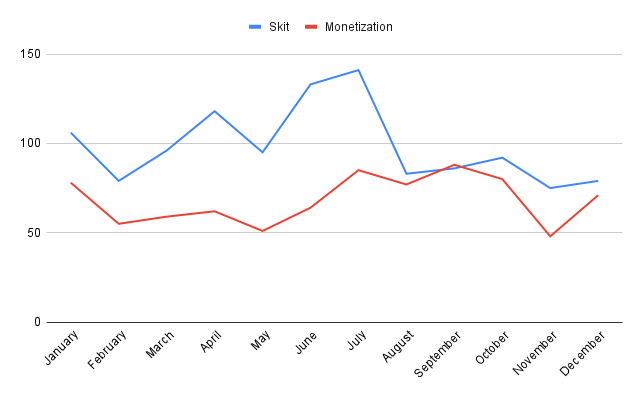
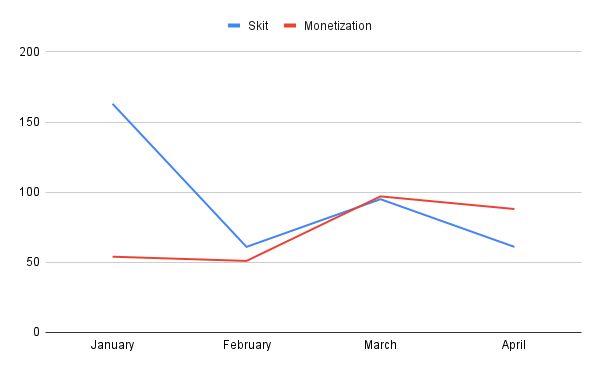
Exhibits 1 and 2 illustrate the high amount of interest the Nigerian public demonstrated in skit and monetization from January, 2023 to April 29, 2024, supporting the idea that the platform will be hiring more users as digital workers. Our analysis indicates that the interest in skit and monetization reached a “strong collision” in March 2024, the same month that the social media giant declared it was willing to grant Nigeria access to the programme. 

Exhibit 1: Nigerian public interest in skit versus monetization in 2023

Facebook
Source: Google Trends, 2024; Infoprations Analysis, 2024

Exhibit 2: Nigerian public interest in skit versus monetization in 2024 (till April 29)

Monetization
Source: Google Trends, 2024; Infoprations Analysis, 2024

Early this year, our digital observation study revealed that a number of new entrants into the skit business were targeting various elements of Nigerian society. This is projected to increase further beginning in June 2024, particularly in places with the fewest skit-makers and a desire to supplement income as the difficult economic situation persists.