DD
MM
YYYY

PAGES

DD
MM
YYYY

spot_img

PAGES

Home Blog Page 3425

Shielding Your Digital Assets – A Comprehensive Guide to DDoS Protection

0

In an increasingly interconnected business landscape, small and large enterprises depend on web and internet-based systems that are constantly available to engage users and drive revenue remotely. A few roadblocks prove as frustrating as Distributed Denial of Service (DDoS) attacks overwhelming sites, causing them to shut down while losing company credibility and customers.

Understanding DDoS Attacks: A Digital Siege

DDoS tactics bombard internet-connected systems with waves of bogus requests from botnets – infected devices that attackers control remotely. Unable to distinguish authentic users, sites become choked, attempting to process the floods until crashing completely from overload. Sustained assaults lasting hours, days, or weeks inflict serious damage:

  • Downtime: Suspended web transactions represent tremendous immediate financial impact, along with the damage of appearing unreliable to visitors of downed websites and portals.
  • Financial Losses: Depending on attack severity, site recovery costs, investigative responses, customer reimbursements, and structural hardening improvements, post-mortem compound budget shocks occur during and after.
  • Data Breaches: Criminals may launch denial of service efforts specifically to distract IT security staff while separately infiltrating databases quietly amidst crisis firefighting confusion, undetected initially.
  • Reputational Damage: Regardless of whether incidents trace back to hackers, political “hacktivists,” or even business rivals, companies experiencing high-profile outages inevitably test consumer trust in providing reliable services, and prospective customers may turn elsewhere from warily.

Different Types of DDoS Protection

Safeguarding environments calls for multilayered protection encompassing:

  • Blackholing: Telecommunications partners simply absorb and discard malicious traffic before it reaches company environments rather than passing it along choked pipes. This safeguards infrastructure integrity effectively but also suspends legitimate access during attacks.
  • Rate Limiting: Strategic rules filter out and throttle excess connection requests and other suspect transmission patterns relative to current site activity, limiting flood impacts. However, configuration mistakes may unintentionally block users.
  • IP Filtering: Blocklists containing updated reputation scores on known malicious IP addresses and botnet ranges filter unwanted activity dynamically, relegating it away from production networks. Maintaining filters continually remains vital as attackers shift.
  • Scrubbing Centers: Specialized third-party DDoS mitigation firms route site traffic through proprietary cleansing centers, identifying and discarding bogus attack requests before passing only clean results onto client sites. This proves highly effective but adds latency.

The Importance of DDoS Protection: Building a Digital Fortress

Robust global DDoS protection services provide indispensable benefits:

  • Ensures Business Continuity: By absorbing and deflecting bogus requests before bombardment overwhelms infrastructure, mitigation keeps websites and portals reliably online throughout sieges. User experiences stay smooth amid attacks unseen behind the scenes.
  • Maintains Customer Trust and Reputation: Enterprises that are proactive enough to implement protections before disasters instill lasting confidence in operational resilience in clients, who are less likely to abandon them for competitors following high-profile attacks.
  • Protects Sensitive Data: Stopping website shutdowns outright prevents related data breaches from hackers infiltrating networks amidst chaos or inciting insider mistakes that accidentally expose databases during high-pressure disaster response.
  • Improves User Experience: Even below outages, site performance suffers drastically from inefficient software attempting to process floods taxing servers. Protection avoids lags, errors, and crashes, preserving intended responsiveness.
  • Enhances Online Security Posture: Expert mitigation partners assess existing infrastructure defenses and content delivery networks, deliver tactical hardening advice, and improve websites’ overall security beyond denial-of-service resilience alone.

Unveiling the Shield: How Global DDoS Protection Services Work

Multi-location DDoS protection relies on specialized network architecture to identify and block threats, including:

  • Network Traffic Monitoring: Sensor arrays across content delivery and data center endpoints build baseline website activity profiles distinguishing legitimate human patterns from botnet traffic. Attack recognition starts here.
  • Traffic Filtering: Once abnormal spikes signal possible siege activity, software filters absorb floods while passing only legitimate appearing access attempts onto client sites. Traffic blackholing safely discards malicious payloads away from production systems.
  • Capacity Augmentation: On-demand expansive bandwidth and compute scale to absorb even 500Gbps-1Tbps sized attacks without client infrastructure flinching protects websites reliably. Filter sensitivity adjusts, ensuring authentic visitors proceed unimpeded.
  • Real-time Threat Detection and Response: Security teams receive immediate attack notifications allowing manual reviewing of threat feeds and adding custom blocking rules complementing automatic systems denying known malicious IP ranges in seconds defending sites continually.
  • Advanced Security Features: Top providers offer web application firewalls, security auditing, VPN access, and content caching enhancements beyond DDoS that better fortify network perimeters holistically.

Choosing the Right Weapon: What to Look for in a DDoS Protection Service

Selecting optimal denial-of-service protection means evaluating partners across these key criteria:

Mitigation Capacity:

Seek globally distributed infrastructure boasting enough capacity to block attacks nearing 1Tbps (1,000 Gbps) in size by flexing cloud-based scrubbing resources up and down, matching real-time traffic peaks. Many providers quote bandwidth numbers only reflecting maximum throughput, not attack absorption figures that signal usable filtering headroom. Cloud-layered solutions offer more flexibility in meeting demands at wartime intensity spikes than purely on-premise hardware.

Detection and Filtering Techniques:

Behavioral attack recognition through algorithmic analysis finding traffic anomalies matters greatly – not simply relying on static reputation blocklists possibly missing new botnet IP ranges attackers continually switch to. Scrutinize traffic with smart signals before passing it. Techniques like anomaly detection, signature analysis, heuristic monitoring, and machine learning indicate technical sophistication, separating experts from novices who are merely routing threats.

Global Network:

The larger the distributed security footprint across regions, the less distance bogus traffic travels before getting identified and discarded—minimizing latency impacting authentic visitors interacting with sites legitimately. Seek worldwide points of presence with technologies housed in key internet exchanges to optimally clean traffic nearest the source.

Performance Impact:

Negligible 1-5% site visitor performance lag indicates precision separating bad traffic from good traffic before it approaches websites. Prioritize solutions that guarantee minimal slowdown for web application usage and MTTR SLAs that are promising under one-minute recovery post-attack. The last thing businesses want is protection quietly hampering conversion and SEO Site speeds daily unnoticed.

Real-Time Monitoring and Alerts:

Security teams need granular visibility from initial attack recognition through post-mitigation aftermath, which informs defensive response tactics as hackers mutate tactics attempting follow-on outbreaks. Dashboards tracking live threats, helping benchmark normal traffic levels, and detailing attack vectors over email empower management.

24/7 Emergency Assistance:

Responsive real-time emergency assistance, escalation contacts, and mandatory post-event analysis represent indispensable DDoS provider traits for enterprises where uptime reputation hangs in the balance continually. Insist partners deliver support rigor aligned to hospital-like severity whether suffering a 3 am peak holiday sales siege or Monday morning team denial-of-arrival lockouts. On-call expertise defends businesses in turmoil.

The ideal DDoS protection partner combines smart detection, mammoth global absorption capacity, negligible performance disruption, expansive real-time visibility, and urgent support. It responds instantly as a digital gatekeeper while companies focus on serving customers safely.

Conclusion

With exponential yearly increases in denial-of-service attacks by the hundreds of millions, no modern digital business avoids risk from potential siege. Implementing layered detection and mitigation defenses to match adversary technical savvy proves essential for keeping services reliably online while safeguarding infrastructure, data, and credibility during events and strengthening systems long-term. Partnering with battle-tested experts allows concentrating on users beyond worrying about the digital “barbarians at the gate” lurking endlessly.

Final Stage For This MemeCoin With 290% Growth! Will Dydx (DYDX) and Render (RNDR) Keep Up?

0

The hype around KangaMoon (KANG) isn’t just for show, the token is steadily breaking milestones in the meme coin market and gaining more attention than expected.  With nearly 300% rise above its initial selling price, KangaMoon is gladdening the hearts of its community members with impressive ROI. Now the question beckons— will the likes of Dydx (DYDX) token and Render (RNDR) coin be able to hold a candle against KangaMoon’s growth. Being relatively new, Dydx still has enough potential for a future price rise however it may not be able to achieve the efforts Render token is making at rivaling KangaMoon.

Dydx Token (DYDX) Falls Below Yearly Support and Settles Down

Dydx only launched late last year, however the new proof of stake made an impressive debut as the token. About a month ago, Dydx reached an all-time high price of $4.52 however, now the token has declined by 49% from this ATH price.

Currently, Dydx holds in a weekly price range of $1.80 and $2.86, after declining by over 20% in the past week and nearly 30% in the past month. Dydx is still relatively new, however, there is potential for further gains this year.

KangaMoon (KANG) Is On A Growth Spree That Will Rival Many Top Meme Coin

KangaMoon (KANG) is already ranking as a top contender for post-Bitcoin Halving surges, boasting substantial growth prospects. While Dydx and Jupiter are experiencing notable downturns, KangaMoon’s native token– KANG has consistently drawn investor interest. Functioning as a play-to-earn platform, KangaMoon offers users opportunities to engage in private tournaments as well as periodic challenges, thereby earning themselves high-value rewards and prizes.

Even non-gamers can participate by speculating on match outcomes for a chance to win, which goes to say every interaction on the platform presents a chance to earn. Whether through gaming challenges or community activities like sharing and commenting on social media posts promoting the project, there appears to be an opportunity for everyone.

With over 6,000 presale purchases and a community exceeding 20,000 members, the project has amassed over $5 million and analysts anticipate a potential 50x return in the near future when it takes over the meme coin market. Currently in its 5th and last presale stage, the native KANG token is available at a price of just $0.0196, coupled with a 10% deposit bonus. With early buyers enjoying up to 290% ROI, savvy investors are seizing the opportunity to accumulate tokens and explore the DeFi market.

Looking ahead, the $KANG token is poised for listing on major tier-1 exchanges like Uniswap in Q2. With that in place, Industry experts foresee the token reaching $1 by Q4, buoyed by the massive $21.2 billion GameFi market that KangaMoon aims to tap into. Given its unique blend of SocialFi, GameFi, and blockchain innovation, KangaMoon ultimately stands out as a prime investment opportunity in the current DeFi market.

Render (RNDR) Recently Slides Down From All-Time High

A month ago, Render token approached an all-time high of $13.53, but its current pricing range reflects a 39.5% decrease below this mark. While Render currently faces a bearish trend, some investors are optimistic as the token is maintaining an impressive rate of trading activity with a 16.79% TVL increase to $267 million.

Render is currently holding in a weekly price range of $6.83 and $9.40, however the token has declined by 25.96% in the past month and over 5.21% in the past week. Render token is still set to hold substantial gains if it can regain a bullish position.


Explore the thrilling opportunities available in the KangaMoon (KANG) presale today!

Website: https://KangaMoon.com/

Join Our Telegram Community: https://t.me/KangaMoonofficial

Experts are Drawn to BlockDAG’s Exciting 30,000x ROI and Lunar Event Amid Cosmos Recovery & Uniswap Trading Volume Surge

0

In recent months, the Cosmos price has shown promising performance, appreciating significantly over the last half-year. Uniswap trading volumes have also reached new heights, surpassing $3 billion. Concurrently, BlockDAG (BDAG) is celebrating record-breaking presale achievements, with over $19 million in revenues and sales totalling over 7.8 billion BDAG tokens.

These milestones coincide with the debut of their DAGpaper at the Las Vegas Sphere event, with each BDAG’s price at $0.005, indicating a potential for a staggering 30,000x return. Expert predictions of the coin reaching $10 by 2025 support this forecast. The buzz around BlockDAG intensified with the release of a teaser for an upcoming lunar-themed keynote video, adding to the excitement.

Analysing Cosmos Price Trends and Recovery Prospects

From October 2023 to mid-March 2024, Cosmos experienced a strong bullish trend, climbing from $6.20 to $14.50, a 34.66% increase over six months. However, recent times have seen a pullback with declines of 21.72% weekly and 31.37% monthly from a peak of $14.50.

Despite these setbacks, the daily charts show robust support at the $7.20 level, suggesting potential for recovery. Market observers remain optimistic that the currency could rebound to higher prices if it successfully breaches existing resistance levels.

The Increase in Uniswap Trading Potential Amid Regulatory Scrutiny

Over the past week, Uniswap has maintained a high daily trading volume, approaching $3 billion, despite looming regulatory concerns from the SEC. This consistency is evident as volumes fluctuated between $2.6 billion and $3.9 billion over the last five days.

As of April 16th, Uniswap’s total value locked stands at $6.62 billion with a market cap of $5.65 billion. Despite these strong metrics, Uniswap’s token (UNI) has faced a downturn, dropping 37.5% from $11 to below $6 and trading at $7.15, a decrease of 8% in the past 24 hours.

BlockDAG Sets New Standards in Crypto Presales with Innovative Features

BlockDAG is reshaping the crypto presale landscape with its array of innovative tools, including an Explorer Platform, a Low Code/No Code Platform, and a Proof of Engagement Mobile App, all designed to enhance user interaction with blockchain technology. These tools aim to improve user experience, reduce transaction fees, and boost scalability.

Moreover, the BlockDAG Payment Card aims to integrate digital assets into everyday financial transactions, potentially broadening cryptocurrency adoption. The ninth presale of BlockDAG has already seen over 7.8 billion coins distributed at a remarkable price of $0.005 each, totalling an impressive $19 million in revenue, which presents a lucrative opportunity for early investors. With such strong presale performance, BlockDAG is anticipated to become a major player in the crypto market, offering significant returns for early adopters.

The BlockDAG team has effectively heightened anticipation with the release of a teaser for an innovative lunar-themed keynote video. This creative marketing strategy not only boosts the project’s visibility but also establishes a new precedent for cryptocurrency presales. As a result, BlockDAG is poised to make a historic impact on the cryptocurrency sector.

BlockDAG: Aiming for Stellar Gains with Enhanced Crypto Initiatives

BlockDAG has overshadowed the Cosmos price performance and the Uniswap trading volumes with its lunar keynote teaser, stirring considerable excitement within the crypto community. The next presale batch features a price increase to $0.001, enticing investors to capitalise on its forward-thinking projects. Experts foresee a potential $10 value per coin by 2025, suggesting a possible 30,000x return on investment, affirming BlockDAG’s central role in the next wave of cryptocurrency innovations.


Join the BlockDAG Presale: Don’t Miss Out on the Next Big Crypto Opportunity

Website: https://blockdag.network

Presale: https://purchase.blockdag.network

Telegram:https://t.me/blockDAGnetworkOfficial

Discord: https://discord.gg/Q7BxghMVyu

FTX’s SBF Agrees to Settlement and will Aid Legal Action Against Celebrity’s

1
Sam Bankman-Fried

The recent developments in the FTX case have taken a significant turn with the news that Sam Bankman-Fried, the founder of the now-defunct cryptocurrency exchange, has agreed to a settlement that may aid legal actions against celebrities who endorsed the platform. This move comes as part of a broader effort to address the fallout from FTX’s collapse and seek accountability from those involved.

The settlement agreement reportedly includes Bankman-Fried’s cooperation in providing key information to authorities about the involvement of various firms and celebrities with FTX prior to its downfall. This cooperation could potentially lead to legal actions against these figures, who may have played a role in promoting the exchange to consumers.

The unraveling began with the sudden implosion of FTX, once one of the world’s largest crypto exchanges. This event triggered a domino effect, exposing a complex web of transactions and endorsements that raised serious questions about the management and ethical practices within the crypto industry. The subsequent investigations revealed a staggering misappropriation of funds, with Bankman-Fried found guilty of defrauding customers and investors of billions of dollars.

Bankman-Fried’s decision to settle and assist in the ongoing investigations marks a pivotal moment in the unraveling of the complex web of transactions and endorsements that preceded the exchange’s sudden implosion. The information he provides could shed light on the extent of the involvement of high-profile individuals and the nature of their agreements with FTX.

The implications of this case are far-reaching. It highlights the need for more robust regulatory frameworks to protect investors and maintain the integrity of financial systems. It also emphasizes the importance of transparency and accountability in an industry that prides itself on decentralization and innovation.

The Bankman-Fried saga is a stark reminder of the fine line between innovation and irresponsibility. It calls for a balanced approach to embracing new technologies while ensuring they serve the greater good without compromising ethical standards. As the industry evolves, it will be crucial to learn from these events to prevent similar occurrences in the future.

The focus is now shifting towards understanding the full scope of the situation and ensuring that all parties who may have contributed to the losses faced by investors are held accountable. The settlement is a step towards unraveling the intricate details of the case and moving forward with the recovery process for those affected by the exchange’s collapse.

As the legal proceedings continue, the crypto community is left to grapple with the fallout of Bankman-Fried’s actions. The case has prompted introspection and debate about the future direction of cryptocurrency and its role in the broader financial landscape.

The Nigeria’s Lost Decade by Looking at GDP Per Capita

0

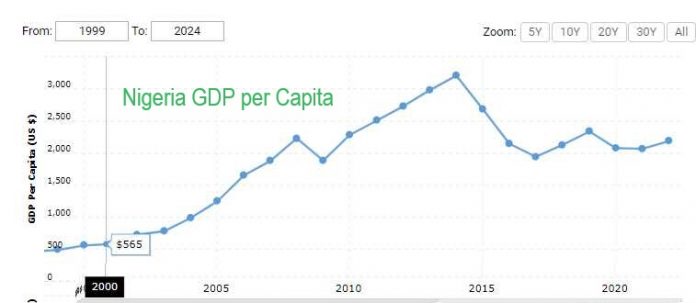
If you do not like constant GDP, but prefer real GDP or nominal GDP, check what really matters: GDP per capita. In other words, divide whatever GDP you prefer by the population, check the trajectory and see the performance. Across all indicators, Nigeria has had a lost decade since 2015.

The Nigeria’s Lost Economic Data Under APC Government

From 1999, you could see how everything was growing. Of course, a great recession happened and Nigeria, like other parts of the world, lost steam. But quickly, Nigeria recovered. 

Some have argued that Nigeria had better oil revenues before the last decade. Unfortunately, I do not buy that argument since consistently Nigeria has increased its budget on absolute Naira and USD in the last decade.

  • Nigeria 2013 budget: N4.99 trillion 
  • Nigeria 2014 budget: N4.69 trillion
  • Nigeria 2015 budget: N4.5 trillion
  • Nigeria 2016 budget: N6.06 trillion
  • Budget 2019: N8.92 trillion
  • Budget 2022:  N16.39 trillion

(convert with the exchange rate then, the last decade has had more resources)

Yes, in the last decade, Nigeria has been spending more money, on yearly average, as what oil money did not provide, we borrowed. Because Naira is Naira, whether from oil sales or debts, the issue here is efficiency on its management and deployment. 

But of course, we cannot debate based on data these days. And that is why we do not even invest efforts to know what worked in the past.

The Growth of Nations: How OBJ Delivered 15% GDP Growth And Buhari Recorded Recessions