DD
MM
YYYY

PAGES

DD
MM
YYYY

spot_img

PAGES

Home Blog Page 3438

2024 Africa Wealth Report: Henley & Partners Projects Millionaire Growth of 65% in Next Decade

0

Amidst its immense diversity and complex socio-economic fabric, the African continent is carving out a formidable presence in the global wealth arena with the number of millionaires and billionaires in the continent rising significantly.

The latest edition of the Africa Wealth Report for 2024, a collaborative effort between Henley & Partners and New World Wealth, unveils a compelling narrative of Africa’s burgeoning wealth landscape.

With a staggering investable wealth tallying at USD 2.5 trillion, coupled with a projected surge of 65% in its millionaire populace over the forthcoming decade, Africa emerges as a pivotal player in the global economic narrative.

In its ninth iteration, the annual report meticulously dissects Africa’s high-net-worth individuals (HNWIs), revealing a current count of 135,200 individuals boasting liquid investable assets exceeding the USD 1 million mark. Furthermore, the continent boasts 342 centi-millionaires and an impressive cohort of 21 billionaires. Although compared to other continents, Africa still lags, mainly due to its multifaceted challenges obstructing economic growth.

Among the challenges are currency depreciation and underperforming stock markets.

“Currency depreciation and underperforming stock markets have chipped away at Africa’s wealth compared to global benchmarks,” notes Dominic Volek, Group Head of Private Clients at Henley & Partners. “The South African rand fell 43% against the US dollar from 2013–2023, and currencies in most other African countries also performed poorly compared to the dollar over the past decade.”

Volek added that currencies in most other African countries also performed poorly compared to the dollar over the past 10 years, with dramatic depreciations of over 75% recorded in Nigeria, Egypt, Angola, and Zambia.

Echoing Volek’s sentiment, Andrew Amoils, Head of Research at New World Wealth, noted the impact of migration on Africa’s wealth trajectory.

“Approximately 18,700 high-net-worth individuals have left Africa over the past decade,” Amoils reveals. “Most of these individuals have relocated to countries such as the UK, the USA, Australia, and the UAE.”

Nevertheless, Africa remains a crucible of opportunity, boasting some of the world’s fastest-growing markets. The ‘Big 5′ wealth markets – South Africa, Egypt, Nigeria, Kenya, and Morocco – stand as a testament to Africa’s economic vibrancy, commanding over 56% of the continent’s millionaires and over 90% of its billionaires, according to the report.

Despite facing challenges over the past decade, including a 20% decline in its millionaire population, South Africa still boasts the largest population of HNWIs in Africa. With 37,400 millionaires, 102 centi-millionaires, and 5 billionaires, South Africa leads the continent in terms of wealth concentration. Egypt follows closely behind with 15,600 millionaires, 52 centi-millionaires, and 7 billionaires.

Nigeria ranks third with 8,200 HNWIs, followed by Kenya with 7,200 millionaires, Morocco with 6,800, and Mauritius with 5,100. Algeria, Ethiopia, Ghana, and Namibia are the top 10 wealthiest countries in Africa, with varying numbers of HNWIs ranging from 2,300 to 2,800. Despite economic challenges, these countries continue to attract and sustain affluent populations, contributing to their positions as key players in Africa’s wealth growth.

Moreover, burgeoning economies such as Mauritius, Namibia, and Zambia are poised to witness exponential growth in their millionaire populations over the next decade.

Renowned South African political commentator Justice Malala noted Africa’s economic prowess, projecting Sub-Saharan Africa as the second-fastest-growing region globally in 2024, trailing only behind Asia.

The growth prospect has opened room for Africa to expand its leadership role globally. With Africa expected to claim 11 out of the 20 fastest-growing economies globally, African leaders are clamoring for greater representation in international decision-making forums.

“With Russia, China, the USA, and the EU all jostling for favor on the continent, African leaders have become more emboldened and are demanding a seat at the top tables. These will come with closer relationships between continental leaders and other “middle powers” such as India, Turkey, Argentina, and Saudi Arabia. Already, Ethiopia and Egypt have joined the BRICS grouping and the African Union has become a permanent member of the G20. Previously, only South Africa was in these exclusive clubs,” said Malala.

He added that with growth projected at 4% by the IMF, Sub-Saharan Africa will be the second-fastest–growing region in the world in 2024, after Asia.

Though the wealth comes from many sectors of the continent’s economy, real estate stands out – with some cities claiming the lion’s share of the growth.

In real estate, Johannesburg and Cape Town emerged as veritable bastions of wealth, with promising growth trajectories witnessed in cities such as Kigali, Windhoek, and Marrakech.

Louisa Mojela and Nontobeko Ndhlazi of WIPHOLD extol Africa’s allure for investment, attributing its appeal to a youthful demographic dividend and rapid urbanization.

In luxury real estate, Cape Town reigns supreme, closely followed by Grand Baie in Mauritius and select cities in South Africa and Morocco. Berry Everitt, CEO of the Chas Everitt International property group, notes Africa’s allure in the global luxury real estate arena, propelled by a burgeoning demand fueled by demographic and urbanization trends.

However, Africa’s economic mobility is stifled by passport limitations, constraining citizens’ ability to traverse international boundaries for business and investment endeavors.

According to the report, only two African passports, those of Mauritius and Seychelles, grant their holders access to more than 50% of global GDP without requiring a visa in advance. This is despite Africa being home to some of the most open nations in the world based on the Henley Openness Index, which measures visa-free access to other countries. While many African countries are open in terms of visa-free access, the economic power and influence associated with global GDP access remain limited for most African passport holders.

“Africa tops the list of rejections with 30% or one in three of all processed applications being turned down, even though it had the lowest number of visa applications per capita. This was 12.5% higher than the global average,” said Mehari Taddele Maru, part-time professor at the School of Transnational Governance and Migration Policy Centre.

“The rejection rates for African applicants for Schengen visas are generally 10% higher than the global average, three times higher than the highest rejection rate, and ten times higher than for US-Americans. Despite justifications based on security or economic concerns, the European visa system clearly demonstrates apparent bias against African applicants.”

However, the report noted that Africa is ascending in the global wealth echelons – underpinning a continent on the precipice of transformation, brimming with opportunities for discerning investors. It however emphasized the need for friendly immigration policies as investment migration is emerging as a potential further mechanism to accelerate Africa’s economic growth.

“By offering residence and citizenship by investment opportunities, African countries can attract vital foreign capital, stimulate job creation, and foster knowledge transfer,” said Volek.

Elon Musk’s Starlink Clamps Down on Users in Countries Where Constellation is Unauthorized

0

According to reports, Elon Musk-owned Starlink has begun the clampdown on Starlink users in countries where the satellite constellation is unauthorized.

A recent Wall Street investigation revealed that the crackdown is part of the steps taken by the company to close an expanding black market for its satellite kits.

The broadband service which initially allowed roaming, now mandates access only in officially supported areas. Starlink said that users who have been using its roaming plan for more than two months outside the country where they ordered the service, must either change their account country or return to base.

A report by Wall Street Journal reveals that Starlink users in South Africa, Zimbabwe, and Sudan have recently received notifications from Space X regarding termination of access by the end of the month.

The message reads,

“Starting 30 April 2024, you will be unable to connect to the Internet except to access your Starlink account where you can make updates to your account. This restriction does not apply in areas designated as ‘Available’ on the Starlink availability map”.

In response to this, some South African Starlink users have suggested that this change would lead to a market of people willing to offer a paid service to transport the kits to officially supported neighboring countries like Eswatini and Mozambique for the two-month “check-in”.

However, based on Starlink’s email, it does not appear it would allow any access to its roaming plans in countries where Starlink is not yet available.

It is interesting to note that Starlink is yet to secure a license to operate in South Africa, after the Independent Communications Authority of South Africa (Icasa) mandated that applicants must have 30% ownership from historically disadvantaged groups to be eligible for licensing.

However, many in South Africa resorted to creative methods to access Starlink services, including purchasing roaming packages from countries where Starlink is licensed. Last November Icasa clarified that using Starlinks in this manner is illegal.

In Zimbabwe, following the directive of the Postal and Telecommunications Regulatory Authority of Zimbabwe (POTRAZ), the nation’s telecom regulator, Starlink has warned illegal users in the country in an email that it’ll disable its roaming service. 

In the notice, Starlink described the Southern African country as an “unauthorized territory” for its satellite Internet service.  Zimbabwe like South Africa, is yet to approve the broadband satellite Internet service as an official provider within the country.

However, Starlink has promised to restore service and notify Zimbabweans once it obtains regulatory approvals from POTRAZ. For now, it offers users the option to temporarily stop its service and billing.

Also, just last month Starlink cut off its Internet services in the Democratic Republic of Congo last month at the prompting of the country’s regulators.

IMF Forecasts Nigeria’s Inflation to Drop to 26.3% in 2024

0

The International Monetary Fund (IMF) has projected a decline in Nigeria’s inflation rate to 26.3% in 2024, alongside an anticipated economic growth of 3.3% for the same year.

Released as part of its revised Global Economic Outlook for 2024, the IMF’s report highlighted Nigeria’s improving growth prospects while leaving Sub-Sahara Africa’s growth outlook unchanged, balancing a downward forecast in Angola with an upgrade in Nigeria’s projections.

The IMF’s report indicates that Nigeria’s economy is expected to grow by 3.0% in 2025, a slight decrease from the Fund’s previous projection in January 2024. Despite this, the Sub-Saharan Africa region is forecasted to experience growth, rising from an estimated 3.4% in 2023 to 3.8% in 2024 and further to 4.0% in 2025, attributed to the gradual subsiding of earlier weather shocks and improving supply issues.

“In sub-Saharan Africa, growth is projected to rise from an estimated 3.4 percent in 2023 to 3.8 percent in 2024 and 4.0 percent in 2025, as the negative effects of earlier weather shocks subside, and supply issues gradually improve,” the report stated.

Globally, the IMF predicts stable growth at 3.2% for both 2024 and 2025, maintaining the same rate as seen in 2023. The report indicates a slight increase in growth for advanced economies, projected to rise from 1.6% in 2023 to 1.7% in 2024 and 1.8% in 2025. Emerging markets and developing economies are expected to experience a slight deceleration in growth, decreasing from 4.3% in 2023 to 4.2% in both 2024 and 2025.

The IMF’s projection aligns with analysts’ expectations of a downward trend in Nigeria’s inflation, despite the consistent increase witnessed since the beginning of the year. Starting at 29.90% in January and reaching 33.2% by March, inflation has been a significant concern.

The World Bank’s Africa Pulse publication also forecasts Nigeria’s inflation to be lower, projecting it at 24.8% in 2024 and settling at 15.1% in 2026, in line with the IMF’s growth rate projection of 3.3%.

The report attributes the improved economic prospects for Nigeria to several factors, including a slight uptick in global economic growth, stable growth projections for advanced economies, and a relatively favorable outlook for emerging markets and developing economies.

Keeping hope of economic recovery alive

One of the most notable implications of a decline in inflation is the potential boost to the spending power of Nigerians. With prices rising at a slower rate, consumers are expected to experience an increase in their purchasing power. This, in turn, is also expected to stimulate consumer spending, a critical driver of economic activity, and contribute to overall economic growth.

Furthermore, a decrease in inflation is likely to provide relief to households and individuals grappling with the high cost of living. As the erosion of the value of money slows down, Nigerians are expected to find it easier to afford essential goods and services, thereby alleviating financial strain and improving their quality of life.

Moreover, lower inflation rates often lead to a reduction in interest rates by central banks. This policy intervention aims to encourage borrowing and investment, further stimulating economic activity. Businesses may also benefit from increased confidence and stability, potentially leading to higher levels of investment, job creation, and overall economic expansion.

While the IMF’s forecast bodes well for Nigeria’s economic prospects, it is important to note that challenges persist. Experts have warned that the government will need to continue implementing sound economic policies and reforms to sustain the momentum of recovery and address underlying structural issues.

However, economists agree that the IMF’s projection of a decline in Nigeria’s inflation rate offers a glimmer of hope amidst economic uncertainty. They said if realized, this forecast could contribute to a more favorable economic environment, characterized by increased purchasing power, reduced cost of living, and enhanced economic stability.

BlockDAG’s Video Teaser From The Moon Fuels A $17.9M Presale, Surpassing Ethereum’s Buzz

0

Cryptocurrencies like Ethereum have made their investors incredibly wealthy, transforming them from ordinary backers into billionaires. Now, the focus is shifting towards BlockDAG, which has captured the attention of investors with its promise of a 30,000x return. With $17.9 million already secured from its presale events and an additional $2.1 million from miner sales, BlockDAG is becoming a hot topic in the investment community, especially as Ethereum experiences internal debates about its future issuance curve.

Ethereum’s Ongoing Internal Debates

Ethereum is currently embroiled in controversy over proposed changes to its issuance curve as it transitions into its next upgrade phase, Electra. The community is divided, with significant figures like Eric Conner and Ahmad Bitar arguing against proposals that would reduce issuance to maintain the viability of solo stakers. These figures believe that the proposed changes could jeopardize Ethereum’s role as a decentralized digital currency by reacting too drastically to unproven concerns about centralization, reflecting broader uncertainties within the cryptocurrency market.

BlockDAG’s Promising Presale and Technological Innovations

BlockDAG is making waves in the crowded crypto presale market, having raised over $17.9 million in presale funds and $2.1 million from miner sales. The platform’s upcoming keynote, which includes a video teaser shot on the moon, is generating significant excitement. This video highlights a $100 million market liquidity promise and the potential for listings on top exchanges like KuCoin, CoinEx, Gate.io, and Bitget. The listing price is projected to jump over 4900% from its initial batch to $0.05, showcasing an ambitious roadmap for BlockDAG.

At the core of BlockDAG’s appeal is its innovative approach to blockchain technology. Their latest technical whitepaper describes how BlockDAG enables developers to build, deploy, and earn efficiently on the platform. It supports a variety of blockchain activities, including the creation of smart contracts using popular development tools, and deploying applications on a testnet before launching them on the mainnet. The potential for developers to earn through transaction fees, subscriptions, and token sales makes BlockDAG an attractive ecosystem for blockchain innovators.

Additionally, BlockDAG employs Directed Acyclic Graph (DAG) technology to ensure scalability and performance as the network grows. This technological foundation not only supports a wide range of business models but also fosters continuous innovation and community involvement.

Conclusion: BlockDAG’s Market Potential

As investors seek lucrative opportunities beyond Ethereum, BlockDAG emerges as a compelling option with its potential 30,000x ROI. Amid Ethereum’s internal disputes and growing community concerns, BlockDAG is positioning itself as a viable alternative for discerning investors. With significant presale earnings and a vibrant community enthusiastic about its cutting-edge offerings, BlockDAG is set to redefine the investment landscape in the cryptocurrency sector.

This burgeoning platform offers substantial ROI prospects, showcasing an impressive roadmap and technological expertise, promising a rewarding future for early adopters. Those interested in joining this movement should consider exploring BlockDAG’s investment opportunities on their website, potentially standing at the brink of the next major breakthrough in the crypto space.


Join BlockDAG Presale Now:

Website: https://blockdag.network

Presale: https://purchase.blockdag.network

Telegram: https://t.me/blockDAGnetworkOfficial

Discord: https://discord.gg/Q7BxghMVyu


The Dream of a N750/$ Naira Economy for Nigeria

3

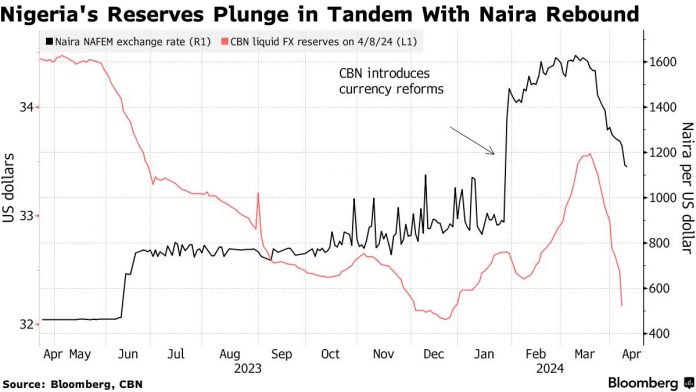
Plot the exchange rate of Naira against time. Plot the foreign reserves of Nigeria against time. This is what you get. Is that statistically significant to deduce that the recent strengthening of the Naira was not done naturally, but has a connection to the depletion of the foreign reserves?

Of course, you can argue that the reserve is there to strengthen the Naira, and if using it has worked well to strengthen Naira, that should be celebrated. So, it comes down to how our leaders communicate. Yes, they can celebrate this by articulating a position, instead of fighting data. A suggestion…

“Fellow Citizens, I have used some reserves to strengthen the Naira, and I expect this policy to be sustained over the next 12 months. This will help us stabilize the FX market and bring stability for our manufacturing companies which need imported raw materials to produce. With a strengthened and stable Naira, the government will have the window to focus on catalytic projects we have for the nation. We expect this policy to cost $10 billion.

“Sure, we understand your concerns on what happens after we pause the policy. Let me tell you that by then, we will attain equilibrium in our local manufacturing through initiatives 1, 2, and 3 which are expected to boost local manufacturing output by 15%. Also, even though we will burn $10b for this current policy, a stable and strengthened Naira will unlock $50 billion in FDI within 12 months.

“Our banks are expected to hit the market for more funds. A stable Naira will help them outperform, and that will help the nation. No investor would like to invest if Naira is not curtailed within an investable range. Through Project 2, 3, and 5, the Naira will attain an organic equilibrium in 12 months and we’re looking at N750/$. Project 2 will provide solar bulk storage facilities in 774 LGAs in Nigeria, to reduce food waste, and that will boost overall supply of food, and cut down on the demand of USD for food imports.  The disintermediation will reduce pressure on Naira by N120/$. 

“Project 3 will task all LGAs to make 100 hectares available for mini cities across Nigeria where people in diasporas could be given lands to build for free. That will bring more than $300 billion over three years. “Project 5….” as this can go on.

Summary: do not waste time arguing over data, rather, communicate on a higher purpose and secure Naira’s future.

Comment on Feed

Comment: Ndubuisi Ekekwe like I wrote in one of your earlier post, please come back by 1st week in May with this graph. All figures for other months were captured as at month end why pick this in the middle? The CBN Governor has said that the reduction in the reserve is due to routine payment of FG’s obligations so let us at least give him that benefit of doubt.

My Response: Unless they have modified the 2024 national budget, my understanding is that debt servicing and debt payment are not modeled to come from the foreign reserves: “Nigeria’s 2024 budget includes 30% of spending on debt servicing, which is N8.25 trillion. The budget is projected to be N27.5 trillion, with 18.3 trillion in revenue, and a budget deficit of N9.18 trillion. The budget will be funded by borrowing, asset sales, and loans from multilateral creditors, such as the World Bank and the African Development Bank.”

What is happening here is this: Nigeria does not want to do Ways and Means (asking CBN to give the government money in Naira), but wants to “borrow” from the foreign reserves. So, unlike the last government which went for more CBN printing, it seems now we are focusing on using the reserves to pay for debts. That is legal, but making it look like there is no correlation between borrowing money from AfDB (to support the Naira) and using foreign reserves to service the associated interest, on Naira performance, is not real.

Finally, “ routine payments of FG’s obligations” are usually budgeted. If that was the case, such could have been noted what was paid.

Comment 1A: Ndubuisi Ekekwe I usually refrain from commenting on controversial ‘opaque’ matters, but in this case, a little light has been thrown. Actually, the country CAN and DOES service debt from external reserves, but that debt is FOREIGN DEBT! It is budgeted for, yes, but the budget is in Naira and You have to pay in USD. As a matter of fact, there are obligations due CBN to some Nigerian Banks in USD that should have been taken from reserves this year, but they have kicked the can down the road by issuing them high coupon bonds in lieu. My point is DEBT CAN BE PAID FROM RESERVES! Secondly, I see your chart and what you’re driving at by plotting the time series of reserves and exchange rate. It would be a classic mistake (rookie mistake amongst Economists) to mistake CORELLATION FOR CAUSATION. The pattern you see might just be out of a spurious corellation (not saying it is.) But when you tell folks to conclude via a statistical significance of same corellation to corroborate your assertion, one wonders to what tests of statistical significance you refer, it’s not nit-picking, it actually matters when you’re making definitive statements. I believe we have to take the CBN Governor’s explanation for now, howbeit with a pinch of salt!

My Response: I am not disputing the CBN position and I am not saying that foreign reserves cannot be spent. That money is there to be spent on something. My position is arguing that spending it has no relationship to the strengthening of Naira. You build the reserves to spend it. And they’re spending it.

“Actually, the country CAN and DOES service debt from external reserves, but that debt is FOREIGN DEBT!” As I noted, I was referring specifically to the 2024 budget which was billed to actually boost and increase the foreign reserves. The government has made the case that it is actively working to “boost” the reserves. So, seeing it drawing from it was my confusion.

Finally, your position on the Bloomberg’s economists’ chart would have been more powerful if you have one that disputes their correlation. For the fact you cannot dispute it, we can assume that it stands. Economics is a social science (not natural philosophy). So, your position could hold, but this one could also hold since this is not physics. That is why it is a democracy, and we can debate. Yet, I did not create the plot. Thanks as always, we learn whenever you make time to comment here. Thanks