DD
MM
YYYY

PAGES

DD
MM
YYYY

spot_img

PAGES

Home Blog Page 3580

Managing Compliance in the Crypto Sector

0

The recent surge in presale events within the cryptocurrency sector has sparked a significant buzz among investors and enthusiasts alike. This phenomenon, often referred to as a ‘presale frenzy’, is characterized by the early release of new digital tokens to a select group of participants before they are made available to the general public.

The cryptocurrency space has witnessed a significant increase in presale scams in the past weeks, posing serious risks to investors and undermining the integrity of the digital asset market. These fraudulent schemes often promise high returns on investment through initial coin offerings (ICOs) or token presales, only to disappear with participants’ funds, leaving them with worthless tokens or no tokens at all.

Presale investors in the SLERF memecoin, for example, lost $10 million this week when the coin’s creator accidentally-on-purpose burned the SOL tokens they had contributed.

This week, a stark reminder of this uncertainty came to light as presale investors in the SLERF memecoin faced a devastating setback. An estimated $10 million was lost when, in a shocking turn of events, the coin’s creator executed a move that resulted in the burning of SOL tokens contributed by these investors.

This incident has sparked intense discussions within the crypto community about the need for greater oversight and security measures to protect investors from such unforeseen losses.

The surge in presale scams can be attributed to several factors. The decentralized nature of cryptocurrencies offers a veil of anonymity to scammers, making it challenging for authorities to trace and prosecute perpetrators. Additionally, the lack of regulation and oversight in certain jurisdictions creates an environment where fraudulent activities can thrive without immediate repercussions.

Investors must exercise due diligence when participating in presales. This includes researching the project’s team, assessing the feasibility of the business model, and verifying the legitimacy of the token offering through multiple sources. It is also advisable to be wary of projects that guarantee unusually high returns or have unclear tokenomics.

The crypto community and regulatory bodies must collaborate to establish clearer guidelines and protective measures against presale scams. This could involve creating standardized procedures for conducting token sales, enhancing transparency requirements for project developers, and educating potential investors about the risks associated with cryptocurrency investments.

As the crypto space continues to evolve, presales have become a pivotal aspect of token distribution strategies for emerging blockchain projects. These events not only serve as a fundraising mechanism but also help in gauging the market’s interest and establishing a preliminary valuation for the tokens.

However, navigating the presale landscape requires due diligence and a strategic approach. Potential investors must thoroughly research the project’s whitepaper, understand the tokenomics, assess the team’s credibility, and evaluate any associated risks.

Moreover, it’s crucial to be aware of regulatory considerations. As governments and financial authorities scrutinize the crypto space more closely, compliance with legal frameworks becomes increasingly important for presale participants and project developers alike.

While presale events can offer early access to promising crypto projects and potentially lucrative investment opportunities, they also come with their own set of challenges and risks. It is imperative for interested parties to approach these opportunities with caution and informed decision-making.

Are memecoins financial nihilism?

0

The emergence of memecoins in the cryptocurrency market has sparked a debate over their impact on the financial ecosystem. Memecoins, often inspired by internet memes and created as a joke or for fun, have gained significant traction among investors, leading to discussions about their legitimacy and influence.

Financial nihilism refers to a belief system that rejects or devalues traditional financial principles and institutions. It’s a perspective that may view traditional financial systems as obsolete or corrupt, advocating for a new approach or system that is more aligned with certain values or ideologies.

In a stunning display of market dynamics, the memecoin BOME has defied conventional financial trends by escalating from a base market capitalization of $0 to a staggering $1.5 billion in the immediate aftermath of its presale past week. This extraordinary ascent is not just a numerical feat but a testament to the coin’s burgeoning popularity and the speculative enthusiasm that surrounds emerging cryptocurrencies.

The presale event, which was strategically orchestrated to generate maximum investor interest, saw an overwhelming response from both individual and institutional participants. The coin’s value proposition, coupled with aggressive marketing tactics, created a fertile ground for this explosive growth. As BOME positions itself within the competitive landscape of digital currencies, market analysts are keenly observing its performance for indications of long-term viability and impact on broader market trends.

When considering whether memecoins represent financial nihilism, it’s essential to examine their characteristics and the motivations behind their creation and use. Memecoins typically lack the fundamental attributes of traditional investments, such as intrinsic value, utility, or backing by physical assets. They often rely on community support and social media hype to drive their value.

Some argue that the rise of memecoins reflects a form of financial nihilism, as they challenge conventional investment wisdom and operate outside traditional financial systems. They can be seen as a critique of established financial norms, embodying a rebellious spirit against the status quo.

However, others contend that memecoins are simply a new form of speculative investment within the broader cryptocurrency market. They point out that while memecoins may not adhere to traditional financial principles, they still operate within the existing financial framework and are subject to market forces.

The memecoin BOME’s value proposition lies at the intersection of innovative blockchain technology and a strong community-driven approach. From a starting point of $0 market capitalization, BOME’s presale weeks ago catapulted its valuation to an impressive $1.5 billion, signaling a robust market interest and confidence in its potential.

BOME’s core value proposition is its commitment to transparency and decentralization, key tenets of the blockchain philosophy that resonate with a growing base of crypto enthusiasts. The coin’s architecture promises secure, peer-to-peer transactions with minimal transaction fees, fostering an environment conducive to rapid adoption and scalability.

Moreover, BOME distinguishes itself with unique features such as smart contract functionality, rewards for participation, and a deflationary mechanism that periodically burns coins to reduce supply and drive demand. These strategic elements are designed to bolster the coin’s utility and appeal, setting the stage for its explosive growth post-presale.

In conclusion, whether memecoins are an expression of financial nihilism is subject to interpretation. While they certainly disrupt traditional financial narratives and may reflect a growing disillusionment with established systems, they also represent an evolution of investment strategies in the digital age. As the cryptocurrency market continues to mature, the role and impact of memecoins will likely become clearer.

Tesla Reduces EV Production in China Amidst Sluggish Growth And Intense Market Competition

0

Giant Electric Vehicle (EV) maker Tesla, has reduced its production of vehicles in China, amidst a slowdown in sales growth and intense market competition, resulting in a nearly 4% drop in share price.

Reports reveal that the US carmaker earlier this month, instructed employees at its Shanghai facility to lower production of both the Model Y and Model 3, the two vehicles it makes in China by working five days a week.

Output has been trimmed and employees have not been given any clear indication about when production will go back to normal. While overall passenger-vehicle sales in China increased 17% in the first two months of the year, and sales of new-energy vehicles rose 37.5%, Tesla recorded a decline in shipments from the same period a year ago.

Tesla is up against increasingly stiff competition in China, not only from homegrown competitor BYD but from a series of other EV manufacturers churning out more affordable and tech-laden vehicles.

Tesla relies predominantly on two models first unveiled before 2020 to compete in China. The company did update the Model 3 sedan and Model Y sport utility vehicle in the second half of last year. Some of the production lines at Tesla’s Shanghai plant, including the battery workshops, are subject to longer suspensions. The EV maker has told staff and some suppliers to be prepared for extended production limits through April.

In terms of delivery, Tesla delivered 131,812 vehicles in the first two months of 2024, a 6% drop from the same period a year ago, as data released by China’s Passenger Car Association revealed. Only 53% of shipments went to the local market, despite price cuts that Tesla has been carrying out since the start of the year.

The company also has continued to offer incentives for local buyers following an in-advance price-increase announcement for the Model Y in an attempt to spur sales before the first quarter wraps up.

Growth of electric car sales in China is slowing after the government stepped away from a decade-long promotion of the sector and ditched nationwide subsidies at the end of 2022. Shipments of new-energy vehicles to dealers are projected to increase by 25% to 11 million units this year.

In China, Tesla has been dealing with a host of challenges lately, including stiffer competition globally and a cooling of electric vehicle demand. The company has cut prices at various points in the past year in an attempt to stimulate demand.

The company’s CEO Elon Musk has raised concerns about a price war initiated last year to attract consumers facing high borrowing costs, resulting in squeezed margins for Tesla and causing investor worries.

He cautioned that Tesla was approaching the “natural limit of cost down” with its existing lineup. Tesla’s plans to introduce a more affordable mass-market compact crossover, codenamed “Redwood,” in mid-2025 to compete with cheaper rivals were confirmed by Musk.

Tesla has also experienced a significant reduction in deliveries from its Shanghai gigafactory, dispatching only 60,365 vehicles in the previous month. This is a 16% decrease from January and a 19% year-on-year fall, as highlighted by the China Passenger Car Association. However, the company maintains that they’re on track to hit their production target of 1.4 million cars for the year.

Are Exchange-Traded Funds Good for Long-Term Investments

0

Exchange-Traded Funds (ETFs) have become increasingly popular as long-term investment vehicles, similar to stocks. They offer diversification, low expense ratios, and the flexibility of trading like individual stocks. However, whether ETFs are suitable for long-term investments like stocks depends on various factors including investment goals, risk tolerance, and market conditions.

Exchange-traded funds (ETFs) are investment funds that trade on stock exchanges, and can be bought and sold like common stock. ETFs can contain financial assets such as stocks, bonds, currencies, debts, futures contracts, and/or commodities such as gold bars. They can be a way to access a wide variety of asset classes, including domestic and international stocks, bonds, and commodities. ETFs can also be tax efficient and have lower operating expense ratios (OERs) than actively managed mutual funds. ETFs combine aspects of mutual funds and conventional stocks. They can be bought or sold intraday at different prices, and can help to diversify your investments.

Before diving deeper into ETFs, let’s address a common question: What is a mutual fund? A mutual fund is an investment vehicle made up of a pool of funds collected from many investors for the purpose of investing in securities such as stocks, bonds, money market instruments, and other assets.

Mutual funds are operated by professional money managers, who allocate the fund’s assets and attempt to produce capital gains or income for the fund’s investors. A mutual fund’s portfolio is structured and maintained to match the investment objectives stated in its prospectus.

Diversification is one of the key advantages of ETFs. Unlike individual stocks, which expose investors to the performance of a single company, ETFs typically track an index or a basket of assets, spreading out the risk. This makes them an attractive option for long-term investors looking to mitigate volatility.

Another aspect to consider is the cost-efficiency of ETFs. They generally have lower expense ratios compared to mutual funds due to their passive management structure. This means that over the long term, the cost savings can compound and potentially lead to higher returns.

Liquidity is also a significant factor. ETFs can be bought and sold throughout the trading day at market price, which can be beneficial for investors who may need to quickly adjust their portfolios in response to market movements.

However, it’s important to note that not all ETFs are created equal. Some may focus on niche markets or employ complex strategies that may not be suitable for all long-term investors. Therefore, it’s crucial to conduct thorough research or consult with a financial advisor before incorporating ETFs into a long-term investment strategy.

While ETFs offer several benefits that can make them good for long-term investments like stocks, they are not without their nuances. Investors should carefully consider their individual circumstances and perform due diligence to ensure that ETFs align with their long-term investment objectives.

For instance, the liquidity of an ETF can vary significantly depending on the underlying assets and the market conditions. Additionally, while ETFs generally have lower fees than actively managed mutual funds, they can still incur trading costs that can add up over time.

Another nuance of ETF investing is the potential for tracking error. This occurs when there is a discrepancy between the performance of the ETF and the index it is supposed to replicate. Factors such as fund management style and transaction costs can contribute to this issue.

Investors should also be aware of the tax implications associated with ETFs. While they are often touted for their tax efficiency, certain types of ETFs can generate unexpected tax bills. For example, commodity ETFs may be structured as partnerships, which can result in K-1 tax forms and unrelated business taxable income (UBTI).

While ETFs can be a valuable addition to a long-term investment strategy, it’s essential to understand their nuances before incorporating them into your portfolio. By doing so, you can make informed decisions that align with your financial goals and risk tolerance.

The Legends of Money As Trump Goes for $3 billion on Truth Social

1

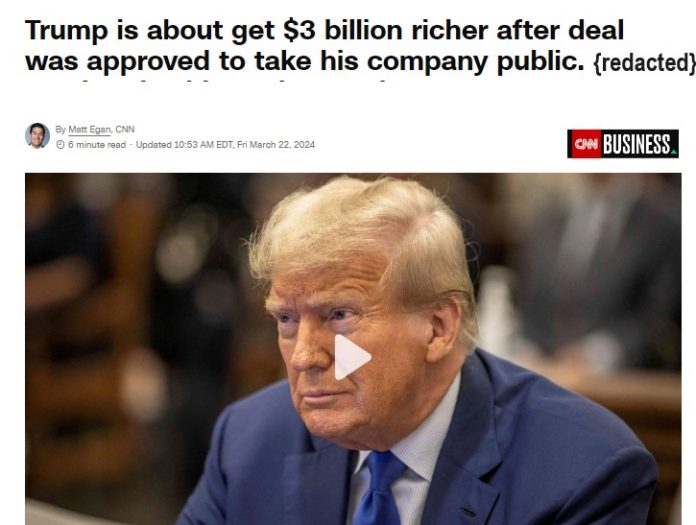
Legends – anywhere they go, they find how to extract value. Today, Donald Trump is about to be rewarded with $3 billion for Truth Social: “Shareholders voted to approve Trump Media’s merger with a blank-check company, following years of legal and regulatory obstacles. Trump will own a dominant stake in a public company, with shares worth more than $3 billion at current market prices.”

We rant here, post day and night, but one businessman with deal sagacity has created a $3 billion fortune in less than 4 years from social media! 

Do not be jealous, just try to understand how they create this value. Because if you are in that virtuous circle of value capture and acceleration, you will always be rolling, whether in real estate, fashion, social media, etc. 

In the greatest Igbo novel ever written (by my call),  Tony Ubesie’s “Isi Akwu Dara N’ala” explained the transformation of Chike, the husband of Ada, in the context of “osisi na ami ego” [literally, a tree which produces money as the leaves]. Heavens opened for Chike, and he harvested money from  trees – and those trees were factories, and industries.  Ubesie was at his finest, producing a trilogy of James Hadley Chase (There’s Always a Price Tag), Thomas Hardy (The Mayor of Casterbridge) and Bertha M Clay (Beyond Pardon) all lumped together. 

Legends – they win at night, they win at day; they always find how to make money in anything, even though we the people may not understand. Post, share, hate, and like, Trump adds $3 billion for the same thing!