DD
MM
YYYY

PAGES

DD
MM
YYYY

spot_img

PAGES

Home Blog Page 3665

Bitcoin Hits New High of $65,000, as Data Reveals 97% of Bitcoin Holders Are in Profit

0

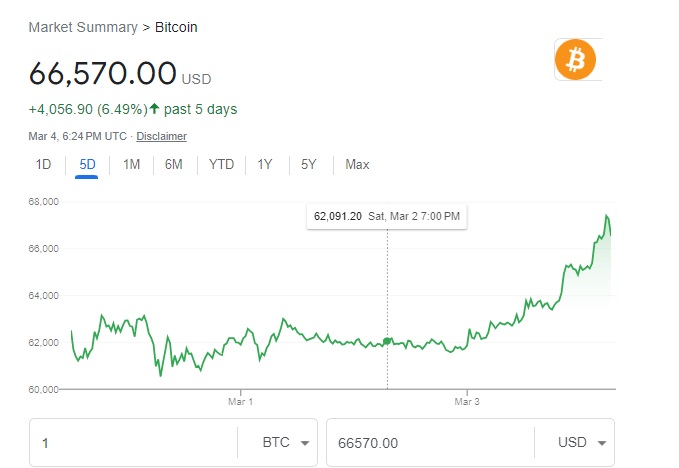
The price of Bitcoin has hit a new all-time high of $65,000, as the crypto rally continues, with data revealing that 97% of Bitcoin holders are currently in profit.

Reports reveal that Bitcoin has gained by more than 50% in 2024, since the start of the year, amid anticipation and approval in mid-January of the first U.S spot Bitcoin ETFs, which has ushered in a fresh wave of investors.

According to a new report from analytics firm, IntoTheBlock, data shows that Bitcoin’s recent surge towards a $67,000 price point, has left 97 percent of addresses holding the coin in money, which according to Coindesk means they have acquired Bitcoin at a lower price compared to the current market rate.

Furthermore, IntoTheBlock notes that the recent spike in profitable addresses, which is the highest since 2021 when the coin hit its highest peak point to date of $69,000 market price, has positive effects on Bitcoin’s bull race, adding “Given the substantial percentage of addresses in profit, the selling pressure from users attempting to break even no longer has a significant effect.”

According to IntoTheBlock, it notes that it is currently observing the actions of long-term Bitcoin holders, particularly those who have held onto their coins for over a year, in order to evaluate the longevity of this trend.

The price of Bitcoin has continued to surge following the approval of ETFs in January by the Securities and Exchange Commission (SEC), which has made it easier for investors to gain exposure to the price movement of Bitcoin as part of a diversified portfolio.

Due to significant inflows into the U.S-based spot ETFs that were authorized in January, Coindesk adds that Bitcoin has increased by 54% this year, expanding its 154% return from 2022. The demand-supply factors are now shifting in favor of the bulls due to Wall Street’s acceptance of spot ETFs, providing an environment for a rise that might push the coin to new highs.

Another noteworthy event that has affected the price of Bitcoin is the upcoming halving, the coin’s price is rising due to preparation for the event, which is expected to uncover the next chapter of Bitcoin’s bull run and send it to all-time highs.

Notably, beyond Bitcoin, Ethereum the second-largest cryptocurrency, rose 3% to above $3,500. Smaller tokens or altcoins also were higher, with Cardano climbing 7% and Polygon popping 3% Memecoins were flying, with Dogecoin up 17% and Shiba Inu jumping 21% signs, that bullish sentiment was reaching fever pitch as traders piled into tokens-based initially on internet jokes.

The Implication of Binance Shutting P2P to Crypto in Nigeria

0

Binance, one of the world’s largest cryptocurrency exchanges, has recently faced a series of regulatory challenges in Nigeria, Africa’s biggest crypto market. The exchange has been accused of contributing to the devaluation of the naira, Nigeria’s currency, by offering peer-to-peer (P2P) trading services that bypass the official exchange rate.

The Nigerian government has also restricted access to Binance’s website and arrested two of its executives in the country. We will explore the implication of Binance shutting P2P to crypto in Nigeria, and what it means for the future of crypto adoption in the country.

What is P2P Trading and Why is it Popular in Nigeria?

P2P trading is a feature that allows users to buy and sell cryptocurrencies directly from each other, without intermediaries or third-party platforms. Users can set their own prices and payment methods and use escrow services to ensure the security of the transactions. P2P trading is popular in Nigeria for several reasons:

It offers an alternative way to access cryptocurrencies after the Nigerian Central Bank (CBN) banned local banks and financial institutions from facilitating crypto transactions in 2021. It provides a hedge against the frequent devaluation of the naira, which has lost more than 50% of its value against the US dollar since 2015.

It enables users to access foreign exchange at market rates, which are often higher than the official rates set by the CBN. It empowers users to participate in the global crypto economy and access various opportunities such as remittances, e-commerce, gaming, and DeFi.

According to data from UsefulTulips.org, Nigeria is the leading country in terms of P2P volume globally, with more than $500 million traded in 2023. Binance is one of the main platforms that offer P2P trading services in Nigeria, along with other players such as Paxful, LocalBitcoins, and Remitano.

Why is Binance Facing Regulatory Pressure in Nigeria?

Binance’s P2P trading services have attracted the attention of the Nigerian authorities, who have expressed concern that the platform is undermining the stability of the naira and facilitating illicit fund movements. Some of the regulatory actions taken against Binance include:

In February 2024, Binance imposed a price cap on Tether (USDT) tokens traded on its Nigerian P2P platform at 1,802 naira per USDT, following a directive from the CBN. This sparked outrage among users who accused Binance of manipulating the market and limiting their freedom. Binance later lifted the cap and claimed that it was due to an automatic system pause.

In March 2024, Binance removed the naira from its P2P market, effectively shutting down its P2P trading services in Nigeria. The exchange did not provide any official explanation for this decision, but some speculated that it was due to regulatory pressure or security issues.

Also in March 2024, two Binance executives were arrested in Nigeria and their passports were confiscated by the Nigerian police. The executives had traveled to Nigeria to address the country’s ban on crypto exchange websites and to meet with local stakeholders. They were released after a few days but remained under investigation.

The implication of Binance shutting P2P to crypto in Nigeria is significant for both the exchange and its users. For Binance, it means losing a large and loyal customer base that generates substantial revenue for the platform. It also means damaging its reputation and credibility as a global leader in crypto innovation and inclusion.

For Nigerian users, it means losing access to one of the most popular and reliable platforms for buying and selling cryptocurrencies. It also means facing more challenges and risks in accessing crypto services from other platforms or sources.

What is the Future of Crypto Adoption in Nigeria?

Despite the regulatory hurdles and uncertainties, crypto adoption in Nigeria is unlikely to stop or decline anytime soon. Nigerians have shown remarkable resilience and creativity in finding ways to access and use cryptocurrencies for various purposes. Some of the factors that will continue to drive crypto adoption in Nigeria include:

The high demand for foreign exchange and alternative assets amid economic instability and currency devaluation. The large population of young and tech-savvy people who are eager to explore new opportunities and solutions offered by crypto.

The vibrant and supportive crypto community that educates and empowers users through various channels such as social media, podcasts, webinars, meetups, and events. The emergence and growth of local crypto startups and initiatives that provide innovative products and services tailored to the needs and preferences of Nigerian users.

Crypto adoption in Nigeria is not dependent on any single platform or entity, but rather on the collective efforts and actions of the users themselves. Binance’s exit from the Nigerian P2P market may be a temporary setback, but it is not a fatal blow. Nigerians will continue to find ways to access and use cryptocurrencies, and to contribute to the development and growth of the crypto industry in the country and beyond.

Binance’s woes in Nigeria continue to mount, but they also present an opportunity for the exchange to demonstrate its leadership and resilience in the crypto space. By engaging with regulators, improving its governance and transparency, and enhancing its security and customer protection measures, Binance may be able to overcome its challenges and regain its trust and reputation in one of its most important markets.

JPMorgan Report and White House recent stance on Bitcoin Mining means Blockchain has gained mainstream adoption

0

In a recent report, JPMorgan analysts have expressed their bullish outlook on the cryptocurrency market, stating that “we see the higher cryptocurrency prices not only sustaining but improving.” The report cites several factors that support this view, such as the growing adoption of digital assets by institutional and retail investors, the increasing innovation and diversity of crypto products and services, and the favorable regulatory environment in some jurisdictions.

The report also acknowledges the challenges and risks that the crypto market faces, such as volatility, security breaches, environmental concerns, and regulatory uncertainty.

However, it argues that these challenges are not insurmountable, and that the crypto industry has shown resilience and adaptability in overcoming them. The report concludes that the crypto market has reached a level of maturity and legitimacy that makes it an attractive asset class for investors seeking high returns and diversification.

JPMorgan’s positive stance on crypto is notable, given that the bank was once one of the most vocal critics of the sector. In 2017, JPMorgan CEO Jamie Dimon famously called Bitcoin a “fraud” and said he would fire any employee who traded it. Since then, however, the bank has changed its tune and embraced crypto as a strategic opportunity.

In 2020, JPMorgan launched its own digital currency, JPM Coin, to facilitate cross-border payments. In 2021, it started offering crypto exposure to its wealthy clients and partnered with Coinbase and Gemini to provide banking services to the crypto exchanges. The bank has also hired several crypto experts and analysts to expand its research and advisory capabilities in the field.

JPMorgan’s report is a clear sign that the crypto market has gained mainstream acceptance and recognition from one of the world’s largest and most influential financial institutions. It also reflects the growing optimism and confidence among investors that the crypto market is poised for further growth and innovation in the coming years.

The White House has expressed concern over the environmental impact of Bitcoin mining, according to a report by Fox Business. The report cites unnamed sources who claim that the Biden administration is “looking into” the issue of cryptocurrency mining and its effect on the power grid.

Bitcoin mining is the process of creating new units of the digital currency by solving complex mathematical problems using specialized computers. The process consumes a lot of electricity, as miners compete to be the first to validate transactions and earn rewards.

According to the Cambridge Bitcoin Electricity Consumption Index, Bitcoin mining consumes about 121 terawatt-hours (TWh) of electricity per year, more than the annual energy consumption of countries like Argentina, Norway, or the Netherlands. The index also estimates that Bitcoin mining accounts for 0.54% of global electricity consumption.

The environmental impact of Bitcoin mining has been a subject of debate for years, as some critics argue that it contributes to climate change and wastes valuable resources. Some proponents, however, claim that Bitcoin mining can be powered by renewable energy sources, such as solar, wind, or hydro, and that it can incentivize the development of green energy projects.

The report by Fox Business does not specify what actions the White House might take to address the issue of Bitcoin mining, or whether it has any plans to regulate the cryptocurrency industry. The report also notes that the White House did not respond to a request for comment.

The report comes amid a surge in the price and popularity of Bitcoin, which hit a new all-time high of over $65,000 in March 2024. The cryptocurrency has attracted the attention and investment of major corporations, such as Tesla, MicroStrategy, and Square, as well as institutional investors and celebrities.

Bitcoin is also facing increased competition from other cryptocurrencies, such as Ethereum, which is undergoing a major upgrade to make its network more efficient and scalable. Ethereum is also planning to switch from a proof-of-work system, which relies on mining, to a proof-of-stake system, which relies on validators who stake their coins to secure the network.

The future of Bitcoin and its environmental impact remains uncertain, as the cryptocurrency industry continues to evolve and innovate. The White House’s stance on Bitcoin mining could have significant implications for the regulation and adoption of the digital currency in the US and beyond.

AI + Bitcoin = A New Economic Order

0

Wow – that is parabolic. Yes, Bitcoin is hitting new numbers. Yet, what happens if everyone buys coins and just sleeps, hoping for new highs? Unlike when you buy company stocks, your BTC money is used to pay the person who sold you the coin. That contrasts with stocks in which the money received from investors is deployed into production activities, to create products and services. Even for gold, there is a physical thing at the end of the channel.

In a historic milestone, the total market capitalization of Bitcoin has exceeded $1.3 trillion, making it the ninth-largest asset in the world by market value. This means that Bitcoin is now worth more than some of the most influential companies in the world, such as Facebook, Tesla, and Amazon.

Bitcoin crosses $66,000 per coin; it is not only breaking new records but also breaking new grounds.

Bitcoin’s remarkable rise has been driven by several factors, including increased institutional adoption, growing public awareness, and favorable regulatory developments

It may be time someone in the African Union models how these new species of assets could affect Africa’s economy (Economics PhD students, research top). Indeed, what stops people pulling funds from stock exchanges and pump into Bitcoin, retire and enjoy.

AI + Bitcoin = A New Economic Order

Promises and Opportunities in Emerging Energy in Nigeria and Africa.

0

Ugoji Harry, CEO of Egoras, Nigeria’s electric vehicle startup, will be teaching tomorrow in Tekedia Mini-MBA. Egoras is unveiling its EV brand, Egoras APEX 28, on April 28, 2024. Join us Harry educates on the promises and opportunities in emerging energy in Nigeria and Africa.

Meanwhile, we have opened registrations for the next edition of Tekedia Institute Mini-MBA which will begin on June 3, 2024. Go here and register