DD
MM
YYYY

PAGES

DD
MM
YYYY

spot_img

PAGES

Home Blog Page 3714

Mastercard Wraps up CBDC pilot with Reserve Bank of Australia; GMX receives largest share of $40M Arbitrum STIP grants

0

Mastercard, the global payment technology company, has announced the completion of a central bank digital currency (CBDC) pilot project in collaboration with the Reserve Bank of Australia (RBA) and other partners. The pilot tested the feasibility and functionality of using CBDCs for cross-border transactions between different digital currency platforms.

The pilot involved the issuance and exchange of two CBDCs, one denominated in Australian dollars and the other in Singapore dollars, using Mastercard’s distributed ledger technology (DLT) platform. The participants included banks, fintechs, and regulators from Australia, Singapore, and other regions. The pilot aimed to demonstrate how CBDCs can enhance efficiency, transparency, and interoperability in the global payment system.

According to Mastercard, the pilot achieved several key outcomes, such as:

Enabling seamless and secure conversion and transfer of CBDCs between different DLT platforms, without the need for intermediaries or centralized infrastructure.

Supporting various use cases for CBDCs, such as wholesale settlement, cross-border remittance, trade finance, and foreign exchange.

Providing end-to-end visibility and traceability of CBDC transactions, as well as compliance with anti-money laundering (AML) and counter-terrorism financing (CTF) regulations.

Offering flexibility and scalability for CBDC issuance and management, as well as compatibility with existing payment systems and standards.

Mastercard said that the pilot was part of its ongoing efforts to support central banks and governments in exploring and developing CBDCs, which are expected to play a key role in the future of money and digital economy. Mastercard also said that it will continue to work with the RBA and other partners to further test and refine the CBDC solutions.

Raj Dhamodharan, Executive Vice President of Digital Asset and Blockchain Products and Partnerships at Mastercard, said: “We are proud to have successfully completed this pilot with the RBA and our partners. This is a significant milestone for the advancement of CBDCs in Asia Pacific and globally.

We have demonstrated that it is possible to create a robust and interoperable CBDC ecosystem that can deliver real benefits for consumers, businesses, and governments. Mastercard is committed to being a trusted partner for central banks and governments in their journey towards digital currency innovation.”

The cryptocurrency market has grown exponentially in the past decade, reaching a market capitalization of over $2 trillion in 2021. This has attracted the attention of many traditional financial institutions, who see the potential of crypto as a new source of revenue, innovation and customer satisfaction.

According to a recent survey by KPMG, more than 60% of global banks are either already offering or planning to offer crypto services in the next two years. These services include custody, trading, lending, payments and advisory. Some of the leading banks in this space are JP Morgan, Goldman Sachs, BNY Mellon and Standard Chartered.

The benefits of offering crypto services are manifold. For banks, it can help them diversify their portfolio, increase their fee income, enhance their brand image and attract new customers. For customers, it can provide them with more choice, convenience, security and access to the emerging digital economy.

However, offering crypto services also comes with significant challenges and risks. Banks need to comply with complex and evolving regulatory frameworks, ensure adequate cybersecurity and anti-money laundering measures, manage volatility and liquidity issues, and educate their staff and customers about the benefits and risks of crypto.

To overcome these challenges and succeed in the crypto space, banks need to adopt a strategic and holistic approach. They need to partner with reputable and reliable crypto service providers, leverage their existing infrastructure and expertise, invest in innovation and research, and foster a culture of learning and collaboration. By doing so, banks can position themselves as leaders in the crypto industry and gain a competitive edge in the rapidly changing financial landscape.

Mastercard has completed a central bank digital currency pilot with the Reserve Bank of Australia and the Digital Finance Cooperative Research Centre. The project tested how authorized parties, who have gone through know-your-customer protocols, could hold, use and redeem CBDCs.

GMX receives largest share of $40M Arbitrum STIP grants amid Tether Appointing new CEO

GMX, a decentralized exchange (DEX) that supports leveraged trading of perpetual contracts, has announced that it has received the largest share of the $40 million Strategic Treasury Investment Program (STIP) grants from Arbitrum, a layer-2 scaling solution for Ethereum.

According to a blog post published on October 13, GMX received $10 million worth of grants from Arbitrum, which will be used to bootstrap liquidity and incentivize users on its platform. GMX claims to be the first DEX to offer up to 30x leverage on perpetual contracts, as well as the first to support cross-margin trading with stablecoins and wrapped tokens.

GMX said that it chose Arbitrum as its layer-2 solution because of its compatibility with Ethereum, its fast and cheap transactions, and its growing ecosystem of projects and users. GMX also praised Arbitrum for its transparent and fair grant allocation process, which was based on objective criteria such as user growth, TVL (total value locked), and social engagement.

The STIP grants are part of Arbitrum’s initiative to support the development and adoption of its layer-2 network, which launched on mainnet in late August. Arbitrum aims to distribute $40 million worth of grants to projects that build on its platform over the next year, with the first batch of recipients announced on October 12.

Among the other projects that received grants from Arbitrum are Uniswap, SushiSwap, Balancer, Curve, Aave, Compound, MakerDAO, Synthetix, Chainlink, The Graph, and Etherscan. However, one notable project that missed out on the grants was Lido, a decentralized staking protocol that allows users to earn rewards on their staked ETH without locking it up.

Lido’s omission from the grant recipients sparked some controversy in the crypto community, as some users questioned Arbitrum’s criteria and decision-making process. Lido is one of the largest projects in the Ethereum ecosystem, with over $8 billion worth of ETH staked through its protocol. Lido also recently launched its stETH token on Arbitrum, which represents staked ETH on layer 2.

Lido’s team expressed their disappointment and confusion over Arbitrum’s decision on Twitter, saying that they had applied for the grants and had been in contact with Arbitrum’s team. They also said that they had received positive feedback from Arbitrum’s users and that they were looking forward to collaborating with them in the future.

Arbitrum’s team responded by saying that they had received over 400 applications for the grants and that they had to make some tough choices. They also said that they appreciated Lido’s work and that they hoped to work with them in the future. They added that the STIP grants are not a one-time event and that they will continue to distribute grants to more projects in the coming months.

Tether promotes Paolo Ardoino to CEO Role

Tether, the company behind the world’s largest stablecoin, has announced that Paolo Ardoino has been appointed as its new chief executive officer. Ardoino, who has been serving as the chief technology officer of Tether and its sister company Bitfinex since 2015, will take over the leadership role from Jean-Louis van der Velde, who will remain as a board member and advisor.

Ardoino is a veteran in the cryptocurrency industry, having joined Bitfinex as a senior software developer in 2014. He has been instrumental in developing and maintaining the technology platforms of both Bitfinex and Tether, as well as overseeing the integration of Tether with various blockchain networks, such as Ethereum, Tron, Algorand, and Solana. He is also a vocal advocate for innovation and transparency in the crypto space, often engaging with the community on social media and podcasts.

In a press release, Ardoino said that he is honored and excited to lead Tether into its next phase of growth and development. He added that he will continue to work closely with van der Velde and the rest of the team to ensure that Tether remains the most trusted and widely used stablecoin in the world.

Van der Velde, who has been the CEO of Tether since 2016, said that he is proud of what Tether has achieved under his tenure, especially in terms of expanding its market capitalization, user base, and network support. He also praised Ardoino for his technical expertise, vision, and leadership skills, saying that he is confident that he will take Tether to new heights of success.

Tether was launched in 2014 as a digital token pegged to the US dollar, aiming to provide a stable and transparent alternative to fiat currencies in the crypto ecosystem. Since then, Tether has grown to become the dominant stablecoin in terms of market capitalization, liquidity, and adoption, with over $70 billion worth of tokens in circulation across various blockchains. Tether claims that every token is backed by a corresponding reserve of fiat or other assets and publishes regular attestations from independent auditors to verify its reserves.
How to Be More Innovative and Creative in Nigeria

0

Innovation serves as the foundation for invention. However, mere invention, devoid of proper commercialization, falls short in fostering rapid economic growth and its sustainability. Therefore, to foster invention, one must cultivate innovation, which, in turn, relies on creativity. Throughout this process, culture, encompassing norms, values, and traditions related to innovation, creativity, and commercialization, becomes indispensable for achieving sustained economic growth that leaves no one behind.

This analogy underscores the importance of vigilance among Nigerians across various levels of governance, business, and community, in guarding against cultural elements that hinder their capacity for innovation and creativity. Several years ago, Professor Geert Hofstede developed a cultural framework that illustrates how people in various countries, including Nigeria, manifest their cultural norms, values, and traditions in the workplace. Professor Hofstede posits that this framework reflects the national culture of the studied countries.

Collectivism is deeply ingrained in Nigeria’s cultural fabric. Families and communities hold an unbreakable bond, with the collective good often taking precedence over individual desires. However, within this communal spirit lies the potential for innovation. Nigerian families and communities increasingly recognize the significance of education and entrepreneurship in a rapidly globalizing world, nurturing a new generation of individuals eager to make their mark.

Masculinity prevails in Nigerian culture, emphasizing qualities such as assertiveness, competition, and success. While traditional gender roles have played a significant role, the country is experiencing a transformative shift toward greater gender equality. Women are assuming leadership roles in politics and business, contributing to a more diverse and innovative society.

Historically, Nigeria has taken a moderate approach to uncertainty avoidance. While some tolerance for ambiguity exists, there is a preference for clear rules and structured situations. However, in the era of technological advancements and a burgeoning appetite for innovation, Nigerian entrepreneurs and startups are challenging established norms, embracing risk, and pushing the boundaries of what’s possible.

Long-term orientation has not been a dominant trait in Nigeria, with traditions and immediate goals often taking precedence. However, as the country aspires to economic growth and development, there is a growing recognition of the need for long-term thinking. Innovation and sustainable practices are increasingly integral to Nigeria’s vision for the future.

Nigeria’s higher score on indulgence signifies a relaxed attitude toward enjoying life and seeking pleasure. This openness to gratification can fuel creativity and innovation. Nigerians’ ability to celebrate diversity and adapt to changing circumstances fosters an environment conducive to innovation.

Nigeria’s journey toward innovation is not without its challenges, including infrastructure limitations and economic disparities. Nevertheless, the cultural landscape is evolving. Nigeria is a country that embraces its rich cultural heritage while harnessing the spirit of innovation to address contemporary challenges. The fusion of tradition and innovation is shaping a dynamic and promising future for this diverse nation.

Previous analyses by various scholars have demonstrated that national culture has a positive impact on innovation rates. The most conducive conditions for stimulating innovation occur when there is minimal power distance, a high degree of individualism, feminine attributes, a low aversion to uncertainty, a long-term orientation, and a higher level of indulgence.

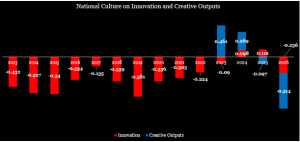
In our own experience, as illustrated in the figure, culture significantly influenced levels of innovation and creative outputs in Nigeria between 2013 and 2022. During this period, culture was associated with innovation, implying that a one-unit change in culture translated to over 28% of Nigerians, particularly businesses, becoming more innovative.

However, when we analyzed its connection to creative outputs, as measured by the World Intellectual Property Organization in its Global Innovation Index, we found that only 5.3% of the cultural dimensions (including power distance, individualism, collectivism, uncertainty avoidance, indulgence, long-term orientation, short-term orientation, and masculinity) were linked to knowledge creation, dissemination, and impact.

In our observations, we discovered that only 5.3% and 0.3% of culture influenced the levels of innovation and creative outputs between 2013 and 2022. This suggests that Nigerians and businesses were influenced by the negative aspects of Professor Geert’s formulated dimensions, which affected their attitudes and behaviors towards innovation and creativity during that period. In other words, their ability to absorb innovative and creative knowledge, as well as skills, was limited. Consequently, they struggled to develop sustained innovative outputs, failed to create and disseminate impactful knowledge, and generate intangible assets, creative products, and services, whether online or in physical stores.

Source: Global Innovation Index, 2023; Geert Hofstede, 2023; Opolo Global Innovation Analysis, 2023

Beyond the data, it is imperative for ecosystem players to leverage on some cultural advantages for innovation in the country. First, innovation hubs keen on skilling up the youths could take the advantage of the collectivistic culture for collaboration, partnership and sponsorship. This enriches the innovation landscape making indigenous organizations and township associations a strong part of the innovation stakeholders.

Second, the masculine and patriarchal nature is reflected in the composition of the innovation sector which is currently men dominated. For a more inclusive and feminine-sensitive innovation ecosystem, there is a need for more deliberate balanced education and knowledge system that caters for the low presence of women in tech and innovation landscape. This would address prevailing poverty among women. It would also contribute to quality education. Therefore, government agencies, civil societies and other innovation-focused organizations should pay more attention to bridging this gender gap.

Third, there is an increasing confidence among the youth to take more risks leveraging technology, as against the culture of being risk averse prevalent in the country. To unleash this newly found creative and innovative energies of young Nigerians, policy, funding and other support mechanism should be strengthened for entrepreneurs and startups. One of such avenues is the Nigerian Startup Act. The Act is meant to provide a coordinated support system for the tech and innovation ecosystem. A good feature of the Act is its adaptability for the use of sub-national governments. One year after it was signed to law, the NSA is yet to be adopted on higher scale.  The Ministries of Science, Technology and Innovation as well as that of Communication, Innovation and Digital Economy need to close ranks and collaborate for innovation to foster in the country.

Fourth, long term planning and goal setting has to be taken with all seriousness. Measurable goals should be set to benchmark achievements of goals in technology and innovation in the country. We have seen this come to play in the reports shared to the public by the Ministry of Communication, Innovation and Digital Economy with the 1Million Co-Creation of Tech Talents in Nigeria as well as the Strategy document for the ministry. It is hiped this would be a common culture among government agencies in the innovation ecosystem.

Fifth, the country must address infrastructural limitations which prevent the percolation of innovation to the rural areas. Doing this would enable the country to make use of her rich traditional culture and heritage spread all over its 774 local government areas. Using innovation and digital technologies, the country can rake in a lot of money through virtual tourism. People, all over the world, are ready to part with personal resources to see the cultural beauty of the Giant of Africa. This could only happen only if we are ready to invest in digital infrastructure.

In wrapping up this piece, it is critical to say that national culture has a lot of implications on the spread of innovation in any country. It is therefore imperative for Nigeria to plug the cultural gaps and leverage on cultural advantages to not only spread innovation but prosperity that comes with it.

Notable Provisions Of The Regulatory Framework Governing Aerial Work In Nigeria

0

Aviation Law:- Provisions Of The Regulatory Framework On Aerial Work In Nigeria – Part 1 (Agricultural Aircraft Operations, Rotorcraft Operations,& Glider Towing Operations)

The Nigeria Civil Aviation Regulations set forth the requirements for aerial work operations, including agricultural aviation, external-load operations, glider and banner towing operations, television and motion picture filming operations, sightseeing flights,fish spotting, and news media and traffic reporting. 

Although the requirements of this part appear to address operations within Nigeria, in some instances, aircraft registered in Nigeria will perform aerial work in contiguous States.

The Annexes to the International Civil Aviation Organization (ICAO) Convention on International Civil Aviation (Chicago Convention) do not specifically address aerial work. ICAO Annex 1,Personnel Licensing, and Annex 6, Operation of Aircraft, contain a definition of aerial work, but the Foreword, or historical background section, of ICAO Annex 6, Part II, International General Aviation – Aeroplanes, notes that this definition is included so that States will know that Annex 6 does not address aerial work. Because aerial work operations may be conducted outside the boundaries of Nigeria, it is necessary that aircraft used for aerial work operations be operated and maintained in accordance with the ICAO Standards .

This article will thus be looking at the notable provisions of the NCAA Regulations on aerial work in Nigeria, particularly the following categories :-

– Aerial Agrucultural Operations

– Rotorcraft Operations

– Glider Towing Operations

Applicability

– This part prescribes the requirements for those operators that are conducting aerial work and operations that are considered to be aerial work in Nigeria.

– All persons who conduct aerial work in Nigeria shall, at all times, continue in compliance with the certification requirements of this part.

– All persons who conduct aerial work in Nigeria shall, at all times, continue in compliance with the applicable airworthiness requirements and operating rules of this part, except where this part grants relief from those requirements.

– All persons who conduct remotely piloted aircraft (RPA) aerial work in Nigeria shall, at all times, continue in compliance with:

  1. The RPA requirements in Part 21 of the NCAA regulations.
  1. The RPA requirements for foreign air operators in Part 10 of these regulations.
  1. The personnel licensing requirements for RPA in Part 2 of these regulations; and
  1. The applicable requirements of this part, except where this part may be less prescriptive than other parts of these regulations.

– A person operating an RPA and its remotely piloted aircraft systems (RPAS), registered in Nigeria or holding an operator certificate from Nigeria, shall:

  1. Not operate in Nigeria without appropriate authorisation from the Authority;
  1. Not engage in international air navigation without appropriate authorisation from the State from which the take-off of the RPA is made;
  1. Not operate across or within the territory of another State without special authorisation issued by each State, and shall be obtained authorisation prior to take-off if there is reasonable expectation, when planning the operations, that the aircraft may enter the airspace concerned;
  1. Not operate over the high seas without prior coordination with the appropriate air traffic service authority, and shall obtain authorisation prior to take-off if there is reasonable expectation, when planning the operations, that the aircraft may enter the airspace concerned;

5.Operate in accordance with conditions specified by the State of Registry, the State of the Operator, if different from the State of Registry, or the State(s) the flight is to operate within.

General Rules Regarding Aerial Work

(a).No person may engage in aerial work operation unless he/she is a holder of a Permit for Aerial Aviation Services (PAAS) and an Aerial Work Certificate issued by the Authority under the relevant sections of these Regulations.

(b)Each Aerial Work Certificate holder shall carry a certified true copy of the Certificate on board its Aircraft or in the case of unmanned aircraft, at its base of operations.

Agrucultural Aircraft Operations

Applicability 

-This subpart prescribes the requirements governing:

1.Agricultural aircraft operations within Nigeria; and

  1. The issue of commercial and private agricultural aircraft operator certificates for those operations.

– In a public emergency, a person conducting agricultural aircraft operations under this part may, to the extent necessary, deviate from the operating rules of this part in order to perform relief and welfare activities approved by an agency of Nigeria or a local government.

– Each person who deviates from a rule of this part shall, within 10 days after the deviation, send to the Authority a complete report of the aircraft operation involved, including a description of the operation and the reasons for it.

Certification Rules

Certificate Required

(a)Except where provided otherwise in these regulations, no person may conduct agricultural aircraft operations without, or in violation of, an agricultural aircraft operator certificate issued under this part.

(b)An operator may, if it complies with this subpart, conduct agricultural aircraft operations with a rotorcraft with external dispensing equipment in place without a rotorcraft external-load operator certificate.

Rotorcraft External Load Operations

Applicability 

This subpart prescribes:

– Airworthiness requirements for rotorcraft used in external-load operations;and

– Operating and certification rules governing the conduct of rotorcraft external-load operations in Nigeria.

– The certification requirements of this part do not apply to:

  1. Rotorcraft manufacturers when developing external-load attaching means;
  1. Manufacturers demonstrating compliance of equipment utilised under this part;
  1. Operations conducted by a person demonstrating compliance for the issuance of a certificate under this part;
  1. Training flights conducted in preparation for the demonstration of compliance with this part; or
  1. A local or national government conducting operations with public aircraft.

For the purpose of this part, a person other than a crew member or a person who is essential and directly connected with the external-load operation may be carried only in approved Class D rotorcraft-load combinations.

Certification Rules

Certificate Required

– No person subject to this part may conduct rotorcraft external-load operations within Nigeria without, or in violation of the special limitations and specific approvals of, a rotorcraft external-load operator certificate issued by the NCAA.

Glider Towing

Applicability

This subpart applies to those operations involving towing gliders by aircraft.

Aircraft Requirements 

-No person may operate an aircraft that is towing a glider unless:

  1. The aircraft is equipped with a tow hook and release control system that meet the applicable standards of airworthiness; and
  1. The towline used has a breaking strength not less than 80 per cent of the maximum certificated operating mass of the glider and not more than twice the maximum certificated operating mass.

3  The towline used may have a breaking strength more than twice the maximum certificated operating mass of the glider if:

(i)The PIC of the towing aircraft is qualified under Part 2 of these regulations;

(ii)A safety link is installed at the point of attachment of the towline to the glider with a breaking strength not less than 80 per cent of the maximum certificated operating mass of the glider and not greater than twice this operating mass; or

(iii)A safety link is installed at the point of attachment of the towline to the towing aircraft with a breaking strength greater, but not more than 25 per cent greater, than that of the safety link at the towed glider end of the towline and not greater than twice the maximum certificated operating mass of the glider.

Aviation Law:- Notable Provisions Of The Regulatory Framework On Aerial Work In Nigeria – Part 2 (Banner Towing, Aerial Motion Picture & TV Filming Operations, Aerial News Reporting & Aviation Recreation Organizations)

This second instalment article looks at the provisions of the NCAA Regulations (ranging from applicability to certification to operation rules) on the following categories of aerial work in Nigeria :-

– Banner Towing

– Aerial Motion Picture & TV Filming Operations

– Aerial News Reporting

– Aviation Recreation Organizations

Banner Towing

Applicability

This applies to those operations involving towing aircraft banners or othersigns, lit or unlit.

Aircraft Requirements

-No person may operate an aircraft that is towing a banner unless the aircraft is equipped with a tow hook and release control system that meet the applicable.

Aerial Work Certificate Required

– The NCAA will require each person conducting operations in accordance with this subpart to hold an Aerial Work Certificate.

– The Authority will issue an Aerial Work Certificate to an applicant that meets the requirements of this subpart for that certificate or authorisation.

– A helicopter operating under the requirements of this part may tow a banner using an external-load attaching means without an Aerial Work Certificate only if the operator has at least a Class B authorisation on the operating certificate.

Aircraft Requirements

– No person may operate an aircraft that is towing a banner unless the aircraft is equipped with a tow hook and release control system that meet the applicable standards of airworthiness.

– No person may operate a helicopter that is towing a banner unless the helicopter has a means to prevent the banner from becoming entangled in the helicopter’s tail rotor during all phases of flight, including auto-rotations.

Note: The only way to prevent the banner from tangling in the tail rotor during autorotation may be to jettison the banner.

Experience & Training Requirements

– For non-revenue flights, the pilot of the tow aircraft shall hold at least a valid PPL and shall have a minimum of 200 hours PIC time.

– When banner-towing operations are conducted for compensation or hire, the pilot shall have at least a CPL (instrument rating not required) and at least a valid second-class medical certificate.

Motion Picture & Television Filming Operations

Applicability

– This subpart applies to those operations involving motion picture and television filming, appearance in-flight in motion pictures, and airborne direction or production of such filming when those operations are conducted as part of a business enterprise or for compensation or hire.

– For purposes of this provision, “motion picture” shall include film, videos, and live broadcast in any format and the preparation and rehearsal for those operations.

Aerial Work Certificate Required 

Aircraft Requirements 

– In order to be used in motion picture and television filming operations, an aircraft in the experimental category shall have a certificate of airworthiness or any other Certification issued to it by the Original Equipment Manufacturer for the purpose of exhibition or intended operation.

– For any specific type of tethered or moored balloon or aerostat operation, the requirements of these Regulations apply. 

Experience and Training Requirements

-No pilot may conduct motion picture and television filming operations unless that pilot has:

a). CPL with ratings appropriate to the category, class, and type of aircraft to be used under the terms of the authorisation;

(b)Each pilot conducting banner-towing operations shall carry on board the aircraft a current copy of the Aerial Work Certificate allowing banner-towing operations.

– The Authority will require each person conducting operations in accordance with this subpart to hold an Aerial Work Certificate.

-The Authority will issue an Aerial Work Certificate to an applicant that meets the requirements of this subpart for that certificate or authorisation.

– At least 500 hours as PIC, including:

(i) at least 20 hours as PIC in the aircraft type;

(ii)a minimum of 100 hours in the category and class of aircraft to be used;

(iii)a minimum of 5 hours as PIC in the make and model of aircraft to be used under the authorisation; and if the pilot intends to perform acrobatics below 1 500 ft AGL, the pilot shall hold a Statement of Acrobatic Competency for the operations to be performed.

News Media & Traffic Reporting

Applicability

-This subpart applies to those operations involving observation of, and reporting on, news media events and/or vehicular traffic conditions on the highways and streets, when conducted by aircraft or airmen, or both.

Experience and Training Requirements

(i)At least 20 hours as PIC in the aircraft type;

(ii)A minimum of 100 hours in the category and class of aircraft to be used;

Operating Rules 

Each operator shall conduct operations so as not to endanger persons or property on the surface nor aircraft in flight.

Aviation Recreation Organizations

Applicability

(a) This part applies to the approval and operation of organisations whose members operate for recreational purposes:

(1)microlight aeroplanes and powered paragliders

(2)gliders;

(3)free balloons;

(4)gyroplanes;

(5)hang gliders and non-powered paragliders;

(6)parachutes; or

(7) non-type certificated aircraft.

(b) This Part does not apply in respect of –

(1) The holder of an ATL or AOP license 

(2)any person who wishes to operate on an ATL or AOP grant .

3)Any person exempted by the NCAA.

Display of Aviation Recreation Organization Approval

The holder of an aviation recreation organisation approval shall display the approval in a prominent place, generally accessible to the public at such holder’s principal place of business and, if a copy of the approval is displayed, shall produce the original approval to an authorised officer, inspector or authorised person if so requested by such officer, inspector or person.

Advertisements

(a) Any advertisement by an organisation indicating that it is an aviation recreation organisation, shall:

(1) reflect the number of the aviation recreation organisation approval issued by the Authority and

(2)contain a reference to the aviation recreation for which such approval was issued.

Safety Inspections & Audits

(a) An applicant for the issuance of an aviation recreation organisation approval shall permit an authorised officer, inspector or authorised person to carry out such safety inspections and audits which may be necessary to verify the validity of any application made in terms of regulations.

(b) The holder of an aviation recreation organisation approval shall permit an authorised officer, inspector or authorised person to carry out such safety inspections and audits which may be necessary to determine compliance with the appropriate requirements prescribed in this Part.

African Startups Experience A Decline in Fundraising in Q3 of 2023

0

According to a report by The Big Deal, startups in Africa experienced a decline in fundraising in the third quarter (Q3) of 2023, raising less money than they have since the end of 2020.

Data from the Big Deal reveals that African startups raised $500 million across 175 deals in Q3 of 2023, which includes not only equity fundraising but also debt and grants.

In cumulative terms, start-ups in Africa raised $1.4b in equity funding in the first 9 months of 2023, less than half the amount they had raised in the same period in 2022 and 2021.

September 2023 was the second-lowest month this year in terms of funding raised by start-ups in Africa since 2021. Also, there were no exits announced in September.

The decline in African startup fundraising isn’t entirely surprising following a report 6 months ago that disclosed that venture funding in Africa unsurprisingly recorded a major downturn in the first quarter of 2023, due to the global tech downturn and its impact on funding inflow.

These challenges reportedly forced some Venture capitalists to hold on to their checkbooks while expecting a positive turnaround.

While mature venture markets like the United States and Europe are experiencing a decrease in total venture investment, it is not to the extent that raises concerns about insufficient capital. However, for African startups, the decline has become a cause of concern.

Check Out The Fundraising Stats of African Startups for Q3 2023

  • Male-founded ventures still dominated the funding in the region, with male-founded startups accounting for $1b, while female-founded startups accounted for $0.3b.
  • Fintech, Logistics, and Energy remained the leading sector trio in terms of funds raised in Q3 2023.
  • In terms of Equity funding amongst the big four, Nigeria raised $0.3b, South Africa $0.3b, Egypt $0.3b and Kenya $0.2b. In 2023 so far start-ups, the big four have claimed 89% of the equity funding in Africa, an even higher percentage than in the past four years. The share of each Big Four market in the total funding raised in their respective region is also higher for each region compared to 2021 and 2022.

Despite African startup’s funding levels in Q3 2023 hitting the lowest since 2020, there were still some bright spots found. Some sectors and companies have continued to attract investment, highlighting potential growth areas in the African startup landscape.

It is worth noting that the counter-performance in Q3 2023 doesn’t mean that investors are turning their backs on Africa. Last month alone Enza Capital closed $58m across two funds. Also P1 Ventures reached $25m first close for its second round, and Catalyst Fund reached the first close of its fund ($8.6m).

Regardless of the setbacks, African entrepreneurs remain resilient and are actively seeking new ways to secure funding. The ecosystem is hopeful for a rebound in fundraising in the coming quarters as the global economic climate stabilizes.

IMF Applauds CBN’s Lifting of 43 FX Restricted Items, Calls for New Approach to Bridge Exchange Rates Gap

0

The International Monetary Fund (IMF) has praised the Central Bank of Nigeria (CBN)’s decision to remove restrictions on 43 items that were previously not allowed access to foreign exchange at the official window.

This move it said is a positive step towards improving the efficiency and transparency of Nigeria’s foreign exchange market.

The IMF also acknowledged that the newly appointed officials under President Bola Tinubu have initiated a series of reforms aimed at delivering favorable outcomes for Nigerians. It, however, noted that the reforms may require time to achieve the desired results.

Abebe Aemro Selassie, the Director of the African Department at the IMF, announced on Friday the IMF’s approval of Nigeria’s central bank’s decision. This announcement was made during a media briefing on the Regional Economic Outlook for Sub-Saharan Africa, which took place at the IMF/World Bank Annual meetings in Marrakech, Morocco, per THISDAY.

The CBN announced on Thursday that importers of THE 43 items that were previously restricted from accessing foreign exchange (FX) at the official window are now permitted to purchase FX in the Nigerian foreign exchange market moving forward. This decision is part of the CBN’s effort to promote a unified, well-functioning forex market, boost liquidity, and facilitate a more transparent pricing mechanism. It is expected to benefit local production, reduce inflationary pressures, and enhance economic stability.

In June 2015, the CBN, under former governor Godwin Emefiele, initially introduced a list of 41 items that were restricted from purchasing foreign exchange (FX) from the market. This move was aimed at conserving scarce forex resources, promoting domestic production for self-sufficiency, and boosting exports. Subsequently, the list was expanded to include 43 items.

According to the IMF, the view is that Nigeria and many other economies are so sophisticated and complex that trade restrictions like those previously imposed may not be effective.

“The best way to manage a modern economy is to have fiscal policy lever and monetary policy lever to use to affect the kind of policy outcome you want, rather than saying I don’t like these goods and so I don’t want it to come in, etc, that tends to create an unhelpful distortion.

“Of course, there are tax policies you can also use if you really want to be against certain types of imports. In general, I think the direction the CBN has moved is a helpful one,” Selassie said.

Regarding Nigeria’s debt, Selassie emphasized the need to implement tax reforms to enhance revenue generation, create fiscal space, and reduce the burden of servicing and acquiring debts. He additionally told THISDAY that Nigeria’s current debt situation is sustainable and clarified that the country is not engaged in discussions with the IMF regarding debt restructuring.

“I am not aware of any debt discussions that are going on, debt profiling, or debt restructuring in Nigeria. In Nigeria, the most important cause of the pressure is the fact that the government does not generate enough tax revenue for all the services it needs to provide.

“Interest payment as a share of revenue is very high and does not leave much room to spend on other issues that is the key issue that needs to be worked on.

“While there is not enough tax revenue, I think in the past reliance on oil when prices were high and secondly the subsidy regime which also implies and entails lots of government resources being directed where they should not be.

“These are all interlinked issues including causing some of the inflation that you have and the difficulty to tap into the international capital market. That is why the government has had to rely more on domestic financing which of course has crowded out the private sector and put constraints on monetary injections which has weakened the exchange rate,” he said.

He added that the assessment of debts should not be based on the nominal value of a debt stock but on how it relates to many other economic variables.

The Bola Tinubu administration has introduced a series of fiscal policy reforms aimed at revamping the nation’s economy. However, the reforms, which include the floating of the FX market and the removal of fuel subsidy, have compounded economic hardship.

Selassie said the reforms need further work to yield the expected results. He acknowledged Nigeria’s significant potential and highlighted positive strides in recent reforms. He emphasized the importance of ensuring that these reforms are comprehensive and mutually reinforcing, encompassing both monetary and fiscal policies to drive sustainable progress.

He said: “Just as things were not reinforcing each other in the past, there is scope to make the reforms reinforce each other. So, the exchange rate reforms that the government did were very welcome in trying to unify the rates.

“Similarly, the fuel subsidy will not help or stick unless they tighten monetary policy and also you are doing something to mobilize more tax revenue.

“So, a holistic package of reforms is what is needed and we have to give a bit of time to the new administration also.

“The CBN governor has just been appointed, and the minister of finance has only been appointed a few weeks. So, we are hopeful that they will move in the right direction and we stand to provide every policy advice that the government needs.”

Selassie underlined the need for a more comprehensive approach to address the exchange rate gap, highlighting that it should go beyond mere adjustments and corrections. He emphasized the importance of implementing stricter monetary policy conditions in conjunction with these measures to effectively bridge the exchange rate gap.