DD
MM
YYYY

PAGES

DD
MM
YYYY

spot_img

PAGES

Home Blog Page 3734

Certificate Saga: NADECO – USA Asks Tinubu to Resign and Save Nigeria from International Embarrassment

0

The controversy surrounding President Bola Tinubu’s certificate from Chicago State University (CSU) has generated a lot of faux that many believe is embarrassing Nigeria on the international stage.

The National Democratic Coalition in the United States of America (NADECO – USA) has become the latest group to weigh in on the matter. The group has asked Tinubu to resign to save the country from further embarrassment.

Former Vice President Atiku Abubakar had on August 2, filed a suit in the U.S. seeking an order to compel CSU to release Tinubu’s academic record. Tinubu, whose election is being challenged by Atiku and Peter Obi, the Labour Party’s presidential candidate, does not want his record released.

The educational background of Bola Ahmed Tinubu, who contested the Nigerian presidential election under the All Progressive Congress (APC), has been a subject of controversy and has become important for the election tribunal case at the Supreme Court.

The president said making his CSU academic record public would infringe on his privacy rights under the Family Educational and Privacy Rights Act (FERPA), a U.S. law that protects the academic records of students.

Tinubu has appealed an earlier ruling by Judge Jeffrey Gilbert of the United States District Court for the Northern District of Illinois, who in his ruling on September 19 ordered CSU to release the record.

At the Court of Appeal, Tinubu’s lawyers argued before Judge Nancy Maldonado of the United States District Court for the Northern District of Illinois in Chicago, that “Severe and irreparable harm will be done to Bola Tinubu if the records are released.”

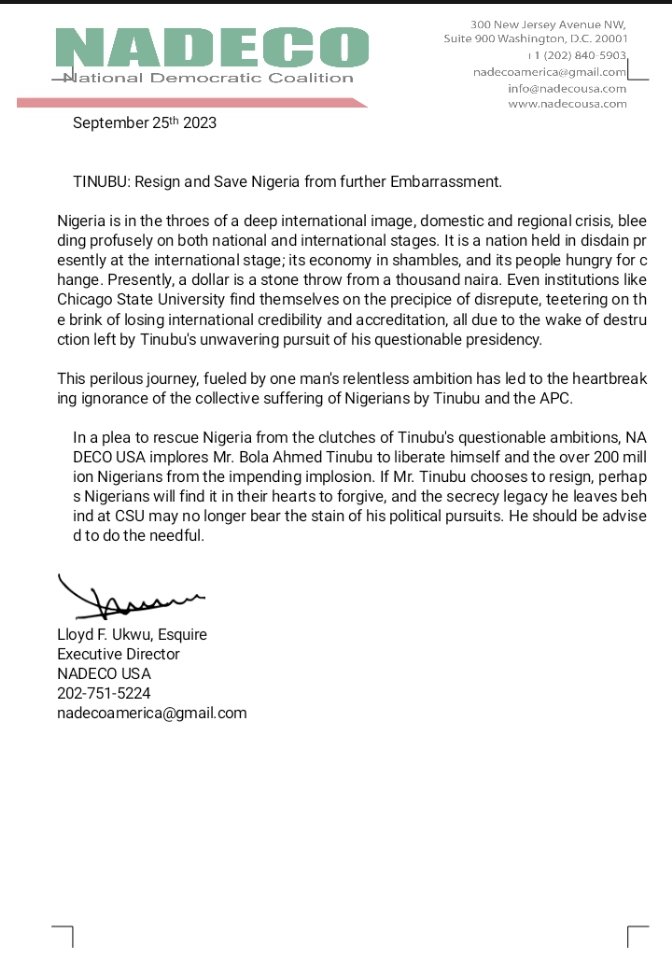
In a statement issued on September 25, 2023, NADECO – USA asserted that the controversies surrounding Bola Tinubu’s academic history at Chicago State University have disgraced the entire nation of over 200 million people on the global stage. The statement also strongly criticized the socio-economic challenges resulting from the perceived failures of Tinubu’s government policies that have adversely affected the lives of Nigerians.

The statement reads: “Nigeria is in the throes of a deep international image, domestic and regional crisis-bleeding profusely on both national and international stages. It is a nation held in disdain presently at the international stage; its economy is in shambles, and its people are hungry for change.

“Presently, a dollar is a stone’s throw from a thousand naira. Even institutions like Chicago State University find themselves on the precipice of disrepute, teetering on the brink of losing international credibility and accreditation, all due to the wake of destruction left by Tinubu’s unwavering pursuit of his questionable presidency.

“This perilous journey, fuelled by one man’s relentless ambition has led to the heartbreaking ignorance of the collective suffering of Nigerians by Tinubu and the APC.

“In a plea to rescue Nigeria from the clutches of Tinubu’s questionable ambitions, NADECO USA implores Mr Bola Ahmed Tinubu to liberate himself and the over 200 million Nigerians from the impending implosion. If MrTinubu chooses to resign, perhaps Nigerians will find it in their hearts to forgive, and the secrecy legacy he leaves behind at CSU may no longer bear the stain of his political pursuits. He should be advised to do the needful.”

Beyond US Dollar Scarcity, Nigeria’s Problem is TRUST Scarcity – and that is leadership [video]

1

Nigeria does not have a dollar scarcity problem or whatever scarcity you may think. Our challenge today is TRUST scarcity. I had planned to drop my Option #2 on how to fix the forex problem, but after reading comments on the Option #1 on social media, I came to this conclusion: it is beyond US dollar scarcity, the real challenge is TRUST scarcity. And Nigeria needs to focus on that.

Good People, but remember, a faith-less and believe-less nation will not have energy to do anything! Yes, if you think your LGA, state and federal systems cannot do anything of value, what are your alternatives?

Nigeria needs to fix its leadership system.

Listed Bitcoin Miners Could be the Ultimate Bet for 2024

0

Bitcoin mining is the process of creating new bitcoins by solving complex mathematical problems using specialized hardware and software. Bitcoin miners are rewarded with newly minted bitcoins and transaction fees for their efforts. Bitcoin mining is essential for securing the Bitcoin network and validating transactions.

However, Bitcoin mining is also a highly competitive and risky business. Bitcoin miners have to deal with fluctuating prices, rising costs, regulatory uncertainties, environmental concerns, and cyberattacks. Moreover, Bitcoin mining is becoming more difficult and less profitable as more miners join the network and the supply of new bitcoins decreases.

The underperformance of listed digital asset companies means that there could be compelling investment opportunities in the bitcoin (BTC) mining space, crypto services provider Matrixport said in a report on Thursday.

If bitcoin were to climb to a new all-time high of $70,000 an investor would realize a return of only 167%, the report said. Investors could see larger gains by buying a diversified portfolio of publicly listed bitcoin mining companies including firms, such as HIVE Digital (HIVE), Bitfarms (BITF) and Iris Energy (IREN). Based on bitcoin’s current price, these stocks are trading at a 33% discount, and offer 52% upside, the note said.

Benefits of listed bitcoin miners:

Liquidity: Listed bitcoin miners are easy to buy and sell on the stock market, unlike mining equipment or cloud mining contracts, which may have limited availability or high fees. You can also diversify your portfolio by investing in different listed bitcoin miners or use options and futures to hedge your risk.

Transparency: Listed bitcoin miners are subject to financial reporting and auditing standards, which means you can access reliable information about their operations, revenues, costs, and profitability. You can also track their hash rate, which is the measure of their mining power and competitiveness in the network.

Leverage: Listed bitcoin miners can benefit from the rising price of bitcoin, as their revenues increase while their costs remain relatively stable. This means they can generate higher returns than simply holding bitcoin. However, this also works in reverse, as a falling price of bitcoin can hurt their profitability and share price.

Innovation: Listed bitcoin miners can access capital markets to raise funds for expanding their mining capacity, upgrading their equipment, or acquiring other mining companies. They can also leverage their expertise and reputation to enter new markets or offer new services related to bitcoin mining.

Challenges of listed bitcoin miners:

Volatility: Listed bitcoin miners are subject to high price fluctuations, as they are influenced by both the stock market and the bitcoin market. Their share price can also diverge from the underlying value of their mining assets, depending on the market sentiment and expectations.

Competition: Listed bitcoin miners face intense competition from other miners, both listed and unlisted, who may have lower costs, higher efficiency, or more favorable locations. They also have to deal with the increasing difficulty of mining, which requires more computing power and energy consumption to maintain the same hash rate.

Regulation: Listed bitcoin miners are exposed to regulatory risks, as different jurisdictions may have different rules and taxes for bitcoin mining. Some countries may ban or restrict bitcoin mining altogether, forcing the miners to relocate or shut down their operations. Regulatory uncertainty can also affect the demand and supply of bitcoin, as well as its price.

Environmental impact: Listed bitcoin miners have a significant environmental impact, as they consume large amounts of electricity and generate carbon emissions. This may attract criticism from environmental activists, investors, and regulators, who may demand more sustainable and green practices from the miners. Some listed bitcoin miners are trying to address this issue by using renewable energy sources or offsetting their carbon footprint.

Listed bitcoin miners are an attractive option for investors who want to gain exposure to bitcoin mining without having to deal with the technical and operational challenges of running a mining facility. However, they also come with high risks and uncertainties, as they depend on the volatile and competitive nature of the bitcoin market. Therefore, investors should do their due diligence and research before investing in listed bitcoin miners.

This is why some Bitcoin miners have decided to go public and list their shares on stock exchanges. By doing so, they can access more capital, diversify their income streams, increase their transparency, and attract more investors. Some of the most prominent listed Bitcoin miners are Marathon Digital Holdings (MARA), Riot Blockchain (RIOT), Bitfarms (BITF), Hut 8 Mining (HUT), and Argo Blockchain (ARBKF).

These listed Bitcoin miners could be the ultimate bet for 2024 for several reasons. First, they have a strong competitive advantage over other miners due to their large-scale operations, efficient equipment, low-cost electricity, and strategic partnerships. Second, they have a high exposure to the price of Bitcoin, which is expected to rise significantly in the next few years due to increasing demand, limited supply, institutional adoption, and innovation. Third, they have a potential to generate additional revenue from other sources, such as hosting services, mining pools, lending platforms, and green energy projects.

Therefore, investing in listed Bitcoin miners could be a smart way to gain exposure to the booming Bitcoin market and benefit from its long-term growth potential. However, investors should also be aware of the risks involved in this sector, such as volatility, regulation, competition, and security. As always, do your own research before making any investment decisions.

The conspiracy on CZ Binance selling Binance affiliate to CommEx

0

There has been a lot of speculation and rumors about the recent deal between CZ Binance, the founder and CEO of Binance, the world’s largest cryptocurrency exchange, and CommEx, a new digital asset platform backed by some of the biggest names in the industry. Some people claim that CZ Binance has sold his Binance affiliate program to CommEx, effectively giving up his control and influence over the Binance ecosystem. But is this really true? And what are the implications for Binance users and the crypto community at large?

Changpeng “CZ” Zhao on Thursday denied that he is the owner of CommEX, the mysterious company that has bought Binance’s business in Russia. Binance, of which CZ is the founder and chief executive officer, this week announced it was quitting Russia after reports of a U.S. Department of Justice investigation into sanctions violations. That led to questions around the identity of CommEX – a company with similar user look and feel to Binance, and which appears to just be a few days old. “I am not their UBO [ultimate beneficial owner], nor do I own any shares there,” CZ said of CommEx in a post on X, formerly Twitter, adding that a few former Binance staff from the region have gone to work for CommEX, or may do so in future.

First of all, let’s clarify what the deal actually entails. According to the official announcement, CZ Binance has agreed to transfer his Binance affiliate program, which rewards users for referring new customers to the exchange, to CommEx. This means that from now on, users who sign up for Binance through CommEx will receive a portion of their trading fees as a commission, instead of getting it from Binance directly. CommEx will also provide additional incentives and benefits for its users, such as access to exclusive products, services, and events.

However, this does not mean that CZ Binance has sold or given up his stake in Binance, or that he has any less influence or authority over the exchange. He remains the founder and CEO of Binance, and he still owns a significant share of the company. He also retains his role as the leader and visionary of the Binance ecosystem, which includes various initiatives such as Binance Chain, Binance Smart Chain, Binance Launchpad, Binance Academy, Binance Charity, and more.

So why did he decide to transfer his affiliate program to CommEx? The answer is simple: to create more value and opportunities for both platforms and their users. By partnering with CommEx, CZ Binance can leverage its network and resources to reach more potential customers and expand his user base. CommEx, on the other hand, can benefit from CZ Binance’s reputation and expertise in the crypto space, and offer its users a seamless and secure way to access the Binance platform. Together, they can create a win-win situation that enhances the growth and innovation of the crypto industry.

In a blog post published on September 28, CZ clarified that he has not sold or given up his stake in Binance, and that he remains fully committed to the vision and mission of the platform. CZ explained that he has been receiving a lot of questions and comments from the community, media, and regulators about his role and status in Binance.

He said that some people have been spreading false information or making baseless assumptions that he has either sold his shares, stepped down from his position, or left the company altogether. He stated that none of these claims are true, and that he is still the largest shareholder and the CEO of Binance.

He also reiterated that he has no plans to change his role or sell his stake in the near future, and that he is proud of what Binance has achieved so far. He said that Binance has grown from a small startup to a global leader in the crypto industry, with over 2,000 employees, 100 million users, and millions of transactions per day. He said that Binance has also contributed to the development and innovation of the blockchain ecosystem, by supporting various projects, initiatives, and charities.

CZ acknowledged that Binance has faced some challenges and difficulties in the past year, especially in terms of regulatory compliance and user protection. He said that Binance has been working hard to improve its systems, processes, and standards, and to cooperate with regulators and authorities around the world. He said that Binance is committed to providing a safe, secure, and compliant platform for its users and partners.

Therefore, there is no reason to believe that this deal is a conspiracy or a betrayal of the Binance community. On the contrary, it is a smart and forward-looking decision that shows CZ Binance’s vision and leadership in the crypto space. He is not selling out or abandoning his loyal followers; he is creating more value and opportunities for them. And he is not losing his influence or control over Binance; he is strengthening it by forging strategic partnerships with other players in the industry.

Important NAFDAC Regulations on Cosmetics in Nigeria

0

This article aims to enlighten readers of the relevant provisions of the National Agency For Food and Drug Administration and Control (NAFDAC) on cosmetic products labelling in Nigeria, especially in light of the worrisome plethora of dubious skin care brands dominating the Nigerian market backed by extravagant marketing.

The NAFDAC regulations apply to all cosmetic products manufactured, imported, exported, advertised, sold, distributed or used in Nigeria. 

Its relevant provisions are as follows:- 

Prohibition

– All cosmetic products manufactured, imported, exported advertised, sold, distributed or used in Nigeria shall be registered in accordance with the provisions of the NAFDAC regulations.

– A cosmetic product shall not be manufactured, imported, exported, distributed, advertised, displayed for sale, offered for sale, sold or used as a cosmetic products, unless a label has been affixed thereto with the information specified in the regulations and appearing on both the inner and outer container.

Labelling Information

– All information required to be indicated on the label of a cosmetic shall be informative, accurate, prominent, legible and distinct.

– All statements shall appear in font size and style type, which is legible for clarity and on a sufficient contrasting background without obscuring designs or vignettes.

– The letters of the name of the cosmetic product and the net content shall be of a size reasonably related to the predominant character on the label.

Validity of Approval

– A cosmetic product label shall state the following :-

  1. Brand name (where applicable)
  1. Product’s statement of identity
  1. Lot/batch number
  1. Net content
  1. Expiry date
  1. Manufacturer’s name and location address including country of origin

– Where a cosmetic is covered with a wrapper, the label shall be legible through the outer wrapper and shall not be obscured.

– Where the wrapper carries the required information, it shall be affixed in a manner that is not removable from the cosmetic container.

– Any claims on the cosmetic product shall be substantiated.

Product Identity

– The outer and inner labels of a cosmetic product shall be required to bear the name of the cosmetic product which shall indicate the accurate natureof the cosmetic product.

– Where a common name or statement of identity has been established for the cosmetic, it shall be used in conjunction with the brand name of the cosmetic product.

– Where no common name or statement of identity exists for a cosmetic product, an appropriate descriptive name shall be affixed to it.

List of Ingredients

– A complete list of ingredients used in preparing the cosmetic product shall be declared on the outer label and inner labels where appropriate in decreasing order of predominance, provided that :-

  1. Fragrance, colour or flavour may be listed in any order after the other ingredients as fragrance, colour or flavour, and
  1. An ingredient that is a fragrance, colour or flavour shall each be designated by internationally identified names or codes.

– Where there is no outer packaging, the list of ingredients shall appear on the inner label.

– Ingredients in concentrations of less than 1% may be listed in any order after those concentrations of 1% or more.

– The declaration of ingredients shall be prominent, readable and understood under normal conditions of purchase.

Net Content of Cosmetic Product

– The accurate average net content of every cosmetic product shall be declared on the inner and outer label in the metric system.

– The declaration of the average net content of the cosmetic product shall be required to be made in the case of :-

  1. Liquid cosmetic in volume
  1. Solid cosmetic by weight & number or count where appplicable.
  1. Semi-solid or viscous cosmetic by weight or volume.

Declaration of Name, Address & Country of Manufacture

– The name and full location address of the manufacturer and packer of a cosmetic product shall be specified on both the inner and outer label where appplicable in such a manner that is easily readable.

– Where the name of the holder of Certificate of Registration of a cosmetic product is specified on the inner and outer label, it shall be easily readable. 

Batch Number

– This shall be indicated on both the inner and outer labels, where appplicable, of all cosmetic products & where it is impossible, for reasons of size, for details of the batch number to appear on both the inner and outer packaging, the details shall be given on the inner packaging.

Date Marking Instructions

– The date marking shall be stated for all cosmetic products and shall be stated on both the inner and outer labels, where applicable.

Storage Condition

– The required storage conditions shall be specified on both the inner and outer labels where appplicable.

Brand Name/Trademark

– The brand name/trademark shall be displayed on the label and shall not give a wrong impression of the nature, quality or substance of yhr cosmetic product.

Registration Number & Directions For Use

– All cosmetic products shall bear on its label its NAFDAC Registration number issued on the Certificate of Registration in such a manner as prescribed by NAFDAC.

– Directions for use, including reconstitution where appplicable, shall be included on the label to ensure correct utilization of the cosmetic product.

Warning and Citations

– The outer and inner label of every cosmetic product shall carry clear and adequate warning to prevent any danger in the use of the product.

Soaps

– Where soap is supplied in a container or wrapper, it shall comply with the labelling requirements contained in these regulations.

Displayed Information

– Any information displayed on a label, which misleads or deceives a consumer in anyway shall constitute an offence under these regulations.

Offences and Penalties

– An individual found guilty of violating these regulations can serve a 1 year jail term, pay a fine of 800 Thousand Naira, or both.

– A body corporate found guilty of violating these regulations will be liable to pay a fine of up to 5 Million Naira.

– Criminal prosecution in this regard can be carried out against directors, managers and secretaries of body corporates found guilty of violating these regulations except where it is proved that the offences were committed without their knowledge, connivance or consent.

Enforcement

– The NAFDAC is entrusted with the statutory duty of enforcing compliance with these regulations.

Cosmetics :- Provisions Of The NAFDAC Guidelines For The Inspection Of Facilities For Manufacture Of Veterinary Cosmetics in Nigeria

These Guidelines as released by the National Agency For Food and Drug Administration and Control (NAFDAC) are for the interest of the general public and manufacturers of Veterinary Cosmetics in Nigeria.

No Veterinary Cosmetics shall be manufactured, exported, imported, distributed, sold or used in Nigeria except in accordance with the provisions of NAFDAC Act CAP N1 (LFN)2004, other related legislations and the accompanying Guidelines.

Step 1- Application For Inspection

Upon request for facility inspection from Registration & Regulatory Affairs Directorate, the following are required :

– An application for inspection should be made on the company’s letter head paper to the Director-General (NAFDAC).

Step 2 – Procedure For Payment

– The application is reviewed to determine payment to be made.

– Payment Advice for inspection and laboratory analysis is issued by NAFDAC desk officer.

– Visit www.remita.net to generate Remita invoice and print out a copy of the invoice.

–  Any nearest commercial bank for payment.

– NAFDAC Accounts Office to collect receipt of payment.

– Attach photocopy of the receipt of payment to the application to be submitted.

Step 3- Submission Of Application

– The reviewed application letter and two (2) sets of the under listed documents are submitted at the Liaison office of the Director (LOD), NAFDAC.

– Duly completed Registration form filled on-line at www.napams.org and printed.

– Photocopy of receipt of payment.

– Certificate of business incorporation of the applicant with Corporate Affairs Commission (CAC) in Nigeria.

– Certificate of registration of brand name/Evidence of Trade mark approval from the Federal Ministry of Commerce in Nigeria, done in the name of the owner of the trade mark.

– Copy of organogram of the company.

– List of Production and Quality Control equipment.

– Comprehensive Certificate of analysis of the raw materials.

– Comprehensive Certificate of Analysis of the batch of product to be registered.

– Certificate of analysis of the raw and treated water for production.

– Product labels.

– Evidence of expired NAFDAC Registration Certificate (for product registration renewal).

– Appointment and acceptance letters of the technical officer including all credentials (Degree, NYSC certificates, etc.). The technical officer should have scientific background with minimum of Ordinary National Diploma; OND or its equivalent.

– Medical Certificate of Fitness for technical and production staff.

– Retainership agreement with a Hospital/Clinic for periodic medical check-up of staff.

– Evidence of fumigation of premises/ factory.

Standard Operating Procedures (SOPs)

– SOP for Production

– SOP for Quality Control

– SOP for cleaning, sanitation and maintenance

– SOP for product recall and distribution

– SOP for receipt of raw materials

– SOP for line clearance

Step 4 – Scheduling Of Inspection

– Upon satisfactory vetting of the application, the date of the inspection is communicated to the company.

Step 5 – Inspection

– The Inspection is conducted as scheduled. Where the Inspection is unsatisfactory a Compliance Directive is issued and communicated to the company.

– For satisfactory inspections, registration samples are taken at the end of the inspection for laboratory analysis while the summary inspection report is forwarded to Registration and Regulatory Affairs Directorate for further processing.

Tariff

As advised by NAFDAC.

Labelling Information

– Labeling should be informative, accurate and in accordance with the Agency’s Labelling Regulations and any other relevant regulations.

– The labelling requirements include:

  1. The Name of cosmetics (common and brand name) and descriptive name where applicable.
  1. Name and full location address of the manufacturer.
  1. Provision for NAFDAC Registration Number on product label.
  1. Batch Number, Manufacturing date and Expiry date.
  1. Dosage form & strength on the package.
  1. Description of the method of usage (Mode of application).
  1. Quantitative listing of all ingredients in descending order of in-going weight.
  1. Adequate warnings where necessary.
  1. Net content of products
  2. Storage conditions

It should be noted that the clock stops once Compliance Directives are issued.