DD
MM
YYYY

PAGES

DD
MM
YYYY

spot_img

PAGES

Home Blog Page 3755

BIG ISSUE: Africans’ Willingness to Fight Despite Growing Wealth Inequality

0

Across the African continent, a striking and resilient spirit is emerging—a spirit that refuses to be overshadowed by the growing chasm of wealth inequality. Recent studies, such as the World Values Survey conducted between 2017 and 2022, have revealed a fascinating trend: despite the economic disparities plaguing their nations, Africans are demonstrating a strong willingness to defend their countries when called upon. This growing interest in patriotism and unity in the face of adversity is not only a testament to Africa’s unwavering strength but also a beacon of hope for the continent’s future.

The Wealth Inequality Challenge

It is no secret that wealth inequality is a pressing issue in many African nations. Disparities in income and access to resources have persistently plagued the continent, often deepening divisions among its people. While the reasons behind this inequality are complex and multifaceted, one might expect such economic disparities to erode the social fabric and undermine national unity. However, the reality is quite the opposite.

A Willingness to Fight

In the midst of these economic challenges, Africans are displaying a remarkable readiness to defend their countries. The World Values Survey revealed that citizens from countries like Nigeria, Kenya, Ethiopia, Zimbabwe, Tunisia, and Libya are, on average, over 60% willing to take up arms for the sake of their homeland. This statistic is not a mere numerical figure; it embodies a profound commitment to preserving the sovereignty and unity of their nations.
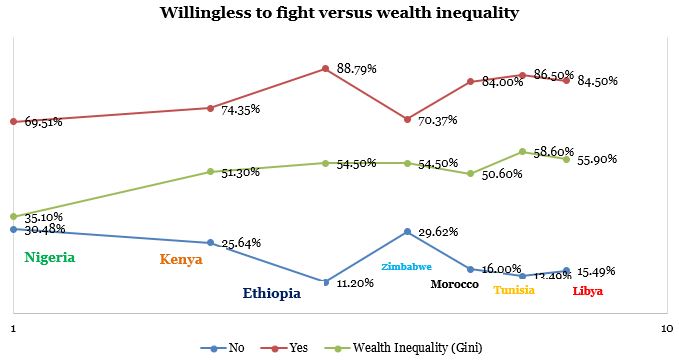
Source: World Economics, 2023; Infoprations Analysis, 2023

The Nigerian Paradigm

Nigeria, one of Africa’s most populous and economically diverse nations, stands out as a prime example of this phenomenon. Despite significant wealth inequality within its borders, Nigeria consistently demonstrates a high level of willingness among its citizens to protect their homeland. This readiness to fight is a testament to the deep-rooted sense of national pride and unity that transcends economic disparities.

Unity in Diversity

The African continent is often celebrated for its rich cultural diversity, a tapestry woven together by myriad languages, traditions, and histories. In the face of wealth inequality, this diversity becomes a source of strength rather than division. Africans are showcasing that their commitment to their nations transcends ethnic, linguistic, and regional boundaries.

The North African Story

Even in the North African countries of Tunisia, Morocco, Libya, and Ethiopia, where wealth inequality was notably high according to 2019 measurements, the spirit of unity remains unwavering. The citizens of these nations are ready to stand shoulder to shoulder in defence of their countries, reflecting a shared determination to protect the sovereignty they hold dear.

Hope for the Future

Africa’s growing interest in patriotism and its readiness to fight for the nation in the face of wealth inequality offers a glimmer of hope. It underscores the continent’s resilience and determination to overcome obstacles that have persisted for generations. This trend is a reminder that economic challenges, while significant, cannot extinguish the flame of national pride and unity.

Harnessing the Spirit of Unity

As Africa moves forward, it must harness this spirit of unity and willingness to defend the nation. Governments, civil society organizations, and international partners can play a crucial role in addressing wealth inequality and creating economic opportunities for all citizens. By reducing disparities and ensuring that the benefits of growth are shared equitably, Africa can build a more prosperous and harmonious future.

In the face of growing wealth inequality, Africans’ willingness to fight for the nation is a compelling narrative of resilience and unity. It showcases a determination to protect the sovereignty and unity of countries across the continent. This growing interest in patriotism serves as a beacon of hope, reminding us that even in the face of economic challenges, the spirit of unity can prevail. As Africa moves forward, it must harness this spirit to build a brighter and more equitable future for all its citizens.

One Death, Many Misinformation, and Implications for Justice for Mohbad

0

In an era where information spreads like wildfire through the vast networks of social media and digital platforms, the tragic death of the late singer, Ilerioluwa Aloba, popularly known as Mohbad, serves as a stark reminder of the perils of misinformation and its far-reaching consequences. In the wake of his untimely demise, the internet was flooded with rumours, speculations, and unfounded accusations, highlighting the urgent need for responsible information dissemination and the implications of such misinformation for the pursuit of justice.

In the digital age, content creators have emerged as influential voices, capable of shaping public perception and driving narratives. While many content creators use their platforms responsibly to inform, educate, and entertain, others exploit the sensational nature of tragedy for personal gain. In the case of Mohbad’s death, several content creators seized the opportunity to gain attention and followers by spreading unverified information.

One of the most glaring examples of misinformation surrounding Mohbad’s death was the widely circulated rumour that his mother had passed away. This misinformation was particularly distressing, as it not only added unnecessary anguish to the grieving family but also underscored the reckless nature of some content creators. It serves as a stark reminder that verifying information from credible sources should always be a priority, especially when dealing with sensitive subjects like death.

In the absence of concrete evidence and official statements, many individuals and groups were unjustly accused of being responsible for Mohbad’s death. The digital witch hunt that ensued on platforms like Twitter, TikTok, Instagram, and Facebook was not only damaging to the reputations of those accused but also a threat to the principles of justice and due process.

The misinformation and false accusations surrounding Mohbad’s death have far-reaching implications for the pursuit of justice. First and foremost, they create a toxic environment where speculation and rumours overshadow the facts. This can hinder the ability of law enforcement agencies to conduct thorough investigations and apprehend the actual culprits responsible for the tragedy.

Moreover, the individuals and groups wrongly accused may suffer long-lasting damage to their reputations, and the potential for vigilantism becomes a real concern. When the court of public opinion bypasses the legal system, it undermines the very foundations of justice that societies depend on.

The tragic death of Mohbad and the subsequent wave of misinformation and unfounded accusations highlight the urgent need for responsible information dissemination in the digital age. It is crucial that we recognize the power and perils of social media and the role of content creators in shaping public opinion. To safeguard against the destructive effects of misinformation, society must prioritize media literacy education, responsible content creation, fact-checking, transparency, and accountability. Only by doing so can we ensure that justice is not compromised in the face of sensationalism and falsehoods and that tragedies like Mohbad’s death are not further compounded by the spread of misinformation.

CZ, Binance-US filed to dismiss SEC lawsuit against its Exchanges

0

Binance is the world’s largest cryptocurrency exchange by trading volume, offering hundreds of digital assets and derivatives to millions of users around the globe. However, the exchange has also faced increasing regulatory scrutiny in recent months, as authorities in several countries have accused it of operating without proper licenses, facilitating money laundering, and violating securities laws.

The cryptocurrency exchange Binance, its U.S. affiliate Binance.US and its founder and CEO Changpeng Zhao (CZ) have filed a motion to dismiss a lawsuit brought by the U.S. Securities and Exchange Commission (SEC) in New York.

One of the most prominent regulators that has taken action against Binance is the U.S. Securities and Exchange Commission (SEC), which has been investigating the exchange for potential violations of federal securities laws. The SEC has not publicly disclosed the details of its probe, but some of the possible issues that it may be looking into are:

Binance’s offering of tokens that may be considered securities, such as stock tokens that track the performance of publicly traded companies, or tokens that represent fractional shares of other cryptocurrencies.

Binance’s handling of customer funds and data, especially in relation to its U.S. subsidiary, Binance.US, which operates under a different legal entity and regulatory framework than the parent company.

Binance’s involvement in market manipulation, insider trading, or other fraudulent activities, such as the recent hack of Poly Network, a decentralized finance (DeFi) platform that resulted in the theft of over $600 million worth of crypto assets, some of which were traced back to Binance accounts.

The lawsuit, which was filed in April 2023, alleges that Binance and CZ violated the federal securities laws by offering and selling unregistered securities in the form of digital tokens on their platforms. The SEC claims that Binance and CZ failed to register or seek an exemption for their offerings, which involved more than 50 different tokens, some of which were deemed to be securities by the SEC.

Binance and CZ argue that the lawsuit should be dismissed for several reasons, including:

The SEC lacks jurisdiction over Binance and CZ, who are not U.S. persons and do not operate in the U.S.

The SEC fails to allege any specific facts that show that Binance and CZ offered or sold any securities in the U.S. or to U.S. investors.

The SEC fails to identify any specific tokens that are securities or explain how they meet the criteria of the Howey test, which is used to determine whether an asset is a security.

The SEC fails to allege any scienter or intent to defraud on the part of Binance and CZ, which is required for a securities fraud claim.

The SEC’s claims are barred by the statute of limitations, as most of the alleged conduct occurred more than five years before the lawsuit was filed.

Binance and CZ also contend that the lawsuit is part of the SEC’s “regulation by enforcement” strategy, which creates uncertainty and confusion in the crypto industry and harms innovation and growth. They assert that the SEC has not provided clear and consistent guidance on how it applies the securities laws to digital assets, and instead relies on retroactive enforcement actions that are based on vague and subjective standards.

Binance and CZ request that the court grant their motion to dismiss the lawsuit with prejudice, meaning that it cannot be refiled. They also seek an award of their attorneys’ fees and costs. The motion to dismiss is expected to be heard by Judge Alison J. Nathan in the coming months. The outcome of this case could have significant implications for the crypto industry, as it could set a precedent for how the SEC regulates digital assets and exchanges in the U.S.

The SEC has not yet filed any formal charges or taken any enforcement actions against Binance or its US affiliate, but it has reportedly issued subpoenas and requests for information to the exchange and its affiliates. The SEC has also warned investors about the risks of trading on unregistered platforms that may not comply with U.S. securities laws.

Sometimes you just fight as delay is also a strategy looking at how Intel’s case has played out over years.

A years-old antitrust case against Intel may be drawing to a close, at least in part. European regulators are re-fining the chipmaker $400 million over allegations it paid retailers and computer makers to “delay, cancel or simply not sell” products containing chips from rival AMD between 2002 and 2006. Intel was penalized over $1 billion after a 2009 ruling, but that fine was scrapped when one part of the case was annulled. The development comes as both EU and U.S. regulators flex their muscles in high-profile antitrust cases, including a landmark trial on Google’s search dominance. Another facet of the case alleging that Intel “gave hidden rebates and incentives” to computer manufacturers to use its chips remains under appeal.

New Central Bank of Nigeria Governor Yemi Cardoso, Four Deputies Assume Office

0

Olayemi Cardoso has officially assumed office as the new Governor of the Central Bank of Nigeria (CBN), along with four new Deputy Governors: Nnana Usoro, Muhammad Abdullahi Dattijo, Philip Ikeazor, and Bala Bello. They have all taken over their roles in an acting capacity, pending confirmation by the Senate, according to a statement from the CBN.

The announcement comes on the heels of the forex crisis currently rocking the country, which requires utmost fiscal policies from the central bank to address.

Cardoso is to replace Folashodun Shonubi, who has been serving as the CBN governor in an acting capacity.

President Bola Ahmed Tinubu nominated Cardoso to serve as the acting Governor of the CBN, along with the four new Deputy Governors, on September 22, 2023. Cardoso’s nomination came after the suspension of Godwin Emefiele from office approximately three months before the announcement.

The Cardoso-led team has assumed leadership of the central bank following the resignations of Godwin Emefiele, Shonubu, and the other deputy governors, as confirmed by the CBN in its statement issued on Friday.

“Dr. Olayemi Michael Cardoso, recently nominated by President Bola Ahmed Tinubu, has on Friday, September 22, 2023, formally assumed duty, in an acting capacity, as the Governor of the Central Bank of Nigeria (CBN), pending his confirmation by the Senate. This follows the resignation of Mr. Godwin Emefiele as Governor of the Central Bank of Nigeria (CBN),” the statement said.

“Deputy-Governors-Designate have also assumed duty, in acting capacities, sequel to the formal resignation of Mr Folashodun Shonubi, Mrs Aishah Ahmad, Mr Edward Lametek Adamu, and Dr Kingsley Obiora as Deputy Governors of the CBN,” it added.

Olayemi Cardoso and the other new appointees officially assumed their roles after taking the relevant oaths of office in a brief ceremony held at the CBN’s Head Office in Abuja on Friday, September 2023. They have now begun their responsibilities related to administering monetary and financial sector policies for the Federal Government, as stated in the CBN’s announcement.

The wait for the confirmation of the newly-appointed CBN governor, Cardoso, and his deputies has been linked to the abysmal performance of the naira in the parallel market this week. The gap in decision-making that it created is believed to have impacted the CBN’s supply to the FX market, opening an N217 exchange rate gap between the parallel market and the I&E window. The naira was trading at N955/$1 in the parallel market, and N738/$1 in the Investor & Exporter window on Friday.

Following their assumption, the governor and his deputies are expected to tackle the FX crisis head-on. Although the Finance Minister, Wale Edun, said to boost FX liquidity, Nigeria needs to clear the $6.8 billion in overdue forward payments in the foreign exchange market, sound monetary and financial sector policies by the CBN are expected to ameliorate the situation.

SEC, Blockchain Capital, Digital Currency Group, Anchorage Digital, Toncoin and More

0

The U.S. Securities and Exchange Commission (SEC) has expressed a strong interest in examining Binance.US, the American affiliate of the global cryptocurrency exchange Binance. The regulator is concerned about the safety and security of the digital assets that Binance.US holds on behalf of its customers, as well as the compliance of its trading platform with the federal securities laws. The SEC has requested access to Binance.US’s books and records, as well as information about its internal controls, governance, and risk management practices.

Blockchain Capital, one of the oldest and most prominent venture capital firms in the crypto industry, has announced the closing of two new funds with a total of $580 million in capital commitments. The firm, which was founded in 2013 and has backed some of the most successful projects and companies in the blockchain space, said that the new funds will enable it to continue investing in both early-stage and growth-stage opportunities across the crypto ecosystem.

The two funds are Blockchain Capital VI, a $300 million fund focused on seed and Series A rounds, and Blockchain Capital Growth Fund I, a $280 million fund dedicated to later-stage investments. According to the firm, the new funds were oversubscribed and attracted a diverse group of investors, including pension funds, endowments, foundations, family offices, corporations, and high-net-worth individuals.

Blockchain Capital also said that it has expanded its team and added new strategic partners to support its portfolio companies and enhance its network. The firm’s co-founder and managing partner, Bart Stephens, said that the crypto industry is at an inflection point, with more innovation and adoption than ever before. He added that Blockchain Capital is well-positioned to capitalize on this trend and help shape the future of finance, technology, and society.

“We are incredibly honored to welcome such a distinguished group of investors into our new funds,” Stephens said in a press release. “We believe that we are in the early stages of a multi-decade adoption cycle for digital assets and blockchain technology. Our mission is to support the best entrepreneurs in the world who are building this new and exciting digital economy.”

Digital Currency Group (DCG), a global blockchain and cryptocurrency investment leader, has appointed Professor Tonya Evans as a new independent director. Professor Evans is an expert in blockchain law and policy, digital assets and intellectual property. She is also the founder and CEO of Advantage Evans Academy, an online education platform for blockchain literacy and crypto asset management.

Professor Evans has over 20 years of experience as a lawyer, scholar, educator and entrepreneur. She teaches blockchain, crypto and fintech courses at Penn State Dickinson Law School. She also chairs the Maker Foundation’s MakerDAO Law and Policy Working Group and advises several blockchain startups and organizations.

“Professor Evans is a visionary leader in the blockchain space, with deep legal and regulatory insights. Her perspective and guidance will be invaluable as we grow our portfolio of companies and initiatives across the globe,” said Barry Silbert, founder and CEO of DCG.

“I am honored and excited to join DCG’s board of directors. DCG is at the forefront of innovation and adoption in the blockchain and cryptocurrency sector. I look forward to working with Barry and the board to advance DCG’s mission of a better financial system for everyone,” said Professor Evans.

Anchorage Digital, a leading crypto custody and staking platform, saw a significant increase in the demand for Ether staking services in 2023, according to its co-founder and president, Diogo Monica. In an interview with Bloomberg, Monica revealed that the amount of Ether staked on Anchorage’s platform quadrupled in the past year, reaching over $40 billion worth of the second-largest cryptocurrency. Monica attributed the growth to the launch of Ethereum 2.0, a major upgrade that aims to transition the network from a proof-of-work to a proof-of-stake consensus mechanism.

By staking Ether, users can earn rewards for securing the network and validating transactions. Monica said that Anchorage’s clients, which include institutional investors, hedge funds, and corporations, are attracted by the high returns and low volatility of staking Ether compared to other crypto assets. He also said that Anchorage’s platform offers a unique advantage of allowing users to stake Ether without locking it up for an indefinite period, as is the case with some other platforms. “We have a very innovative solution that allows our clients to stake their Ether and still have access to it for trading, lending, or any other use case they might have,” he said.

Toncoin, the cryptocurrency backed by the popular messaging app Telegram, has surged ahead of bitcoin in the latest crypto market rally. According to CoinMarketCap, Toncoin’s price increased by more than 50% in the past 24 hours, reaching a new all-time high of $2.34.

The spike came after Telegram’s founder and CEO Pavel Durov announced on his channel that Toncoin will be integrated into the app’s payment system, allowing users to send and receive Toncoins within chats. Durov also praised Toncoin’s speed, scalability and security, calling it “the future of digital money”. Bitcoin, meanwhile, lagged behind Toncoin, gaining only 10% in the same period and trading at around $27,266. Analysts attribute Toncoin’s dominance to its strong community support, innovative technology and growing adoption by mainstream platforms.