DD
MM
YYYY

PAGES

DD
MM
YYYY

spot_img

PAGES

Home Blog Page 385

Whitelist Opening Soon: Zero Knowledge Proof (ZKP) Lets You Prove Without Revealing a Single Detail

0

The next stage of blockchain isn’t about higher token prices or faster transfers, it’s about trust. Traditional blockchains have given us transparency, but that openness comes at a cost: every transaction, every wallet, every data point is exposed for anyone to see.

Zero-Knowledge Proof (ZKP) flips that logic by making it possible to prove authenticity without showing the underlying information. Solvency can be confirmed without balance sheets, identity can be verified without disclosing personal details, and contracts can execute without revealing sensitive logic. With its whitelist opening soon, Zero Knowledge Proof gives early participants the chance to enter a system built on privacy and proof instead of exposure.


The Philosophical Shift – Proving Without Revealing

What makes Zero Knowledge Proof unique isn’t only its technology, it’s the new philosophy it brings to digital trust. For years, the blockchain narrative has centered on transparency as the antidote to corruption. While transparency works for auditability, it also strips away privacy in ways that don’t fit real-world needs. Businesses don’t want competitors reading their transactions, and individuals don’t want their entire financial history published on a ledger.

Zero Knowledge Proof technology changes this relationship. It allows users to prove that something is valid, such as a payment, identity, or asset, without disclosing the details themselves. The concept is simple: show proof of correctness while withholding the data behind it.

  • Finance: Banks can demonstrate solvency without releasing sensitive internal records.
  • Healthcare: Patients can verify medical eligibility without exposing full medical histories.
  • Governance: Voters can cast ballots privately while the system verifies fairness.

This shift reframes blockchain not as a “glass box” but as a “trust engine” that respects confidentiality.


Core Technology Driving the Network

The mechanics of Zero Knowledge Proof rest on a dual foundation: zk-SNARKs and zk-STARKs. zk-SNARKs focus on efficiency, producing small proofs that verify quickly, making them ideal for high-frequency use cases like financial transfers. zk-STARKs, on the other hand, emphasize scalability and transparency while offering resilience against future quantum computing risks.

By combining both systems, Zero Knowledge Proof offers a flexible toolkit: enterprises can prioritize efficiency where speed matters and scale where volume matters. Importantly, this approach ensures the project doesn’t lock itself into one branch of cryptographic innovation.

Additional scaling measures, such as zk-Rollups and recursive proofs, allow thousands of transactions to be verified in compressed form. Parallel computation adds another layer of throughput. These tools collectively remove the bottlenecks that have prevented privacy chains from scaling.

This isn’t just theoretical, Zero Knowledge Proof’s architecture supports tens of thousands of transactions per second while maintaining low costs. That positions the network to handle consumer-scale adoption and enterprise-grade workloads simultaneously.


Real-World Applications Beyond Finance

The power of proving without revealing extends well beyond financial use cases. Zero Knowledge Proof has mapped out a broad ecosystem that shows how cryptography can serve multiple sectors.

  • Healthcare: Hospitals and insurers can process claims with zero-knowledge verifications, ensuring eligibility and compliance without exposing sensitive patient data.
  • Supply Chains: Manufacturers can confirm product authenticity without exposing supplier details or trade secrets.
  • Voting Systems: Ballots can remain private, yet the system can guarantee fairness, preventing fraud or manipulation.
  • Digital Identity: Users can prove compliance with KYC requirements without handing over their personal documents to every platform they use.

The inclusion of shielded smart contracts means applications can be built privately without altering logic transparency. Developers can code in a familiar environment but deliver outputs that protect users’ information. This balance makes the network flexible for both regulators and users.

These real-world pathways make Zero Knowledge Proof much more than an abstract technology. They make it a framework for digital trust.


Why the Whitelist Matters

The whitelist opening soon is more than a fundraising stage, it’s an entry point into a new trust model for the digital age. Early participants aren’t just buying tokens; they’re gaining front-row access to a paradigm shift in how data is handled. The network’s modular design, post-quantum readiness, and governance structure put it on track to become a long-term infrastructure layer, not a speculative side project.

Getting involved at this stage means aligning with the very definition of privacy-first validation. Investors often look for early exposure to scalable technology, but here the incentive runs deeper. By participating, individuals align with a network that allows proofs of solvency, identity, and authenticity without revealing underlying information.

In practical terms, this whitelist offers entry-level pricing at a moment when privacy is moving from niche concern to mainstream demand. Those who step in now are positioned ahead of the curve, at the start of a shift likely to reshape how digital trust is defined.
Final Take

Zero Knowledge Proof is more than another blockchain, it’s a philosophical redefinition of what trust in digital systems can look like. Instead of exposing everything for validation, it proves correctness without compromising data. That makes it relevant for industries ranging from finance and healthcare to voting and identity.

With its whitelist opening soon, the opportunity is not just about early participation but about engaging with a network designed for the next decade of data privacy and security. By combining advanced proof systems with real-world applications, Zero Knowledge Proof crypto positions itself as a foundation for digital trust where privacy and verification finally coexist.

Innovative gaming advancements in 2025

0

The global gaming industry has always been driven by innovation, but 2025 is shaping up to be a transformative year where emerging technologies are not only enhancing entertainment but also redefining what players expect from digital experiences. Casino gaming, in particular, is at the centre of this transformation, blending cutting-edge tools with consumer demand for personalisation, immersion, and convenience.

The gaming landscape is undergoing a profound transformation with the rise of AR and VR integration. This shift is not merely a technological upgrade, but a redefinition of the gaming experience. Developers are no longer confined to flat screens and simple interfaces. Instead, they are crafting fully immersive 3D environments where players can project a poker table onto their living room floor or step into a virtual casino teeming with avatars and live dealers. These setups, which seamlessly blend realism with interactivity, give players a sense of presence that blurs the lines between physical and digital spaces.

Artificial intelligence is not just a feature, but a cornerstone of the modern gaming ecosystem. Its influence extends beyond providing quick support through chatbots. AI now shapes the entire customer journey, from detecting fraud to predicting player preferences. It’s being used to personalise rewards, game recommendations, and even difficulty levels in real time. This tailoring of experiences not only keeps engagement high but also fosters loyalty in a highly competitive market. The widespread adoption of this technology, even in popular gaming sites such as Tooniebet casino, is a testament to its transformative power.

The role of blockchain and cryptocurrency in the gaming industry has expanded significantly. These technologies are not just offering secure, transparent, and instant transactions, but revolutionising the way casinos operate. Smart contracts ensure payouts are automated and tamper-proof, while decentralised platforms add layers of fairness that traditional systems often lack. Combined with the global adoption of crypto wallets, these innovations are allowing casinos to reach a wider player base with less friction in payment processing, thereby enhancing player trust and convenience.

Meanwhile, the mobile-first revolution continues to accelerate thanks to 5G connectivity. High-definition streaming, instant-play games, and live dealer interactions are now smoother than ever on handheld devices. The near elimination of lag means players can seamlessly join live roulette or blackjack sessions without worrying about delays. Developers are responding by building lightweight, responsive interfaces that fit smaller screens but don’t compromise on quality.

Generative AI is another game-changer in 2025. Unlike traditional AI, this technology can dynamically create content, adapt storylines, and evolve gameplay based on user behaviour. Non-player characters are smarter, worlds feel alive, and even slot machines can adjust their mechanics to suit player styles. The result is gameplay that feels less scripted and more personalised, keeping audiences engaged for longer.

Other trends highlight the push toward accessibility and convenience. Smartwatch gaming is gaining ground, making it possible to place quick bets or spin digital slots on the go. Hybrid games, which merge live dealers with automated features, offer the best of both worlds: human interaction and efficient play. At the same time, gamification elements like leaderboards, daily challenges, and social features are making casino platforms feel closer to mainstream video games.

As 2025 unfolds, it’s clear that innovation in gaming isn’t about single breakthroughs but the convergence of multiple technologies. From AI-driven personalisation to immersive VR spaces and blockchain-backed security, the industry is building experiences that are more engaging, more transparent, and more adaptable to a global audience. What was once experimental is now becoming the new standard for digital entertainment.

Breaking Down The Top Crypto Presale List: Maxi Doge, Snorter, & STBL Try to Impress, But BlockDAG Races Ahead With $420M+ Raised

0

The crypto market is buzzing with projects that are going beyond promises and showing actual delivery. Investors are no longer only focused on coins that might grow later, they want to see real momentum right now.

Presales have become the key entry point for those aiming to join early, before a project lists on major exchanges. In 2025, presales have already pulled in millions of dollars within weeks, creating urgency and excitement at levels not seen in years.

Some projects are gaining traction through partnerships, testnets, and active communities, while others are pushing bold presales and ambitious tokenomics. For traders checking the top crypto presale list, four names stand out: BlockDAG, Maxi Doge, Snorter, and STBL.

1. BlockDAG: Power Ahead to $420M Raised with F1®

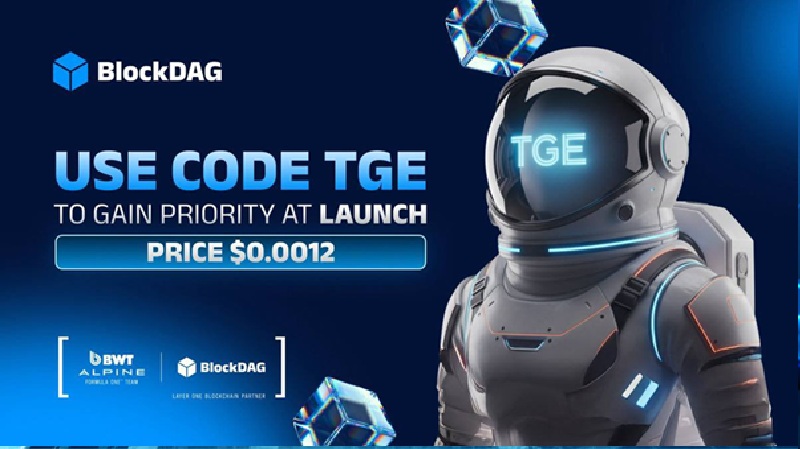
BlockDAG (BDAG) has taken a different route compared to most early-stage projects. It isn’t just selling a future dream; it already has a working Awakening Testnet and a multi-year partnership with the BWT Alpine Formula 1® Team. This mix of technical progress and global sports branding makes BlockDAG stand out from other presales. The presale has already raised over $420 million with the coin priced at $0.0012 for GENESIS Day, making it one of the strongest campaigns of 2025.

With the GENESIS Day activation, early holders have the chance to grab coins at the lowest entry price and gain early access.

CODE “TGE” allows early access at launch depending on your rank:

1– 300 Rank: Instant Airdrop

301 – 600 Rank: Airdrop after 30 min

601 – 1000 Rank: Airdrop after 60 min

1001 – 1500 Rank: Airdrop after 2 h

1501 – 2000 Rank: Airdrop after 4 h

2001 – 5000 Rank: Airdrop after 6 h

5001 Rank: Airdrop after 24 h

The Testnet is delivering around 1,400 transactions per second and is fully EVM compatible, giving developers the freedom to deploy dApps instantly. It also features tools like an open-source IDE, NFT explorer, live dashboards, and even built-in apps such as Reflection and Lottery. For users, gasless transactions are being planned to make things smoother and more affordable. The fact that these tools are already functional sets BlockDAG apart from presales that only push whitepapers.

The BWT Alpine Formula 1® Team partnership is live with on-track activations, fan simulators, and developer showcases, pushing BlockDAG into the mainstream spotlight. At $0.0012, with limited claim spots remaining, the urgency around this presale is real. For anyone looking at the top crypto presale list, BlockDAG is the one creating genuine FOMO right now.

2. Maxi Doge: A Meme with Multiple Faces

Maxi Doge remains one of the more unpredictable tokens on the market. Prices vary widely depending on the source, ranging from $0.000062678 on CoinGecko to $0.0001563 on Bitget and $0.0009673 on Solana listings. The spread underscores both its volatility and the fact that it is still establishing market stability. Some forecasts suggest a listing near $0.0003, with higher upside targets circulating among speculators.

What keeps interest alive is its tokenomics. Roughly 25% of supply is allocated to the “MAXI Fund,” while staking rewards of 5% are built into the model. Launched in July 2025 at $0.00025, the presale has inched upward to $0.0002745. Despite inconsistencies, Maxi Doge remains a closely watched meme-driven presale, drawing speculative attention.

3. Snorter: The Bot Token Testing Presale Momentum

Snorter, also known as Snorter Bot (SNORT), has gained attention as a presale token combining AI-driven bot functions with Solana integration. Reports from July 2025 showed the project raised about $1.5 million during its presale, sparking early momentum. Since then, price data has been inconsistent: Coinbase lists it at $0.00000043 with no active volume, while Bitget places it near $0.0001334. Phantom shows a market cap of roughly $115K, signaling modest speculative activity.

Despite unclear reporting, Snorter has carved out a niche by linking its brand to automated bot trading. A theme that resonates with investors chasing tech-driven narratives. While still highly speculative and far less established than BlockDAG, it stays on top crypto presale lists as a risky but intriguing early bet.

4. STBL: A Token with Strong Liquidity & Volatility

STBL has become one of the most discussed tokens in late 2025 thanks to sharp market activity. As of early October, it trades around $0.2722 with daily volume between $144 million and $176 million, giving it a market cap of $136–145 million based on a circulating supply near 500 million. Its all-time high of $0.610 in late September makes the recent 34–43% pullback significant.

Even with the dip, STBL has shown resilience and maintained liquidity, a rarity for newer tokens. Analysts note it has previously bounced around the $0.37–$0.40 support region, sparking speculation of a medium-term recovery toward $1. With strong exchange backing, liquidity, and active speculation, STBL earns a place on top crypto presale lists as a fast-rising token.

Final Take

Crypto presales in 2025 continue to prove they can capture both attention and significant capital long before tokens reach exchanges. They have become launchpads for fundraising and for testing the vision and credibility of development teams. Strong technical delivery, ambitious narratives, and community-driven hype all play a role in which projects attract early traction.

BlockDAG stands apart by pairing real delivery with global visibility, backed by presale that’s $420 million, a live testnet, and its BWT Alpine Formula 1® Team partnership.

At the same time, Maxi Doge, Snorter, and STBL showcase the variety of speculative paths investors pursue. From meme appeal and AI-powered tokens to liquidity-driven trading. Together, these names illustrate the mix of opportunity and risk shaping the top crypto presale list.

SMBs & Cybersecurity: The Smaller, The Tastier

0

A golden rule for SMBs and start-ups is that cybersecurity should be a consideration from the very first day. After all, people generally lock down everything, from their smartphones to their social media accounts, so why wouldn’t you afford the same treatment to where your heart and money lie – your new business.

It’s an easy thing to get wrong. There’s a certain false confidence in assuming you’re “too small” or “too new” to attack – but evidence suggests the cybersecurity food chain works as it should, and the little ones get eaten first.

Encryption

Each company has its own cybersecurity needs. Web-based companies that handle personal information and/or credit cards inevitably have heavier protections than personal blogs.

A mega-corporation like Walmart wears its security credentials on its sleeve, dedicating part of its corporate website to listing privacy certifications. These are vast and complex, and likely well beyond the interest of all but experts in the field.

Source: Pexels.

Most websites use Secure Socket Layer (SSL) encryption as a means of masking sensitive information sent over the internet. In some cases, especially where cash changes hands, this is worth pointing out to potential customers.

JackpotCity, an online casino in the UK, remarks on its “powerful” and “state-of-the-art” SSL encryption on its homepage. The idea is to instill confidence in players so they sign up. Put another way, SSL is a piece of tech that serves a second job as a marketing tool.

Organisations can opt in to an increasingly aggressive set of standards and frameworks to secure their businesses. In the US, this comes under NIST, while the UK has its Minimum Cyber Security Standard. International standards include ISO 27001 and ISO 27032.

At-risk Businesses

Just by reading the previous, it’s easy to feel that these cybersecurity knick-knacks are way above the SMB’s pay grade – especially when it comes to the ISOs. Yet the unfortunate nature of cybercrime is that it feeds bottom up. Smaller companies are easier to bring down and hold to ransom than the denizens of Silicon Valley.

The US Chamber of Commerce’s Small Business Index for Q1 2024 revealed that 60% of SMBs were worried about cybersecurity, with 27% believing that a single incident would force the company to close.

Security firm Cloudstrike claims that the most at-risk businesses are those growing quickly and taking on lots of employees. People are often the weak link when it comes to opening the door to malware or phishing attacks. So, the more people, the bigger the “risk profile”.

Cyberattacks are often crimes of opportunity. It’s rarely a case of revenge or the work of a disgruntled ex-employee. An open door is an open door, whether it’s in real life or over the internet. A florist is just as much of a target as a pharmacist or hardware store.

Let’s go back to that golden rule – cybersecurity “hygiene” begins on the first day. It might seem like an uphill struggle trying to maintain security practices during hectic periods, but the outcome of an attack is often terminal for SMBs.

Citi Ventures Invests in BVNK to Accelerate Stablecoin Innovation And Bridge Traditional Finance

0

Citi Ventures, the corporate venture capital and innovation arm of Citigroup, has announced a strategic investment in BVNK, a leading global platform specializing in stablecoin infrastructure.

Arvind Purushotham, Head of Citi Ventures, highlighted the growing use of stablecoins for settlements and on-chain transactions, commending BVNK’s proven capabilities.

Speaking on the investment, he said,

“Stablecoins are seeing increased interest in use for settlement of on-chain and crypto asset transactions. We were impressed by BVNK’s enterprise-grade infrastructure and their proven track record”.

Although Citi did not reveal the investment amount or BVNK’s current valuation, co-founder Chris Harmse in an interview with CNBC disclosed the company is now worth more than the $750 million reported in its last funding round.

Through this investment, BVNK will collaborate with Citi to strengthen the link between traditional finance and the emerging digital financial system. BVNK’s technology operates as a global payments rail, enabling users to move funds seamlessly between fiat currencies and stablecoins.

The platform allows businesses to pay suppliers, contractors, and merchants across borders while offering full-stack solutions for stablecoin adoption. BVNK currently processes over $20 billion annually for global enterprises and payment providers, powering companies such as Worldpay, Flywire, and dLocal.

Also commenting on the investment, BVNK CEO Jesse Hemson-Struthers noted that Citi’s investment will advance the company’s mission to accelerate global money movement. This latest funding follows previous investments from Visa, Haun Ventures, Tiger Global, and other prominent backers.

Citi’s investment in BVNK comes amid growing regulatory clarity around stablecoins, with initiatives such as the GENIUS Act in the United States paving the way for banks to issue stablecoins.

This has also seen major financial institutions increasingly embrace the digital asset. JPMorgan, Bank of America, Citi, and Wells Fargo are reportedly exploring a joint stablecoin project, while BNY Mellon experiments with tokenized deposits and HSBC has already launched a tokenized deposit service.

Recently, The Bank of England adopted a more open stance toward stablecoins, amid calls to ease regulation. In a report by Bloomberg, the UK central bank plans to grant exemptions to proposed limits on Stablecoin holdings by businesses, indicating a softening stance toward crypto assets amid growing competition from the US.

Stablecoins digital assets pegged to fiat currencies like the U.S. dollar or euro have become a cornerstone of the modern financial ecosystem. In 2025, the total stablecoin market capitalization surpassed $300 billion, with forecasts from Standard Chartered projecting it could reach $2.8 trillion by 2028.

Driven by institutional adoption, regulatory progress, and expanding real-world use cases, stablecoins are redefining global payments, cross-border settlements, and decentralized finance (DeFi) marking a new era in the convergence of traditional and digital finance.

Interestingly, Stablecoins will play a transformative role in emerging economies, particularly in Africa, Latin America, and Southeast Asia, where currency volatility and limited banking access persist.

With regulatory clarity improving across major economies, banks are likely to integrate stablecoins into their existing payment infrastructure. Notably, as infrastructure matures, stablecoins are poised to become a core component of global finance, ushering in an era of faster, programmable, and inclusive money movement