DD
MM
YYYY

PAGES

DD
MM
YYYY

spot_img

PAGES

Home Blog Page 3854

You Underestimate How Prepared You Are to Win In 2024

1

It is Christmas and this is a message for the #Future.

Nothing great has ever been achieved without a start. The promise of the future depends on #Action today. Is this the right time for that next move, from a General Manager to a Director? Why not move ahead with the product launch, after all, you have taken months and months over-analysing things? Can the customers be given the opportunities to test the hypothesis of this product?

You underestimate how prepared you are. You underestimate how ready you are. Yes, get over that indecision and take action. Launch that company. Apply for that graduate program. Apply for that next line job. Unveil that product. Move forward, and you will be surprised at the outcome. Remember: nothing great has ever been accomplished until someone takes action. Action begins history!

Greatness has been achieved, not because of special talent or absolute readiness, but rather via total dedication, perseverance and commitment when humans meet obstacles. The first victory over obstacles is overcoming what keeps you from taking ACTION.

In 2024, #TakeAction on something productive, and see how the impact will compound. Win that Future. Merry Christmas and happy new year ahead.

Stripe is Building APIs for Crypto Businesses, Amid Tim Draper Donating to Fund Bitcoin Development

0

Stripe, the leading online payment platform, has announced that it is developing a suite of APIs for crypto businesses. The APIs will enable crypto companies to integrate Stripe’s payment infrastructure and access its global network of customers and partners.

Stripe’s APIs will support various use cases for crypto businesses, such as:

Accepting payments in cryptocurrencies and stablecoins. Converting crypto to fiat and vice versa. Managing crypto wallets and balances. Issuing and redeeming crypto tokens. Creating and verifying crypto proofs. Complying with regulatory requirements and best practices.

Stripe’s APIs will leverage its existing technology stack and expertise in payment processing, fraud prevention, compliance, reporting, and customer support. Stripe’s APIs will also be compatible with its existing products and features, such as:

Stripe Connect, which enables platforms and marketplaces to accept payments from and pay out to third parties.

Stripe Billing, which simplifies recurring and subscription-based billing.

Stripe Radar, which detects and prevents fraud using machine learning.

Stripe Atlas, which helps entrepreneurs start and scale their online businesses.

Stripe Capital, which provides financing to growing businesses.

Stripe’s APIs will be available in beta later this year and will be open to crypto businesses of all sizes and types, from exchanges and wallets to protocols and platforms. Stripe’s APIs will initially support Bitcoin, Ethereum, and USDC, with plans to add more cryptocurrencies and stablecoins in the future.

Tim Draper donated $150,000 to fund Bitcoin developers

In a generous gesture of support for the Bitcoin community, billionaire venture capitalist Tim Draper has donated $150,000 to the Bitcoin Development Fund, a non-profit organization that provides grants to Bitcoin developers.

The donation was announced by the Bitcoin Development Fund on Twitter, thanking Draper for his contribution and stating that it will help fund “the future of Bitcoin development”.

Draper is a well-known figure in the crypto space, having invested in several successful projects such as Coinbase, Ledger, and Tezos. He is also a vocal advocate of Bitcoin, predicting that it will reach $250,000 by 2022.

Draper’s donation is part of a larger trend of increased funding for Bitcoin development, as more individuals and organizations recognize the importance of supporting the core protocol and its ecosystem. According to Bitcoin Optech, a newsletter that tracks Bitcoin development, there are currently over 50 developers who receive regular funding from various sources, such as companies, foundations, and sponsors.

The Bitcoin Development Fund is one of the entities that facilitate this funding, by collecting donations from the public and distributing them to developers who work on improving Bitcoin’s security, scalability, privacy, and usability. The fund was launched in 2019 by BitMEX, a leading crypto exchange, and has since received support from other prominent donors such as Square Crypto, Kraken, and Gemini.

The fund’s website states that its mission is to “ensure the long-term success of Bitcoin by funding open-source projects that contribute to its advancement”. The fund also aims to increase transparency and accountability in Bitcoin development, by publishing regular reports on its activities and finances.

The fund currently supports six developers: Calvin Kim, Dhruv Mehta, Fanquake, Gleb Naumenko, Jeremy Rubin, and Michael Ford. These developers work on various aspects of Bitcoin, such as improving its performance, testing its code, enhancing its network protocol, and researching new technologies.

The fund welcomes donations from anyone who wants to support Bitcoin development and accepts contributions in both fiat and crypto. The fund also encourages potential donors to contact them if they have specific preferences or suggestions regarding the projects or developers they want to fund.

By donating to the Bitcoin Development Fund, Draper has shown his commitment to the growth and innovation of Bitcoin. His generous gesture will undoubtedly inspire more people to follow his example and contribute to the development of the world’s leading cryptocurrency.

Stripe’s APIs for crypto businesses are part of its vision to increase the GDP of the internet by enabling more online commerce. Stripe believes that crypto is a powerful catalyst for innovation and inclusion, and that by providing easy-to-use APIs for crypto businesses, it can help accelerate the adoption and growth of the crypto ecosystem.

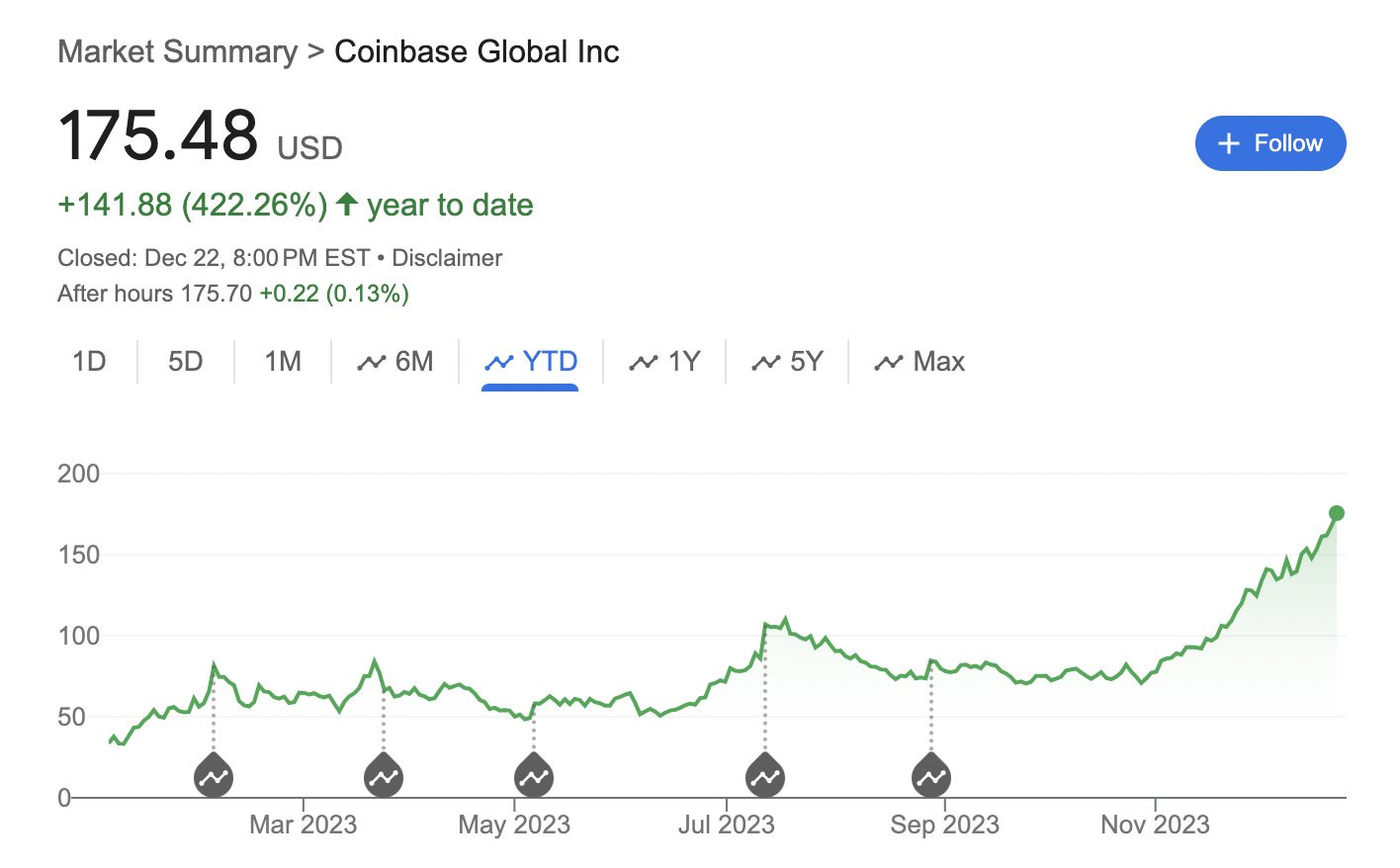
Coinbase is now up 422% year-to-date

0

Coinbase, the leading cryptocurrency exchange in the US, has seen its share price soar by 422% since the beginning of the year, as investors flock to gain exposure to the booming crypto market.

The company, which went public in April, reported record revenues and profits in the third quarter, driven by strong trading volumes and user growth. Coinbase now has more than 73 million verified users, up 96% year-over-year, and more than 9.4 million monthly transacting users, up 117% year-over-year.

The impressive performance of Coinbase reflects the growing demand for bitcoin and other digital assets, which have reached new highs in 2021. Bitcoin, the largest cryptocurrency by market capitalization, recently surpassed $60,000 for the first time since April, while Ethereum, the second largest, hit a new all-time high of over $4,800. The total market value of all cryptocurrencies now exceeds $2.8 trillion, according to CoinMarketCap.

Coinbase is not the only company that is benefiting from the crypto craze. Wall Street firms are also eager to tap into this emerging asset class, which offers high returns and diversification benefits.

Several banks, such as Goldman Sachs, Morgan Stanley, and JPMorgan Chase, have launched or are planning to launch crypto-related products and services for their clients, such as funds, futures, ETFs, and custody solutions. Some traditional asset managers, such as BlackRock, Fidelity, and Vanguard, have also expressed interest or invested in crypto.

The increasing adoption of crypto by institutional investors is a positive sign for the industry, as it indicates a shift in perception and acceptance of this new form of money. However, there are still many challenges and risks that need to be addressed, such as regulatory uncertainty, security breaches, volatility, and environmental concerns.

The cryptocurrency market has been growing at an unprecedented rate in the past years, reaching a total market capitalization of over $2.5 trillion in May 2021. Bitcoin, the largest and most popular cryptocurrency, has seen its price surge from around $10,000 in October 2020 to over $60,000 in April 2021, before experiencing a sharp correction in May and currently trading around $43,700 per BTC.

This phenomenal growth has attracted the attention of many institutional investors, who are looking for ways to gain exposure to this new and exciting asset class. Wall Street, in particular, has been showing a strong interest in bitcoin and other cryptocurrencies, as they offer a number of advantages over traditional assets, such as:

High returns: Cryptocurrencies have outperformed most other asset classes in terms of returns, especially in the long term. For example, bitcoin has delivered an annualized return of over 200% since its inception in 2009, compared to around 10% for the S&P 500 index.

Diversification: Cryptocurrencies have a low correlation with other asset classes, meaning that they can reduce the overall risk and volatility of a portfolio. For example, bitcoin has a correlation of around 0.2 with the S&P 500 index, meaning that they move independently from each other most of the time.

Innovation: Cryptocurrencies are at the forefront of technological innovation, as they are based on blockchain technology, which is a decentralized and distributed ledger that records transactions securely and transparently. Blockchain technology has the potential to disrupt many industries and sectors, such as finance, healthcare, supply chain, and more.

Coinbase and other crypto players will have to navigate these issues and prove their resilience and innovation in order to maintain their growth and competitive edge in the long run.

NASA has Started Planning Its Next Big Project, The Space-based Habitable Worlds Observatory

0

NASA has started planning its next big project, the space-based Habitable Worlds Observatory. This ambitious mission aims to search for signs of life on planets orbiting other stars, using a powerful telescope and a starshade that blocks the glare of the host stars.

The HWO is one of four concepts that NASA is considering for its next flagship mission, which is expected to launch in the 2030s. The other three are the Lynx X-ray Observatory, the Origins Space Telescope, and the Large UV/Optical/IR Surveyor. NASA will select one or two of these concepts for further development in 2024.

The Habitable Worlds Observatory (HWO) is a proposed mission concept that would consist of two spacecraft: a 4-meter telescope and a 52-meter starshade. The telescope would observe the light from distant planets, while the starshade would fly information with it, blocking the light from the parent stars. This would allow the telescope to detect the faint signals of the planets’ atmospheres, which could reveal clues about their habitability and potential biosignatures.

The HWO would use a technique called spectroscopy to analyze the light from the planets. Spectroscopy is the study of how light interacts with matter, and it can reveal information about the chemical composition, temperature, and pressure of a planet’s atmosphere. By comparing the spectra of different planets, scientists could identify which ones have Earth-like conditions, such as liquid water, oxygen, and ozone.

The HWO would be a revolutionary instrument that would advance our understanding of the diversity and evolution of planetary systems. It would have a primary mirror with a diameter of 15 meters, which is about five times larger than the Hubble Space Telescope. This would allow it to collect more light and resolve finer details on distant worlds.

The HWO would focus on planets in the habitable zone of their stars, which is the range of distances where liquid water could exist on the surface. The habitable zone depends on the size and brightness of the star, as well as the planet’s orbit and rotation.

The HWO would target planets around sun-like stars, as well as smaller and cooler stars called M dwarfs. M dwarfs are the most common type of star in our galaxy, and they host many planets, some of which are in the habitable zone.

The HWO would be a groundbreaking mission for astrobiology, the study of life in the universe. It would be able to detect biosignatures, which are features in a planet’s atmosphere that indicate the presence of life. For example, oxygen and methane are biosignatures on Earth, because they are produced by living organisms and are unlikely to exist together without life. The HWO would also be able to measure other factors that affect habitability, such as climate, weather, seasons, and geology.

The HWO would use a technique called coronagraphy to block out the glare of the host stars and reveal the faint light reflected by their planets. It would also use a technique called spectroscopy to analyze the chemical composition of the planetary atmospheres and look for clues of life, such as oxygen, methane, and water.

The HWO would aim to survey hundreds of exoplanets, ranging from Earth-sized rocky worlds to giant gas planets. It would focus on planets in the habitable zone, or the region around a star where liquid water could exist on the surface. It would also look for planets with moons, rings, or magnetic fields that could enhance their habitability.

The HWO would complement other missions that are currently studying exoplanets, such as the Transiting Exoplanet Survey Satellite (TESS) and the James Webb Space Telescope (JWST). TESS is finding thousands of new exoplanet candidates by detecting their transits, or dips in brightness when they pass in front of their stars. JWST, which is scheduled to launch later this year, will observe some of these planets and measure their temperatures, pressures, and weather patterns.

The HWO is an ambitious and visionary project that would open a new window into the cosmos. It would inspire generations of scientists and explorers to pursue the quest for life beyond Earth. It would also challenge us to reflect on our own place and role in this vast and wonderful universe.

The HWO is still in the early stages of development, and it faces many technical and financial challenges. The mission would require precise engineering and coordination between the telescope and the starshade, as well as a large budget and a long duration. However, if successful, the HWO would revolutionize our understanding of our place in the cosmos, and answer one of the most profound questions in science: Are we alone?

Tesla Develops A Method for Reducing Cost for Electric Vehicle Production by 50%

0

Tesla engineers have developed a new process they expect will reduce the cost of making an electric vehicle by 50 percent. This is a major breakthrough for the company, which has been struggling to achieve profitability and compete with other automakers in the rapidly growing EV market.

The new process involves using a single-piece casting machine to create the entire rear underbody of the vehicle, instead of assembling it from multiple parts. This reduces the weight, complexity and manufacturing time of the vehicle, as well as the number of robots and workers needed.

Tesla claims that this process will also improve the quality and safety of its vehicles, as there will be fewer welds and joints that could fail or corrode. The company claims that this process will enable them to produce electric vehicles that are more affordable, efficient, and sustainable than ever before.

Tesla has already installed the giant casting machine, dubbed “Giga Press”, at its Fremont factory in California, and plans to deploy more of them at its other factories around the world. The company says that the Giga Press can produce one rear underbody every 90 seconds, which translates to about 4,000 vehicles per day.

The new process is the result of years of research and development by Tesla’s engineering team, led by Elon Musk, the founder and CEO of Tesla. Musk said that the new process is a game-changer for the electric vehicle market, as it will make electric vehicles more accessible and attractive to consumers. He also said that the new process will help Tesla achieve its mission of accelerating the transition to sustainable energy. He also hinted that Tesla has more surprises in store for its upcoming Battery Day event, where it is expected to reveal new battery technologies and products.

Tesla plans to implement the new process in its upcoming models, starting with the Model 3, which is expected to launch in 2024. The company expects that the new process will lower the price of the Model 3 from $40,000 to $20,000, making it one of the most affordable electric vehicles on the market. The company also expects that the new process will improve the performance, range, and durability of the Model 3, as well as reduce its environmental impact.

Tesla hopes that by lowering the cost of production, it will be able to offer more affordable and attractive EV models to consumers and increase its market share and profitability. The company also aims to achieve its long-term goal of producing 20 million vehicles per year by 2030, which would make it one of the largest automakers in the world.

Tesla’s new process is a major milestone for the electric vehicle industry, as it could potentially disrupt the dominance of traditional gasoline-powered vehicles. Tesla hopes that its new process will inspire other automakers to follow suit and adopt more innovative and sustainable practices. Tesla also hopes that its new process will encourage more consumers to switch to electric vehicles and contribute to the fight against climate change.