DD
MM
YYYY

PAGES

DD
MM
YYYY

spot_img

PAGES

Home Blog Page 3856

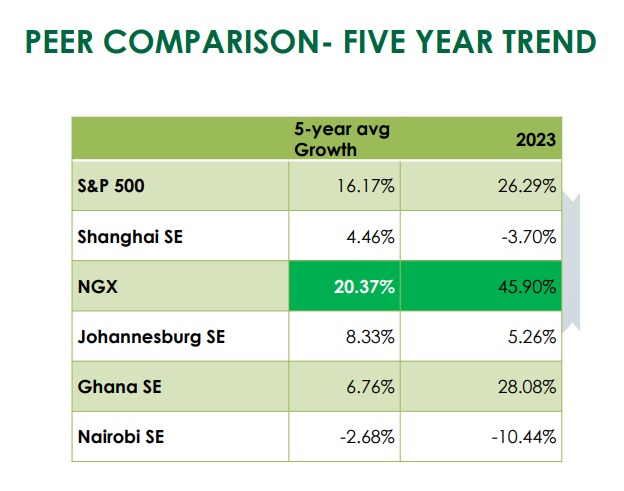
Beyond Nigeria’s Stock Exchange Returning 46% in 2023

1

In eight months of Tinubu administration, Nigeria’s stock market leads the world by Bayo Onanuga” – the Nation newspaper.

My comment: The Nigeria stock exchange (NGX) has been growing on absolute Naira, but on the real value, it is not. That statement is factual but the irony is that the growth, as noted by Bayo, has made many people poorer and depressed the overall value of the stock market. That is why foreign investors are not coming for that 45% gain because if you made 45% on equity, but lost 50% on currency, with 30% on inflation, you are poorer. 

One thing is clear:  the ability to make more Naira in Nigeria has never diminished for years because there are opportunities in Nigeria. The issue is making the Naira under a stable currency when benchmarked with other global currencies. That way, if you are importing funds into Nigeria, you can win as shares of companies accelerate.

For one thing: this shows how rigged the Nigerian economy is. For all the pains people are going through, the fortunate few like most of us here are still logging a 45% increase in the stock market. If they offer that as an option in an ICAN exam, asking most Nigerians to pick that in the last five years that our market has returned 20% on yearly average, do not expect them to pass that exam.

Yet, if you are looking for one thing to commend Buhari, look at some of the reforms in the stock exchange. He transformed it from a quasi NGO to a demutualized profit making institution which shows that reforms do work! Yet, this is not to tell anyone to go and buy anything (just a village guy sharing info): our stock exchange is over-concentrated on power and risk, as 10 companies out of the 155 there command more than 70% of the total market cap.

Analyzing further, Nigeria has about 25 real companies in the stock exchange, as the top 25 combine for most of the value with the other 130 marking ‘present” and nothing more, and that position does not change which shows lack of innovation and creative destruction.

The finest Nigerian companies like Moniepoint and Flutterwave are not yet there, and we have to find ways to get them in the NGX party. But one thing is constant: do not bet against Nigeria!


Data source: Rewane’s 2024 Economic Outlook (Jan 2024)
One Job Role That Is Always OPEN in Venture-Backed Startups, and Companies

1

I glanced through LinkedIn’s  “The 25 fastest-growing roles in the U.S.” and I saw that “Chief growth officer” made the #1 cut. That is correct, and factual, because in nearly all the portfolios in Tekedia Capital, one job that is always a constant is a growth-related job.  According to LinkedIn, “Chief growth officers develop and execute an organization’s strategies for driving revenue, expanding market presence and ensuring sustainable growth.”

Sure, not everyone can be a “Chief Growth Officer”, but if you have the skills to enable and accelerate growth, finding jobs will not be hard. It is one role every company likes to fill with the very best.

Of course, in Nigeria, we have made “growth and marketing related jobs” to be thankless ones. It is common to hear people say “I don’t want sales or marketing jobs”.  Unfortunately, the mission of firms after everything goes through growth and sales, and when you do not like them, it is unlikely you can grow to the top, because 90% of the time, the CEOs of companies are those who bring growth in firms. 

Sure, I know that some bank marketing jobs are thankless. Yet, do not disqualify yourself from one of the most critical roles in business by conditioning your mind that it cannot work. The key is rethinking what sales and business growth is about, and connecting the dots that without business growth, the purpose of any company will fade.

In that mindset, you can see how to contribute instead of saying “I do not want a bank/startup/etc  marketing job” when that is the only thing always available.


What Chief Growth Officers do: Chief growth officers develop and execute an organization’s strategies for driving revenue, expanding market presence and ensuring sustainable growth.

| Most common skills: Growth Strategies, Strategic Partnerships, Business Development | Most common industries: Technology and Internet, IT Services and IT Consulting, Advertising Services | Where the most jobs are: Washington, D.C.-Baltimore, New York City, Dallas | Current gender distribution: 27% female; 73% male | Median years of prior experience: 4.2-6.5 | Top roles transitioned from: Vice President of Sales, Chief Operating Officer, Vice President of Business Development | Flexible work availability: 33.6% remote; 25.0% hybrid

Nigeria Needs Big Companies!

3

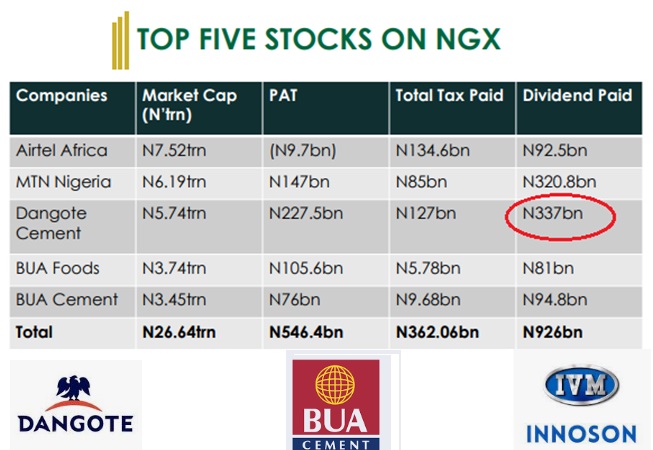
I am reading Bismarck Rewane’s academic tome on Nigeria’s 2024 economic outlook. When I got to this table (on page 12), I paused. If you remove the foreign companies, Aliko Dangote does really well on that chart: the government gets its tax even as investors have tons to share as dividends. 

If you model the impact of that dividend, you will see a huge multiplier effect via investors in Dangote Group. As a startup investor, I have this construct that nations must aspire to have BIG companies because they’re usually the ones with capacities and resources to solve huge challenges. 

In other words, a  place where most people are founders or entrepreneurs is a poor place, as that typically happens because visions cannot scale. And if visions remain punted and stunted, everyone runs his or her show, with no benefits of economies of scale, and efficient utilization of factors of production. Yes, everyone employs himself or herself!

You may not like those big companies but get it from me: until you have them, your economy will not be redesigned at scale because only them have scale to do really big things. The thousands of “mini-founders” and  “mini-entrepreneurs” you have in your village’s open market will not transform that village because at the end of the day, there will be missing columns for taxes and dividends, for governments and investing-public respectively.

Nigeria’s stock market is worth about $50 billion while South Africa’s is about $950 billion. If we extrapolate to parity, we will have 20x Dangote, and if we modulate with our population (3x of South Africa’s), that is 60X. That means, Nigeria should have 60 Dangote Groups and every company listed in our stock market, plus more! That it is not the case is a clear indicator that we’re not firing all cylinders. That must change.

The Person Last Seen With The Deceased Is Presumed To Be The Killer

0

If you are last seen with a person before the person turns up dead in a circumstance looking like murder, you will be presumed to be the killer of that person. This is known as the doctrine of last seen. This doctrine of last seen, in basic terms, simply means that the law presumes that the person who was last seen with a deceased individual bears full responsibility for their death.

In the case of Madu v State, (2012) LPELR-7867(SC) the Supreme Court declared that this doctrine is indeed of global application, that is to say that this doctrine is applied in most criminal jurisdictions around the world. The apex court stated that in some other jurisdictions, it is called “the last seen theory”. In support of this, the Supreme Court cited an Indian case where the Indian Supreme Court applied and upheld this principle. The Indian case is the case of Rajesh Khanna Vs. State of A.P (2006) 10 SCC 172, where the Indian Supreme Court noted as follows: “The last seen theory, comes into play when the time gap between the point of time when the accused and the deceased were last seen alive and the deceased is found dead is so small that possibility of any person other than the accused being the author of the crime becomes impossible”. 

In the case of NJOKU V. STATE (2012) LPELR-20608(SC), the Supreme Court held that this principle of last seen is usually invoked where there is no explanation as to what happened to or caused the death of a deceased who was last seen in the company of the accused except the accused explains to the satisfaction of the Court as to what really happened or caused the death of the said deceased.

It is noteworthy that the criminal justice system and the evidence act have placed the duty to prove the guilt of an accused beyond a reasonable doubt on the prosecution, so even as this principle of last seen has been judicially noted and serially applied by the court in a plethora of cases, the prosecution still has it as a magnanimous duty to prove before the court that the accused who was last seen in the company of the deceased indeed caused the death of the deceased. When the prosecution has successfully executed this duty of proving beyond reasonable doubt the guilt of the accused, the onus is then shifted to the accused to satisfactorily explain to the court what happened to the deceased or for him to prove his innocence. 

The accused who was last seen at the company of the deceased proving his innocence was the position of the court of appeal in the case of Madu v state (2000) LPELR-9875(CA) when his Lordship, IBRAHIM TANKO MUHAMMAD, JCA stated thus, “…If the prosecution proves the commission of a crime beyond reasonable doubt, the burden of proving reasonable doubt is shifted on to the accused.”

In summary, the doctrine of the last seen or the last seen theory only raises the presumption (although rebuttable) that the last person who was in the company of the deceased caused the death of the deceased and/or if he did not cause the death of the deceased will have a solid explanation as to what caused the death of the deceased. 

OpenAI’s Sam Altman Rallies Investors to Raise Billions for Chip Venture to Avert Global Semiconductor Shortage

0

In a bid to address the escalating global semiconductor shortage, Sam Altman, Chief Executive Officer of OpenAI, is reportedly in advanced talks with major global investors to secure substantial funds for an audacious chip venture.

According to insider sources cited by Fortune, Altman envisions the creation of a comprehensive network of semiconductor manufacturing plants, colloquially known as fabs, signaling a departure from the prevalent industry trend.

Among the potential investors engaged in discussions with Altman are Abu Dhabi-based G42 and SoftBank Group Corp. Bloomberg had previously reported on Altman’s fundraising efforts, but the specific emphasis on manufacturing and the expansive scope of the project was not previously disclosed.

The talks, still in their nascent stages, aim to forge collaborations with leading chip manufacturers, propelling the establishment of a global network of fabs to meet the surging demand for semiconductors.

The sources indicate that discussions with G42, a prominent player in artificial intelligence, revolved around raising an impressive $8 billion to $10 billion for this visionary project. However, the full list of partners and funders remains undisclosed, and the current status of these discussions remains fluid.

Altman’s aggressive push for fundraising stems from his concerns that the widespread adoption of artificial intelligence (AI) could outpace chip production, leading to a severe shortage.

The proliferation of AI applications among companies and consumers has sparked an unprecedented demand for computing power and processors, prompting Altman to stress the urgency of tackling the imminent semiconductor shortage.

In a departure from the strategies of industry peers like Amazon, Google, and Microsoft — OpenAI’s primary investor — who typically design custom silicon and outsource manufacturing, Altman’s approach involves not only designing but also constructing and maintaining fabs.

The construction of a single state-of-the-art fabrication plant can entail costs in the tens of billions, and creating a global network of such facilities is a colossal undertaking that could span several years.

Altman, who briefly stepped down as OpenAI CEO in November before returning, has revitalized efforts on the chip project, noting the need for immediate industry action to ensure an adequate chip supply by the end of the decade.

The scale and financial commitment of Altman’s vision underscore the severity of the semiconductor shortage and the complexities associated with meeting the growing demand for AI-related chips. Reports suggest Altman has approached Microsoft about the plan, with the software giant expressing interest.

As discussions progress and the chip venture takes shape, stakeholders in the tech industry, investors, and consumers are closely monitoring how the development will impact semiconductor manufacturing and supply.

Key players involved, including OpenAI, G42, Intel, Microsoft, SoftBank, and TSMC, have opted not to comment on the matter. Notably, Samsung officials were not immediately available for comment.

Additionally, the ongoing scrutiny of G42 by US lawmakers introduces another layer of complexity to this ambitious project, raising questions about potential geopolitical implications and trade restrictions. US lawmaker, Mike Gallagher, the House China Select Committee Chairman, has urged Commerce Secretary Gina Raimondo to consider sanctions on G42 and 13 of its subsidiaries and affiliates, due to their ties with blacklisted Chinese companies including Huawei Technologies.

The unfolding narrative of Altman’s chip venture holds the promise of influencing the future trajectory of the semiconductor industry on a global scale.