
DD
MM
YYYY

PAGES

DD
MM
YYYY

spot_img

PAGES

Home Blog Page 39

Why Investors Should Buckle Up for More Pain From the Bond Market Sell-Off

0

The bond market is sending a message that investors can no longer afford to ignore: borrowing costs may remain elevated for longer than markets had hoped. In September, the U.S. 10-year Treasury yield moved above 5%.

While the 30-year yield climbed as high as 5.39%, its highest level since 2004. That move matters because Treasury bonds sit at the foundation of global financial markets. When their yields rise sharply, the consequences extend far beyond government debt.

Mortgages become more expensive, corporate financing costs increase, equity valuations come under pressure and investors begin reassessing the premium they are willing to pay for riskier assets. The recent sell-off has several forces behind it.

Inflation remains a concern, particularly as energy prices have been pushed higher by geopolitical tensions. U.S. economic activity has shown surprising resilience. Stronger growth can keep inflation pressures alive and reduce expectations for aggressive monetary easing.

Recent business surveys reinforced that concern, helping push the 10-year yield to 5.10%. There is a much larger fiscal question hanging over the market. The U.S. government continues to carry an enormous debt burden.

Requiring substantial Treasury issuance to finance deficits and refinance maturing obligations. Globally, rising government debt has become an important factor behind higher long-term borrowing costs, according to Reuters. This creates a difficult feedback loop.

Higher yields increase the government’s interest expense, potentially requiring more borrowing. More borrowing can increase the supply of bonds investors must absorb. If investors demand greater compensation for holding that debt, yields can rise further.

The bond market’s pain can also migrate into stocks. A Treasury yielding around 5% provides investors with a significantly higher risk-free return than during the era of near-zero interest rates. That changes the mathematics behind equity valuations.

Particularly for technology and other growth companies whose expected profits lie far in the future. Reuters has noted that rising Treasury yields can pressure stocks through both higher borrowing costs and competition from fixed-income investments.

The effects are equally tangible. Treasury yields influence mortgages and other long-term borrowing costs. Recent data showed U.S. mortgage rates moving higher alongside Treasury yields, making financing more expensive even without a corresponding surge in house prices.

The crucial question is not simply whether yields have reached 5%. It is whether 5% becomes a new floor. Reuters recently reported that investors are beginning to consider whether 6% could become the next threshold if inflation, fiscal concerns and term premiums remain elevated.

That does not guarantee another disorderly sell-off. Bond yields can fall quickly if inflation weakens, economic growth slows or geopolitical risks ease. Indeed, the 10-year yield briefly declined below 5% as oil prices fell earlier this month.

But the broader lesson is clear: the bond market is no longer operating in the easy-money world investors became accustomed to. Fidelity describes the current environment as a shift toward a higher cost of capital.

Driven by inflation uncertainty, government borrowing, economic strength and other structural forces.  For investors, that means volatility may remain part of the landscape. The bond sell-off is not merely about falling bond prices.

It is a repricing of money itself—and that repricing can reach almost every corner of the financial system.

Anthropic Moves Toward Public Markets With Founder Control

0

Anthropic is preparing for one of the most closely watched technology listings in years, but before its shares reach public markets, the artificial-intelligence company is asking shareholders to approve a corporate structure that would give its founders extraordinary voting control.

According to Reuters, citing a report from The Information, CEO Dario Amodei and Anthropic’s six other co-founders would collectively receive 50.1% of the company’s voting power under the proposed arrangement.

The structure would use a special class of shares and would allow the founders to retain control over most corporate matters even after the company becomes publicly traded.

The proposal reflects a broader shift in Silicon Valley toward dual-class and founder-controlled ownership structures. Under such arrangements, economic ownership and voting power can become significantly different.

Investors may own a substantial portion of the company while possessing comparatively limited influence over strategic decisions.

The structure is particularly notable because the company is entering public markets at a moment when questions about AI governance, safety and corporate accountability are becoming increasingly important.

Anthropic has positioned itself not merely as an AI software company but as an organization focused on developing advanced systems while emphasizing safety. Its governance framework already includes the Long-Term Benefit Trust.

An unusual mechanism intended to preserve the company’s long-term mission. The proposed founder voting arrangement therefore adds another layer to the governance equation.

According to the reported plan, the special voting rights would remain in place as long as at least three of the seven founders maintain a specified minimum shareholding.

The timing is also significant. Anthropic is moving toward an IPO after a period of extraordinary commercial expansion. Bloomberg reported that the company was preparing for a possible listing as soon as October.

While later reports indicated that its annualized revenue could exceed $100 billion in 2026.  The company has also been strengthening its financial position ahead of the listing.

Bloomberg reported earlier this month that Anthropic was finalizing an expansion of its revolving credit facility to $15 billion, with Morgan Stanley, Goldman Sachs, JPMorgan and Citigroup involved in the financing process.

For prospective public-market investors, the central issue will not simply be Anthropic’s growth. It will also be the relationship between ownership, voting rights and accountability.

A founder-controlled structure can provide management with insulation from short-term shareholder pressure, potentially allowing executives to pursue long-term investments in infrastructure, research and product development.

Concentrated voting power means ordinary shareholders have fewer mechanisms to influence corporate decisions. That tension becomes particularly important for an AI company whose capital requirements are enormous and whose strategic decisions can involve billions of dollars in computing infrastructure, talent and research.

Public investors will therefore have to evaluate both the company’s commercial trajectory and the governance framework attached to their shares. Anthropic’s proposal also demonstrates how the AI boom is changing the traditional IPO model.

As private technology companies reach valuations once associated with established public corporations, founders and early investors are seeking ways to enter public markets without surrendering strategic control.

The shareholder vote will consequently be an important step in Anthropic’s transition from private AI laboratory to publicly traded technology company. The eventual IPO will give investors access to one of the industry’s most closely followed businesses.

While the proposed 50.1% founder voting structure will determine how much influence those investors actually possess once they become shareholders.

U.S And China Agree to $30 Billion Reciprocal Tariff Cuts And New AI Dialogue

0

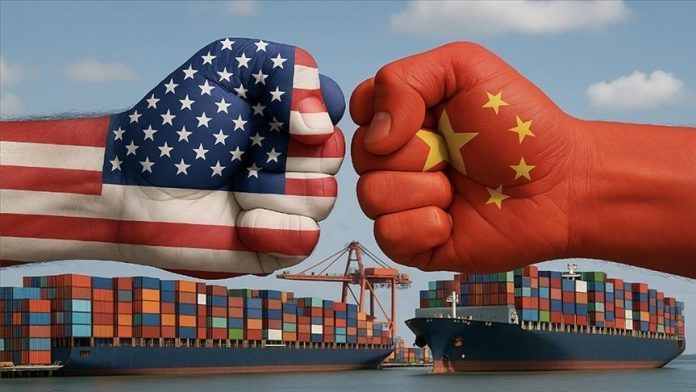
China and the United States have agreed to a reciprocal tariff-reduction arrangement covering $30 billion worth of goods and to launch a formal dialogue on artificial intelligence, according to a statement from Beijing on Saturday.

The measures form part of an eight-point consensus reached during Chinese President Xi Jinping’s three-day state visit to Washington, which ended on Friday.

The Chinese Foreign Ministry said the two sides endorsed the work of their economic and trade teams, including the establishment of a trade council and the extension of outcomes from earlier talks in Kuala Lumpur.

Speaking at the meeting, President Trump said,

“President Xi and I both understand that we represent different systems, but the ties between our people endure, and we’ve never gotten along better. Together we can continue to build a relationship that promotes prosperity and security for future generations. May all of our people know a future of harmony, peace, and success.”

From his remarks at the ceremony, Chinese President Xi Jinping said,

“Mr. President, during your visit to China this year, we agreed to build a constructive China-U.S. relationship of strategic stability. I am ready to work with you to steer the giant ship of China-U.S. relationship on a steady course toward the future.

“Both China and the United States are leading nations in artificial intelligence. We have both the capability and responsibility to develop and manage AI for good, and ensure that the development of AI is always under human control and serves the well-being of the people.”

Under the tariff arrangement, both countries will reduce duties on an equivalent volume of non-sensitive or noncritical goods.

The agreement follows an earlier decision to extend a broader trade truce by two months beyond its previous November 10 expiration, providing additional time to pursue a potentially larger deal.

On artificial intelligence, the two governments agreed to establish a China-U.S. AI Dialogue to exchange views on the technology’s risks and benefits. The next round of discussions is scheduled for November.

They also committed to creating a bilateral communication channel specifically for AI-related incidents. The White House described a similar “US-China Super Intelligence Dialogue” and bilateral channel for incidents, reflecting language used by U.S. officials during the talks.

The significance of the initiative is closely tied to the position of the United States and China in the global AI race. Both countries are developing advanced AI models, computing infrastructure and AI applications at a scale that gives their decisions consequences beyond their own borders.

Analysts at the Carnegie Endowment describe them as the two countries building the world’s most advanced AI systems while simultaneously competing for technological supremacy.

That creates an unusual situation: the same countries competing to build increasingly capable AI systems are also among the countries with the greatest ability to influence how those systems are governed.

The dialogue therefore does not necessarily represent the end of the U.S.-China AI competition. Instead, it creates a mechanism through which competition can coexist with communication on issues where the two countries have shared interests

Xi’s visit, his first state visit to the United States in more than a decade, centered on personal diplomacy between the two leaders rather than major public breakthroughs.

Chinese Foreign Minister Wang Yi described the trip as enriching a constructive and stable bilateral relationship with far-reaching implications for global peace and development. The leaders also reaffirmed support for each other in hosting upcoming APEC and G20 summits and addressed other issues including counternarcotics cooperation.

The tariff and AI steps build on earlier discussions, including meetings in Busan last year and Beijing earlier this year. While the $30 billion figure represents a limited share of overall bilateral trade, officials on both sides presented the outcomes as practical measures to stabilize economic ties and manage emerging technological risks. Xi has returned to Beijing, Chinese state media reported.

Outlook

The latest U.S.-China agreement could mark a shift toward managed competition, particularly as economic and technological tensions between the two countries continue.

The reciprocal tariff reductions may provide businesses with greater certainty and create additional room for Washington and Beijing to negotiate a broader trade agreement, although the limited scope of the $30 billion arrangement means significant trade barriers remain.

The AI dialogue could prove even more consequential over the longer term. As both countries continue developing increasingly capable AI models, the November discussions could provide an early test of whether Washington and Beijing can establish practical safeguards around the technology despite their wider strategic rivalry.

Kalshi’s AI Ad Controversy Exposes the New Risks of Creator-Driven Advertising

0

Artificial intelligence has made advertising faster, cheaper and increasingly difficult to distinguish from original human content. But the technology is also creating a new problem for companies.

What happens when an advertisement appears to borrow a creator’s work without permission and then digitally changes the person appearing in it?

That question is now confronting Kalshi after YouTube creator Elliot Choy accused the prediction-market company of taking one of his videos, recreating it with artificial intelligence and altering his appearance so that he appeared to be white.

Choy posted side-by-side images of his original video and the Kalshi advertisement, highlighting similarities in the apartment setting, composition and presentation.

The controversy is significant because it goes beyond an ordinary dispute over advertising style. At its core are questions about ownership, consent, likeness and the increasingly complicated boundary between inspiration and imitation.

Kalshi said the advertisement was approximately four months old and had been produced by an outside agency. The company said it had curtailed its use of AI-generated advertising depicting people and was reviewing its relationship with the agency responsible for the campaign.

Kalshi did not publicly identify the agency.  For creators, the issue is larger than one advertisement. The episode follows a similar dispute involving creator Pushpek Sidhu earlier this year. Sidhu said a Kalshi advertisement closely replicated one of his videos about the 2026 FIFA World Cup.

Including much of the structure and dialogue, while featuring another person. He also said Kalshi had previously contacted him about a possible collaboration. These incidents illustrate the uncomfortable economics of generative AI.

A company can potentially take an existing visual concept, feed it into an AI system and produce a modified version without paying the original creator. From a marketing perspective, that can appear efficient.

From the creator’s perspective, it can look like the value of their work has been extracted without permission or compensation. The technology makes the process particularly powerful because video-to-video systems can preserve elements of an original recording while changing faces, voices, environments or other characteristics.

Industry experts cited in reporting on the controversy have noted that such tools make it technically straightforward to transform existing social-media videos.  That creates a difficult legal and ethical landscape.

Copyright law does not automatically make every imitation unlawful, while the use of a person’s likeness can raise separate legal questions depending on the circumstances and jurisdiction. Consequently, the central dispute cannot simply be reduced to whether AI was involved.

The controversy also arrives as AI-generated advertising becomes increasingly common. Research cited in recent coverage found generative AI appearing in a meaningful share of advertisements, although it remains only a portion of the overall market.

The lesson is increasingly practical: automation does not eliminate responsibility. If an agency uses AI to reproduce recognizable elements of a creator’s work, the brand may still face the reputational consequences even when the agency technically produced the advertisement.

For creators, the incident demonstrates another challenge of the digital economy. Their videos are not merely entertainment; they are intellectual property, personal branding and, increasingly, commercial assets.

Kalshi’s decision to review its agency relationship and reduce its use of AI-generated advertisements involving people shows how quickly the cost-saving promise of AI can collide with questions of trust.

The broader advertising industry is now confronting a fundamental question: when AI can reproduce almost anyone’s work or likeness in seconds, who gets to decide when imitation becomes appropriation? The answer will shape not only advertising, but the future relationship between creators, platforms, agencies and artificial intelligence.

Bitcoin Options Expiry Puts $90K and $100K Strikes in Focus Amid BitMON by Des Lucréce Set to Launch on Fake World Assets October 1

0

Bitcoin is entering another important derivatives event as nearly $16 billion in Bitcoin options expire, placing the $90,000 and $100,000 strike levels at the center of market attention. Activity across the broader digital-asset ecosystem is expanding.

With TokenWorks distributing FWA V2 airdrop tokens to snapshot depositors and BitMON by Des Lucréce preparing to launch on Fake World Assets on October 1. Together, the developments highlight how derivatives, token distributions and experimental digital assets continue to shape crypto-market activity.

The Bitcoin options expiry is significant because large concentrations of contracts around particular strike prices can increase trading activity as expiry approaches. The $90,000 and $100,000 levels are especially important psychological and technical reference points.

Traders holding calls, puts or more complex strategies may adjust their positions as Bitcoin moves closer to or farther from these levels, creating additional spot-market and derivatives flows. Options expiry does not automatically determine Bitcoin’s direction.

Instead, its immediate influence depends on positioning, hedging activity, open interest and the relationship between the current Bitcoin price and major strike prices.

Market makers may need to rebalance their exposure as prices move, while traders can roll positions into later expiries or close contracts altogether.

The $100,000 strike carries additional psychological significance because six-figure Bitcoin remains a major threshold for investors. A sustained move around that level can influence sentiment, leverage and speculative positioning.

The $90,000 strike provides another important reference point for traders assessing downside protection and potential support. The expiry therefore arrives at a time when Bitcoin derivatives markets remain an important mechanism for expressing expectations without necessarily requiring immediate ownership of the underlying asset.

The growing size of options markets also means that crypto price discovery increasingly occurs across interconnected spot, futures and options venues. Away from Bitcoin, TokenWorks has delivered FWA V2 airdrop tokens to users who participated as snapshot depositors.

Airdrops such as this have become an important mechanism for distributing tokens to early participants, rewarding activity and creating an initial community around emerging protocols or digital-asset projects.

The TokenWorks distribution illustrates the importance of snapshot mechanics in crypto. A snapshot establishes which wallets qualify according to predetermined conditions at a particular point in time. Once eligibility is established, token distribution can follow separately.

Allowing projects to recognize earlier participation while continuing to develop their ecosystems. Another project attracting attention is BitMON by Des Lucréce, which is scheduled to launch on Fake World Assets on October 1.

The launch adds another experimental asset to an increasingly diverse crypto landscape in which projects are testing alternative approaches to ownership, collectibles, community participation and tokenized digital culture.

The combination of a major Bitcoin options expiry and new token launches demonstrates the different layers of today’s crypto economy. Bitcoin derivatives operate at institutional scale, with billions of dollars in contracts influencing short-term market positioning.

Smaller token ecosystems continue experimenting with airdrops, snapshots and novel forms of digital assets. The immediate focus remains Bitcoin’s reaction around the $90,000 and $100,000 strikes as options settle.

For participants in emerging ecosystems, TokenWorks’ FWA V2 distribution and the upcoming BitMON launch provide separate examples of how token ownership and participation are being structured.

These events reflect a market that is simultaneously becoming more financially sophisticated and more experimental. Bitcoin options bring increasingly complex financial instruments into crypto, while airdrops and new asset launches continue to test the boundaries of digital ownership.