DD
MM
YYYY

PAGES

DD
MM
YYYY

spot_img

PAGES

Home Blog Page 3903

SEC has Given Guidance That a Bitcoin ETF Will Be Approved by Jan 10

0

The cryptocurrency community is eagerly awaiting the decision of the US Securities and Exchange Commission (SEC) on whether to approve the first Bitcoin exchange-traded fund (ETF) in the country. According to a report by Fox Business, the SEC has given guidance that a Bitcoin ETF will be approved by January 10, 2022, the deadline for the agency to review several applications.

A Bitcoin ETF is a type of investment product that tracks the price of Bitcoin and allows investors to buy and sell shares of the fund without having to deal with the complexities of owning and storing the digital asset. A Bitcoin ETF would provide more liquidity, transparency and regulatory oversight to the market, as well as lower fees and barriers to entry for investors.

The approval of a Bitcoin ETF in the US would be a major milestone for the cryptocurrency industry, as it would signal the growing acceptance and legitimacy of Bitcoin as an asset class. It would also likely boost the demand and price of Bitcoin, as more institutional and retail investors would have access to the fund.

However, the SEC has been reluctant to approve a Bitcoin ETF in the past, citing concerns over market manipulation, fraud, custody and investor protection. The SEC has rejected several proposals for a Bitcoin ETF since 2013, and has delayed its decision on the current batch of applications several times.

The report by Fox Business claims that the SEC has given guidance to some of the applicants that they are likely to approve a Bitcoin ETF by January 10, as long as they meet certain conditions. These include using futures contracts rather than spot prices to track Bitcoin, having adequate liquidity and capital reserves, and complying with anti-money laundering and other rules.

The report also suggests that the SEC may approve more than one Bitcoin ETF, creating competition and choice for investors. Some of the leading contenders for a Bitcoin ETF approval include Valkyrie Investments, VanEck, ProShares, Invesco and Galaxy Digital.

Satoshi Nakamoto is the pseudonym of the mysterious creator of Bitcoin, the first and most popular cryptocurrency. Bitcoin was launched in 2009, after Nakamoto published a white paper describing the protocol and the vision behind it. Nakamoto’s identity remains unknown, but his or her legacy is undeniable.

Bitcoin has revolutionized the way people transact value online, without intermediaries or central authorities. It has also inspired thousands of other cryptocurrencies and blockchain projects, some of which aim to improve or challenge Bitcoin’s dominance.

Nakamoto’s innovation has opened up new possibilities for finance and technology, as well as social and political implications. In this blog post, we will explore some of the aspects of Nakamoto’s legacy and how they have shaped the world we live in today.

While the report by Fox Business is optimistic, it is not an official confirmation from the SEC, and there is still a possibility that the agency may deny or postpone its decision on a Bitcoin ETF. The SEC has not commented on the report or its plans for a Bitcoin ETF approval.

Therefore, investors should exercise caution and do their own research before investing in any cryptocurrency-related products. A Bitcoin ETF may be a game-changer for the industry, but it is not a guarantee of success or profitability.

BlackRock just filed an updated Bitcoin ETF application after SEC had a big day of meetings with all of the issuers

Meanwhile, BlackRock, the world’s largest asset manager, has submitted a revised application for a Bitcoin exchange-traded fund (ETF) to the U.S. Securities and Exchange Commission (SEC). This comes after the SEC held a series of meetings with various ETF issuers yesterday, signaling a possible breakthrough in the long-awaited approval of Bitcoin ETFs.

 

In its filing, BlackRock proposed to launch the BlackRock Bitcoin Futures Trust, which would invest in cash-settled Bitcoin futures contracts traded on registered commodity exchanges. The trust would not invest directly in Bitcoin or other cryptocurrencies. The filing also stated that the trust would use the CME CF Bitcoin Reference Rate as its benchmark index, which is based on the aggregated trade flow of major Bitcoin spot exchanges.

BlackRock is not the only ETF issuer that is vying for the SEC’s green light. According to Bloomberg, there are at least 20 other Bitcoin ETF applications pending before the regulator, including those from VanEck, WisdomTree, Fidelity, and Valkyrie. Some of these issuers have also filed for ETFs that would invest in Bitcoin futures contracts, while others have proposed to hold physical Bitcoin or use a combination of both.

The SEC has been reluctant to approve any Bitcoin ETFs so far, citing concerns over market manipulation, investor protection, and regulatory oversight. However, some industry observers believe that the tide may be turning in favor of Bitcoin ETFs, as the SEC has recently appointed several crypto-friendly officials, such as Gary Gensler as the new chairman and Hester Peirce as a commissioner. Peirce, who is known as “Crypto Mom” for her pro-crypto stance, has repeatedly advocated for a more flexible and innovation-friendly approach to regulating crypto assets.

The approval of a Bitcoin ETF in the U.S. could have a significant impact on the crypto market, as it would provide an easier and more accessible way for institutional and retail investors to gain exposure to Bitcoin. It could also boost the price and liquidity of Bitcoin, as well as enhance its legitimacy and adoption as an alternative asset class. Some analysts have estimated that a Bitcoin ETF could attract billions of dollars in inflows in its first year of operation.

However, there is no guarantee that the SEC will approve any Bitcoin ETFs anytime soon, as it still has the authority to delay or reject any applications. The SEC has already postponed its decision on VanEck’s Bitcoin ETF until June 17, and it could extend the review period for up to 240 days. Moreover, the SEC could impose strict conditions or limitations on any approved Bitcoin ETFs, such as requiring high fees, imposing trading restrictions, or mandating enhanced disclosures.

Therefore, investors who are interested in Bitcoin ETFs should exercise caution and patience, as well as conduct their own due diligence before investing. While a Bitcoin ETF may offer some advantages over other ways of investing in Bitcoin, such as lower costs, higher security, and tax efficiency, it may also entail some risks and challenges, such as regulatory uncertainty, market volatility, and operational complexity.


New Drug to Extend the Life of Your Dog is Pending Approval with the FDA

0

If you are a dog lover, you might be interested in a new drug that could extend the life of your furry friend. The drug, called CaniVita, is currently pending approval with the Food and Drug Administration (FDA) and claims to slow down the aging process in dogs.

According to the company behind CaniVita, the drug works by activating a gene that protects the cells from oxidative stress and inflammation, two major factors that contribute to aging and age-related diseases. The drug also boosts the immune system and enhances the metabolism of dogs.

The company says that CaniVita can extend the lifespan of dogs by up to 25%, depending on the breed and size. That means that a dog that would normally live for 10 years could live for 12.5 years with CaniVita. The drug is administered as a daily pill that can be mixed with food or given as a treat.

The company has conducted several clinical trials with more than 500 dogs of different breeds and ages and claims that the results are promising and consistent. The company also says that the drug is safe and has no significant side effects.

However, not everyone is convinced by CaniVita. Some experts have raised concerns about the ethical and social implications of extending the life of dogs. They argue that prolonging the life of dogs could lead to overpopulation, environmental issues, and animal welfare problems. They also question the quality of life of dogs that are kept alive beyond their natural lifespan.

Additionally, some critics have pointed out that CaniVita is not yet approved by the FDA, and that the company has not published its data in peer-reviewed journals. They warn that the drug might not be as effective or safe as the company claims, and that there might be unknown risks or complications.

Therefore, if you are considering giving CaniVita to your dog, you should consult with your veterinarian first and weigh the pros and cons carefully. You should also keep in mind that CaniVita is not a miracle cure, and that your dog will still need proper care, nutrition, exercise, and love to live a happy and healthy life.

The drug, called Rejuvenate, is designed to slow down the aging process in dogs by targeting the cellular mechanisms that cause deterioration and disease. Rejuvenate is based on the research of Sam Altman, a billionaire entrepreneur and investor who is also the founder of OpenAI, a research organization dedicated to creating artificial intelligence that can benefit humanity.

Altman believes that aging is not inevitable, but rather a biological problem that can be solved with science and technology. He has been taking Rejuvenate himself for the past two years, and claims that he feels younger, stronger, and more energetic than ever. He also says that he expects to live at least ten years longer than the average lifespan.

Rejuvenate is not yet available for public use, but it has been undergoing clinical trials with dogs of different breeds and ages. The results have been promising so far, showing that rejuvenate can improve the health and vitality of dogs, as well as extend their lifespan by up to 25%. Some of the benefits reported by the owners of the dogs participating in the trials include:

Improved mobility and agility.

Reduced inflammation and pain.

Enhanced cognitive function and memory.

Increased appetite and metabolism.

Better coat quality and appearance.

Lower risk of cancer and other age-related diseases.

Rejuvenate is expected to receive FDA approval for dogs by the end of next year and will be sold as a monthly injection that can be administered by a veterinarian or at home. The cost of Rejuvenate is not yet known, but Altman says that he wants to make it affordable and accessible for everyone who loves their dogs.

He also hopes that Rejuvenate will pave the way for developing a similar drug for humans, which could potentially revolutionize the field of anti-aging medicine and extend the human lifespan by decades.

Rejuvenate is not just a drug, but a vision for a better future for our canine companions and ourselves. As Altman says, “We love our dogs as much as we love ourselves, and we want them to live as long as we do. With Rejuvenate, we can make that dream a reality.”

Typical American family got about 37% richer, in real terms, between 2019 and 2022

0

The economic recovery from the pandemic has been remarkable for many American households. According to the latest data from the Federal Reserve, the median net worth of families in the US increased by 37% in real terms from 2019 to 2022, reaching a record high of $121,700. This means that the typical American family got about 37% richer, in real terms, between 2019 and 2022.

How did this happen? There are several factors that contributed to this wealth boom. One is the unprecedented fiscal and monetary stimulus that the government and the central bank provided to support the economy during the crisis. This included direct payments, enhanced unemployment benefits, small business loans, mortgage forbearance, and low interest rates. These measures helped many families to maintain or increase their income and savings, while reducing their debt and expenses.

Another factor is the strong performance of the stock market, which rebounded quickly from the initial shock of the pandemic and reached new highs in 2022. Many families benefited from this as they owned stocks directly or indirectly through retirement accounts, mutual funds, or pension plans. The value of these assets increased significantly, boosting their net worth.

A third factor is the surge in home prices, which also reached record levels in 2022. The demand for housing was fueled by low mortgage rates, limited supply, changing preferences, and demographic shifts. Many families saw their home equity grow as their property values rose, adding to their wealth.

Of course, not all families experienced the same degree of wealth increase. There are still large disparities in wealth across income groups, racial groups, age groups, and geographic regions. Some families faced financial hardships due to job losses, health issues, or other challenges. Some families had little or no exposure to the stock market or the housing market, and thus missed out on the gains from these sectors.

Nevertheless, the overall picture is one of remarkable resilience and prosperity for the typical American family. The pandemic posed a serious threat to their economic well-being, but they managed to overcome it and emerge even stronger than before.

“Anthrobots” successfully tested by Biomedical Engineers at Tufts University

0

A breakthrough in the field of biomedical engineering has been achieved by researchers at Tufts University, who have successfully tested a new type of artificial cells that can self-assemble and repair damaged neurons. These cells, dubbed “anthrobots” by the scientists, are made of synthetic DNA and protein molecules that can mimic the functions of natural cells.

The anthrobots can communicate with each other, form complex structures, and respond to external stimuli. They can also sense and repair neuronal damage, which could have implications for treating neurological disorders and injuries.

The study, published in the journal Nature Communications, describes how the anthrobots were able to form functional neural networks in vitro and in vivo, and how they were able to restore the electrical activity of damaged neurons in a mouse model of spinal cord injury.

The anthrobots were able to integrate with the host tissue and form synaptic connections with the native neurons, as well as secrete neurotrophic factors that promote neuronal survival and regeneration.

The researchers say that their work “opens the way to personalized medicine” by creating artificial cells that can adapt to the specific needs of each patient. They envision that the anthrobots could be used to deliver drugs, gene therapies, or stem cells to targeted areas of the brain or spinal cord, or to create biohybrid devices that can interface with the nervous system. They also hope that their work will inspire new ways of thinking about the design and engineering of synthetic life forms.

Some other possible applications of anthrobots include:

  • Creating artificial organs or tissues that can replace or augment the function of damaged or diseased ones.

  • Developing biosensors or biocomputers that can process information and perform tasks using biological logic and memory.

  • Engineering novel biomaterials or biocatalysts that can perform chemical reactions or synthesize molecules with high efficiency and specificity.

  • Exploring the origins and evolution of life by creating synthetic organisms with different properties and behaviors.

“This is a novel approach to creating living machines that can perform complex tasks and interact with their environment in a dynamic and intelligent way,” said Dr. Michael Levin, professor of biology and director of the Allen Discovery Center at Tufts University, and senior author of the study.

“We are not just building machines, we are creating new forms of life that can learn, evolve, and self-organize. This could lead to a revolution in biotechnology and medicine.”

The future of anthrobots is uncertain but promising. The researchers plan to further optimize the performance and functionality of the anthrobots, as well as to explore their potential applications in various fields of biotechnology and medicine.

They also aim to address the ethical and social implications of creating and using artificial life forms that can self-organize and evolve. They hope that their work will contribute to the advancement of science and humanity, as well as to the understanding of life itself.

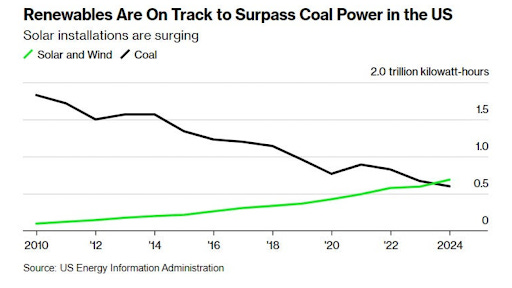
Renewables Are On Track to Surpass Coal Power in the United States

0

The US energy landscape is undergoing a dramatic transformation. According to the latest report from the US Energy Information Administration (EIA), renewable energy sources such as wind, solar, hydro and biomass are expected to generate more electricity than coal for the first time in 2023. This is a remarkable milestone for the country that has long relied on coal as its dominant source of power.

The EIA projects that renewable energy will account for 24% of the US electricity generation in 2021, up from 20% in 2020. Coal, on the other hand, will see its share drop from 19% in 2020 to 16% in 2021. This means that renewables will surpass coal by 8 percentage points, a significant gap that reflects the changing economics and policies of the power sector.

One of the main drivers is the declining cost of renewable energy technologies, especially wind and solar. The EIA estimates that the levelized cost of electricity (LCOE) for wind and solar photovoltaic (PV) plants entering service in 2025 will be $31 and $36 per megawatt-hour (MWh), respectively, compared to $41 for coal.

The LCOE is a measure of the average cost of producing electricity over the lifetime of a plant, taking into account capital, fuel, operation and maintenance costs.

Another factor is the growing demand for clean energy from consumers, businesses and governments. Many states have set ambitious renewable portfolio standards (RPS) that require utilities to procure a certain percentage of their electricity from renewable sources. For example, California has a target of 60% by 2030 and 100% by 2045.

Similarly, many corporations have pledged to source 100% of their electricity from renewables by a certain date, such as Google, Apple and Walmart. These commitments create a strong market signal for renewable energy development.

A third factor is the regulatory and policy environment at the federal level. The Biden administration has made climate change a top priority and has announced several initiatives to support renewable energy deployment.

For instance, the American Jobs Plan proposes to invest $100 billion in grid modernization and transmission expansion, which are essential for integrating more variable renewables into the system. The plan also proposes to extend and expand tax credits for wind and solar projects, which are set to expire or phase out in the coming years.

The EIA’s projections are based on current laws and regulations, but they could change depending on future policy decisions. For example, if Congress passes a national clean electricity standard (CES) that mandates utilities to achieve a certain percentage of carbon-free electricity by a certain date, such as 80% by 2030 and 100% by 2035, as proposed by President Biden, then renewables could grow even faster than expected.

The transition from coal to renewables is not only beneficial for the environment, but also for the economy and public health. According to a study by Harvard University, replacing coal with renewables could save $1.7 trillion in health and environmental costs by 2050, as well as prevent 3.6 million premature deaths.

Moreover, renewable energy creates more jobs than coal per unit of electricity generated. According to a report by Environmental Entrepreneurs (E2), clean energy jobs outnumbered fossil fuel jobs by nearly three to one in 2019.

The US is not alone in this transition. Many other countries are also moving away from coal and towards renewables, such as China, India and Germany. The global share of renewable energy in electricity generation reached 29% in 2020, according to the International Renewable Energy Agency (IRENA) and is expected to reach 45% by 2030 and 65% by 2050.

Renewable energy is no longer a niche or alternative source of power. It is becoming the mainstream and dominant source of power in many markets around the world. The US is on track to join this trend and surpass coal power with renewables in 2023. This is a historic moment for the country and a positive sign for the future of clean energy.