DD
MM
YYYY

PAGES

DD
MM
YYYY

spot_img

PAGES

Home Blog Page 3911

Supreme Court rules Apple can continue to Tax App Developers 30% on revenue generated through its App Store

0
An Apple logo is seen at the entrance of an Apple Store in downtown Brussels, Belgium March 10, 2016. REUTERS/Yves Herman/File Photo

In a landmark decision, the Supreme Court of the United States has ruled that Apple can continue to charge app developers a 30% commission on the revenue generated through its App Store. The ruling, which was issued on Monday, rejected a class-action lawsuit brought by a group of app developers who claimed that Apple’s commission was anticompetitive and violated antitrust laws.

The Supreme Court, in a 6-3 opinion written by Justice Brett Kavanaugh, held that Apple’s commission was not a direct charge to consumers, but rather a fee paid by developers for using Apple’s platform and services. The Court also found that Apple did not have monopoly power in the market for mobile apps, as consumers had other choices of devices and app stores. The Court said that app developers were free to set their own prices and compete with each other on quality and innovation.

Apple’s App Store is one of the most successful platforms for app developers, generating billions of dollars in revenue every year. But how does Apple make money from its App Store, and what are the implications for developers and consumers?

One of the key sources of Apple’s income from the App Store is the 30% commission that it charges for every paid app, in-app purchase, and subscription that goes through its platform. This means that for every $1 that a user spends on an app or a service, Apple gets $0.3 and the developer gets $0.7. This commission applies to both one-time purchases and recurring subscriptions, with some exceptions for subscriptions that last longer than a year.

Apple claims that this commission is justified by the value that it provides to developers, such as hosting, distribution, security, marketing, and customer support. Apple also argues that its commission is comparable to or lower than other app stores and digital platforms, such as Google Play, Steam, and Amazon.

However, some developers and regulators have criticized Apple’s 30% commission as unfair, anti-competitive, and harmful to innovation. They argue that Apple has a monopoly over the iOS app market, and that it uses its power to stifle competition and extract excessive fees from developers. They also claim that Apple’s commission reduces the profits and incentives of developers, and ultimately increases the prices and reduces the choices for consumers.

Some of the most prominent examples of this controversy are the legal battles between Apple and Epic Games, the maker of Fortnite, and between Apple and Spotify, the leading music streaming service. Both companies have accused Apple of abusing its dominant position and imposing unreasonable restrictions on their businesses. They have also launched alternative payment methods or platforms to bypass Apple’s commission, which have resulted in their apps being removed or restricted by Apple.

The debate over Apple’s 30% commission is likely to continue as more developers and regulators challenge its practices and policies. The outcome of this dispute could have significant implications for the future of the app economy and the digital ecosystem.

The ruling is a major victory for Apple, which has faced increasing scrutiny and criticism over its App Store policies and practices. Apple has argued that its commission is justified by the value it provides to developers and consumers, such as ensuring app quality, security, privacy, and customer service. Apple has also said that its commission helps fund the development of its operating system and software tools, which benefit all app developers.

The ruling is also a blow to app developers who have challenged Apple’s commission as unfair and excessive. Some developers, such as Spotify and Epic Games, have bypassed Apple’s payment system and offered alternative ways for users to pay for their apps or in-app purchases. This has led to legal battles and disputes with Apple, which has accused these developers of violating its App Store guidelines and terms of service.

The ruling may have implications for other tech giants that operate app stores or digital marketplaces, such as Google, Amazon, and Facebook. These companies may face similar lawsuits or regulatory actions from app developers or consumers who claim that they are abusing their market power and charging excessive fees. The ruling may also affect the ongoing investigations and inquiries by Congress and federal agencies into the practices and policies of these companies.

The ruling has sparked mixed reactions from the tech industry and the public. Some have praised the ruling as a win for innovation and consumer choice, while others have criticized it as a loss for competition and fairness. Some have also called for more regulation and oversight of the tech industry to ensure that it operates in the public interest and does not harm consumers or competitors.

Business Lessons from Agility in Warfare: Case of Russia-Ukraine War

1

Good People, I do not support wars, but that does not mean that we cannot pick some business lessons from warfare. Today, I am going to focus on agility in business, drawing lessons from the Ukraine-Russian conflict. In markets, you need to innovate so that you can create a differentiation, and win customers, through superior product offerings. Most times, we begin innovatively great, but over time, we miss the critical component of continuous innovation in the market.

When war broke out in Ukraine in February 2022, many equipment and tools were deployed. But as the paralysis continues, I have noticed one thing: Russia is now using some tools it did not have as at that Feb 2022. Yes, over time, it is learning on the fly, and updating its battle systems. From new species of lancet drones to new formulations of its “gunpowder”, many things have evolved. The new formulations make it  possible to take off advanced tanks like German Leopard, US Bradley, etc which are new variables from last year in the frontlines.

Last week, they introduced a “drone cage” which can house 24 soldiers. In other words, even if you see soldiers with your drone, the glass cage will protect them if you attack them. Of course, if your missile is within range, the cage cannot protect from such.

On the Ukraine side, they are also innovating, providing feedback to NATO, to update tools supplied for battle. From the reconfiguration of the US made Patriots to looking for better ways to overcome electronic warfare (EW), Ukraine continues to find how to navigate and overcome obstacles. Unlike a few months ago, its drones can travel farther now; simply, it is becoming better at evading EW.

Here is the business lesson: agility wins empires – territorial land or market share. With AGILITY, you adjust on the fly to the prevailing battle conditions, and compensate as necessary, and acquire new competitive positions. Over time, the “winner” will likely be the entity that can outsmart the other on this continuous tech-anchored battle rivalry.

Yes, what you did in Feb 2022 is irrelevant; the issue right now is how you are dealing with the market challenges which did not exist last year. #peace in market; #unity in the world.

Political and Economic Uncertainty: A Catalyst for Coups in West Africa’s GUBUMAN Countries

0

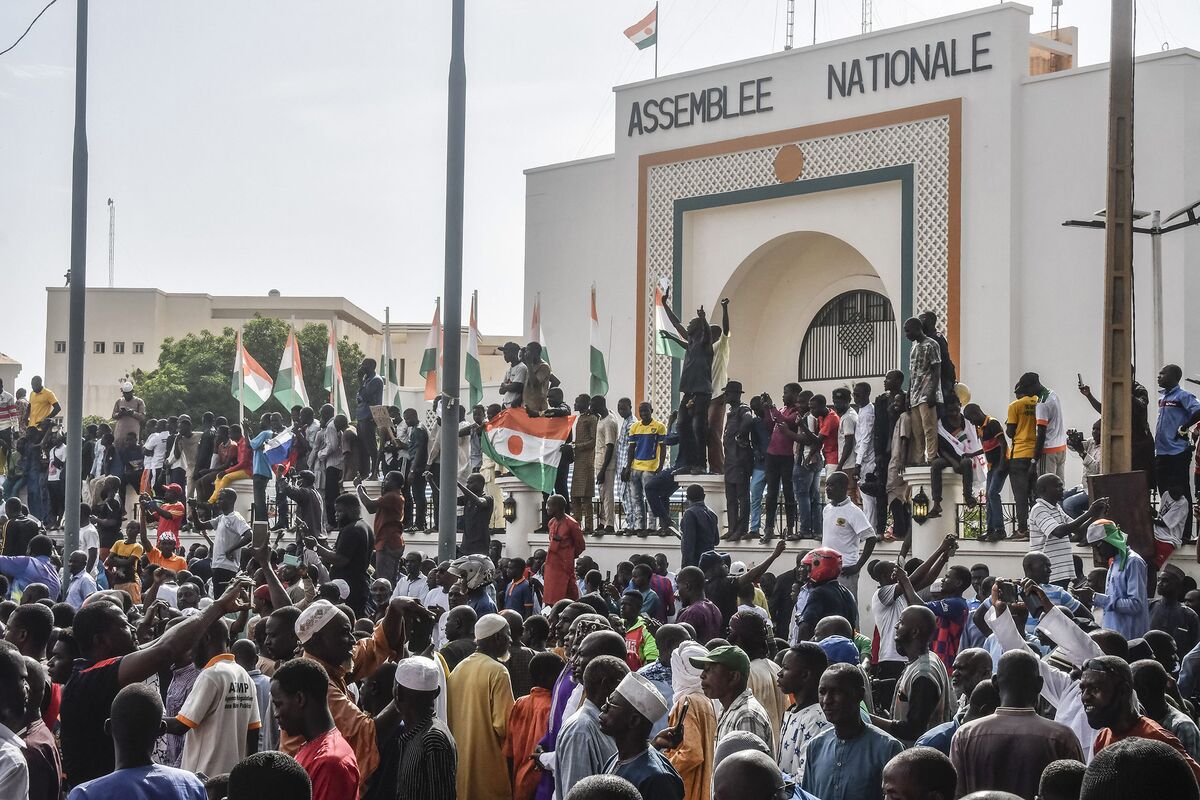
The recent history of West African nations, specifically Guinea, Mali, Burkina Faso, and Niger, bears witness to a series of coups that have shaken the political landscape. These coups have left citizens questioning the stability of their democratically elected governments. Delving into the data and the societal response, it becomes evident that political and economic uncertainty played a pivotal role in facilitating these coups. This article explores how these uncertainties paved the way for military takeovers in these nations and examines the public’s attitude towards democracy during this tumultuous period.

The Unraveling of Stability

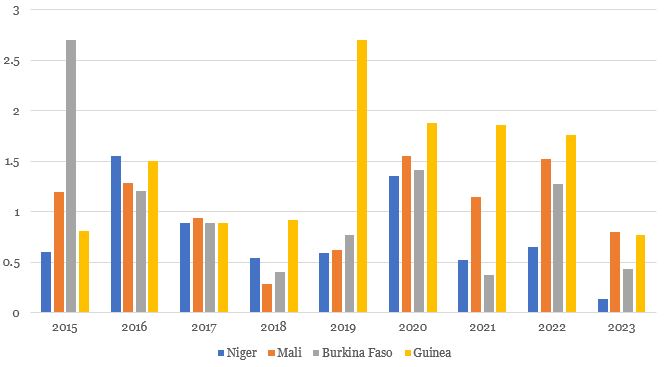
As we assess the trajectory of political and economic uncertainty in the four countries over the span of nine years, a distinct pattern emerges. Burkina Faso, Guinea, Mali, and Niger all witnessed varying degrees of instability during this period. Among them, Burkina Faso experienced the highest levels of uncertainty, notably in 2015, 2020, and 2022. Guinea followed closely with its peaks in 2019, 2020, and 2021. Mali and Niger displayed a more unsteady growth in uncertainty but shared their highest points in 2020 and 2021. These elevated levels of uncertainty have been instrumental in providing fertile ground for the growth of dissatisfaction and discontent among citizens.

The Nexus of Uncertainty and Coup d’état

The connection between political and economic uncertainty and the occurrence of coups is apparent when observing the timeline of these events. In each of these countries, the years of highest uncertainty often coincide with coup attempts. It is here that we find the intersection of public disillusionment, wavering confidence in the government’s ability to address socio-political challenges, and an environment conducive to a military intervention.

Guinea, Mali, Burkina Faso, and Niger all experienced their own unique challenges – from economic instability to corruption and lack of effective governance. In these environments, citizens often seek a semblance of stability and progress, two elements that are sorely lacking in times of high uncertainty. This vacuum leaves room for charismatic military leaders, promising swift solutions, to emerge as saviors of the nation. The dissatisfied masses, feeling abandoned by traditional democratic institutions, can be easily swayed to support military interventions.

Exhibit 1: Level of political and economic uncertainty between 2015 and 2023(Q2)

Source: World Uncertainty Index, 2023; Infoprations Analysis, 2023

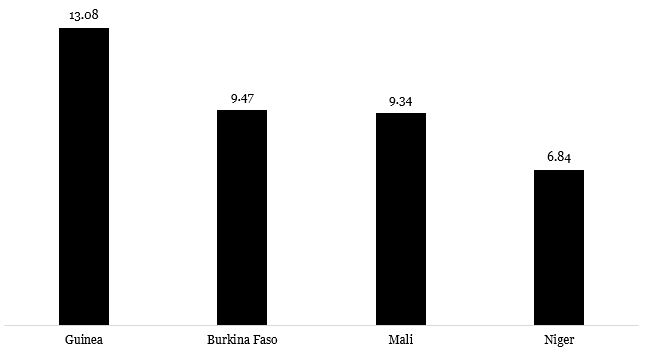
Exhibit 2: Cumulative level of political and economic uncertainty between 2015 and 2o23(Q2)

Source: World Uncertainty Index, 2023, Infoprations Analysis, 2023

Citizen Attitudes: Democracy vs. Military

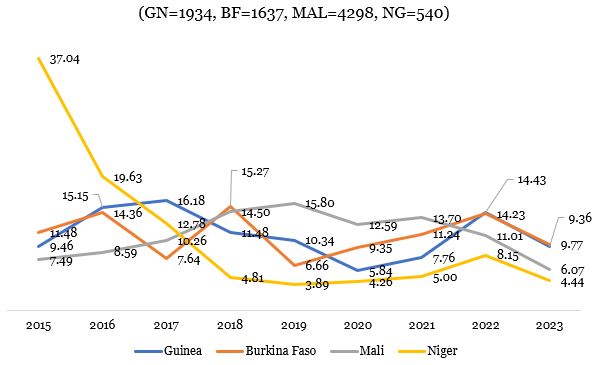
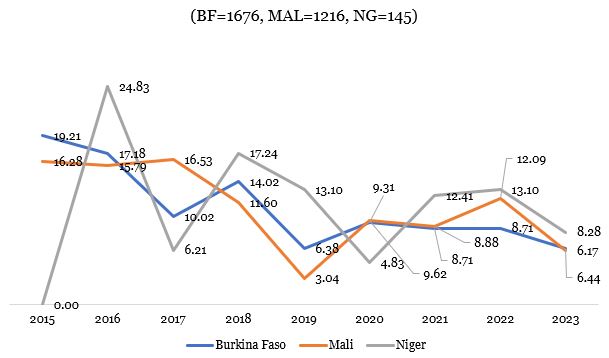
The citizens’ search behaviour on the Internet, as evidenced by Google search trends, provides valuable insights into their priorities and inclinations. Surprisingly, the data shows that throughout the period analyzed, citizens displayed greater interest in the military and armed forces rather than in democracy. This trend is consistent across all four countries, further underscoring the population’s growing disillusionment with the efficacy of democratic governance.

The public’s information-seeking behaviour reflects their yearning for stability and effective governance, even if it means resorting to military intervention. The military often portrays itself as a force capable of restoring order, promising swift and decisive actions that democratic governments may struggle to deliver.

Exhibit 3: Public interest in military between 2015 and 2023

Source: Google Trends, 2023, Infoprations Analysis, 2023

Exhibit 4: Public interest in democracy between 2015 and 2023

Source: Google Trends, 2023, Infoprations Analysis, 2023

The Imperative of Addressing Uncertainty

In the aftermath of these coups, it becomes clear that political and economic uncertainty has acted as a catalyst for the erosion of democratic norms and the rise of military interventions. The stability of nations rests on their ability to address socioeconomic and political challenges with sustainable strategies. Failure to do so not only perpetuate uncertainty but also exacerbates the potential for coups, further perpetuating a cycle of instability.

As West African nations grapple with the aftermath of coups, it is imperative for leaders and policymakers to recognize the critical role of uncertainty in shaping the political landscape. Strengthening democratic institutions, promoting transparent governance, and addressing economic disparities are essential steps toward fostering stability and avoiding the lure of military interventions. Only through these efforts can the region move forward toward a future of sustainable progress and democratic resilience.

Marketers Announce Plan to Increase Cooking Gas Prices Next Week

0

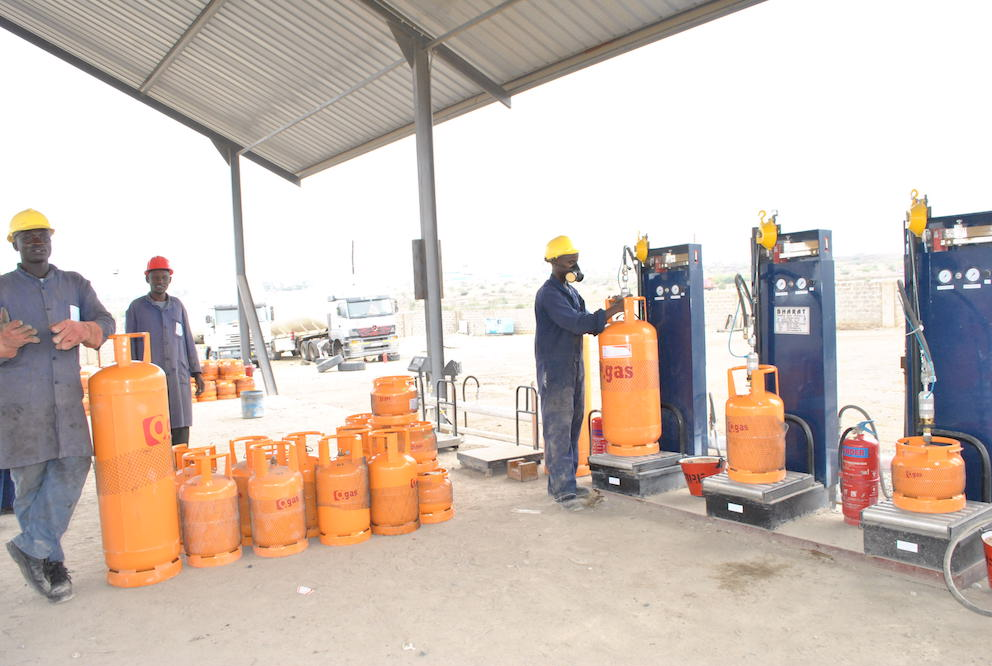
The Nigerian Association of Liquefied Petroleum Gas Marketers has announced a plan to increase prices for cooking gas, adding to the plethora of spikes in commodity costs choking consumers.

The President of the association Olatunbosun Oladapo attributed the price hike to the recent subsidy, electricity, and forex reforms carried out by the federal government.

Oladapo said the reforms, which have significantly stoked the cost of goods and services, have added to rising international prices, high tax rates, and prices of vessels – leaving marketers with no other option than to conduct an upward review of cooking gas prices.

“It is starting next week because international prices have gone up. The prices of vessels have gone up and taxes are high, but consumers are not earning more.

“Their purchasing power has gone down. Everybody is crying. Consumers, middlemen, and retailers are feeling the impact because business is now on the low side,” he said.

The move which comes amid the declining spending power of consumers has been decried as an additional nail on the coffin of suffering Nigerians, a situation Oladapo acknowledged.

“The situation is very unfortunate because prices are going higher. Nigerian consumers are passing through very difficult times because they can no longer afford gas,” he said.

The move also follows the push by organized labor to force the government to provide palliatives that will mitigate the impacts of the reforms. Though the push has suffered setbacks, with the Nigeria Labour Congress and the Trade Union Congress embarking on only a day nationwide strike, Oladapo believes one way the government should provide the palliative is through tax breaks.

He indicated that besides the impacts of President Bola Tinubu’s economic reforms, taxes have played a major role in the decision of marketers to review gas prices.

“The government should come in and alleviate the suffering of the masses by providing palliatives, reducing taxes and levies.

“You can imagine that for every 1kg of gas priced at N700, tax would take way N3.50. How much is left in such a business?” he lamented, adding that “local taxes are worsening the problem.”

As part of his economic reforms, Tinubu has set up a committee on fiscal policy and tax reforms, aimed at eliminating the issue of multiple taxation among other bottlenecks hindering economic growth; the implementation is expected to take a while.
The period is expected to see a further increase in the price of commodities, including gas, as the naira dips further in the FX market.

The naira traded at N920/$1 in the parallel market on Wednesday, compounding inflationary shocks.

LPG prices in Nigeria are determined through international benchmarks using Nigerian Liquefied Natural Gas Contract prices and are consistently influenced by global price trends.

According to a National Bureau of Statistics report on retail gas prices, the mean retail cost for refilling a 5kg cooking gas cylinder showed a month-on-month decline of 6.71%, dropping from N4,360.69 in May to N4,068.26 in June.

On a year-on-year basis, this marked a decrease of 3.56% from June 2022’s figure of N4,218.38.

Oladapo did not say how much the increment will come with.

Modern banking is here and Moove is the largest in financing vehicular fleet in Africa

0

Modern banking is here and Moove is the largest in financing vehicular fleet in Africa: “Moove, a Nigerian mobility startup that provides vehicle financing to drivers of ride-hailing platforms like Uber, has secured $76 million in new funding to expand globally.” Yes, Moove is moving things and great brands like Blackrock are believers.

Do not be confused: Moove is a tech company which offers banking services for those who want to buy cars for use in the ride-sharing ecosystem. It has essentially disintermediated the regular banks in the sector. As they grow, new ordinances will emerge. I expect them to be closing in total at least $500 million by Dec 2023 (they’re at $334 million before this new announcement).

Tekedia Capital salutes #builders.

Speaking on the funds raised, Moove Co-Founder Ladi Delano said: We are excited to be partnering with Mubadala and BlackRock to double down on our already profitable markets including the UAE, India, Uk, and South Africa, as well as continuing to invest in our customer experience and accelerate our product development to deliver group-wide profitability within the next 12 months.

“With this investment, we will now accelerate our mission and continue creating life-changing opportunities for our customers while working towards profitability, It gives us great pride in seeing our customers build a better life for themselves and their families, and this funding will allow us to offer this chance to more entrepreneurs.”

While Moove is raising money, not many startups are that lucky as global challenges on fundraising continue.

Startup companies are struggling to survive as venture funding dries up, according to The Wall Street Journal. Some potential investors pulled back after Russia invaded Ukraine, while others are hesitant to invest in companies that aren’t growing revenue or turning a profit. Despite investors’ enthusiasm in artificial intelligence companies, funding for U.S. tech startups plunged 49% in the year ended June 30, per recent PitchBook data. Investment in U.S. early-stage startups in the second quarter also fell sharply to $10 billion, leading more startups to fail. One investor calls it a “perfect storm.”