DD
MM
YYYY

PAGES

DD
MM
YYYY

spot_img

PAGES

Home Blog Page 3911

A Big Commendation As Onitsha Inland Port Begins Operations; Hello Ibom Deep Seaport

5

The lizard jumped from the top of the iroko tree to the ground, and yet survived. Then it looked around but no one was commending it. Quickly, it said aloud, “whether you commend me or not, I have accomplished a huge feat”. 

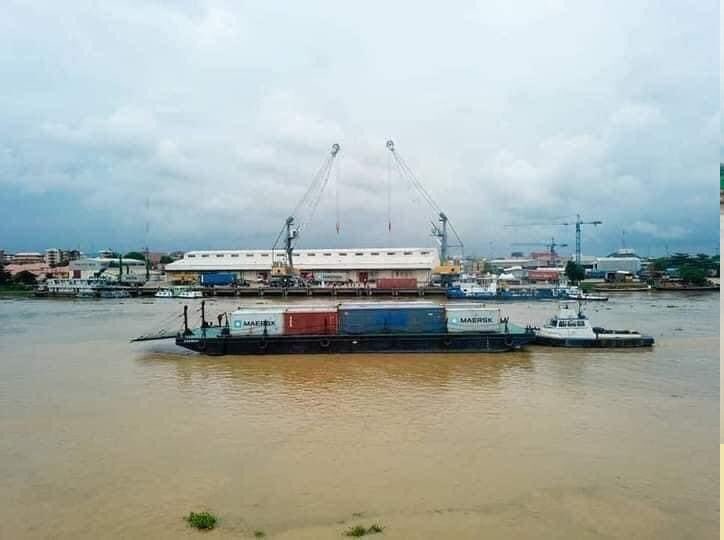
And that is why we have to commend the Nigerian government and its partners for making the Onitsha port come to live: “The Onitsha River Port received its first barges last week, paving the way for the expansion of shipping activities in the Southeastern mini-port. The concessionaire of the port, Elysium Consortium Limited, which took over the management last year, said it has revamped its operations.” Ya gazie [may it continue to go well]

Senator Akpabio: among all the important tasks as the Senate President, remember the Ibom deep seaport. If we do that, we will reduce the cost of shipping and boost our economy. 

I did geography in secondary school and in the physical & human geography and map reading sections, my teacher, Mazi Oji (Thank you for all the efforts, Sir), would push us to draw the maps connecting cities. Maiduguri is closer to Uyo* than it is to Lagos, and if we have a deep seaport in the Uyo axis, Maiduguri and broad Northeastern businesses would save more than 15% of cost in shipping, if they go through Uyo* over Lagos. We Want Ibom Deep Seaport.

In short, North East Nigeria through the old Maiduguri – Enugu – Ovim – Umuahia – PHC railway lines were there for a reason. The colonial era leaders used those routes to ship the goodies out because the distance was better. We need to expand opportunities in the nation because Nigeria has got everything!

Ibom deep seaport or Ibaka deep seaport (pick your location or name) MUST be deployed urgently. It’s about time!

Ibaka/Ibom deep seaport in Akwa Ibom will be a great promise for Nigeria. If you have that seaport and link Aba with a railtrack, making it easier to move cargoes from Ibaka/Ibom to Enyimba city, Nigeria will advance.

But Akwa Ibom may not have the capacity to build that seaport alone. Yes, unlike decades ago where Nigeria was organized regionally, for development, the states of today do not have financial muscles for grand infrastructure projects.  Here is a solution: Abia and Akwa Ibom can come together to execute the playbook.

*pick your location: Ibaka, Ibom, etc work for me.

Comment on Feed

Comment 1: This write up is an example of how LinkedIn can be frustrating: someone writes an idea and gets hailed. But it is often hard to get clear answers to the questions that the write up raises:

Just looking at a map of Nigeria, this post makes no sense without first explaining the following:

  1. Where does the Onitsha port connect? The idea of an inland port at Onitsha has been discussed for years. It required dredging of parts of the River Niger. When was that dredging done?
  2. Port Harcourt is so close to Onitsha (130 km by air and 170km by road) that flights from Abuja to PH start their descent shortly after Onitsha. Why not deepen PH port. And then use roads/rail to connect Rivers, Abia, Imo and Anambra States
  3. Why “Uyo Axis”, wherever that is. Is there not a port in Calabar already begging to be utilized? For a country that is on its knees financially, does it not make sense to deepen Calabar port than start from scratch at so-called Uyo axis?
  4. Is this really the best way Sen Akpabio can use his clout as Sen Pesident to benefit his state and Nigeria? Would the country not be better served if Akpabio helped establish something at Uyo to complement, rather than duplicate Calabar

My Response: Not a balanced comment since we’re limited to few words when summarizing here; you could have clicked to learn more as everything is on the links: “… undertake the dredging of the river channel. This action, he emphasized…” Then on your questions:

1 – While you need to dredge to expand, you can start small from where you are today. They did that last week and plan to expand via dredging.

  1. Your point can work but that does not mean the water is not also an option. Onitsha is the largest market in Africa and having that port will make it grow. What is wrong having all options?

  2. We wrote DEEP SEAPORT, no port. Read for the differences. There is no deep seaport in SS or any place but Lagos. Again, DEEP.

  3. You have no point. That section began with “among all the important tasks “, that means he can do more. Again, there is nothing in Calabar since there is no DEEP seaport in Calabar.
First Commercial Barges Hit Onitsha Inland Port

0

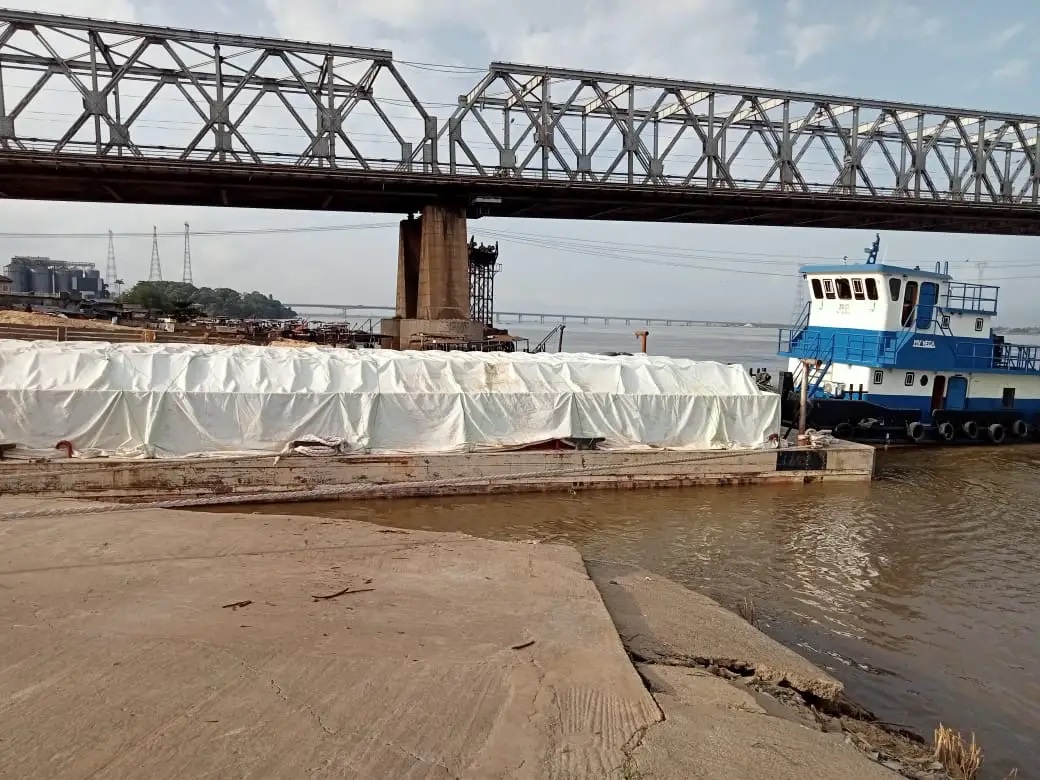
The Onitsha River Port received its first barges last week, paving the way for the expansion of shipping activities in the Southeastern mini-port.

The concessionaire of the port, Elysium Consortium Limited, which took over the management last year, said it has revamped its operations.

The managing director, Dr. George Nwangwu, was quoted as saying that the barges were fully handled by the crew of Onitsha River Port.

The barges, which arrived at the port on August 16, were a consignment of tiles from Ajaokuta to Onitsha.

Anticipated to become a weekly affair, this initial barge arrival marks the commencement of a regular movement involving 600 tons of tiles transported to Onitsha every week, along with a corresponding 600 tons of clay back to Ajaokuta.

Expressing his delight at the milestone, Nwangwu said the port’s operation has curtailed the number of trucks on the roads.

He said that the port operation helped take more than 70 trucks off the busy roads, adding that this was only possible and achievable because of the higher water level in the River Niger during the rainy season.

He observed that this occurrence is limited to only six months within a year, primarily due to the decreased water levels in the River Niger during the dry season.

However, he made an earnest appeal to the federal government, urging them to undertake the dredging of the river channel. This action, he emphasized, would enable goods to traverse the river channel throughout the entire year, leading to substantial advantages for the nation.

He extended his commendation to the operations team at the port, comprising supervisors, dockers, crane operators, and forklift operators. He acknowledged their remarkable dedication, which contributed significantly to the smooth and successful execution of the operations.

As stated by the Chief Executive of Onitsha River Port, the company’s objective remains focused on persistently striving to showcase the port’s excellence, despite the prevailing challenges.

The Onitsha Inland Port was rehabilitated and commissioned in 2012, in a bid to accommodate smaller vessels and ease Lagos port congestion. But the port has not commenced full operation until now.

The port was built under the administration of President Shehu Shagari in 1983 and has lied fallow and completely under-utilized until 2012 when it was rehabilitated and commissioned by former President Goodluck Jonathan.

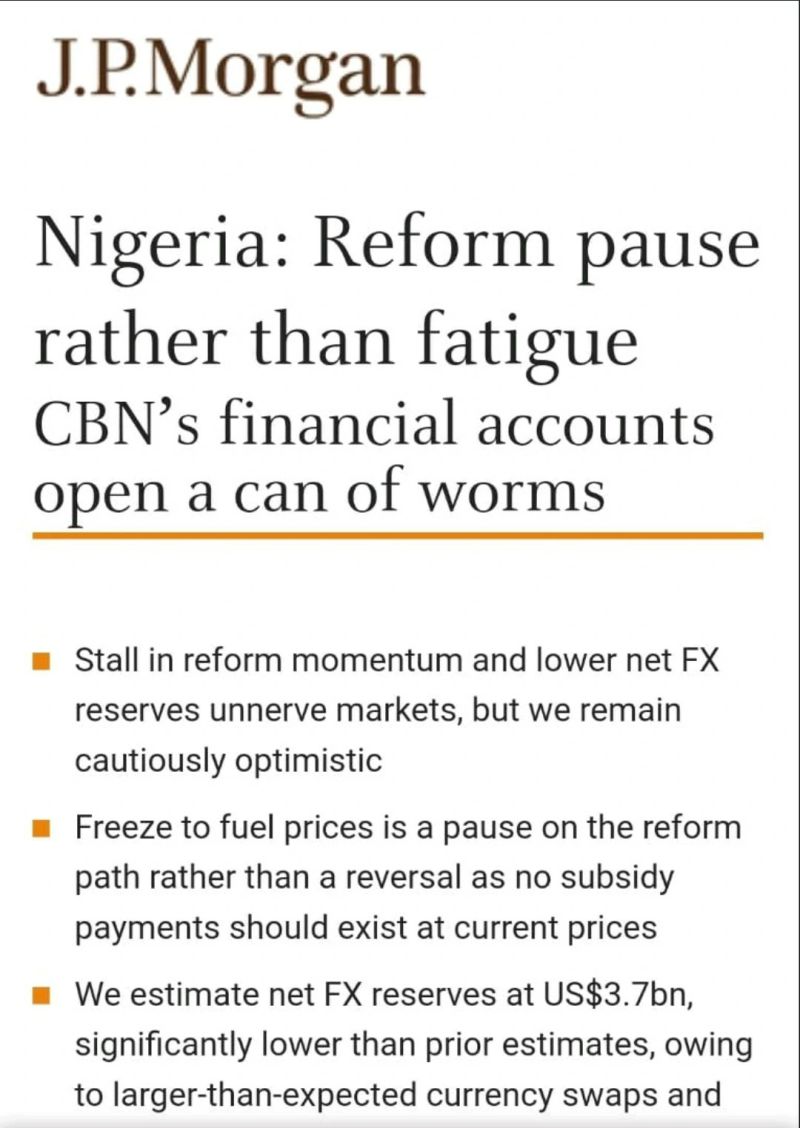
JP Morgan Estimates Nigeria’s Foreign Reserves At $3.7bn

0

Nigeria’s bad – Net FX reserves are “significantly lower” than previously estimated, according to a recent analysis by JPMorgan. The American multinational financial firm said the new information is based on partial information from the audited financial accounts of the Central Bank of Nigeria.

“We estimate that CBN’s net FX reserves were around US$3.7bn at the end of last year, from US$14.0bn at end-2021,” JPMorgan said.

Investors have expressed concern that Nigeria’s external reserve is far lower than what the central bank is presenting, referencing the apex bank’s inability to fulfill many of its financial obligations.

Nigeria’s central bank said the country’s foreign reserves stood at $37.09bn as at December 2022, and at $40.52bn as at the end of December 31, 2021

But information from the recent CBN audit reveals that Nigeria’s foreign reserves are far below what the central bank has been publishing for months because much of it has been used to securitize lending from foreign banks.

A statement posted on the CBN’s website said that “the Group entered into a securities lending agreement with Goldman Sachs and J. P. Morgan and as part of the agreement, the Group pledged its holdings on foreign securities in return for cash. The cash received from Goldman Sachs is N0.23 trillion ($500 million), 2021: N0.22 trillion ($500 million), and JP Morgan N3.23 trillion ($7 billion), 2021: N3.05 trillion ($7 billion) is recognized in other foreign securities.”

This revelation implies that the actual worth of current Nigeria’s foreign reserves, previously thought to be approximately $30 billion, going by the CBN’s figures, is in fact, around $17 billion.

Though JPMorgan said the $3.7bn net FX reserves estimate was done with a few assumptions, which if incorrect would substantially change the picture, the report paints a very gloomy picture for Nigeria’s FX market and explains, among other things, why the pegs on the dollar were removed.

“This settles the argument on why the dollar peg was removed; you CANNOT peg with $3.7b,” financial analyst, Kalu Aja, said.

JPMorgan listed the assumptions as follows: (i) an addition of US$5.0bn in IMF Special Drawing Rights (SDR) to external reserves in order to arrive at total gross FX reserves of US$37.8bn, broadly in line with the 30-day moving average of US$37.08bn previously published on the central bank’s website; (ii) 11 adjusting the gross external reserves with three key FX liability lines that include FX forwards (US$6.84bn), securities lending (US$5.5bn) and currency swaps (US$21.3bn); and (iii) estimating currency swaps by backing out FX forwards and outstanding OTC Futures balances from an overall aggregate published in the financial accounts.

Financial analysts believe that this new information confirms the fears of investors and will continue to deter foreign direct investments (FDIs) if not urgently addressed. 

“This is the main reason foreign investors have refused to bring in their funds,” Kelvin Emmanuel, Co-Founder and CEO at Dairy Hills said. “Principles work, so if you’re taking steps and things are not responding, then there’s something off somewhere, and this right here is the dead body in the woods.”

He explained that what is really remarkable is Nigeria’s Balance of Trade for 2022, which was $46.93bn for exports and $53.61bn for imports – putting the Balance of Trade at $6.68bn and outstanding forwards at $6.8bn. 

Citing the Guidotti-Greenspan Rule that measures the ratio of reserves (Balance of payment for 1-Year to external debt); Emmanuel noted that Nigeria’s External Debt position is at $43bn while the balance of payments for One Year is $6.68bn. Going by the Rule, Nigeria’s external reserves (currently at $3.7bn) must not drop below its balance of payments ($6.68bn) for one year.

“If the principle of a float is not working, and black market premium that measures fair value to spot rate is over 5% and is currently at 11.3%. Then it means that a fundamental principle has been violated,” he said.

JPMorgan said the situation has compounded the nation’s forex crisis, noting that the Net FX position makes an FX float less likely and halts Eurobond upward price momentum.

The bank also noted that lower net FX reserves reduce the ability and willingness to introduce a flexible exchange rate regime in the near term.

“Owing to a structural balance of payments deficit in Nigeria, and a worse starting point for net FX reserves than previously anticipated, authorities’ ability to transition to a significantly more flexible exchange rate regime is severely hampered,” it said.

The New York-based financial firm further noted that the process of rebuilding reserve buffers is likely to be protracted as significant reforms are needed to attract foreign direct (and portfolio) investment on a multi-year basis. 

“Perhaps short-term fixes could involve a swift improvement in oil output and significantly tighter monetary policy – authorities will have to increase the frequency of OMO auctions, which resumed last week. In the meantime, we remain on the sidelines, but on balance of risks we now believe selling USD/NGN NDFs may be the next trade given the reduced likelihood of further significant near-term FX adjustments,” it added.

Last week, the Nigerian government, through the Nigerian National Petroleum Company Limited (NNPCL) secured an emergency $3 billion crude oil repayment loan from Afreximbank. The loan, which has seen the naira up its performance in the FX market, was a big boost to the nation’s depleted foreign reserves. 

The loan was expected to hold off investors’ concerns in the short term. But JPMorgan’s report is believed to have shattered the expectation.

“The coordinating Minister of the economy should call a press conference and speak, the markets need confidence from an adult that understands a balance sheet,” Aja, said. 

“This JP Morgan report creates serious pressure on Nigeria’s ability to maintain a “strong” naira, and I fear it takes the winds away from the sails of that NNPC $3b. Nigerians want to know this, is the Naira safe to hold?” he added.

The JP Morgan’s Nigeria’s Vanishing $Billions

0

The revelation: JP Morgan posits that Nigeria’s FX Reserve to be in the neighbourhood of $3.7 billion instead of the $30 billion everyone has been using in reports. Why? Nigeria borrowed money on this reserve and has yet to return the money. In other words, when most fund managers refused to lend to us, we ransacked the reserve.

Nigeria’s bad – Net FX reserves are “significantly lower” than previously estimated, according to a recent analysis by JPMorgan. The American multinational financial firm said the new information is based on partial information from the audited financial accounts of the Central Bank of Nigeria.

“We estimate that CBN’s net FX reserves were around US$3.7bn at the end of last year, from US$14.0bn at end-2021,” JPMorgan said.

Investors have expressed concern that Nigeria’s external reserve is far lower than what the central bank is presenting, referencing the apex bank’s inability to fulfill many of its financial obligations.

Nigeria’s central bank said the country’s foreign reserves stood at $37.09bn as at December 2022, and at $40.52bn as at the end of December 31, 2021

But information from the recent CBN audit reveals that Nigeria’s foreign reserves are far below what the central bank has been publishing for months because much of it has been used to securitize lending from foreign banks.

This now explains why the government is largely probing the Central Bank of Nigeria (CBN). I hope they make the outcome public for We The People.

In the bank’s report – “Nigeria: Reform pause rather than fatigue” – you get a conflicting message from what other big banks have written, indicating that everyone is still trying to figure things out.

Good People, as that probe goes on, expect more revelations with cross-border implications. Everyone is going to publish a report because the searchlight is coming. Question: if this was not disclosed, what was the money used for? “Also, the CBN owes JP Morgan and Goldman Sachs a combined sum of $7.5bn as of the financial year ended December 2022. Included as part of its liabilities is another $6.3bn owned in foreign currency forwards.” – from CBN recent statement

Comment on Feed

Comment 1: I don’t understand much in economics but it means that naira will drop furthermore?

My Response: Not really immediately since Afreximbank gave us a loan ($3B) to support Naira in the export import window. That money should be enough for 30 days. So, there is nothing to worry about for the next 30 days. What happens after that time will decide the near-term trajectory of Naira

The Shredding of Meta’s Threads

1

“Threads was released in early July, and within five days, became the fastest app to reach 100 million downloads — but it has since lost about 85% of its daily active users, said digital analytics firm SimilarWeb. Threads now has fewer than 10 million daily active users; in contrast, X had nearly 238 million daily active users in July 2022”, notes LinkedIn News.

Indeed, the Threads hype went down. You hardly create a new tribe of customers when the product is a clone of a popular product (here, Twitter, now called X). Typically, creating fandom happens when you offer a new basis of competition, by offering something really new to users. Category-king companies pioneer new vistas in markets and chart their paths to financial glory. They go for the perceptions of customers, and not just the needs.

Remember: never scale a product until you have found a product-market fit. If you do not follow that, users will come, become disappointed, and then will leave. Advertising money does not retain customers; only products do!

Now that Meta wants to add a web version of Threads, the new app could become relevant to more users. Simply, this principle works, whether a big or small company: you must create a value proposition for users to win them in the market battle.

Meta Platforms  plans to launch a web version of microblogging app Threads early this week, the biggest new feature to be introduced on its competitor to Elon Musk’s X.

The desktop version would address one of the biggest of a long wish list of features users have sought for Threads. The text-first social-media app appeared on track to be a smash hit out of the gate when Meta launched a bare-bones version in early July, but use of it has plunged in recent weeks.

Users have been able to see specific Threads posts on the web but their access is limited, as the app is mostly geared for mobile phones.

Adam Mosseri, head of Instagram, said on Friday on his Instagram profile, that the web version of Threads would be launching soon and is already being tested internally at Meta. People familiar with Meta’s plans said it will launch early this week, although the launch plans aren’t final and could change.

“It’s a little bit buggy right now, you don’t want it just yet,” Mosseri said. “As soon as it is ready we will share it with everybody else.”

Meta rushed to launch Threads to take advantage of the growing interest for an alternative to X, formerly known as Twitter. Threads became the fastest app to reach 100 million downloads, hitting the mark in five days.

Yet, do not count out Threads because it is funded by a really deep pocket: Facebook’s Meta. They can decide to keep pumping money into it, just as they’re doing with WhatsApp which is amazing, and yet FREE in all sense of free. Just for that, I wish Threads well, and hopefully it can pick the shreds and thread back!

Comment on Feed

Comment 1: Your narrative is spot on, Scaling a product should only happen after achieving product-market fit. In my work with online businesses, I emphasize that they must initially gather a substantial customer base at a set acquisition cost. Additionally, those customers should actively use the product and it be something they are willing to share with their network before scaling becomes a consideration.

This was not really the case for ? threads, they never really got around getting people to use the app and what to use the app for exactly, I believe they will figure it out as they go along

Nice analysis

My Response: “I emphasize that they must initially gather a substantial customer base at a set acquisition cost. ” – a clinical great strategy which is like physics because it works.