DD
MM
YYYY

PAGES

DD
MM
YYYY

spot_img

PAGES

Home Blog Page 3912

How can Blockchain improve Security in the Workplace?

0
Security lock concept

Blockchain is a technology that allows data to be stored and exchanged in a decentralized, distributed and immutable way. It is often associated with cryptocurrencies, but it has many other potential applications in various sectors, including security.

One of the main benefits of blockchain is that it eliminates the need for intermediaries or trusted third parties, such as banks, governments or corporations, to verify transactions or data. Instead, blockchain relies on a network of nodes, or computers, that validate and record data using cryptographic algorithms and consensus mechanisms. This makes blockchain more transparent, resilient and secure than traditional systems.

In the workplace, blockchain can improve security in several ways. For example:

Blockchain can enable secure identity management and authentication. By using blockchain-based digital identities, employees can access authorized resources and services without relying on passwords or centralized databases that can be hacked or compromised. Blockchain can also provide a verifiable record of employees’ credentials, skills and achievements, as well as their interactions with other parties.

Blockchain can enhance data protection and privacy. By encrypting and storing data on a blockchain, employees can ensure that their personal and professional information is safe from unauthorized access or manipulation. Blockchain can also enable data sharing and collaboration among employees, partners and customers, while preserving data ownership and consent. Blockchain can also support compliance with data protection regulations, such as GDPR.

Blockchain can prevent fraud and corruption. By using blockchain-based smart contracts, employees can automate and enforce agreements and transactions without human intervention or intermediation. Smart contracts are self-executing programs that run on a blockchain and execute predefined rules and conditions. This can reduce the risk of fraud, errors, disputes and delays in the workplace. Blockchain can also provide a tamper-proof audit trail of all activities and transactions, increasing accountability and transparency.

One of the best practices for workplace blockchain integration is to have a clear and compelling vision and strategy for the technology. Blockchain is not a magic bullet that can solve all problems or create all opportunities. Rather, it is a tool that can enable or enhance certain solutions or outcomes. Therefore, it is crucial to have a clear understanding of why and how blockchain can add value to the organization, its stakeholders and its customers.

This involves defining the specific problems or pain points that blockchain can address, the expected benefits or impacts that blockchain can deliver, and the key performance indicators or metrics that can measure the success or progress of blockchain initiatives. Moreover, it involves aligning the vision and strategy with the organization’s mission, values and goals, as well as communicating them effectively to all stakeholders.

Another best practice for workplace blockchain integration is to have a collaborative and agile approach to the technology. Blockchain is a fast-moving and dynamic field that requires constant learning, experimentation and adaptation. Moreover, blockchain is a network-based technology that relies on the participation and cooperation of multiple parties across different domains or sectors. Therefore, it is vital to have a collaborative and agile mindset that embraces change, innovation and diversity.

This involves creating cross-functional teams that include experts from different disciplines, such as business, technology, legal or regulatory. It also involves engaging with external partners or stakeholders that are part of the blockchain ecosystem, such as developers, vendors, regulators or customers. Furthermore, it involves adopting agile methodologies that allow for iterative development, testing and feedback cycles that can optimize the performance and usability of blockchain solutions.

Nigeria’s Unemployment Rate Drops to 4.1% in Q1 2023 – NBS

0

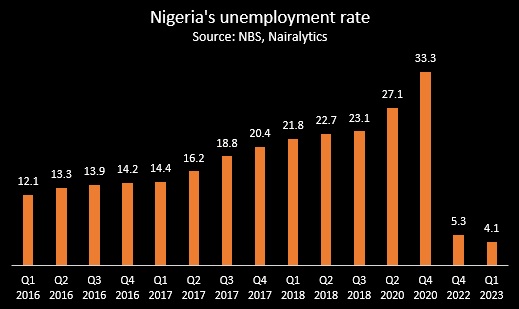
The National Bureau of Statistics (NBS) said Nigeria’s unemployment rate decreased to 4.1 percent during the first quarter (Q1) of 2023, down from the previous quarter’s 5.3 percent.

Back in the fourth quarter (Q4) of 2020, the bureau reported the country’s unemployment rate to be 33.3 percent.

In a statement released on Thursday, the NBS announced that the recent unemployment report employed a new methodology and provided a comprehensive examination of the labor market.

“The latest Nigeria Labour Force Survey (NLFS) report sheds light on the dynamics of labor market within the country,” the statement reads.

“This report covers the fourth quarter of 2022 and the first quarter of 2023, presenting an in-depth analysis of key labor market indicators such as employment, including unemployment rates, underemployment rates, hours worked, and informal employment.

“The revised methodology aligns with our contemporaries in Africa such as Ghana, Niger, Chad, Cameroon, Benin, Gambia etc, in line with international best practices.”

UNEMPLOYMENT RATE MOVED FROM 5.3% to 4.1% IN THREE MONTHS

The latest report from the NBS indicates that Nigeria’s unemployment rate stood at 5.3 percent during Q4 2022 and then declined to 4.1 percent in Q1 2023.

According to the agency, these figures are in line with rates seen in other developing nations where engaging in work, even in low-productivity roles for only a few hours, is vital to sustaining livelihoods, especially in the absence of any social safety nets for the unemployed.

The bureau also stated that the revised methodology now defines employed individuals as those who work for pay or profit and have worked for a minimum of one hour within the past seven days, as opposed to the previous criterion of 40 hours.

“The old methodology placed a range on the working-age population- 15 – 64 years, while considering working hours between 20-39 hours as underemployment, 1-19 hrs as unemployment,” the statement reads.

“In addition, subsistence agriculture and temporary absentees from employment work were not properly represented as well as the absence of mutually exclusiveness of unemployment and employment.

“These improvements, among others, captured in the revised computations will make Nigeria’s Labour Force data comparable with other countries.”

UNDEREMPLOYMENT MOVED FROM 13.7% to 12.2% in THREE MONTHS

The NBS defines the underemployment rate as the proportion of employed individuals working fewer than 40 hours per week while expressing willingness and availability to work more. This rate was recorded at 13.7 percent in Q4 2022 and reduced to 12.2 percent in Q1 2023.

The report highlights that the rate of informal employment, which includes agricultural work among employed Nigerians, was 93.5 percent during Q4 2022 and decreased to 92.6 percent in Q1 2023.

The NBS’s NLFS also indicated that approximately three-quarters of Nigerians within working age were gainfully employed. In Q4 2022, this rate stood at 73.6 percent, and in Q1 2023, it rose to 76.7 percent. This underscores that a majority of individuals were engaged in some form of job, involving at least one hour of work per week for compensation or profit.

Number of Active African Fintech Ventures Jumps 17.7% in Two Years

0

Recent report has revealed that Africa’s Fintech startup ecosystem has been on a growth trajectory, with the number of startups operating in the space increasing by 17.7 percent to 678 in 2023 as compared to 2021.

In the latest edition of Disrupt Africa’s Finnovating for Africa publication, the number of Fintech startups active in Africa increased by 125.2 percent between 2017 and 2023.

The growth is reportedly taking place across the continent, with all major markets such as South Africa, Egypt and Nigeria growing relatively fast. The number of Fintech companies based in these countries have leaped by 66.7 percent and 50 percent respectively over the last two years.

The Fintech space in Africa leads the way for investments, when it comes to both funding and exit activity. A report by Disrupt Africa revealed that since 2015, 540 Fintech startups from 25 countries have raised an extraordinary US$ 3,635,823,965 three times more than any other sector.

Since 2016, total investment per year has been on a fairly steady upward trajectory, and growth has been impressive in the last two years. The number of funded ventures has almost doubled since 2021, and more than US$ 2.7 billion has flooded into the ecosystem in the last 24 months.

Meanwhile, not only are African fintech startups more likely to raise funding than their peers, they are also more likely to be acquired.

Disrupt Africa tracked 26 fintech startup acquisitions between June 2021 and July 2023, compared to just seven between 2019 and 2021, and accounting for over 60 per cent of the 43 such deals reported since 2011.

In 2023, Disrupt Africa identified fintech startups operating across 25 African countries, the same as in 2021. The number of ventures per country ranges from one, in places such as Algeria, Burkina Faso and Mali, to 217 in Nigeria, which over the last couple of years has overtaken South Africa to become Africa’s most fintech-populated country.

South Africa has been for a long time being the most populated market, but has now fallen to second with 140 ventures. This accounted for 20.6 percent of Africa’s 678 fintech startups, behind Nigeria’s 217 ventures of 32 percent.

Kenya falls in third place with 102 companies in operation, 15 percent of the total. It is worth noting that 459 (67.7%) of Africa’s fintechs are located in either Nigeria, South Africa or Kenya, a percentage share that barely differs from a 67.9 per cent share in 2021 and 65.2 percent in 2019.

The share of Fintech activity contributed by the “big three” markets of South Africa, Nigeria and Kenya maintained its 2021 levels, with 459 (67.7%) of the startups tracked.

Notably, there were three new fintech markets to emerge for the first time in the 2023 edition of this report, which are Burkina Faso, Lesotho and Namibia.

While clearly levels of activity hugely differ, with different ecosystems at vastly different points in their lifecycle, fintech has certainly infiltrated markets across the continent, and is changing financial markets and boosting access to financial services.

“Uwa bu ahia” [the world is a market], Come to Tekedia Mini-MBA To Learn About Markets

0

Many posit that online is the future of business. And if we begin to transition into that online universe, we need to think of security. Many empires in this world have collapsed because of cyber-attacks which come in many forms. Just recently, a US university (Lincoln College)  collapsed when a ransomware attack blocked the college from accessing data used in its student recruitment. With no students for a new year, the mission was punted – and a 157-year old university folded. 

Tekedia Mini-MBA is a wholistic program. Today, one of the best in this sector will be in class to educate us. From protecting BMW’s autonomous vehicles to teaching in the academic world, our Faculty, Dr. Francis Nwebonyi, is a technical and an academic leader. Meet him in class; Zoom link in the board.

 This is Tekedia Mini-MBA. This is the temple for the mastery of entrepreneurial capitalism. Join the next class beginning Sept 11 here 

 I like business education because “uwa bu ahia” [the world is a market], and if that is the case, we need knowledge to play in it. Tekedia Institute is a school for YOU. Join us.

My Call on JP Morgan vs Central Bank of Nigeria $3.7 billion Debate: DRAW

0

Now the explanation: “The Central Bank of Nigeria (CBN) has responded to the analysis by JPMorgan, which estimates the actual worth of Nigeria’s foreign reserves as at December 2022 to be $3.7bn – far lower than the $37bn that the apex bank had published. A statement made by Hassan Mahmud, director of monetary policy department, CBN, said the estimate was presented “out of context”’.

JPMorgan said the estimate was done with a few assumptions, which if incorrect would substantially change the picture.

It listed the assumptions as follows: (i) an addition of US$5.0bn in IMF Special Drawing Rights (SDR) to external reserves in order to arrive at total gross FX reserves of US$37.8bn, broadly in line with the 30-day moving average of US$37.08bn previously published on the central bank’s website; (ii) 11 adjusting the gross external reserves with three key FX liability lines that include FX forwards (US$6.84bn), securities lending (US$5.5bn) and currency swaps (US$21.3bn); and (iii) estimating currency swaps by backing out FX forwards and outstanding OTC Futures balances from an overall aggregate published in the financial accounts.

They are both correct. JP Morgan is coming from the angle of TRUST while the apex bank is relying on accounting principles: ‘“even if you have outstanding liabilities, you don’t mark the outstanding liabilities to market on a day and say this is your net balance. “I can have $20 million in my account and I am owing someone maybe $13 million that is supposed to be paid in 2027; you can’t come in 2023 and say if I remove that $13 million, your money is $7 million or you are having $7 million.

“Now, I am not having $7 million, I am having $20 million. Because before I took a facility of $13 million, I knew in the next three years, I would get $17 [read $13m]  million so I could pay you back.”

The US bank is counting that you may not have that $13m to pay back. That is unfortunate, but not irrational, since you have been borrowing to pay previous debts,  and the bank does think you may run out of capacity to borrow more. My Call: draw for the two debaters.

Comment on Feed

Comment 1: My call: the data provided by JP Morgan is a true and better representation of the actual worth. If the Apex bank wants to use the point that the liabilities will be paid in the future then we also need to see how income generated in the future will cover current and future liabilities.

My Response: Lol – I am laughing. Nigeria believes in wishes. The money will come; no need to ask.

Comment 2: Nigeria is just like a comedy show where people just make sarcastic statements on real issues.
Whether it’s the real asset or accounting principles, Nigeria is in trouble. Unfortunately, we’re not even making the right decisions to get back on track.

Comment 3: JP Morgan is absolutely correct ???. Being financially wreckless is nothing else but utter foolishness and amazing stupidity