DD
MM
YYYY

PAGES

DD
MM
YYYY

spot_img

PAGES

Home Blog Page 3916

Thank You Tekedia Mini-MBA Edition 11 Graduation Ceremony Sponsors

0

Good People, join me to THANK these amazing companies for jointly sponsoring Tekedia Mini-MBA edition 11 Graduation Ceremony which is coming up tomorrow.  Last year, Lagos Business School’s Pan-Atlantic University surprised us with a generous donation, and it was a great moment for our Learners.

For tomorrow’s event, these four companies have provided our learners with all the resources they need to have another Academic Festival. Finance zen-master, Azeez Lawal, Managing Director of TrustBanc Capital, will deliver the graduation lecture.

Thank you Emmppek Farms: “A resilient, integrated, circular economy, and inclusive food company” led by Chris Edeh Ph.D.

Thank you C3 Pictures Limited  “An international photography brand. Let’s immortalize your cherished moments with a touch of excellence”with amazing professionals like Olorunfemi Michael.

Thank you Audma Integrated Services Ltd (AISL): “Engineering and Construction Company” founded by Ferdinand Chizoba Okechukwu.

Thank you Salvy’s Pastries: “slices of joyful nourishments”.

The message from Eyitayo Adeleke, mMBA is that the graduation hall is getting ready. Thank you Graduation Committee. Thank you Abuja, Lagos, Port Harcourt, London, etc graduation coordinators. Tekedia Institute appreciates these Learners-led events, which celebrate our academic tradition.

Deciphering the Global Innovation Race Among BRICS and Invited Members

0

In pursuit of bolstering their positions in the realm of global economic and political influence, the BRICS coalition, comprising Brazil, Russia, India, China, and South Africa—a dynamic multi-continent economic and political bloc—made a significant announcement in August 2023. They extended their embrace by inviting six new members to join their ranks in January 2024, expanding the group’s horizons to encompass Argentina, Egypt, Ethiopia, Iran, Saudi Arabia, and the United Arab Emirates. This move signified a strategic effort to unite top emerging economies, creating a formidable force on the global stage.

In this piece, our analyst delves into the innovation ecosystems of both the established BRICS members and the newcomers. The aim is to discern the level of competitiveness within this esteemed group. Drawing upon the wealth of annual data provided by the World Intellectual Property Organisation (WIPO) and a consortium of research teams hailing from diverse countries across the Global North and South, our analyst conducted a comprehensive examination.

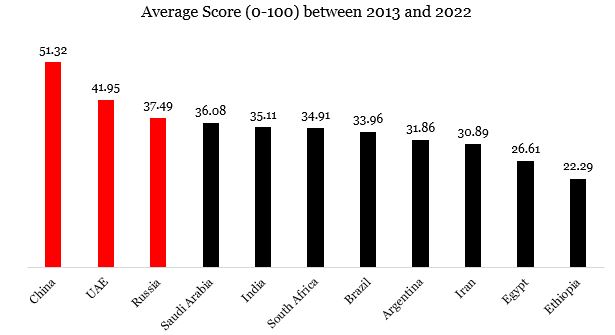
Exhibit 1: Average performance between 2013 and 2022

Innovation in BRICS
Source: Global Innovation Index, 2013-2022; Infoprations Analysis, 2023

Over the span of a decade, the analysis revealed intriguing patterns and trends. On average, China, the United Arab Emirates, and Russia consistently outperformed the other members, including the recently added newcomers. This suggests a degree of established strength and innovation prowess within these three countries that sets them apart. However, one of the most surprising insights to emerge from our analysis was the remarkable global competitiveness of the United Arab Emirates, despite being a newly inducted member. This revelation underscores the rapid development and strategic investments made by the UAE in fostering an innovation ecosystem that can compete on a global scale.

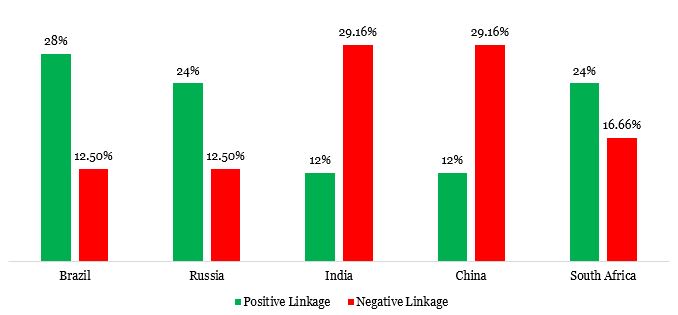
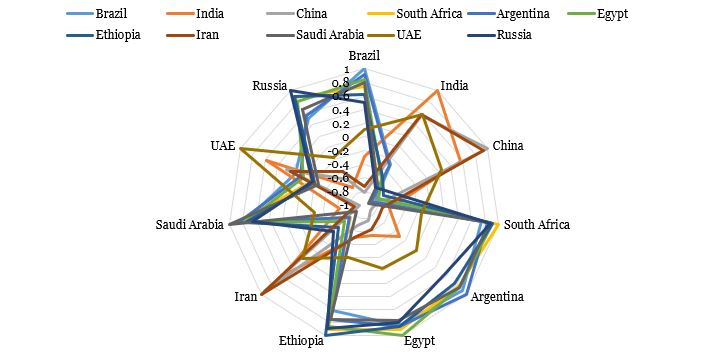
China exhibits a negative correlation with several countries, including Brazil, South Africa, Argentina, Egypt, Ethiopia, Saudi Arabia, and Russia. This suggests that China’s performance in innovation competitiveness tends to vary inversely with these nations. In other words, when China’s competitiveness in the innovation ecosystem increases, the competitiveness of these countries tends to decrease. On the flip side, China displays a positive correlation with India, Iran, and the United Arab Emirates. This implies that as China’s innovation ecosystem competitiveness rises, these countries tend to experience corresponding increases in their own competitiveness.

Exhibit 2: Frequency of positive and negative linkages of BRICS’s and AEEISU’s Innovation Index

Source: Global Innovation Index, 2013-2022; Infoprations Analysis, 2023

Russia, like China, shows a negative correlation with several countries, including India, Iran, and the UAE. This suggests that when Russia’s innovation ecosystem competitiveness improves, these nations tend to experience decreased competitiveness. Conversely, Russia exhibits a positive correlation with Brazil, South Africa, Argentina, Egypt, Ethiopia, Saudi Arabia, and Russia itself. This means that as Russia’s innovation ecosystem competitiveness strengthens, these countries tend to see improvements in their own competitiveness. India demonstrates a negative correlation with Brazil, South Africa, Argentina, Egypt, Ethiopia, Saudi Arabia, and Russia. This implies that when India’s innovation ecosystem competitiveness increases, these countries tend to experience a decrease in their own competitiveness. India, on the other hand, shows a positive correlation with China, Iran, and the UAE. This suggests that as India’s innovation ecosystem competitiveness improves, these countries tend to see corresponding improvements in their own competitiveness.

South Africa displays a negative correlation with India, China, Iran, and the UAE. This indicates that when South Africa’s innovation ecosystem competitiveness rises, these countries tend to witness a decline in their own competitiveness. In contrast, South Africa has a positive correlation with Brazil, Argentina, Egypt, Ethiopia, Saudi Arabia, and Russia. This means that as South Africa’s innovation ecosystem competitiveness strengthens, these countries tend to experience enhancements in their own competitiveness.

Brazil exhibits a negative correlation with India, China, and Iran. When Brazil’s innovation ecosystem competitiveness increases, these nations tend to see decreases in their own competitiveness. Brazil demonstrates a positive correlation with South Africa, Argentina, Egypt, Ethiopia, Saudi Arabia, the UAE, and Russia. As Brazil’s innovation ecosystem competitiveness improves, these countries tend to witness corresponding improvements in their own competitiveness.

Exhibit 3: Concentric of Innovation Index of the BRICS and AEEISU

Source: Global Innovation Index, 2013-2022; Infoprations Analysis, 2023

As the BRICS alliance expands its horizons and welcomes these new members, the dynamics of the group’s innovation landscape are poised for transformation. The blending of experiences, resources, and expertise from both the old and new members promises to shape the future of global innovation and economic influence in exciting and unforeseen ways. This development underscores the importance of continually monitoring and analyzing the evolving innovation ecosystems of these nations, as they collectively aim to chart the course for a new era in global economic and political affairs.

Threads Plans to Roll Out Highly Anticipated “Search” Feature

0

Meta’s text-based social network Threads, has announced plans to roll out the highly anticipated “search” feature on the platform.

At the moment, users can only search for usernames on Threads, therefore, the company is working on bringing full-text-based search.

Announcing the launch of the “search” feature on Threads, Meta’s CEO Mark Zuckerberg wrote on the platform, “Get Excited, Search is coming to Threads”.

As with previous early-stage releases, advanced search filters or options are not available in this initial version.

Reports reveal that Threads is already testing the search feature in Australia and New Zealand, and is planning for a wider rollout to other English-speaking countries.

Meanwhile, there was no specific timeframe provided for the rollout, but the Head of Instagram Adam Mosseri, stated that the company is also working on adding more languages and requested feedback from those who are already testing the feature.

The launch of the “Search” feature on Threads, is coming a week after the platform rolled out its web version. According to suggestions, being able to use Threads from the web is a potential game-changer for those still trying to make the shift from X (Formerly Twitter).

From day one, web support has been among users’ top requests, which shows that the company is actively listening to its user’s requests and working on more features to enhance their experience.

Notably, Threads has been trying to increase sign-ups and user engagement on the app, after the excitement during its launch dwindled. Most users were disappointed by the lack of features on the app compared to its rival Twitter (now called X).

Threads came out of the gate strong, breaking records to become the fastest app to top 100 million users within days of its arrival, thanks to the clever way it leveraged Instagram’s social graph to onboard new users. According to market intelligence firm data.ai., the app topped 200 million installs at launch.

Since then, user engagement has declined rapidly post-launch, with app intelligence firm Sensor Tower noting that Threads’ daily active user count fell 82% from launch as of July 31, leading to just 8 million daily active users. The app had peaked at roughly 44 million daily users following its launch, indicating a large drop-off.

This has spurred Threads to roll out most of the sought-after features such as the following tab, and repost tab, amongst others.

However, it appears that Zuck, Instagram head Adam Mosseri, and the Threads team are not sitting on their laurels, as they are working tirelessly to bring more sought-after features on the Threads platform as soon as possible.

With some of the most highly requested features already launched, the team can now move on to working on the implementation of Direct messages, hashtags, and other features that its competitors already offer.

Meta’s head Zuckerberg has been pushing for new Threads features to improve retention rates. Last month, he told employees that he considered the drop in active users to be “normal,” adding that things would likely improve as the app added more features.

Also, Meta’s chief product officer, Chris Cox, said the company was working on “retention-driving hooks” to boost daily user rates.

The Evolution of Online Banks And Fintech

0

In an era of rapid technological advancements, the financial industry has been at the forefront of innovation. Traditional banking institutions are facing unprecedented competition from online banks and fintech companies, ushering in a new era of financial services. Research suggests that this evolution is reshaping the financial landscape, with companies like Reduce Loans in Australia leading the way. However, this transformation isn’t confined to one country alone; it’s a global phenomenon. Let’s explore the evolution of online banks and fintech on a global scale, with a focus on Reduce Loans and similar disruptors in other countries.

Research suggests that the transformation of the financial industry through online banks and fintech is a dynamic and ongoing process, with significant implications for the future of finance.

If you’re considering a Home loan and refinancing options, it’s essential to explore your choices carefully. Home loans are a significant financial commitment, and making the right decision can save you money in the long run. Whether you’re a first-time buyer or looking to refinance your existing mortgage, it’s crucial to evaluate your options thoroughly.

The Rise of Online Banks and Fintech

Traditional banking has always been characterized by brick-and-mortar establishments, long queues, and complex paperwork. However, the rise of online banks and fintech companies has revolutionized the way we manage our finances. This transformation can be attributed to several factors:

Digitalization and Connectivity: The widespread adoption of the internet and smartphones has enabled easy access to financial services from anywhere, at any time.

Consumer Expectations: Today’s consumers expect convenience, transparency, and personalized services, which traditional banks often struggle to provide.

Lower Operational Costs: Online banks and fintech companies can operate with significantly lower overhead costs compared to traditional banks, allowing them to offer competitive interest rates and lower fees.

Innovation in Financial Products: Fintech companies continually innovate, introducing novel financial products and services that cater to specific consumer needs.

One noteworthy example of a company that has embraced these changes is Reduce Loans in Australia.

Reduce Loans: Disrupting Conventional Financing

Reduce Loans is a prime example of how modern offers and incentives have disrupted conventional financing in Australia. This innovative fintech company specializes in personal loans and mortgage refinancing. They have successfully leveraged technology to streamline the lending process, making it more efficient and customer-friendly.

Reduce Loans offers competitive interest rates, personalized loan options, and a user-friendly online platform that allows customers to apply for loans and get approval within minutes. Their commitment to transparency and customer-centricity has earned them a loyal customer base. Research suggests that Reduce Loans’ approach has not only reduced the hassle associated with traditional lending but has also significantly lowered the cost of borrowing for Australians.

Similar Disruptors Across the Globe

Australia is not the only country experiencing the fintech revolution. Fintech disruptors are emerging in various parts of the world, reshaping the financial services landscape. Here are three other countries where similar developments are occurring:

United States: The United States has witnessed a surge in online banks and fintech startups. Companies like SoFi, Robinhood, and Square have gained prominence by offering a range of financial services, from lending and investing to payment processing. They focus on user-friendly interfaces and attractive incentives, catering to a younger and tech-savvy audience.

United Kingdom: In the UK, fintech has made significant inroads into the banking sector. Companies like Monzo, Revolut, and Starling Bank have disrupted traditional banking by offering digital-only accounts with features like real-time spending alerts, fee-free currency conversion, and easy budgeting tools. These companies have gained popularity among millennials and digital natives.

China: China’s fintech landscape is dominated by tech giants like Alibaba’s Ant Group and Tencent’s WeChat Pay. These companies have created vast ecosystems that encompass payment services, wealth management, insurance, and more. Mobile payment solutions are widely used in China, with consumers relying on apps like Alipay and WeChat Pay for daily transactions.

The Future of Online Banks and Fintech

The evolution of online banks and fintech is far from over. As technology continues to advance, we can expect further disruption in the financial industry. Some key trends to watch out for include:

Artificial Intelligence (AI) and Machine Learning: AI-powered chatbots, credit scoring algorithms, and personalized financial advice will become more prevalent, enhancing customer experiences and risk assessment.

Blockchain and Cryptocurrency: These technologies will reshape payment systems, remittances, and even traditional banking infrastructure. Digital currencies and decentralized finance (DeFi) platforms are gaining traction.

Regulatory Changes: Governments and regulators are adapting to the fintech boom, introducing new regulations to ensure consumer protection, data security, and financial stability.

Global Expansion: Fintech companies are increasingly expanding their operations internationally, catering to a global customer base. Cross-border payments and remittances will become more efficient.

In conclusion, the evolution of online banks and fintech is a global phenomenon that is fundamentally changing the way we access and manage financial services. Companies like Reduce Loans in Australia are setting the benchmark for customer-centric, technology-driven financial solutions. Similar disruptors can be found in the United States, the United Kingdom, and China, where innovation is reshaping traditional banking. As we move forward, the fintech revolution promises further advancements and greater accessibility, ultimately benefiting consumers worldwide.

Preparing Your Windows Systems for the Unexpected

0

For all those who back up only their cloud data and not their PC’s, it is time to review your disaster preparedness levels and related policies. In our epoch of rapidly accelerating digital transformation, the sanctity of data emerges as the modern-day alchemy, the cornerstone upon which modern enterprises are built today. For this reason, it makes sense that the TeraByte’s Image for Windows is the one crucial measure we will be zooming in on today.

Just as electricity is vital for city life, data is now a big part of our daily and work lives. Operating systems like Windows play a big role in this digital world. But just like real life, the digital world can have problems. When data goes wrong, it causes more than just small issues.

Deciphering a Cautionary Digital Chronicle

Recall the tribulation that befell a prominent New York consultancy—an exemplar in the financial domain, seemingly impervious in its digital sanctum. Their odyssey into digital turbulence was instigated by a pernicious software nemesis that insidiously exfiltrated and obliterated vast swaths of invaluable client datasets. The aftershocks of this digital cataclysm reverberated through plummeting public trust and a fiscal debilitation of staggering magnitude. One is compelled to ponder: could a meticulously architected disaster mitigation blueprint have forestalled this digital debacle? The consensus amongst the cognoscenti is an emphatic affirmation.

Evaluating the Landscape of Preparedness

Eminent scholars and analysts, upon meticulous scrutiny, have unveiled a perturbing trend within the sanctum of IT: an alarming paucity in disaster readiness. Empirical evidence suggests a substantial fraction of enterprises, irrespective of their stature, exhibit laxity in crafting rigorous data resiliency and rejuvenation blueprints. This oversight becomes increasingly precarious in light of the multifarious digital threats that lurk, ranging from the tangible—like hardware attrition—to the ethereal, such as cyber malefactions. Given the lynchpin role of digital repositories in today’s corporate orchestration, even a transient aberration can cascade into ramifications that encompass data depletion, operational stasis, and the subsequent fiscal and reputational erosion. Thus, the clarion call from luminaries is unambiguous: in the absence of a holistic disaster fortification mechanism, entities risk the very bedrock of their digital existence.

The TeraByte Paradigm: Navigating Digital Quagmires

The TeraByte Drive Image Backup and Restore Suite’s recent magnum opus, version 3.61a, unfurled on July 12, 2023, stands as a beacon of hope in these turbulent digital seas. Beyond mere software, it serves as a formidable custodian of digital assets, poised to shepherd data back from the brink of abyss.

Image for Windows: The Digital Custodian

As a cornerstone of the TeraByte compendium, Image for Windows embodies a synthesis of robustness, efficacy, and user-centricity. By affording a diverse gamut of storage pathways, it pledges a near-instantaneous resurrection of your digital sanctum.

Consistency in Backup: The VSS and PHYLock™ Confluence

By combining the strengths of Volume Shadow Copy Service (VSS) and PHYLock™, Image for Windows allows users to keep working while backups are being made. This tool creates a temporary snapshot, preventing the usual problems seen when saving active partitions.

Digital Versatility: Transcending the Boundaries of Operating Systems

Image for Windows, despite its name, isn’t just for Windows. It works with a wide range of operating systems, from the old DOS system to modern Linux. This means it can work across many different platforms. Its design shows a clear goal: to make sure data protection is available for all, not just for specific systems.

The TeraByte Almanac: A Comprehensive Arsenal

Spanning Image for Windows, Linux, DOS, and the OSD Tool Suite, the TeraByte ensemble encapsulates a panoramic vista of drive imaging faculties. Its prowess remains undiminished even in the absence of a functional Windows crucible.

OS Deployment Tool Suite Pro: The Magnum Opus

Embedded within the professional incarnation of the TeraByte OS Deployment Tool Suite (TBOSDTS) lies a tapestry of sophisticated scripts, designed meticulously to facilitate the seamless transplantation of Windows across heterogeneous hardware terrains.

Proliferation of Compatibility

TeraByte’s suite manifests an ecumenical embrace, harmonizing seamlessly across a plethora of Windows iterations and server manifestations. It rises as a panacea for entities diversified in their system ethos.

TeraByte’s Assurance: The Risk-Free Exploration

As a testament to its unwavering faith in its own craftsmanship, TeraByte offers a no-strings-attached exploration window of 30 days. This interlude allows potential adopters to delve into the suite’s intricacies, calibrating its alignment with their unique disaster deterrence frameworks, thus empowering an enlightened integration decision.

Final words? Well it seems like TeraByte’s concept is not based on a mere product—it’s a pledge, a commitment to safeguarding the very digital essence that underpins contemporary enterprises. In today’s fast-changing digital world, this protection isn’t just nice to have—it’s essential.