DD
MM
YYYY

PAGES

DD
MM
YYYY

spot_img

PAGES

Home Blog Page 3921

IMF Warns That High Crypto Adoption Could Undermine Macro-Financial Stability, Calls For Regulation to Protect Risks

0

The International Monetary Fund (IMF), has expressed concerns about the high adoption of crypto assets across the globe, noting that it could undermine macro-financial stability, as it calls for necessary infrastructure & regulation to protect against risk.

While speaking at a conference in Seoul, South Korea, on digital currency, the Managing Director of IMF, Kristalina Georgieva emphasized the need to regulate cryptocurrencies, due to the impact on financial stability.

In her words,

“The challenge is that high crypto asset adoption could undermine macro-financial stability. It could affect the effectiveness of monetary policy transmission, capital flow management measures, and fiscal sustainability to volatile tax collection. Our goal is to make a more efficient, interoperable, and accessible financial system by providing rules to avoid the risks of crypto and infrastructure by leveraging some of its technologies.

“Rules are not meant to return us to the pre-crypto world, nor squash innovation, good rules can spur and guide innovation. For instance, banks are exploring new trading infrastructure using blockchain technology refined and popularized by the crypto boom. They hope to cut costs and speed for trillions of dollars of daily asset transactions, and to broaden financial access to those currently content with low yielding deposits accounts”.

In a panel discussion, Georgieva emphasized the need for policymakers  to actively participate in the process, contributing to its improvement, or risk being excluded, warning that countries should desist from adopting cryptocurrencies as a legal tender.

Also speaking on the topic of digital money,  Seoul’s finance minister Choo Kyung-ho noted that despite a series of challenges, a clear transition to digital money is already happening which is unstoppable.

He noted that the goal now is to establish a set of policy tools that not only support economic growth and financial innovation but also ensure reliability and stability.

Choo emphasized the need for every country and global institution to stay nimble to keep up with digital innovation and focus on solutions to build public trust and stability on top of the convenience and efficiency provided by digital money.

“Setting up global standards through close collaboration with governments and international bodies are essential, especially considering that digital money knows no borders,” he added.

The adoption rate of crypto across the globe has continued to increase significantly, which had seen businesses across the world now accepting crypto as a means of payments. In the U.S, more than 85% of merchants view enabling crypto payments as a high-priority.

As of September 2023, Chainalysis 2023 Global Crypto Adoption Index, reported that the estimated global crypto ownership rate was at an average of 4.2%, with over 420 million crypto users worldwide. India, Nigeria, and Thailand were ranked as the top three countries with lower middle-income (LMI) nations leading the way in the grassroots adoption of cryptocurrencies.

While crypto assets offer a new world of opportunities, such as driving global financial inclusion, albeit, it comes with high risk. The volatile nature of cryptocurrencies could lead to financial instability if not properly managed.

Financial Times reports that crypto assets have so far not reduced but rather amplified the financial risks in less developed economies.

The concern of the IMF centers on the fact that without adequate regulation, factors such as market fluctuations, security vulnerabilities, and potential illicit activities could jeopardize the broader financial system.

Hence, striking a balance between innovation and safeguarding macro-financial stability is seen as essential for a sustainable and secure financial environment in the face of increasing cryptocurrency adoption.

CHATGPT TRAINING: How New York Times Can Succeed With Generative AI

0

As the discussions over the effect of generative artificial intelligence on journalism practice and revenue of news media organisations rage on across the world, in this piece, our analyst examined one of the recent legal actions of the New York Times, which was widely reported from the political economy perspective. Out of the numerous articles, our analyst selected one from National Public Radio.

It is mostly known as the public radio network of the United States. Every day, NPR connects with millions of Americans on air, online, and in person to explore the news, ideas, and what it means to be human. Though it has ‘public’ as part of its name, available information, however, indicates that it is an independent and non-profit media organisation.

Despite being headquartered in Washington, NPR reports issues and needs of local, national, and global importance towards creating a more informed public. Therefore, reporting issues around artificial intelligence in the news industry resonates with the mission. Being an independent medium, our analyst also expects some level of neutrality and objectivity in the article: New York Times considers legal action against OpenAI as copyright tensions swirl [available here], which was written by Bobby Allyn and supported by David Folkenflik as a contributor.

The Subject and the Arguments of the Writer

Lawyers for the Times are considering legal action against OpenAI to protect the intellectual property rights associated with its reporting. The Times and ChatGPT maker have been on intense negotiations over reaching a licensing deal in which OpenAI would pay the Times for incorporating its stories in the tech company’s AI tools. The discussions have become so contentious that the paper is now considering legal action. A lawsuit from the Times against OpenAI would set up what could be the most high-profile legal tussle yet over copyright protection in the age of generative AI. A top concern for the Times is that ChatGPT is becoming a direct competitor with the paper by creating text that answers questions based on the original reporting and writing of the paper’s staff.

Federal copyright law also carries stiff financial penalties, with violators facing fines up to $150,000 for each infringement “committed willfully.” If a federal judge finds that OpenAI illegally copied the Times’ articles to train its AI model, the court could order the company to destroy ChatGPT’s dataset, forcing the company to recreate it using only work that it is authorised to use. Federal law allows for the infringing articles to be destroyed at the end of the case. The Times’ talks with OpenAI follow reports that the paper will not join other media organisations in attempting to negotiate with tech companies over use of content in AI models. If OpenAI is found to have violated any copyrights in this process, federal law allows for the infringing articles to be destroyed at the end of the case.

Legal experts say AI companies are likely to invoke a defense citing “fair use doctrine,” which allows for the use of a work without permission in certain instances, including teaching, criticism, research, and news reporting. There are two legal precedents that will likely play a part in the pending AI copyright disputes: a 2015 federal appeals court ruling that found that Google’s digitally scanning of millions of books for its Google Books library was a legally permissible use of “fair use,” and not copyright infringement. Lawyers for the Times believe OpenAI’s use of the paper’s articles to spit out descriptions of news events should not be protected by fair use, arguing that it risks becoming something of a replacement for the paper’s coverage.

Our Critical Comment

The New York Times has to maintain its revenue from subscriptions and other products, so it has the right to safeguard its content from generative AI. We also concur that ChatGPT is a direct rival to newspapers, especially when one takes into account how quickly the maker will analyse news articles from newspapers for users who have a variety of inquiries. Also, since the New York Times‘ position is protected by copyright law in the United States, OpenAI is expected to be aware that the articles are being used unlawfully. Furthermore, requesting that OpenAI remove the used articles is one thing. Finding out for sure if it has been permanently erased is another matter. As such, this would not be the best way to resolve the problem.

While the author cited several cases won on the basis of the US fair use doctrine, particularly Google scanning of several books for its Google Book library, it is important to note that Google allows the authors of the books to still benefit from their work by stating names and publishers, which serve as a means for potential buyers to approach the publishers or buy from physical and online bookstores. As a result, employing newspaper news stories by OpenAI does not provide newspapers with the possibility to get more readers and possible advertisers because users of the ChatGPT do not need to approach the newspaper as long as their need for condensed information is met.

The essence of the subject lies in the fact that advanced emerging technologies are eroding the quantity of value conventional news media should be capturing. Big technology companies are overshadowing traditional news media organisations, leveraging the capacity to gather, scale, and transform big data being generated by people and organisations. In the long run, OpenAI and others will be more valuable than news media organisations. In our view, we believe that now that OpenAI wants to use large language models for crawling online news media for the training of their software and selling large language products to potential users, the idea of recommodification of newsmakers or sources’ data similar to platforms’ user data is evolving.

Conventional news outlets, like New York Times, already obtained information from sources without paying them. This information was then turned into news and sold to subscribers, with the advertisers being incentivised to purchase specific space for their ads based on the number of views and reads. In this regard, we consider the New York Times‘ legal action against OpenAI as a major contradiction in its drive to defend journalism in the age of generative AI.

There is no doubt the struggle for control over content, financial considerations, and the evolving relationship between traditional media and AI technology are on the rise. The dispute reflects broader tensions in the digital age, where established media organisations confront challenges posed by emerging technologies and their impact on content creation, distribution, and revenue streams.

As we previously explained, traditional media gathers data by obtaining information from newsmakers and other relevant sources and converting it to commodities (editorial contents) without compensating the newsmakers and other sources. Commodities are sold to readers or subscribers in the form of pre-commodities and intermediate commodities, that is advertising spaces. In this context, news media organisations often have constant capital in the form of news sources and others they employ, whereas OpenAI is using the same in its products without legal permission by using large language models.

Legal interventions, in our view, should change from preserving competition and extracting surplus value to defending public interest, creating public wealth, and fostering social, technological, political, and economic alternatives to data commodification. If LLMs can greatly increase the rate of surplus value, OpenAI should be aware that the New York Times, with its adoption of technologies for production and distribution, is a vital stakeholder in its effort to train ChatGPT. As a result, rethinking the concept of surplus and exchange value in the age of technological revolution (particularly redistribute surplus wealth) is critical.

Another approach, which we believe would fix the problem and create a win-win situation, is for OpenAI to adopt the value creation and sharing formula used by Google News, Google Shopping, Google Scholar, and Google Play, among others. In other words, the New York Times should look for ways to persuade OpenAI to pay for the information it gathered on its website.

In addition, the newspaper and others should begin working on a vertical integration plan comparable to content syndication with OpenAI. In this case, OpenAI and others would be required to cite the newspapers that were used to train their ChatGPT in the outputs received by users. This will go a long way toward reinforcing the news industry’s sustainability in the age of generative AI and also enhances the credibility of ChatGPT at the same time.

Relocate to Naija And Unlock The Goodies in Nigeria!

1

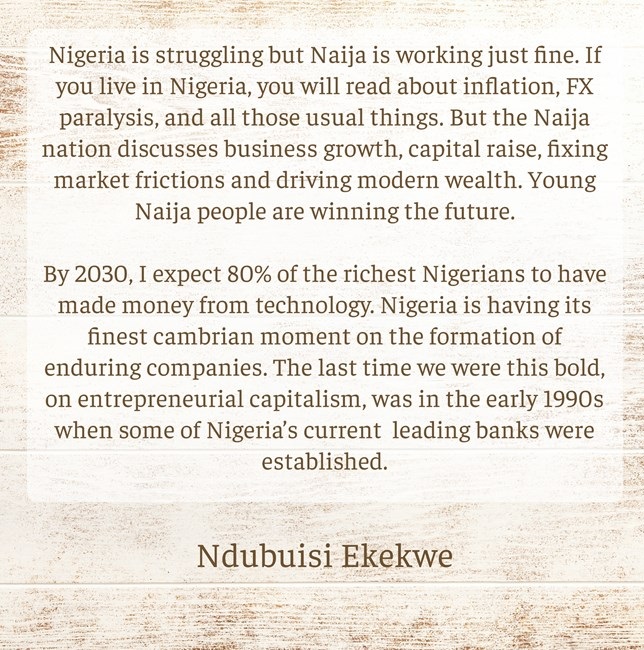
Nigeria is struggling but Naija is working just fine. If you live in Nigeria, you will read about inflation, FX paralysis, and all those usual things. But the Naija nation discusses business growth, capital raise, fixing market frictions and driving modern wealth. Young Naija people are winning the future.

By 2030, I expect 80% of the richest Nigerians to have made money from technology. Nigeria is having its finest cambrian moment on the formation of enduring companies. The last time we were this bold, on entrepreneurial capitalism, was in the early 1990s when some of Nigeria’s current  leading banks were established.

The 1990s gave us the new generation banks. The 2000s brought voice telephony. The 2010s ushered mobile internet. The 2020s would deliver the era of application utility across industry sectors and market territories.

From education to healthcare, from financial services to logistics, and beyond, the empires of the future are being built –  and Naija is a promise! Today, relocate to Naija and unlock the goodies in Nigeria. At Tekedia Institute, we will help you, as you plan how in 2024 and beyond.

Wellness at Your Fingertips: CapCut’s Online Photo Editor for Inspirational Wellness Graphics

1

In an era where visual content dominates the digital landscape, the intersection of technology and wellness has given rise to a powerful tool for self-expression and motivation. CapCut, renowned for its versatility in design and editing, extends its capabilities to the realm of health and wellness. In this article, we explore how CapCut’s online photo editor tool serves as a transformative tool for crafting inspirational graphics that promote well-being. CapCut’s seamless integration of cutting-edge technology with wellness-oriented design empowers users to create visuals that go beyond aesthetics, serving as catalysts for positive lifestyle changes. As the demand for meaningful visual content in the health and wellness domain continues to grow, CapCut emerges as a beacon, providing individuals and professionals alike with a user-friendly tool to articulate their well-being narratives.

The Fusion of Creativity and Wellness

In a fast-paced world where the importance of mental and physical health is increasingly recognized, the role of visual content in promoting well-being cannot be overstated. CapCut emerges as a game-changer, offering individuals, wellness professionals, and enthusiasts alike the means to create visually appealing content that inspires and uplifts.

CapCut’s Toolbox for Wellness Design

  • Free Online Photo Editor

CapCut’s AI-powered free online photo editor becomes a sanctuary for wellness enthusiasts looking to convey their messages through compelling visuals. Whether you’re a yoga instructor, nutritionist, or simply someone passionate about health, CapCut’s online photo editor provides an array of tools to bring your ideas to life.

  • Ready-to-Use Templates

The journey to well-being begins with convenience. CapCut recognizes this and offers ready-to-use templates that cater specifically to health and wellness themes. From motivational quotes to serene landscapes, these templates serve as an ideal starting point for your wellness-inspired designs.

  • AI Helper for Simplified Workflow

CapCut’s AI helper takes the complexity out of design, offering features like color matching, image resizing, and automatic cutouts. This simplifies the creative process, allowing individuals to focus on the essence of their wellness message rather than getting bogged down by technicalities.

  • Filters, Effects, and Stickers

The expressive power of visuals lies in the details. CapCut’s extensive library of filters, effects, and stickers provides the tools needed to evoke specific emotions in your audience. From calming filters to vibrant overlays, each element can be strategically chosen to enhance the overall impact of your wellness graphics.

  • Text Effects for Impactful Messaging

Text can be a powerful ally in conveying messages of inspiration and motivation. CapCut’s text effects feature stylish fonts, overlays, formatting options, and animations that allow you to infuse your wellness graphics with impactful messaging. Let your words resonate visually and emotionally. Moreover, CapCut also offers a sticker maker online tool to create attractive stickers online.

Crafting Wellness-Inspired Graphics with CapCut

  • Step 1: Upload and Set the Canvas

Begin your wellness design journey by visiting the CapCut website and creating an account. Log in with your credentials and enter the online photo editor. Create a blank canvas or start with a free wellness template that aligns with your vision.

  • Step 2: Edit and Customize with AI Assistance

Let CapCut’s AI helper assist you in the editing process. Utilize color matching, color picking, and image resizing features to ensure visual harmony. The ‘Auto cutout’ function simplifies the removal of unwanted elements, allowing you to replace them with wellness-centric visuals. Meanwhile, explore the filters, effects, stickers, and text animations to add layers of depth to your design.

  • Step 3: Export Your Wellness Masterpiece

Once satisfied with your creation, click ‘Download’ to retrieve your final work. CapCut provides the flexibility to save your masterpiece on your device, in the cloud, or share it seamlessly with your wellness community. For those seeking more dynamic presentations, consider using CapCut’s online video editor to create captivating wellness slideshows.

Inspiration for Wellness Designs

  • Mindful Quotes

Infuse your wellness graphics with mindful quotes that resonate with your audience. Use CapCut’s text effects to bring these quotes to life, adding a visual dimension to the wisdom you wish to share.

  • Yoga and Fitness Visual Guides

For fitness enthusiasts and instructors, CapCut becomes a canvas to create visual guides for yoga poses, workout routines, and wellness practices. Illustrate each step with clarity, accompanied by motivational elements to keep users engaged.

  • Nutritional Infographics

Nutritionists and health professionals can leverage CapCut to design informative infographics about the benefits of various foods, dietary tips, and nutritional facts. Engage your audience with visually appealing and informative content.

  • Nature-inspired Relaxation Scenes

Wellness extends beyond physical health to mental well-being. Craft graphics featuring serene landscapes, calming visuals, and nature-inspired scenes to evoke a sense of tranquility and relaxation.

  • Goal Tracking and Achievement Celebrations

Create visuals that track wellness goals and celebrate achievements. Whether it’s weight loss milestones, fitness accomplishments, or mindfulness achievements, CapCut allows you to design graphics that inspire continued progress.

CapCut’s Impact on the Wellness Community

As individuals and communities increasingly turn to digital platforms for wellness inspiration, CapCut emerges as a catalyst for positive change. The ability to visually communicate health and wellness messages fosters a sense of community, encouragement, and shared progress.

Conclusion: Elevating Wellness through Visual Expression

In the age of information overload, the ability to convey wellness messages effectively is a valuable skill. CapCut empowers individuals to transcend conventional boundaries, providing a tool where creativity and wellness intersect. By harnessing the tools offered by CapCut, anyone can become a visual storyteller, weaving narratives that inspire, motivate, and contribute to the holistic well-being of individuals and communities alike. So, dive into the world of CapCut, and let your wellness journey find expression through the language of captivating visuals.

Google Will Kill Third-party Cookies for 30 Million Chrome Users in 2024

0

Google’s long-anticipated move to phase out internet cookies is set to begin on January 4th, starting with a blockage for 1% of Chrome users, roughly totaling 30 million individuals.

This action, which comes nearly four years since third-party cookies have been disabled in Firefox and Safari, marks the initial significant step in Google’s Privacy Sandbox initiative, an effort aimed at replacing cookies with an alternative tracking mechanism, dubbed “Tracking Protection,” which the tech giant asserts is more privacy-oriented.

For decades, online entities have relied on “third-party cookies” as the primary tool for tracking users’ activities. These cookies enable websites to collaborate with various companies, including Google, to monitor users’ online actions. The looming extinction of third-party cookies reflects a major shift in digital tracking strategies.

Instead of third-party cookies, Google introduced a new set of tools enabling Chrome itself to monitor users’ online behavior. This new approach involves categorizing users into distinct groups or “Ad Topics,” preserving data on their devices. Websites can inquire about a user’s categorized group but won’t access individualized information, a departure from the conventional cookie-based tracking methods.

Victor Wong, Google’s senior director of product management for Privacy Sandbox, told Gizmodo in an interview in April, about the company’s commitment to enhancing privacy while maintaining accessibility and usefulness of information across the web. According to Wong, this move aligns with Google’s broader mission to ensure an open and accessible internet while safeguarding user privacy.

“We are making one of the largest changes to how the Internet works at a time when people, more than ever, are relying on the free services and content that the web offers,” he said. “The mission of the Privacy Sandbox team writ large is to keep people’s activity private across a free and open Internet, and that supports the broader company mission, which is to make sure that information is still accessible for everyone and useful.”

Despite these changes, Chrome will continue to track user activity, setting it apart from browsers like Firefox and Safari. However, this new approach aims to limit the extent of information exposed about users’ online behavior, representing a step toward enhanced privacy.

The cookie replacements, part of the Privacy Sandbox initiative, are currently an optional feature on Chrome. Users retain the ability to disable these tools through browser settings if they find the concept unfavorable.

As Chrome’s user base constitutes a significant portion of internet users, Google’s cookie deactivation will effectively eliminate them from widespread use. A small test group of 1% of users will experience the default activation of “Tracking Protection,” identified by an eyeball logo in the URL bar, starting January 4th.

Acknowledging the complexity of this transition, Google forewarns users of potential glitches in the early stages. While cookies serve various functions beyond tracking, such as maintaining login statuses and storing cart items, Google aims to segregate and retain necessary cookies while addressing any arising issues.

Users will have the option to disable Tracking Protection or receive prompts to deactivate it for specific websites in case of disruptions.

This strategic move by Google aligns with an industry-wide shift towards fortifying user privacy in response to growing regulatory scrutiny and heightened user demand for stringent safeguards against unwarranted data tracking and profiling.