DD
MM
YYYY

PAGES

DD
MM
YYYY

spot_img

PAGES

Home Blog Page 3941

Barry Silbert resigns as Grayscale chairman amid MicroStrategy acquiring 14,620 additional Bitcoins

0

Barry Silbert, the founder and CEO of Digital Currency Group (DCG), has announced his decision to step down as the chairman of Grayscale Investments, the largest digital asset manager in the world. Silbert will remain as the CEO of DCG, which is the parent company of Grayscale and other crypto-related businesses.

Silbert’s resignation comes at a critical time for Grayscale, as the U.S. Securities and Exchange Commission (SEC) is expected to make a ruling on its application for a spot Bitcoin ETF in the coming weeks. Grayscale has been trying to convert its flagship product, the Grayscale Bitcoin Trust (GBTC), into an ETF since 2016, but has faced regulatory hurdles and competition from other ETF providers.

In a blog post, Silbert said that he was leaving the chairmanship role to focus on his vision for DCG and to support Grayscale’s new leadership team. He also expressed his confidence in Grayscale’s future and its ability to offer innovative products and services to investors.

“I am incredibly proud of what we have built at Grayscale and the role we have played in bringing digital assets to the mainstream. I have full faith in the Grayscale team and their ability to execute on our mission of increasing access and exposure to this emerging asset class,” Silbert wrote.

He added that he will continue to be involved in Grayscale’s strategic direction and will remain as a board member and a shareholder. He also thanked the Grayscale community for their trust and support over the years.

Silbert’s successor as the chairman of Grayscale will be Michael Sonnenshein, who has been the CEO of Grayscale since January 2021. Sonnenshein has been with Grayscale since 2014 and has played a key role in growing its assets under management from $60 million to over $50 billion.

Sonnenshein said that he was honored to take on the chairmanship role and praised Silbert for his vision and leadership. He also said that he was looking forward to working with Silbert and the rest of the DCG team to advance the adoption of digital assets.

“Barry is a pioneer and a visionary in the digital asset space, and I am grateful for his mentorship and guidance over the years. He has built an incredible legacy at Grayscale and DCG, and I am excited to continue working with him to bring more innovation and value to our industry,” Sonnenshein said.

MicroStrategy buys additionally 14,620 BTC.

MicroStrategy, a leading business intelligence and software company, announced today that it has purchased 14,620 more bitcoins for approximately $615.7 million in cash. The company said that the average price of the acquired bitcoins was $42,110 per coin, inclusive of fees and expenses.

This latest acquisition brings MicroStrategy’s total holdings of bitcoin to 142,054 bitcoins, which it bought for $3.16 billion at an average price of $22,268 per bitcoin. The company has been one of the most vocal and active proponents of bitcoin as a store of value and a hedge against inflation.

In a press release, MicroStrategy’s CEO Michael Saylor said: “We continue to believe that bitcoin is the world’s best and most widely adopted digital asset. The acquisition of additional bitcoins announced today reaffirms our belief in the long-term potential of the bitcoin network and its ability to serve as a reliable store of value for investors and corporations around the globe.”

MicroStrategy also revealed that it intends to sell up to $1 billion worth of its class A common stock from time to time to raise additional funds for buying more bitcoins. The company said that it will use the net proceeds from the stock offering for general corporate purposes, including the acquisition of additional bitcoins.

The company’s aggressive strategy of accumulating bitcoins has attracted both praise and criticism from the crypto community and the wider market. Some analysts have applauded MicroStrategy for its visionary and bold move to embrace bitcoin as a superior asset class, while others have questioned its risk management and diversification policies.

MicroStrategy’s stock price has closely followed the fluctuations of bitcoin’s price in recent months, as investors see the company as a proxy for gaining exposure to the cryptocurrency. As of December 27, 2023, MicroStrategy’s stock was trading at $1,234.56, up 12.34% from the previous day. Bitcoin’s price was also up 10.45% at $44,567.89, according to CoinMarketCap.

Grayscale just filed another update to its Bitcoin ETF application S-3

Meanwhile, Grayscale, the world’s largest digital asset manager, has submitted another update to its Bitcoin ETF application with the U.S. Securities and Exchange Commission (SEC). The latest filing, dated December 22, 2023, is an amendment to the Form S-3 registration statement that Grayscale initially filed in March 2023.
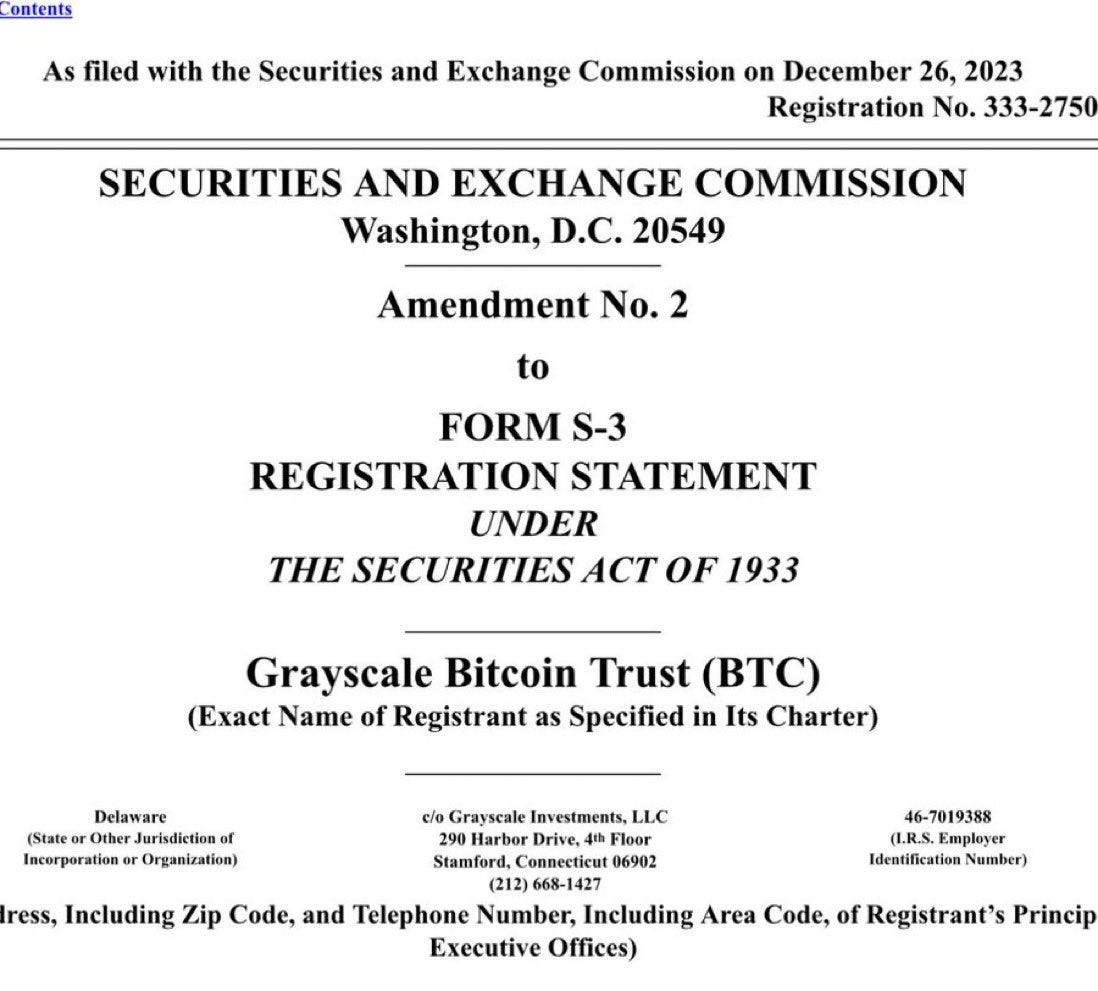
The amendment includes several changes to the proposed Bitcoin ETF, such as:

Updating the name of the fund from Grayscale Bitcoin Trust (GBTC) to Grayscale Bitcoin ETF (GBTC-ETF). Adding a new section on the risks associated with investing in the fund, such as market volatility, regulatory uncertainty, cyberattacks, and tax implications. Providing more details on the fund’s investment objective, strategy, fees, expenses, and performance history.

Clarifying that the fund will use a third-party custodian to hold its bitcoin assets and that the custodian will be subject to periodic audits by an independent auditor. Stating that the fund will seek to track the performance of the Bloomberg Galaxy Bitcoin Index (BGCI), a market capitalization-weighted index that measures the performance of bitcoin across various trading venues.

Explaining that the fund will trade on the NYSE Arca exchange under the ticker symbol GBTC-ETF and that its shares will be redeemable for bitcoin at the end of each trading day.

Grayscale’s latest filing comes amid growing anticipation for a Bitcoin ETF approval in the U.S., as several other firms have also submitted their applications to the SEC. However, the regulator has yet to approve any Bitcoin ETFs, citing concerns over market manipulation, investor protection, and valuation.

Grayscale’s CEO Michael Sonnenshein said in a statement that the firm is “committed to converting GBTC into an ETF” and that it is “working closely with regulators and our service providers to prepare for this important milestone”. He added that Grayscale believes that a Bitcoin ETF “will provide investors with greater access, transparency, and liquidity” in the bitcoin market.

Grayscale currently manages over $40 billion in assets across its various crypto products, with GBTC being its flagship offering. GBTC holds over 650,000 bitcoins, representing more than 3% of the total supply. GBTC shares trade at a premium or discount to the net asset value (NAV) of the underlying bitcoin, depending on the supply and demand dynamics in the market.

A Bitcoin ETF would eliminate this discrepancy and allow investors to buy and sell shares at their fair value. It would also reduce the fees and complexity associated with buying and storing bitcoin directly. Moreover, a Bitcoin ETF would attract more institutional and retail investors to the crypto space, potentially boosting the adoption and price of bitcoin.

New York Times Files Lawsuit Against Microsoft And OpenAI, Alleging Copyright Infringement

0

American-based daily newspaper company New York Times (NYT), has taken legal action, by suing Microsoft and OpenAI, the developer of ChatGPT, for allege copyright infringement.

The lawsuit which was filed in US District Court New York, claims that the generative AI tools that Microsoft and OpenAI have created, rely on large language models, or LLM, that were built by copying and using million of The Time’s copyrighted new articles, reviews, opinion pieces, amongst others.

Part of the lawsuit reads,

“While defendants engaged in widescale copying from many sources, they gave Times content particular emphasis when building their LLMs revealing a preference that recognizes the value of those works. Through Microsoft’s Bing Chat (recently rebranded as “Copilot”) and OpenAl’s ChatGPT, defendants seek to free-ride on The Times’s massive investment in its journalism by using it to build substitutive products without permission or payment.

“Powered by LLMs containing copies of Times content, Defendants’ GenAl tools can generate output that recites Times content verbatim, closely summarizes it, and mimics its expressive style, as demonstrated by scores of examples, including multiple pieces included as exhibits in the suit. These tools also wrongly attribute false information to The Times.

By providing Times content without The Times’s permission or authorization, Defendants’ tools undermine and damage The Times’s relationship with its readers and deprive The Times of subscription, licensing, advertising, and affiliate revenue. If the Times and other news organizations cannot produce and protect their independent journalism, there will be vacuum that no computer or artificial intelligence can fill. Less journalism will be produced, and the cost to society will be enormous”.

The suit however does not include a monetary demand, but insist that defendants should be held responsible for billions of dollars in statutory and actual damages related to the unlawful copying and use of The Time’s uniquely valuable works.

The Times claims that for months, it has attempted to reach out to both companies for an agreement, but it has so far been unsuccessful.

As AI boom continue to spread across industries, media organizations have spent the past few years analysizing and examining the legal, financial and journalistic implications of this technology. Some news outlets have reportedly reached agreements to some of these AI companies for the use of their work.

It is important to note that lately, AI firms have come under fire for allegedly infringing on copyrights. On June 29, 2023, Two U.S. authors sued OpenAI in San Francisco federal court, claiming in a lawsuit that the company misused their works to train its popular generative artificial-intelligence system ChatGPT.

In the wake of this, The New York Times hired an editorial director of artificial intelligence initiatives, as media organizations look to leverage artificial intelligence in the newsroom and experiment with the technology, while still grappling with ethical choices to protect public trust.

Nigeria Is Yet To Build The Temples for Capital And Wealth Acceleration

1

Nations become richer not by fattening bank accounts but by accelerating the creation and utilization of capital. India’s (with the two major exchanges combined) now ranks as the 4th largest stock exchange in the world, at $4 trillion, behind only United States, China and Japan.

  • India – $4 trillion
  • South Africa – $950 billion
  • Nigeria – $50 billion

How do you feel Nigeria?

Since the bulk of the global wealth is extracted from the capital market, it does mean that Nigeria can technically have at maximum 50 billionaires, assuming an average of $1 billion per b-club member. Think of the possibilities in India and South Africa.

Do not remind me of the “billionaires” in Nnewi or Abeokuta. I do not believe those things just like I do not see Kano being a center of commerce, as the budget continues to drop to troubling level (now N350 billion when Lagos is hitting close to N2.3 trillion). By 2025, it is possible that a small state like Imo State can spend twice the budget of Kano State, and yet someone will shout “Kano is a big market”! How???

(Sure, Nigeria is rich on money, but not capital, as the economy remains largely informal)

We can all claim to be giants but when it comes to empirical data-anchored evidence, we fade. I call on the leaders of Nigeria to reform our economy, and make it capital-anchored, over money-anchored. Unfortunately for that to happen, our judiciary needs to do better because the temple of capital is an efficient legal system.

Nigeria does not have many altars for creating capital because the core temples are yet to be built. And that is where our National Assembly can serve the nation. I do like to quote these numbers to make some people uncomfortable because most times we think we’re good for the finals even though we’re not in the game during the group phases! Yes, we must play better to compete for the global economic trophies.

Nigera’s Consumer Protection Commission (FCCPC) Slaps $110M Fine on British American Tobacco

0

In a resounding move that marks regulatory vigilance and stringent enforcement, the Federal Competition and Consumer Protection Commission (FCCPC) has imposed a hefty fine of $110 million on British American Tobacco (BAT) Nigeria and its affiliated companies.

This penalty, which stems from numerous violations of the FCCPC Act and other regulations, marks the FCCPC as one of the most efficient regulatory agencies in Nigeria.

The FCCPC management, headquartered in Abuja, unequivocally declared on Wednesday that BAT and its affiliate entities had breached multiple provisions embedded in the FCCPC Act, the National Tobacco Control Act, and other pertinent legal frameworks.

This landmark decision was reached following exhaustive scrutiny and engagement between the Commission and the BAT parties, conducted under the Cooperation/Assistance Rules & Procedure (CARP) of 2021.

The specified penalty emerged from the FCCPC’s Cooperation/Assistance Framework (CAF), wherein benefits such as potential reductions in monetary penalties and the prospect of waiving the application of the Commission’s Administrative Penalties Regulations 2020 were outlined.

This cooperative engagement mandated BAT parties to provide written assurances to the Commission under Section 153 of the FCCPA, cementing their commitment to compliance.

“In exchange for BAT parties fulfilling their obligations under the Consent Order, the Commission withdrew pending criminal charges against BATN and one employee for attempting to prevent execution of the search warrant and initial lack of cooperation/compliance with steps in the investigation,” the agency said.

The genesis of this consequential investigation dates back to August 28, 2020, when the FCCPC initiated an extensive inquiry into British American Tobacco Nigeria Limited and its affiliated companies. The decision was catalyzed by credible intelligence, triggering an exhaustive evaluation of the activities of these entities.

The Commission said, “The outcome of the investigation demonstrates the Commission’s desire as well as will to enforce the law and hold businesses accountable; even when it takes complex, painstaking and protracted investigations.”

Moreover, as part of the agreement, the FCCPC said that the implicated companies are mandated to engage in mandatory public health and tobacco control advocacy, ensuring strict adherence to tobacco control legislation and regulations.

The investigation’s procedural arc was punctuated by a significant legal development. The FCCPC secured an Order and Warrant of Search and Seizure from the Federal High Court, enabling simultaneous raids across multiple BAT parties’ locations and a service provider’s premises on January 25, 2021.

Subsequently, an array of evidence, inclusive of electronic communications and corroborative information, was procured and analyzed, substantiating the violations of the FCCPA and other relevant enactments.

“The Commission gathered, received, and procured substantial evidence from forensic analysis of electronic communications and other information/data obtained during the search, as well as other evidence procured during, and after the search from other legitimate sources.

“Additional investigation, including proffers, hearings, transcripts of sworn testimonies, and continuing analysis of evidence established and supported multiple violations of the FCCPA and other enactments,” FCCPC added.

This regulatory accomplishment adds to a series of successes achieved by the FCCPC, which includes cracking down on the harassment tactics employed by digital loan apps. Under the leadership of Babatunde Irukera, the FCCPC has been actively addressing various issues within its purview.

The commission said it generated N56 billion in revenue from fines in 2023.

TRON for Unbanked, and Major Crypto Ecosystem’s Outlook for 2024

0

As the year 2023 near end, it is time to look ahead and anticipate what the next year will bring for the major crypto ecosystem. We will analyze the current state of the market, the key trends and challenges, and the potential opportunities and risks for 2024.

The Current State of the Market

The year 2023 was a turbulent one for the crypto industry, with several highs and lows. The market capitalization of all cryptocurrencies reached a new all-time high of over $2.5 trillion in November, driven by the adoption of Bitcoin as legal tender in El Salvador, the launch of the first futures-based Bitcoin ETF in the US, and the increased institutional and retail interest in crypto assets. However, the market also faced significant headwinds, such as regulatory uncertainty, environmental concerns, cyberattacks, and market manipulation.

The major crypto ecosystem, which consists of the top 10 cryptocurrencies by market cap, performed well overall, with an average return of over 300% in 2023. Bitcoin remained the dominant player, with a market share of over 40% and a price of over $43,000 at the end of the year. Ethereum followed closely behind, with a market share of over 20% and a price of over $2200. The other major players included Binance Coin, Cardano, Solana, Polkadot, XRP, Terra, Avalanche, and Dogecoin.

The Key Trends and Challenges

The year 2024 will likely see the continuation and intensification of some of the key trends and challenges that shaped the crypto industry in 2023. Some of these are:

The adoption of crypto as a mainstream asset class: Crypto will continue to gain acceptance and legitimacy as a form of money, store of value, and investment vehicle. More countries will follow El Salvador’s example and adopt Bitcoin or other cryptocurrencies as legal tender or reserve assets.

More institutional investors will allocate funds to crypto assets, either directly or through intermediaries such as ETFs or trusts. More retail investors will access crypto through platforms such as PayPal, Robinhood, or Coinbase. More merchants will accept crypto as a payment option, either directly or through intermediaries such as BitPay or Flexa.

The innovation and competition in the crypto space: Crypto will continue to evolve and innovate at a rapid pace, with new projects, protocols, and platforms emerging every day. The major crypto ecosystem will face increasing competition from other ecosystems that offer faster, cheaper, more scalable, more interoperable, more decentralized, or more user-friendly solutions.

Some of these ecosystems include Cosmos, Polygon, Fantom, Algorand, Harmony, Hedera Hashgraph, Near Protocol, and Zilliqa. The major crypto ecosystem will also have to contend with the emergence of central bank digital currencies (CBDCs), which are digital versions of fiat currencies issued by central banks. Some of the countries that are expected to launch or pilot CBDCs in 2024 include China, Japan, Sweden, France, Canada, and Brazil.

The regulation and governance of the crypto industry: Crypto will continue to face regulatory scrutiny and uncertainty from various authorities around the world. Some of the issues that regulators will have to address include consumer protection, investor protection, taxation, anti-money laundering (AML), counter-terrorism financing (CTF), cybersecurity, environmental impact, and monetary policy.

Some of the regulators that will play a key role in shaping the crypto industry in 2024 include the US Securities and Exchange Commission (SEC), the US Commodity Futures Trading Commission (CFTC), the Financial Action Task Force (FATF), the European Commission (EC), and the International Monetary Fund (IMF). The major crypto ecosystem will also have to deal with internal governance issues such as consensus mechanisms.

TRON banked the unbanked mostly in 2023 compared to other Blockchains

The year 2023 was a remarkable one for the global financial inclusion movement. Millions of people who had been excluded from the traditional banking system gained access to digital financial services thanks to a revolutionary project: TRON.

Tron is a blockchain-based platform that aims to create a decentralized internet and a global digital content ecosystem. Tron was founded by Justin Sun, a former chief representative of Ripple in China, and launched its mainnet in June 2018. Tron claims to have over 40 million active users and over 1,800 decentralized applications (DApps) running on its network.

One of the key metrics that investors and traders use to evaluate the value and potential of a cryptocurrency is its market capitalization, or marketcap for short. Marketcap is calculated by multiplying the current price of a coin or token by its total circulating supply. For example, if a coin has a price of $0.1 and a circulating supply of 10 billion, its marketcap is $1 billion.

According to CoinMarketCap, as of December 27, 2023, Tron has a price of $0.1 and a circulating supply of 88.3 billion, which gives it a marketcap of $9.22 billion. This makes Tron the 15th largest cryptocurrency by marketcap, behind Bitcoin, Ethereum, Binance Coin, Cardano, Solana, XRP, Polkadot, Terra, Avalanche, Dogecoin, Shiba Inu, Polygon, Chainlink and Stellar.

One of the most innovative features of TRON is its integration with BitTorrent, the world’s largest peer-to-peer file sharing network. BitTorrent users can earn TRX by seeding files, and use TRX to pay for faster downloads, premium content and other services. BitTorrent also provides a massive distribution channel for TRON-based applications and content creators.

But TRON is not only about entertainment and content. It is also about empowering the unbanked and underbanked populations around the world. According to the World Bank, there are still 1.7 billion adults who do not have an account at a financial institution or a mobile money provider. These people face many challenges and risks, such as lack of access to credit, savings, insurance, remittances and other essential financial services.

TRON addresses this problem by providing a low-cost, fast and secure alternative to the traditional banking system. With TRON, anyone can create a digital wallet and start transacting with TRX in minutes. TRX can be used to pay for goods and services, send and receive money across borders, store value and access various decentralized applications on the TRON network.

One of the most popular applications on TRON is JustLend, a decentralized lending platform that allows users to borrow and lend TRX and other TRON-based tokens. JustLend enables users to access credit without intermediaries, collateral or credit scores. Users can also earn interest by supplying liquidity to the platform.

Another popular application on TRON is JustSwap, a decentralized exchange that allows users to swap TRX and other TRON-based tokens instantly and with low fees. JustSwap eliminates the need for centralized exchanges, brokers and market makers, and provides liquidity for the TRON ecosystem.

TRON also supports cross-chain transactions with other major blockchains, such as Bitcoin, Ethereum and Polkadot. This means that users can easily exchange their TRX for other cryptocurrencies, or vice versa, without leaving the TRON network. This enhances the liquidity, interoperability and usability of TRX and other TRON-based tokens.

Thanks to these features and applications, TRON has become one of the most widely used and adopted blockchains in the world. According to TRON’s official website, as of December 2023, there are over 50 million active users, over 2 billion transactions and over 20 million smart contracts on the TRON network. Moreover, there are over 2000 decentralized applications and over 1000 global partners on the TRON ecosystem.

But more importantly, TRON has made a significant impact on the lives of millions of people who had been excluded from the traditional banking system. By providing them with access to digital financial services, TRON has enabled them to participate in the global economy, improve their livelihoods and achieve their goals.

TRON’s vision is to create a truly decentralized internet that democratizes information, value and power. By doing so, it has also banked the unbanked around the world in 2023.