DD
MM
YYYY

PAGES

DD
MM
YYYY

spot_img

PAGES

Home Blog Page 397

Dogecoin Price Prediction: How High DOGE Could Go in 2025 as Little Pepe (LILPEPE) Eyes Top 20 Rank

0

As the crypto market prepares for a new wave of activity in 2025, investors are asking how high DOGE could climb while Little Pepe quietly positions itself for a Top 20 breakthrough.  The Little Pepe presale is in Stage 13 at $0.0022, already 93.55% filled, with early backers up 120% since Stage 1. Current buyers are still looking at a 36.36% gain potential by launch, at $0.0030.

DOGE’s Current Price and Market Performance

At the time of writing, Dogecoin trades around $0.22 to $0.24, according to market data from BanklessTimes. It has lost nearly 19% over the past week yet remains up over 100% compared to the same period last year. Analysts from CoinCodex expect DOGE to range between $0.2576 and $0.2924 by late 2025, while some optimistic forecasters envision a path to $0.30 if the market turns bullish.
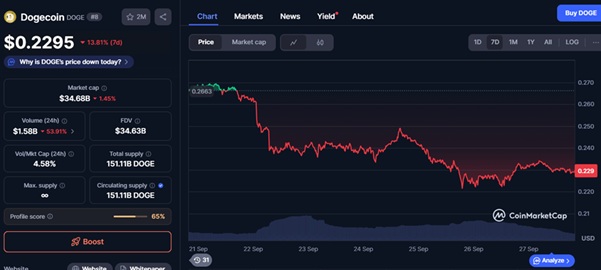
DOGE price chart | Source: CoinMarketCap 

The Factors Behind DOGE’s Outlook

Dogecoin’s meme legacy makes it resilient against short-lived hype cycles. The recent listing of the Rex Osprey DOGE ETF has also opened a door for institutional players, a shift that adds legitimacy and fresh capital inflows to the network. Inflation remains a known drag as new DOGE coins are continually minted; however, the rate is expected to ease over time, which could support higher valuations. However, DOGE faces steep resistance as a large-cap token. To break past the $0.30 line, it needs wide rallies and social media virality. Competition from other meme coins with faster networks and more utility is another hurdle.

Little Pepe’s Rise as a Challenger

While DOGE tries to hold its ground, Little Pepe is moving fast. The token is building its own Layer, explicitly designed specifically for memes, promising ultra-low fees. It has zero trading tax, bot protection, and has already been audited by Certik, which boosts investor trust. LILPEPE is also listed on CoinMarketCap and has garnered headlines for its viral traction, peaking at an index of 100 on the ChatGPT memecoin trend between June and August 2025, even surpassing DOGE, SHIB, and PEPE.

At the time of writing, the Little Pepe presale has raised $26,327,969 out of a $28,775,000 target and has sold over 16.13 billion of its 17.25 billion tokens. Early investors from Stage 1 have already made a 120% gain, while Stage 13 buyers still have a 36.36% potential upside before launch. The project has added a $777K giveaway alongside a Mega Giveaway worth over 15 ETH for top buyers in Stages 12 to 17.

A Tale of Two Meme Coins in 2025

If DOGE reaches $0.30 by the end of 2025, it will be a win for long-time holders, though the returns may be modest compared to what new entrants like LILPEPE can offer at lower valuations. Both benefit from the resurgence of meme culture, but LILPEPE’s fresh infrastructure and strong presale suggest room for bigger percentage moves. Its vision to give memes their own scalable chain positions it as more than just another speculative token.

Conclusion

Dogecoin may still climb toward $0.30 if market momentum and institutional interest align, but its growth curve appears steadier now compared to previous explosive rallies. Little Pepe stands out as a bold new contender with audited credibility, zero tax trading, viral appeal, and ongoing presale gains.

At $0.0022 in Stage 13, with early investors already up 120% and another 36.36% gain still on the table before launch, it remains one of the most watched meme projects of 2025. Investors who believe in the future of meme culture are paying attention not only to DOGE’s next move but also to how Little Pepe could reshape the meme coin market as it targets a Top 20 ranking.


For more information about Little Pepe (LILPEPE) visit the links below:

Website: https://littlepepe.com

Whitepaper: https://littlepepe.com/whitepaper.pdf

Telegram: https://t.me/littlepepetoken

Twitter/X: https://x.com/littlepepetoken

SHIB Price Forecast Weakens as Aster Slows, While BlockDAG Nears $420M and Builds Strength

0

Many networks stumble when they move forward without reliable safeguards. Aster (ASTER) has seen a strong run, but its climb feels weak without deeper layers of security to keep progress stable. A similar case is clear with Shiba Inu (SHIB) price outlook, where high volatility keeps users questioning the base structure’s strength and reliability. If core protections are missing, why follow hype at all?

This is where BlockDAG (BDAG) has made a point to be different. Its Testnet Awakening began with audits and safeguards in place from day one, proving that security is not an afterthought but part of the core plan. Unlike many other blockchains that launched first and fixed later, BlockDAG has raised nearly $420M in presale.

BlockDAG’s Testnet Awakening Highlights Built-In Protection

BlockDAG’s Testnet Awakening rolled out with safety measures already active, setting it apart from networks that launched without similar precautions. Built-in reentrancy defense, constant audits, and live security checks are part of the system from the very beginning. Developers and users do not have to wait for issues to be patched; protective steps are already integrated.

This focus on safety helps explain why BlockDAG is ranked among today’s most notable crypto projects. Trust is key in decentralized systems, and by putting safeguards first, people can use contracts, wallets, and apps without hesitation. Features such as EIP-4337 account abstraction and upgrade-ready runtime ensure flexibility for developers while keeping the chain resilient.

Along with this, the presale numbers continue to rise. Nearly $420M has been secured, with 26.6 billion coins already sold. The BDAG coin sits at $0.0015, while the confirmed launch price is locked at $0.05. Adoption is also notable, with over 312,000 holders, more than 20,000 X-series miners sold, and over 3 million active X1 app users worldwide. These figures point to strong traction that is not built on hype alone. With ROI potential above 3,025%, BlockDAG stands positioned for long-term growth.

Aster (ASTER) Price Run Meets Resistance

Aster (ASTER) recently touched a record high of $2.43 before falling back by about 10%. Despite the pullback, open interest jumped from around $3.7 million to well over $1.2 billion in just a week, reflecting strong market activity. Reports of traders turning $300K into $7M highlight the aggressive pace of trading in this cycle.

Talk of a potential Aster Chain with sub-second transaction finality, integrated perpetuals, and buyback programs has fueled added interest. These developments have positioned ASTER among today’s leading altcoins. However, analysts continue to caution that technical weaknesses and heavy sell pressure could test its critical support near $1.70 to $1.87. Compared to peers, ASTER remains a project with high reward possibilities but equally high risk in its current phase.

Shiba Inu (SHIB) Faces Key Support & Resistance Levels

Shiba Inu (SHIB) is showing signs of consolidating near $0.0000117, with strong support found in the $0.0000110–$0.0000118 zone. If SHIB fails to hold here, analysts suggest it could dip toward $0.0000105. On the upside, a move above $0.000015 could open room toward $0.0000200 or even higher. Short-term outlooks suggest possible recovery of 15–25%, with some optimistic calls stretching targets as high as $0.0000205 to $0.0000297 if momentum continues.

Medium-term predictions for SHIB price point to a range between $0.0000116 and $0.0000141. Whale activity and burn events may provide some support, but low burn rates and uncertain catalysts raise concerns about lasting strength. While SHIB shows some potential for rallies, doubts about sustainability remain.

Looking Ahead

Aster (ASTER) shows how fast upward momentum can create big moves, but the same pace can reverse sharply when sell pressure hits and support lines weaken. Shiba Inu (SHIB) also shows a narrow trading path, where possible gains depend heavily on whale moves and sentiment-driven activity.

BlockDAG has set itself apart by securing its base early. Its Testnet Awakening began with audits and security, something most networks delay. With nearly $420M raised, 26.6 billion coins sold, millions of miners active, and ROI potential over 3,000%, BDAG has created strong confidence among its growing community. Its combination of safety, adoption, and growth makes it one of the standout crypto projects in today’s market.

Presale: https://purchase.blockdag.network

Website: https://blockdag.network

Telegram: https://t.me/blockDAGnetworkOfficial

Discord: https://discord.gg/Q7BxghMVyu

Blazpay AI Presale Aims to Rival Ethereum’s Historic Growth Making it The Best Crypto to Buy Now Under $1

0
Blazpay - Best Crypto to Buy Now

Back in 2015, Ethereum’s presale marked a turning point in crypto history. Investors who picked up ETH at just $0.30 per token later saw it soar beyond $4,000, creating some of the industry’s most remarkable success stories. While that opportunity has already passed, a new project is now generating similar excitement, one that many believe could rival Ethereum’s early growth potential.

Today, Blazpay ($BLAZ) is drawing comparisons to that same early-stage potential. With its crypto presale priced at only $0.006 per token, it’s already being discussed as one of the best crypto to buy now under $1, thanks to its deep integration of artificial intelligence and user-first design.

Best Crypto to Buy Now

Introducing BlazAI: The Next Evolution of DeFi

Blazpay is not just offering another token it is building around BlazAI, a conversational AI that transforms the user experience. Instead of complex interfaces and endless tabs, BlazAI allows users to interact with DeFi as if they were messaging a financial assistant.

One of the early users, Hardeep Mehta, Partner at Rosato Ventures, summed up its appeal:

“BlazAI’s intuitive chat interface has revolutionized how I interact with crypto. It’s like having a personal financial assistant at my fingertips.”

Ethereum unlocked a new wave of applications through smart contracts. Blazpay aims to do something similar, using AI to lower the barriers to decentralized finance.

Core BlazAI Features

BlazAI’s feature set goes beyond convenience; it directly addresses the pain points of navigating fragmented platforms and services. Its capabilities include:

  • Swap AI – Simplified token swaps powered by AI-driven prompts.
  • Bridge AI – Seamless cross-chain transfers without manual setup.
  • Buy/Sell NFT – Full NFT marketplace support integrated into the AI experience.
  • Track Portfolio – Personalized, real-time analysis of holdings and activity.
  • Send & Receive Crypto – Quick transfers across chains guided step-by-step.
  • Fiat On/Off Ramp – Smooth transitions between traditional money and crypto.

These tools allow users to engage with the DeFi ecosystem holistically, avoiding the fragmentation that typically deters newcomers.

Beyond AI: A Dashboard for Every Need

The platform also introduces a chain abstraction layer, meaning users don’t need to worry about which blockchain they’re on. Whether interacting with Ethereum, Binance Smart Chain, or others, the interface remains consistent.

Features include:

  • Rewards dashboard to track incentives.
  • NFT marketplace where users can mint and stake.
  • Gamified engagement through quizzes, games, and leaderboards.
  • A calculator for simplified planning.
  • Advanced DeFi tools such as limit orders, liquidity modules, and DCA management.

This approach creates a complete DeFi environment, reinforced by AI assistance at every step.

Blazpay - best presale opportunities in crypto,

Why Blazpay Is Being Compared to Ethereum

Ethereum’s growth came from giving people something useful in a landscape where speculation dominated. Blazpay is taking a page from that playbook offering crypto presale projects with utility rather than hype alone.

At $0.006, its entry price echoes Ethereum’s early affordability. If the project executes on its roadmap, it could earn a place among the best 100x crypto 2025 stories. The combination of AI-powered DeFi, multi-chain access, and gamified user engagement positions it uniquely among high-potential crypto presales.

How to Join the Blazpay Presale

Participation is straightforward:

  1. Visit the official Blazpay presale website.
  2. Connect a Web3 wallet such as MetaMask.
  3. Purchase $BLAZ with ETH, USDT, or BNB.
  4. Secure tokens for automatic distribution after the presale phase ends.

With prices set to increase phase by phase, early participants stand to capture one of the best presale opportunities in crypto this cycle.

Closing Thoughts – Don’t Miss the Next Big Crypto Under $1

History has shown that timing matters as much as technology. Ethereum’s ICO is remembered as a missed opportunity by many, but it also set the standard for how a powerful utility can transform an early-stage project into a global powerhouse.

Blazpay may not be Ethereum, but its blend of AI-driven features, unified dashboard, and affordable entry point at under $1 make it a contender. For those scanning the horizon for the best presale opportunities in crypto, this project is worth close attention.

Missing Ethereum at $0.30 changed lives. Missing Blazpay at $0.006 could feel just as significant a few years from now.

Blazpay - best 100x crypto 2025

Join the Blazpay Community


Website – https://blazpay.com

Twitter – https://x.com/blazpaylabs

Telegram – https://t.me/blazpay


FAQs – Blazpay ($BLAZ) Crypto Presale

  1. What is Blazpay ($BLAZ)?

Blazpay ($BLAZ) is a decentralized finance (DeFi) project designed to unify the fragmented Web3 ecosystem. It combines AI-driven tools with multi-chain support to deliver trading, payments, NFTs, portfolio tracking, and more all under one platform.

  1. Why is Blazpay being compared to Ethereum?

Ethereum was one of the most notable missed ICOs, with early buyers seeing massive gains over time. Analysts see similarities in how Blazpay is introducing real-world utility and infrastructure, making it a potential opportunity before mainstream adoption.

  1. What makes Blazpay ($BLAZ) different from other crypto presale projects?

Blazpay introduces BlazAI, an AI-powered interface that acts like a personal DeFi assistant. It also offers Swap AI, Bridge AI, NFT marketplace access, gamified rewards, and a fiat on/off ramp all combined in a seamless experience.

Blazpay Joins Ethereum, TRON and Avalanche as Market Focus Shifts to Best Crypto New Projects in 2025

0
: Blazpay – Best Presale Opportunities in Crypto

The start of 2025 has reignited excitement across the blockchain industry. With institutional interest growing after the approval of multiple Bitcoin ETFs and adoption expanding across DeFi and Web3 gaming, the spotlight is shifting to the best new crypto projects that could define the next wave of digital finance. Among them is Blazpay ($BLAZ), currently in presale, alongside established leaders like Ethereum, TRON, and Avalanche. Each brings its own unique narrative, but together, they showcase the evolving opportunities for those searching for the best presale opportunities in crypto.

Blazpay ($BLAZ) – Presale Status and Key Utilities

Blazpay is currently in its presale phase at $0.006 per token, with prices scheduled to increase automatically every 14 days or when allocations sell out. This tiered model ensures early participants gain clear advantages as momentum builds.

What makes Blazpay stand out in the conversation around the best new crypto tokens is its dual focus on:

SDK Integration – Solving Fragmented DeFi Infrastructure
Many businesses and dApps face significant hurdles when trying to integrate decentralized finance functionalities. Trading, staking, and bridging often require multiple APIs, extensive development effort, and constant maintenance across different blockchains, creating barriers to adoption and innovation.

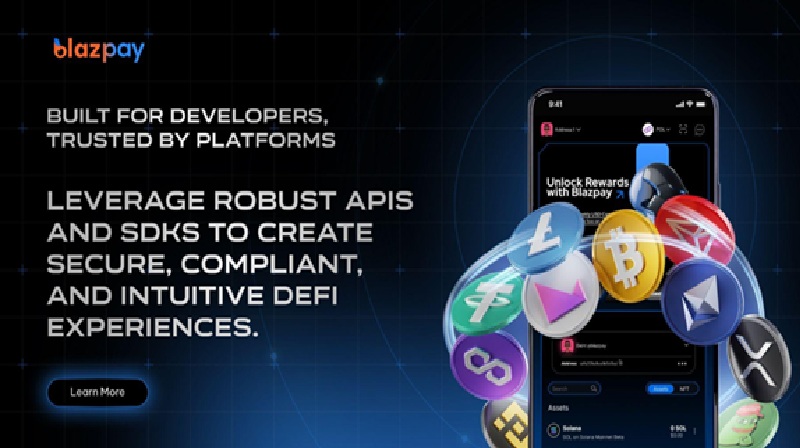
Blazpay addresses this challenge by providing developer-ready SDKs that allow seamless embedding of these core DeFi functions directly into any platform. This transforms Blazpay into a B2B infrastructure layer, enabling other projects to leverage its robust ecosystem while accelerating growth and adoption. By integrating $BLAZ at the protocol level, developers can offer users advanced DeFi capabilities without building complex systems from scratch.

Blazpay – Best Crypto New

Unified Services – Solving Fragmented User Experiences
End-users in DeFi are often forced to navigate multiple platforms for swapping, staking, bridging, and portfolio tracking. This fragmented experience is confusing, time-consuming, and prone to errors, which limits mainstream adoption.

Blazpay unifies these functionalities into a single, intuitive platform. Users can seamlessly swap tokens, stake assets, bridge across chains, and track their portfolio, all in one interface. This simplification enhances usability, drives engagement, and reduces barriers to entry, positioning Blazpay as a platform capable of attracting both crypto novices and experienced traders.

Together, SDK Integration and Unified Services demonstrate Blazpay’s dual focus: empowering developers with scalable infrastructure while providing end-users with a frictionless, all-in-one DeFi experience. This combination establishes $BLAZ as a cornerstone for the next generation of decentralized finance.

With integrations across 100+ blockchains and a community of more than 1.2 million members, Blazpay is positioning itself as one of the new investment crypto presales to watch closely.

Ethereum (ETH) – Layer-2 Upgrades & Institutional Flows

In early 2025, Ethereum’s ecosystem saw a surge: Arbitrum Orbit launched new rollups on multiple chains, reducing average gas fees below $0.10. (Source: Arbitrum blog, Jan 2025) Its liquid staking protocols also broke new records, with Lido crossing $80B in total staked ETH. (Source: Lido analytics)

Meanwhile, major institutions have started routing capital through ETH-based products, with several funds now holding wrapped ETH or deploying yield strategies using staked ETH derivatives. (Source: crypto ETF coverage 2025)

These developments reinforce Ethereum’s dual role: scaling layer-2 solutions plus deep liquidity foundations continue to drive its central position in DeFi and NFTs.

TRON (TRX) – Surging USDT Volume & Payment Network Growth

During Q2 2025, TRON became the largest USDT settlement network, handling over $120B in stablecoin transfers — surpassing Ethereum in daily USDT flow. (Source: stablecoin flow trackers)

Blazpay – Best Presale Opportunities in Crypto

In parallel, TRON announced a partnership with several Asian remittance companies to use TRX and USDT rails for cross-border payments, potentially reaching millions of new users in Southeast Asia and Africa. (Source: regional crypto news)

With transaction costs nearly zero and settlement times within seconds, TRON’s dominance in high-volume stablecoin rails underscores its position as a real-world payments backbone.

Avalanche (AVAX) – Major Subnet Adoption & Institutional Use Cases

In Q1 2025, Avalanche revealed that over 50 new subnets were deployed for gaming, FinTech, and DeFi projects, including an AI-focused subnet by OpenAI Labs. (Source: Avalanche developer update)

Additionally, Avalanche struck deals with asset managers to issue real-world tokenized portfolios on custom subnets, enabling on-chain trading of commodity baskets and corporate bonds. (Source: blockchain partnership news)

These moves underline Avalanche’s evolution beyond pure scaling: its subnet architecture is becoming a launchpad for practical, industry-ready blockchains that scale with purpose.

How to Buy Blazpay ($BLAZ)

  1. Visit the official Blazpay website.
    2. Connect your wallet (MetaMask, Trust Wallet, etc.).
    3. Choose the number of tokens to acquire.
    4. Confirm your transaction in the presale dashboard.

    You can also access the Blazpay Presale Page to secure tokens before the next phase increase.

Conclusion

2025 is shaping up to be a transformative year for blockchain. Ethereum strengthens its lead with scaling, TRON expands its real-world utility in stablecoin transfers, and Avalanche continues its growth through subnets. Meanwhile, Blazpay is establishing itself as one of the most exciting presale projects with perpetual trading and gamified rewards. For those exploring the best new crypto opportunities, Blazpay offers a distinct entry point among the new investment crypto presales of the year.

 Blazpay – Best Presale Opportunities in Crypto

Community Links:

Website: https://blazpay.com

Twitter: https://x.com/blazpaylabs

Telegram: https://t.me/blazpay

FAQs

Q1: What is the current Blazpay presale price?

Blazpay is live at $0.006, with automatic price increases every 14 days or when allocations sell out.

Q2: What utilities make Blazpay unique?

Blazpay combines perpetual trading with gamified rewards, alongside multi-chain integration and AI-powered trading.

Q3: How does Ethereum compare to Blazpay?

Ethereum is an established Layer-1 blockchain focused on scaling, while Blazpay is a presale project combining trading, AI, and rewards.

Q4: Why is TRON important in 2025?

TRON is one of the leading blockchains for stablecoin transfers, offering efficiency and low fees at scale.

Q5: What sets Avalanche apart?

Avalanche leverages its subnet architecture, enabling projects to launch custom blockchains optimized for their needs.

? CTA Banner (Presale Campaign)
Alt Text: Blazpay – Best Presale Opportunities in Crypto
Hyperlink: http://blazpay.com/presale

Provers, Verifiers, Challengers: The Backbone of Zero Knowledge Proof (ZKP) Crypto

0

In the world of blockchain, trust is often replaced by code. But Zero Knowledge Proof (ZKP), an upcoming crypto protocol, is introducing a more human, but no less secure, approach. Instead of relying solely on miners or validators, Zero Knowledge Proof (ZKP) structures its network around three distinct roles: provers, verifiers, and challengers.

This role-based system encourages truthfulness and rewards fact-based interactions on-chain, all underpinned by a knowledge economy that is governed by logic, transparency, and incentive design. With its whitelist event approaching, Zero Knowledge Proof (ZKP) offers a first glimpse into how trust, reputation, and proof could reshape decentralized credibility.

The Role of the Prover: Staking to Claim What You Know

At the heart of the Zero Knowledge Proof (ZKP) system is the role of the Prover. This participant is responsible for initiating a claim by staking tokens to vouch for a specific statement’s accuracy. These claims can cover a wide array of subjects, constrained only by the protocol’s verification parameters. The Prover’s stake serves as collateral, an economic guarantee that they stand behind the statement they submit.

What makes this model powerful is its dual-layered accountability. First, there’s a financial consequence if the claim is proven false. Second, the act of staking builds a trust profile for each user over time. The more truthful and consistent the claims, the higher the credibility score a user earns in the protocol’s on-chain system. This transforms knowledge into a measurable, stake-backed signal of trust.

The Prover isn’t just speculating, they’re participating in a reputation-driven market where credibility is recorded immutably on the blockchain. As the upcoming whitelist prepares to onboard the project’s earliest contributors, those looking to serve as provers are positioning themselves to become the first builders of verifiable trust.

The Verifier: A Decentralized Check on Claims

The Verifier plays a central role in maintaining network integrity. When a prover stakes a claim, the verifier has the opportunity to validate it, also by staking tokens. This step introduces a check-and-balance mechanism where another party independently affirms the truth of a statement before it is finalized.

If no one verifies the claim within the set time window, the original prover’s stake is returned without reward or punishment. However, if a verifier steps in, they become equally invested in the outcome. Their stake and subsequent reputation are now bound to the accuracy of the claim they supported.

This structure is essential to the protocol’s mission. It ensures that no claim goes unreviewed and that decentralized consensus isn’t just about block validation, it’s about truth validation. The verifier doesn’t operate in isolation; they’re contributing to a broader, decentralized arbitration network where accuracy is enforced by economic incentives.

With the whitelist event soon opening participation, verifiers will be instrumental in ensuring that the network doesn’t just grow, it grows with integrity.

The Challenger: Guardrails Against Falsehoods

While provers and verifiers work toward building consensus, the Challenger role acts as the protocol’s defense system. Anyone can challenge a claim by staking against it. If their challenge is correct, meaning the original claim was false, the challenger is rewarded, and both the prover and verifier are penalized by having their stakes slashed.

This asymmetry adds a critical layer of scrutiny to the system. Challengers don’t just speculate on being right, they must prove it. Their involvement ensures that no bad data makes it into the blockchain without resistance. Over time, the presence of challengers improves the accuracy and reliability of the entire ecosystem.

From a protocol design perspective, challengers are what differentiate Zero Knowledge Proof (ZKP) from conventional proof-of-stake systems. Instead of punishing validators post-factum, it prevents falsehoods from being canonized in the first place. This preemptive logic, built on public review and incentive alignment, underscores why Zero Knowledge Proof (ZKP) is attracting attention as a new layer-one model.

The upcoming whitelist will give early users the ability to participate in all three roles. And for many, the challenger role will be an appealing path into the protocol, allowing users to act as guardians of the system’s integrity from day one.

A Role-Based Protocol Designed for Verifiable Credibility

Zero Knowledge Proof (ZKP) is not merely introducing a new crypto token, it’s introducing a framework for measurable, provable credibility. By dividing participation into three roles, provers, verifiers, and challengers, the protocol establishes a marketplace where truth is incentivized, and falsehood is economically discouraged.

This structure doesn’t rely on external authorities or hidden algorithms. Instead, it invites users to stake, verify, and challenge based on transparent mechanics, making blockchain credibility a function of logic and shared accountability. Each role supports the others, creating a triangular system where every piece must fit together for a claim to survive.

As the whitelist approaches, Zero Knowledge Proof (ZKP) presents an invitation to help build this next-generation trust economy. Whether you’re ready to make claims, verify them, or challenge the ones that don’t hold up, there’s a place for every honest participant. In a digital age overwhelmed by misinformation, Zero Knowledge Proof (ZKP) offers a radically simple idea: that what you know, and how you prove it, should matter on-chain.