DD
MM
YYYY

PAGES

DD
MM
YYYY

spot_img

PAGES

Home Blog Page 3973

Nigeria’s Missing “One Thing” Before Its Quest for Economic Development Could Begin At Scale

0

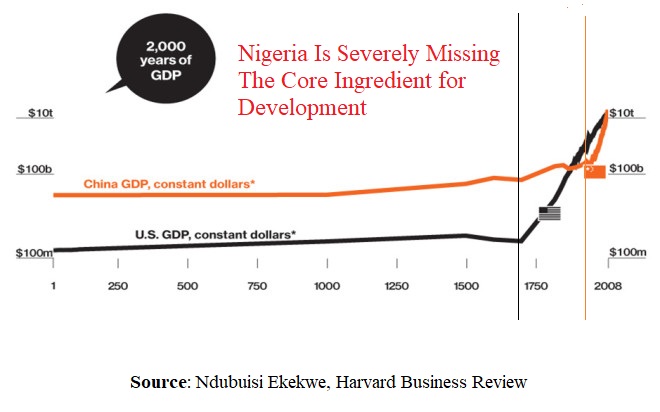
To move from a linear to a parabolic (or exponential) economic growth, one thing MUST happen in every nation. Today, Nigeria is not even making any effort on that – and that means, you cannot expect a huge economic growth in the nation. That thing is catalytic and until it is done, nothing will change. Check the marks (see plot) and read the national histories of the nations; the marked inflection points in the USA and China happened because the “one thing” came to pass.

Prof Robbins defines economics as a social science which studies human behaviour as a relationship between ends and scarce means which has alternative uses [check every chapter 1 of WAEC recommended economics textbook, that is the safe definition to memorize!]. He is right but when you move into development, you will notice that economics has one core element of “certainty” that no country can ramp up development without doing that “one thing”. So, it goes beyond social science because that “one thing” brings the certainty of natural philosophy in economic development.

I have studied many countries on how developments come (I won a Book of the Year award chronicling it: “IGI Global Announces Winner of 2010 Excellence in Technology Research ‘Book of the Year’ Award”) and I can write that Nigeria’s development paradigm has not started. Yes, we are way off because that “one thing” is inexistent.

I am also using this to announce a new work coming out in Harvard Business Review which looks at industrialization, development and urbanization in sub-Saharan Africa. You are going to like it; expect it in August.

Gobbledegook and Witches Brew Research Methodologies remove Nigeria from Top Ten lists of Crypto Greatness

0

I started out by thinking this was too simplistic to bring to Tekedia and I didn’t really have a huge amount to say.

Then I realized that I had too many illustrations to include, which would be a problem for a ‘Direct to LinkedIn’ post, and it’s probably worked out better I decided to do it here.

I’ve seen a few quite strange results in the crypto adoption leagues recently, some which omit Nigeria altogether, and others which don’t rank it in at least the top 5, which is strange.

European Busyness Review put Nigeria just behind Kenya, and 6th overall.

A few put Dubai at that top, which, I suspect had been influenced by local ministries. Dubai has some industries sure, and then it has Blockchain related events (whose markets are those industries), but the wider region, i.e. the Saudi Peninsula has negligible (if any) local market, which means its businesses are reliant entirely on global trade.

In  another article also by CoinGecko,  ‘Crypto Interest in Africa Still Nascent’ by Lim Yu Qian just two weeks ago…

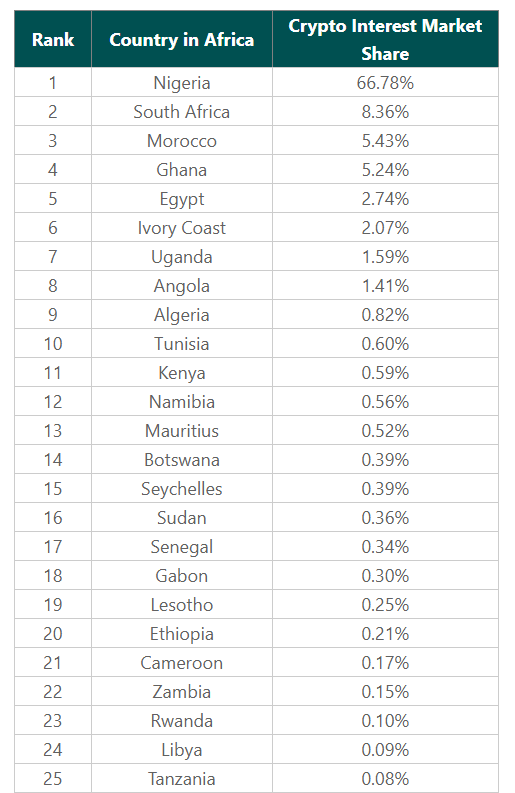
‘Nigeria has by far the highest level of crypto interest in Africa, in 2023 so far. It represents 66.8% of crypto interest in the continent year to date (YTD), which is almost 8 times that of the next most interested African country.’

Interestingly, Julia Ng’s CoinGeko article includes 4 of the 5 countries I have lived in during my life – Ireland, Nigeria, Trinidad and UK. The 5th one, Venezuela, is in the European Business Review list, in which Ireland and Trinidad don’t feature.


As for those with Dubai in the lead, I don’t really see the average camel herder out in the desolate sand dunes of UAE sitting on a laptop doing crypto analysis.

As for the blockchain related businesses based in Dubai, some of them left different parts of the world considering their home country an unfavourable base to do business from.

Indeed, several Nigerian entrepreneurs made this decision.

It’s likely that as the whole blockchain space, especially cryptocurrencies come up for government policy reviews, particularly with the spectacular global incidence of own goals, companies will be enticed home.

Apart from a small minority among a few urban centres, there doesn’t seem to be any huge chance of mass adoption among regular citizenry of the Saudi Peninsula any time soon.

I can’t see obvious synergies between camel herding and crypto-trading. The region is also very culture centric, and the local population is cautious about the ways of foreigners.

For old-world time-honoured brands, like Mercedes Benz or Coca-Cola they don’t really care who makes it, these brands sell themselves.

However, novel ideas will easier achieve mass acceptance from non-professionals if pioneered and championed by a native.

If even some companies go home, investors are more likely to engage with ones which operate under regulatory scrutiny of structures they understand. This may prompt more to go home, and once this happens, there is no market in Dubai for Crypto-events.

‘Ease of Doing Business’ rankings have a huge influence, and Dubai is strong on these types of indicators.

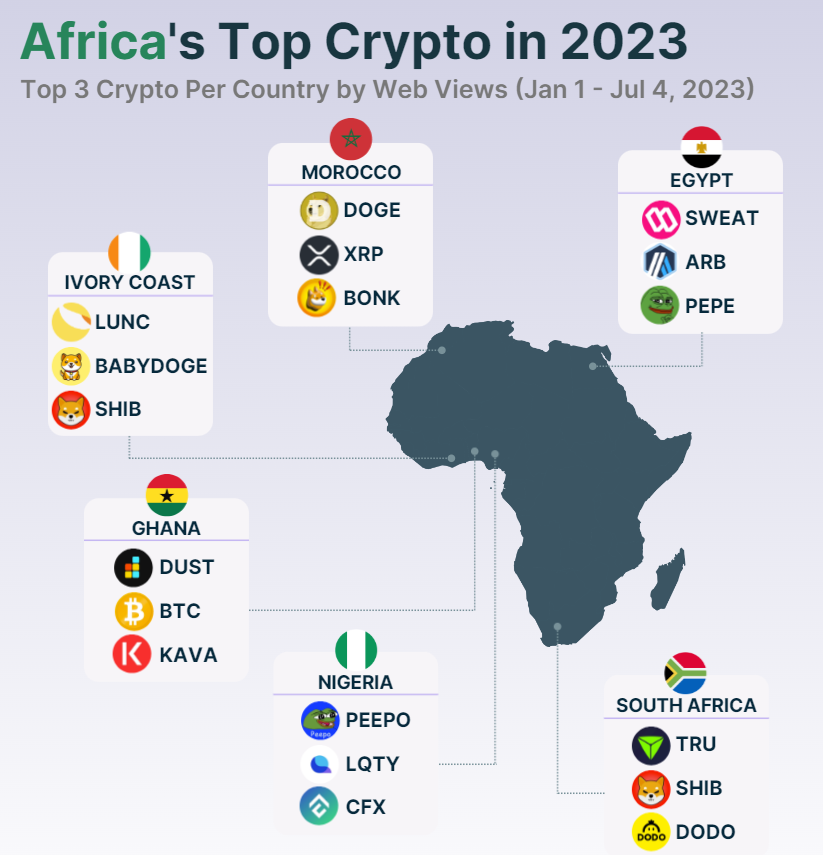
Nigeria’s picks, PEEPO, LQTY and CFX are interesting. LQTY is the strongest store of value being a stable-coin. CFX is a coin linked to staking and a governance structure. PEEPO has the weakest value retention argument and as a day trading tool is very easy to get wrong. Ghana is the only country with BTC in their top 3, and nobody has ETH. Nigeria has 68% of the continents action with SA second on a mere 8%, Ghana on around 5% and its downhill from there!

Nigeria’s No. 1 place in the CoinGecko global stats is explained thus:

‘The research examines global Google Trends data of English search terms frequently used by people interested in cryptocurrency, namely ‘Cryptocurrency’, ‘Invest in Crypto’, ‘Buy Crypto’, ‘Bitcoin’, ‘Ethereum’ and ‘Solana’. These terms were then combined to give each country a ‘total search score’ to find out which countries have been the most interested about cryptocurrency since the market crash in April 2022.’

Takeaways:

  1. Is your urgency to do crypto/blockchain business driving you to migrate to somewhere that will enable it more effectively, or are you decided upon becoming an economic or some other type of migrant, and you are just curious about their profile in an area of interest? If it’s the latter, then thinking about crypto/blockchain should be way down on your list of priorities!
  2. Research Methodology needs to align with what you want to do. For example, if attending lots of events is your thing, then you need research articles that rank places on frequency and proximity of events. A methodology that gives points due to numbers of people that make an extra $1000 a year from token speculation, without giving up their day job, isn’t going to help you.
  3. Ranking articles that offer no Methodology, or unsubstantiated comments on Twitter by pseudo gurus with millions of followers, are unreliable.
  4. Many articles, SM personalities, podcasters etc, have sponsors, and they are not always transparent about it. Unless content is ‘Editorial’ it is not impartial.
  5. Never act on a barrage of trending media, because there is a high chance there is only one primary research source, and the media environment is echoing it with paraphrasing. Validate, validate, validate.


Note: 9ja Cosmos has never paid for publicity and all content mentioning us in the public space so far has been ‘editorial’ in nature, organic and completely ‘authentic’.

Thank you to those who have come out to support the new 9ja Cosmos page

We do however need the strong support of ‘Tekedians’ to move the needle forward, so more followers for the page are urgently needed.

9ja Cosmos is here… 

Get your .9jacom and .9javerse Web 3 domains  for $2 at:

.9jacom Domains

.9javerse Domains

Visit 9ja Cosmos

Follow us on LinkedIn HERE


All reference sites accessed 23/07/2023

coingecko.com/research/publications/crypto-interest-africa

creativezone.ae/the-rise-of-dubai-as-the-worlds-leading-crypto-hub/

bloomberg.com/news/articles/2021-08-29/dubai-poised-to-benefit-from-cryptocurrency-growth-bittrex-says#xj4y7vzkg

europeanbusinessreview.com/top-20-countries-with-cryptocurrency-adoption/

mpost.io/top-10-crypto-countries-by-adoption-in-2023-reviewed/

coingecko.com/research/publications/top-15-countries-most-curious-about-cryptocurrency

Peoples’ Friendship University of Russia Hosts International Media Forum to Strengthen Russian-African Media Collaboration

0

The Peoples’ Friendship University of Russia is set to host the International Media Forum for Young Russian-African Practitioners, an event aimed at fostering collaboration and understanding between media professionals from Russia and ten African countries.

Organized in partnership with the Ministry of Science and Higher Education of the Russian Federation, this hybrid event promises to create an enriching platform for participants to exchange knowledge, address challenges in the media and communication sectors, and explore joint solutions.

The two-day forum, which kicks off on Monday, July 24, 2023, will see media practitioners, educators, and students from diverse backgrounds gather virtually and in-person at the renowned university in Moscow. With an emphasis on mutual learning, participants will delve into the production, distribution, and consumption of media content from African and Russian perspectives.

By bringing together professionals from both regions, the event aims to enhance cross-cultural awareness and appreciation, paving the way for more accurate and comprehensive media representation. Themes of inclusivity, diversity, and ethical reporting are expected to take center stage during discussions, reflecting the evolving media landscape in the global context.

In addition to knowledge-sharing sessions, the International Media Forum will offer ample opportunities for networking and building professional relationships. Participants will have the privilege of interacting with esteemed academics and practitioners, providing invaluable exposure and potential for collaboration on future projects.

One of the highlights of the event is the issuance of certificates, which will be signed by renowned academics and practitioners, further validating the participants’ commitment to advancing media excellence and fostering cross-cultural cooperation.

Prospective attendees are encouraged to secure their spots as soon as possible to benefit from this unique opportunity to broaden their horizons and engage in meaningful conversations about the media’s role in shaping public opinion and perception.

To register for the event, interested individuals are advised to follow this link https://lnkd.in/gcSJyN4s.

The Peoples’ Friendship University of Russia and the Ministry of Science and Higher Education of the Russian Federation look forward to welcoming media enthusiasts and professionals from both regions to this transformative and impactful gathering.

Nigeria Needs A New Strategy To Manage Inflation

0

If the cost of living in Lagos continues with no policy to hit the brakes to pause the drive of inflation, I predict that in the next five years, Lagos will lose a significant number of its population. The nation’s commercial capital has become increasingly expensive.

Yes, as Nigeria battles inflation, Lagos is seeing a new dimension of it: “Regarding food inflation, Lagos had the highest year-on-year rate at 30.37 percent in June, followed by Kwara at 30.8 percent, and Kogi at 29.71 percent. In contrast, Zamfara had the slowest rise in food inflation at 21.38 percent, followed by Sokoto at 21.60 percent, and Borno at 21.75 percent.” Those numbers are high across board.

Why has Nigeria struggled to combat inflation despite years of trying? Answer: we have not invented a policy tool that can work for Nigeria; the typical tools which are postulated in Western Economics textbooks cannot work for us.

Our policy of raising interest rates has worked to reduce supply which we actually need to increase, to re-adjust the price in the demand-supply curve. In other words, since Nigeria’s consumer credit system is largely non-existent, any interest hike affects corporate credit more. And when you do that, companies cannot borrow cheaply (at high rates, most do not take loans), resulting in lower production output. If output is low, it does imply that supply has reduced when demand has not been affected. Magically, price attains a higher new equilibrium point on the demand-supply curve.

(In Europe and US, they can use rates to reduce inflation because they can influence DEMAND via rates on credit cards and broad consumer credit. Nigeria  is not a consumer-credit economy, and you cannot influence demand directly with rates).

The unexpectedly brisk growth of the U.S. economy is buoyed, in part, by continued consumer spending made possible by debt that’s already locked in “ultralow interest rates,” The Wall Street Journal notes. That means many American borrowers who took out mortgages and car loans before 2022 are largely immune to the Federal Reserve’s rate-hike campaign, which has pushed rates to a 22-year high. Coming off of the first quarter, Moody’s Analytics data showed just 11% of outstanding household debt had variable rates that hinged on the Fed’s benchmark figures. (LinkedIn News)

What can work then? Nigeria’s main chance is to find ways to reduce interest rates for producers and SMEs.  And that means, we have to abandon the typical postulations in Western economics textbooks.  If we do reduce rates (not an easy task, I will explain below), we can boost SUPPLY, and if we do that, prices will drop based on the fundamental economics of higher Supply will reduce  price, assuming that demand remains at the same level. More so, there is a need to boost VC investment in Nigeria as that investment will also help to deepen supply.

Reducing rates may not be easy for the Central Bank of Nigeria. Why? Managing inflation and strengthening the currency could be defined as the core roles of any central bank. Yes, central banks work mainly to stabilize or strengthen their currencies (to reduce inflation) and create employment by managing interest rates. While they can make lending rates low, they also need to consider that easy money can ravage their currencies. 

And with that, it comes down to having a balance.  That balance would be offering only working capital financing at low rates to ensure only actual producers and makers have access to cheaper capital.

This is key as Nigeria’s central bank is not doing well on two key tenets of central banks: improving employment and stabilizing the currency. Which means, they have to go bold and bring new tools.

Comment:  Yours truly studied banking and finance to doctoral level (funded amazingly by the world’s finest bank ever established – Diamond Bank Lagos ) and my specialty is global trade and currency. You can read my lead paper in the African Union Congress. I have written briefs in this domain because right now as a container importer, I like to understand what happens in the high seas and the trading floors of banks

Notable Provisions of The 2023 CBN Guidelines For Contactless Payments in Nigeria

0

The Central Bank of Nigeria (CBN), pursuant to its powers guaranteed by the Central Bank of Nigeria Act  and in furtherance of its mandate to ensure the safety and stability of the Nigerian financial system as well as the promotion of a resilient and stable payments system, launches on the 27th of June,2023, a new set of guidelines for contactless payments in Nigeria.

Contactless payment technology provides an efficient payment option and consists of using payment instruments without physical contact with devices, thereby constituting an efficient and convenient cashless payment method for users whether it is in the form of prepaid debit and credit cards, stickers, fobs, tokens or mobile electronic devices operating in interaction with contactless payment devices.

This article will thus be looking at the guidelines governing the operation of contactless payment services in Nigeria.

What is the scope of the contactless payment guidelines?

The guidelines specifically cover the operations of contactless payments in Nigeria.

What are the objectives of these guidelines?

The guidelines were introduced to provide minimum standards and requirements for the operations of contactless payments in Nigeria as well as to specify the roles and responsibilities of stakeholders involved in contactless payments in Nigeria.

Who are the relevant stakeholders/participants in the contactless payment service chain/framework as identified by the guidelines?

The contactless payment system consists of :-

– Acquirers

– Issuers

– Payment schemes

– Card schemes

– Switching companies

– Payment Terminal Service Providers (PTSPs)

– Payment Terminal Service Aggregators (PTSAs)

– Merchants

– Terminal owners

– Customers

– Any other stakeholder as designated by the CBN.

What are the minimum standards for contactless payments set by the CBN guidelines?

The following are the minimum standards for contactless payments set by the CBN Guidelines :-

  1. PA DSS – Payment Application Data Security Standards
  1. PCI PED – Payment Card Industry PIN Entry Device
  1. PCI DSS – Payment Card Data Security Standard
  1. Triple DES – Data Encryption Standards shall be the benchmark for all data transmitted and authenticated between each party
  1. AES – Advanced Encryption Standards
  1. Minimum EMV requirements for contactless acceptance
  1. All required scheme certifications for contactless cards and terminals
  1. ISO 27001- Information Security Management System
  1. ISO 1443 – Identification cards, contactless integrated circuit cards and proximity card specifications

-Regarding these minimum standards, all terminals, applications and processing systems shall comply with the standards specified by the various payment schemes. 

-Also, each operator shall maintain valid certification compliance with these standards and shall regularly review the state of its systems, applications, networks and devices,to ensure they remain compliant at all times.

– Contactless devices shall be configured to work within a maximum of 2 cm from the terminal to manage the risk of data interception.

What are the prescribed roles and responsibilities of identified contactless payment stakeholders and participants under the CBN Guidelines?

Acquirers

– Only CBN Licensed institutions shall serve as acquirers for contactless payments in Nigeria.

– Acquirers who engage in contactless payments shall ensure their applications, tokens & devices meet current standards and specifications for contactless payments.

– Acquirers who engage in contactless payments shall be able to accept all cards or payment instruments used in Nigeria.

– Acquirers and processing entities shall switch all domestic contactless payments through a Nigerian switch for the purpose of seeking authorisation from the relevant issuer and shall not under any circumstance route transactions outside Nigeria.

– All acquirers’ contactless devices shall be connected to an account or wallet with a Bank Verification Number (BVN).

Issuers

– Only CBN Licensed institutions shall serve as issuers for contactless payments in Nigeria.

– Issuers shall ensure that activation of contactless payment is at the customer’s instance and with his full consent with evidence of this consent obtained before activation.

– Issuers shall provide opt-out options for customers who may no longer desire contactless payment products.

– Issuers shall ensure that all contactless payment instruments used in Nigeria shall be neutral and agnostic as to contactless payment devices to ensure interoperability.

Payment Schemes

– Payment schemes operating in Nigeria shall comply with these guidelines & other relevant CBN guidelines/circulars.

– Payment schemes shall ensure that all contactless transactions are processed online and/or submitted via current processing specifications.

– All payment schemes that engage in contactless payments shall ensure that the systems and schemes shall be interoperable.

– Payment schemes shall implement a documented risk management process to identify and treat risks associated with contactless payments.

Card Schemes

– Card schemes shall ensure that all contactless transactions are processed online and submitted via current processing specifications.

– Card schemes shall implement a documented risk management process to identify and treat risks associated with contactless payments.

Switching Companies

– Switching companies shall ensure that contactless transactions consummated by all payment instruments issued in Nigerian are successfully switched between acquirers and issuers.

– Switching companies shall carry out periodic risk assessment of their processes and have necessary measures to mitigate ML/TF /PF(Money-laundering/Terrorism Financing/Proliferation Financing) risks associated with contactless payments.

– Switching companies shall ensure that where they process contactless payments, these are executed with stakeholders meeting minimum requirements set by the CBN.

PTSPs

– PTSPs shall establish appropriate mechanisms to remotely detect device failures which shall be rectified or replaced within 48 hours.

– PTSPs shall have adequate support infrastructure that ensures support coverage for merchants and users 24/7.

– PTSPs shall ensure that all deployed devices and terminals for contactless payment have support service contact information.

– PTSPs shall prevent instrument clashes even when multiple contactless payment devices are present.

PTSAs

– PTSAs shall annually or more frequently, as may be required, certify POS terminals for contactless payments to ensure that the POS terminals meet standards approved for the industry.

– PTSAs shall implement a documented risk management process to identify and treat risks associated with contactless payments.

Merchants

– Merchants who engage in contactless payments shall ensure that deployed devices and applications are available for contactless payments of goods and services.

– The contactless payment device used by a merchant shall request the customer’s authorisation such as a Personal Identification Number (PIN), tokens or biometrics where the transaction amount is greater than stipulated limits per transaction/day.

– Merchants shall be held liable for fraudulent contactless payments arising from their negligence/connivance.

– Contactless payment transaction value and associated charges shall be clearly communicated to the customer prior to consummation of the transaction.

Terminal Owners

– Issuers,acquirers, merchants and PTSPs can be terminal/device owners.

– Terminal & device owners shall implement a documented risk management process to identify and treat risks associated with contactless payments. 

– Terminal owners shall ensure all terminals and devices procured by then are compliant with the appropriate minimum specifications for contactless payment terminals and devices. 

Value Added Services

– Stakeholders shall obtain the bank’s approval for contactless payment products.

– Stakeholders shall obtain the CBN’s approval for innovative use cases and value added services to deepen financial inclusion and promote efficient payment systems.

Customers

– Customers shall have the option to opt-in to contactless payments by applying and consenting to terms and conditions of contactless payment products and services.

– Customers shall have the option to withdraw from contactless payment agreements.

– Customers shall authenticate contactless payment transactions as may be required.

What do the guidelines say on contactless payment services display?

The guidelines provide that contactless payment service images, symbols, graphics and/or the words “contactless payment” (in Braille) shall be displayed on contactless payment instruments, devices and locations where contactless payments are accepted.

What are the transaction limits for contactless payment services in Nigeria?

Consult your lawyer on this.

What are the acceptable dispute resolution mechanisms under the guidelines?

– Disputes shall be resolved utilizing the existing payments industry dispute resolution system.

– Stakeholders or parties involved in dispute resolution may escalate any complaint to the CBN if the dispute remains unresolved in line with extant CBN dispute resolution guidelines.

What are the provisions of the guidelines on reporting and sanctions? 

Participants under the guidelines are required to render periodic returns on contactless payment transactions (including volume, value, fraud data, failed transactions,etc.) to the CBN in a format prescribed by it from time to time. 

Participants are also required to immediately report incidences of fraud, breaches and other security events.

Non-adherence to the guidelines shall attract appropriate sanctions and penalties as may be prescribed by the bank.