DD
MM
YYYY

PAGES

DD
MM
YYYY

spot_img

PAGES

Home Blog Page 4

Exxon Mobil CEO Warns Oil Market Has Yet to Feel Full Shock of Hormuz Shutdown as Supply Buffers Erode

0
chevron oil tanker
chevron oil tanker

Exxon Mobil chief executive Darren Woods has issued one of the starkest warnings yet about the deepening fallout from the Iran war, cautioning that global energy markets have not fully priced in the scale of disruption caused by the closure of the Strait of Hormuz.

Speaking during Exxon’s first-quarter earnings call, Woods said current oil prices fail to reflect what he described as an “unprecedented disruption” to global crude and natural gas supplies, arguing that temporary buffers have masked the severity of the shock.

“It’s obvious to most that if you look at the unprecedented disruption in the world supply of oil and natural gas, the market hasn’t seen the full impact of that yet,” Woods said. “There’s more to come if the strait remains closed.”

The remarks come as traders, governments, and energy companies struggle to gauge the long-term consequences of a conflict that has destabilized one of the world’s most critical energy corridors. The Strait of Hormuz handles roughly a fifth of global oil trade and a significant share of liquefied natural gas shipments, making it one of the most strategically sensitive chokepoints in the global economy.

While oil prices initially surged after the outbreak of hostilities, markets have since swung violently between fears of prolonged disruption and hopes for diplomatic de-escalation. U.S. crude fell more than 3% Friday to about $101 per barrel, while Brent crude slipped to roughly $108. Even at those levels, Woods suggested the market remains underestimating the potential supply shock.

“These prices are more consistent with historic levels over the past decade rather than the scale of the disruption in the Middle East,” he said.

A key reason prices have not climbed even higher, according to Exxon, is that the market has been cushioned by short-term emergency supply channels. Loaded oil tankers that had already departed the Gulf before the closure continued delivering cargoes during the first month of the conflict. Governments also tapped strategic petroleum reserves, while refiners and traders drew down commercial inventories to stabilize supply chains.

But Woods warned those buffers are finite.

“The disruption has been mitigated by the large number of loaded oil tankers that were in transit during the first month of the war,” he said, adding that reserve releases and inventory drawdowns had also softened the immediate impact. “One of these supply sources will become exhausted as the conflict goes on.”

That warning carries broader implications for inflation, industrial activity, and energy security. Analysts have increasingly cautioned that sustained oil prices above $100 per barrel could reignite inflationary pressures globally, complicating monetary policy at a time when major central banks are already navigating elevated geopolitical risk and slowing growth.

The effects are already visible inside Exxon’s own operations. The company said its Middle East production would decline by 750,000 barrels per day compared with 2025 levels if the Strait of Hormuz remains shut through the second quarter. Refinery throughput globally would also fall about 3% from fourth-quarter 2025 levels.

Woods later told CNBC that roughly 15% of Exxon’s overall production has been affected by the disruption.

The fallout extends beyond oil. Iranian attacks on Qatar’s liquefied natural gas export infrastructure damaged two production lines in which Exxon holds ownership stakes. According to a filing submitted to the Securities and Exchange Commission earlier in April, those facilities accounted for approximately 3% of the company’s upstream production last year.

The LNG disruption is particularly significant because Qatar is among the world’s largest gas exporters, supplying key markets across Europe and Asia. Any prolonged impairment raises concerns about tighter global gas markets heading into peak seasonal demand periods.

Woods also outlined what could become the next phase of the supply crunch even after the conflict eventually subsides. He expects flows through the Persian Gulf to normalize within one or two months after the strait reopens, but warned that the recovery process itself could create additional upward pressure on prices.

“Tanker fleets need to be repositioned, the supply backlog needs to be worked through, and it takes time for vessels to reach their destinations,” Woods said.

That means the market may face a secondary demand surge once hostilities ease. Governments and commercial operators that depleted reserves during the crisis will likely move aggressively to rebuild stockpiles, adding fresh pressure to already strained supply chains.

“Governments and industry will need to refill their strategic reserves and commercial inventories if stockpiles are depleted when the conflict ends,” Woods said. “This will bring more demand to the market and put upward pressure on prices.”

The comments lend credence to a growing concern among energy executives that markets may be underestimating the duration and complexity of the disruption. Unlike previous regional flare-ups, the current conflict has directly targeted shipping routes and export infrastructure central to global energy flows.

Yet investor response has remained relatively muted. Exxon shares were down about 1% in midday trading on Friday and have remained largely flat since the conflict began, even as oil prices have climbed roughly 57% over the same period.

That divergence suggests equity markets remain uncertain whether elevated crude prices will translate into sustained earnings gains for oil majors, especially if operational disruptions offset some of the benefits from higher prices.

The larger issue confronting markets is that the current disruption is no longer being viewed as a short-lived geopolitical shock. With strategic reserves steadily being depleted, commercial inventories tightening, and shipping routes constrained, the conflict is increasingly exposing the fragility of the global energy system.

Woods’ warning signals that the industry believes the most severe economic consequences may still lie ahead.

U.S. Bureau of Economic Analysis Data Showed GDP Grew at a 2.0% Annualized Rate

0

The Bureau of Economic Analysis (BEA) advance estimate showed real GDP grew at a 2.0% annualized rate in Q1 2026. This was a rebound from a weak 0.5% in Q4 2025. It came in below consensus expectations of around 2.2–2.3%.

Upturns in government spending, exports, and investment including business equipment and structures, partly offset by slower consumer spending growth. Imports rose faster than exports, subtracting from GDP.  This isn’t a collapse—it’s modest growth in a mature economy—but the miss on forecasts and the soft prior quarter highlight uneven momentum, with some softening in consumption.

National Debt Surpassing GDP

Debt held by the public reached $31.27 trillion as of March 31, 2026, while nominal GDP over the trailing 12 months was about $31.22 trillion. This pushed the debt-to-GDP ratio for publicly held debt above 100% roughly 100.2% for the first time since the immediate post-WWII period when it peaked around 106% in 1946.

Total gross federal debt including intragovernmental holdings like Social Security is higher, around $39 trillion over 120% on some measures. The publicly held figure is the more economically relevant one for interest costs and crowding-out effects, as it represents debt owed to private investors, foreign governments, etc.

This milestone reflects persistent large deficits; not driven by a major war or acute crisis like 2020, but by structural gaps between spending—especially entitlements and interest—and revenues. Interest payments now consume a significant share of the budget around 14% in recent descriptions. Context on debt-to-GDP: It was near 99.5% at the end of fiscal 2025.

CBO projections as of early 2026 saw it rising from ~101% in 2026 toward 108% by 2030 and 120% by 2036 under current policies, assuming no major changes. Post-WWII, the U.S. grew out of a high ratio via strong real growth, inflation, and primary surpluses at times. Today’s trajectory involves slower demographic and productivity trends, aging population, and higher baseline interest costs.

2% growth is roughly trend-like or slightly below potential in many estimates for the U.S., but it falls short of optimistic growth out of the problem scenarios. Stronger sustained growth say, 3%+ would help stabilize the ratio; persistent sub-2% or recessions would worsen it.

High and rising debt-to-GDP isn’t an immediate crisis; the U.S. benefits from the dollar’s reserve status, deep bond markets, and ability to borrow in its own currency, but it raises long-term risks: higher interest rates crowding out private investment, greater sensitivity to rate spikes, reduced fiscal space for future shocks, and potential slower trend growth. Net interest is already a growing budget item.

Drivers are largely bipartisan: mandatory spending growth, tax policy choices, and repeated deficit spending without offsetting reforms. Markets and forecasters will watch revisions to the GDP print due later in May, inflation readings which picked up somewhat in the report, and fiscal policy responses. The combination signals an economy that’s expanding but not robustly, alongside unsustainable fiscal math without adjustments in spending, revenues, or growth.

Historical precedent shows ratios can decline with discipline and favorable conditions—but they can also compound if ignored. The soft GDP miss + sticky core inflation + energy volatility likely keeps the Fed on hold through much of 2026 unless labor market deterioration accelerates or inflation clearly disinflates. Powell has noted the economy’s resilience but flags risks to both sides of the mandate.

Persistent high debt could subtly raise neutral rates or complicate transmission if investors demand higher term premia. Stronger productivity and AI-driven growth could help by boosting potential output and easing inflationary pressures, giving the Fed more room to maneuver. This combination reinforces a cautious, hold-oriented stance for the Fed rather than a pivot to easing.
Growth is adequate but not robust, inflation remains the bigger near-term hurdle, and elevated debt underscores the limits of monetary policy in offsetting fiscal imbalances. The Fed will prioritize anchoring inflation expectations while monitoring for any sharper slowdown. Future revisions to GDP, incoming PCE and inflation data, employment reports, and geopolitical developments will drive the next moves.

Meta Stock Dropped Roughly 9-10% Single Largest Day Decline Since October 2025

0

Meta Platforms (META) stock dropped sharply on April 30, 2026—roughly 9-10% in its largest single-day percentage decline since October 2025. Meta reported solid Q1 2026 earnings after the close on April 29: Revenue reached about $56.3 billion beat estimates.

EPS came in strong around $10+ with growth. Advertising business performed well, with higher impressions and pricing. However, the stock sold off aggressively the next day because Meta raised its 2026 capital expenditure guidance to $125–145 billion from a prior $115–135 billion range.

This increase was driven by higher component prices, more data centers, and aggressive AI infrastructure buildout. The market erased roughly $170–175 billion in market value in one session, with shares closing near $607–612 down from around $669–672 pre-earnings.

Investors focused on these concerns: AI spending without clear, immediate monetization: Meta lacks a large cloud business unlike Amazon, Google, or Microsoft to offset or demonstrate returns on these massive investments. CEO Mark Zuckerberg and the CFO noted conviction in the AI strategy but acknowledged uncertainty around exact scaling and ROI for some products.

Reality Labs continued to lose billions. Alphabet also raised capex but saw its stock rise significantly, partly because its cloud segment is booming and provides a clearer path for AI returns. Modest user growth miss partly due to external issues like internet disruptions, upcoming layoffs ~10% workforce reduction in May and ongoing legal and regulatory risks around youth safety and social media addiction lawsuits.

This echoed the October 2025 reaction, when Meta also faced a big drop around 11% on higher AI spend guidance. META had been trading well below its August 2025 all-time high ~$796. Drops of 9%+ are rare for Meta, only a handful since its IPO. Historical data suggests strong average forward returns after such events though past performance isn’t a guarantee.

The reaction highlights ongoing investor debate: Is Meta’s heavy AI bet; hundreds of billions cumulatively a visionary move that will pay off in advertising efficiency, AI agents, or new products—or is it repeating past over-investment risks like the metaverse.

The core ad business remains robust, but the market is pricing in skepticism about the cost and timeline of AI returns versus near-term margin pressure and free cash flow. Some analysts see it as a potential buying opportunity if Meta can demonstrate progress; others view the elevated capex as a valid reason for caution in a high-valuation stock.

Big Tech earnings seasons often trigger these capex-driven swings—watch for how Meta executes on efficiency and any AI product updates in coming quarters. Meta’s raised 2026 capex guidance to $125–145 billion; up ~$10 billion from prior $115–135 billion reinforces the intense, accelerating AI infrastructure arms race across Big Tech, rather than derailing it.

The ~9% stock drop on April 30, 2026, highlighted investor sensitivity to near-term margin pressure and uncertain ROI timing at companies without strong offsetting cloud revenue streams. However, the broader sector reaction and updated guidance from peers confirm that capex trends are moving higher overall, not lower.

Meta: $125–145B raised; driven by higher memory and component prices + extra data center capacity for AI. Alphabet (Google): $180–190B raised slightly; cloud revenue surged, with strong AI-related growth. Microsoft: ~$190B is well above prior consensus; Q1 capex already up 49% YoY, with demand outstripping supply. Amazon: ~$200B previously guided; AWS benefiting from AI workloads.

Collective total for these four is now tracking $650–725 billion for 2026 — up dramatically from ~$410 billion in 2025 roughly 60–77% YoY growth. Some estimates put hyperscaler AI-related infrastructure spend even higher when including power, networking, and related buildout. Analysts now see the possibility of total AI capex exceeding $1 trillion in 2027 as the buildout continues.

Anthropic’s Mythos Reportedly Used by US NSA to Test Vulnerabilities in Microsoft’s Software

0

The reported use of Anthropic’s Mythos model by the U.S. National Security Agency (NSA) to identify vulnerabilities in Microsoft’s software signals a pivotal moment in the convergence of artificial intelligence and cybersecurity. It reflects not only the growing reliance of state actors on advanced AI systems but also a deeper structural shift in how software flaws are discovered, analyzed, and mitigated.

At its core, this development underscores a transformation from reactive security paradigms toward proactive, machine-augmented defense strategies. Traditionally, vulnerability discovery has relied on human researchers, penetration testers, and bug bounty ecosystems. While effective, these approaches are constrained by scale, time, and human cognitive limits.

Modern software systems—particularly those as expansive as Microsoft’s operating systems, cloud platforms, and enterprise tools—contain millions of lines of code, making exhaustive human review impractical. This is where large-scale AI models such as Mythos introduce a fundamentally new capability: the ability to systematically and continuously analyze vast codebases at speeds and depths unattainable by human teams alone.

Mythos, as described, appears to be designed for deep semantic reasoning over complex systems. Unlike earlier static analysis tools that rely on predefined rules or pattern matching, a model like Mythos can infer intent, trace logic across interdependent modules, and identify subtle edge-case vulnerabilities that might otherwise go unnoticed. For the NSA, whose mission includes safeguarding national security infrastructure, this represents a force multiplier.

By deploying such a model, the agency can simulate adversarial thinking at scale—probing software for weaknesses in the same way a sophisticated attacker might, but with far greater efficiency. The choice of Microsoft software as a focal point is not incidental. Microsoft’s ecosystem underpins a significant portion of global digital infrastructure, from government systems to private enterprise networks.

Any vulnerability within this ecosystem has the potential for widespread impact. By using AI to uncover these weaknesses preemptively, the NSA can work with vendors to patch critical flaws before they are exploited in the wild. This aligns with a broader doctrine of defensive disclosure, where vulnerabilities are identified and resolved internally rather than exposed through active breaches.

However, this development also raises complex questions about the balance of power in cybersecurity. If government agencies possess advanced AI systems capable of identifying zero-day vulnerabilities at scale, the asymmetry between state and non-state actors could widen dramatically. While this may enhance national defense, it also introduces ethical considerations: should all discovered vulnerabilities be disclosed and patched, or might some be retained for offensive cyber operations.

The dual-use nature of such technology complicates the narrative, blurring the line between defense and offense. Moreover, the involvement of a private AI company like Anthropic highlights the increasingly symbiotic relationship between the public and private sectors in technological innovation. AI development is largely driven by private firms, yet its most sensitive applications often lie within government domains.

From a technical standpoint, integrating a model like Mythos into vulnerability research workflows likely involves a hybrid architecture. The AI would ingest source code, binaries, and system documentation, then generate hypotheses about potential flaws—such as buffer overflows, race conditions, or privilege escalation vectors. These hypotheses would then be validated through automated testing environments or human expert review. Over time, the model would refine its understanding based on feedback, effectively becoming more adept at identifying nuanced vulnerabilities.

Another critical implication is the potential shift in the software development lifecycle. If AI-driven vulnerability detection becomes standard, security could be embedded more deeply into the development process rather than treated as a post hoc concern. Continuous AI auditing could flag issues during coding, testing, and deployment phases, reducing the likelihood of critical flaws reaching production environments.

Yet, there are risks. Overreliance on AI systems could introduce blind spots, particularly if the models themselves are not fully understood or are susceptible to adversarial manipulation. Ensuring the robustness, interpretability, and security of the AI tools themselves becomes paramount. After all, a compromised or misaligned model could misidentify vulnerabilities or, worse, introduce new ones.

The NSA’s use of Anthropic’s Mythos model to analyze Microsoft software exemplifies the next frontier of cybersecurity. It demonstrates how AI can augment human expertise to address the growing complexity of modern software systems. At the same time, it raises important strategic, ethical, and technical questions that will shape the future of digital security.

Nigeria’s Decade of Capital Market Transformation and ContiSX’s Mission of Investment Inclusion

0
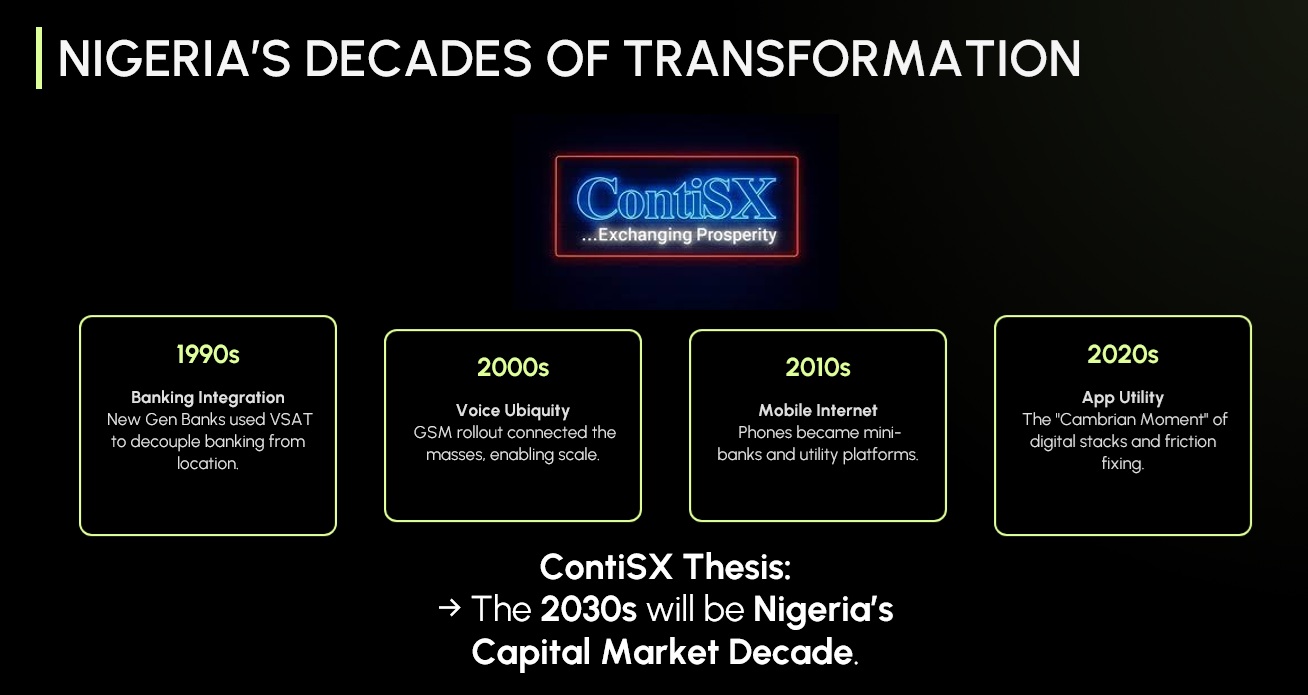
The 2030s will usher in the era of investment inclusion, a shift where Nigeria moves beyond financial inclusion to fully capitalizing assets in all forms. That decade will be defined by the transformation of money into capital, unlocking shared prosperity and abundance across cities, communities, and villages.
 
At Contisx Securities Exchange, our mission is to build the capital market infrastructure, at the lowest possible marginal cost, to enable that future where everyone can rise, not just a few.
 
With our launch set for September 2026, after SEC’s AIP, we are engaging companies and issuers (in extenstion the issuing houses, brokers, dealers, etc) ready to access the capital market.
 
The invitation is open: Build, list, and trade on ContiSX. Let us ring the bell together, and exchange prosperity. Visit contisx.com and contact us via email therein; our Team will schedule to learn about your mission.