
DD
MM
YYYY

PAGES

DD
MM
YYYY

spot_img

PAGES

Home Blog Page 5

Anthropic’s Mythos Reportedly Used by US NSA to Test Vulnerabilities in Microsoft’s Software

0

The reported use of Anthropic’s Mythos model by the U.S. National Security Agency (NSA) to identify vulnerabilities in Microsoft’s software signals a pivotal moment in the convergence of artificial intelligence and cybersecurity. It reflects not only the growing reliance of state actors on advanced AI systems but also a deeper structural shift in how software flaws are discovered, analyzed, and mitigated.

At its core, this development underscores a transformation from reactive security paradigms toward proactive, machine-augmented defense strategies. Traditionally, vulnerability discovery has relied on human researchers, penetration testers, and bug bounty ecosystems. While effective, these approaches are constrained by scale, time, and human cognitive limits.

Modern software systems—particularly those as expansive as Microsoft’s operating systems, cloud platforms, and enterprise tools—contain millions of lines of code, making exhaustive human review impractical. This is where large-scale AI models such as Mythos introduce a fundamentally new capability: the ability to systematically and continuously analyze vast codebases at speeds and depths unattainable by human teams alone.

Mythos, as described, appears to be designed for deep semantic reasoning over complex systems. Unlike earlier static analysis tools that rely on predefined rules or pattern matching, a model like Mythos can infer intent, trace logic across interdependent modules, and identify subtle edge-case vulnerabilities that might otherwise go unnoticed. For the NSA, whose mission includes safeguarding national security infrastructure, this represents a force multiplier.

By deploying such a model, the agency can simulate adversarial thinking at scale—probing software for weaknesses in the same way a sophisticated attacker might, but with far greater efficiency. The choice of Microsoft software as a focal point is not incidental. Microsoft’s ecosystem underpins a significant portion of global digital infrastructure, from government systems to private enterprise networks.

Any vulnerability within this ecosystem has the potential for widespread impact. By using AI to uncover these weaknesses preemptively, the NSA can work with vendors to patch critical flaws before they are exploited in the wild. This aligns with a broader doctrine of defensive disclosure, where vulnerabilities are identified and resolved internally rather than exposed through active breaches.

However, this development also raises complex questions about the balance of power in cybersecurity. If government agencies possess advanced AI systems capable of identifying zero-day vulnerabilities at scale, the asymmetry between state and non-state actors could widen dramatically. While this may enhance national defense, it also introduces ethical considerations: should all discovered vulnerabilities be disclosed and patched, or might some be retained for offensive cyber operations.

The dual-use nature of such technology complicates the narrative, blurring the line between defense and offense. Moreover, the involvement of a private AI company like Anthropic highlights the increasingly symbiotic relationship between the public and private sectors in technological innovation. AI development is largely driven by private firms, yet its most sensitive applications often lie within government domains.

From a technical standpoint, integrating a model like Mythos into vulnerability research workflows likely involves a hybrid architecture. The AI would ingest source code, binaries, and system documentation, then generate hypotheses about potential flaws—such as buffer overflows, race conditions, or privilege escalation vectors. These hypotheses would then be validated through automated testing environments or human expert review. Over time, the model would refine its understanding based on feedback, effectively becoming more adept at identifying nuanced vulnerabilities.

Another critical implication is the potential shift in the software development lifecycle. If AI-driven vulnerability detection becomes standard, security could be embedded more deeply into the development process rather than treated as a post hoc concern. Continuous AI auditing could flag issues during coding, testing, and deployment phases, reducing the likelihood of critical flaws reaching production environments.

Yet, there are risks. Overreliance on AI systems could introduce blind spots, particularly if the models themselves are not fully understood or are susceptible to adversarial manipulation. Ensuring the robustness, interpretability, and security of the AI tools themselves becomes paramount. After all, a compromised or misaligned model could misidentify vulnerabilities or, worse, introduce new ones.

The NSA’s use of Anthropic’s Mythos model to analyze Microsoft software exemplifies the next frontier of cybersecurity. It demonstrates how AI can augment human expertise to address the growing complexity of modern software systems. At the same time, it raises important strategic, ethical, and technical questions that will shape the future of digital security.
Nigeria’s Decade of Capital Market Transformation and ContiSX’s Mission of Investment Inclusion

0
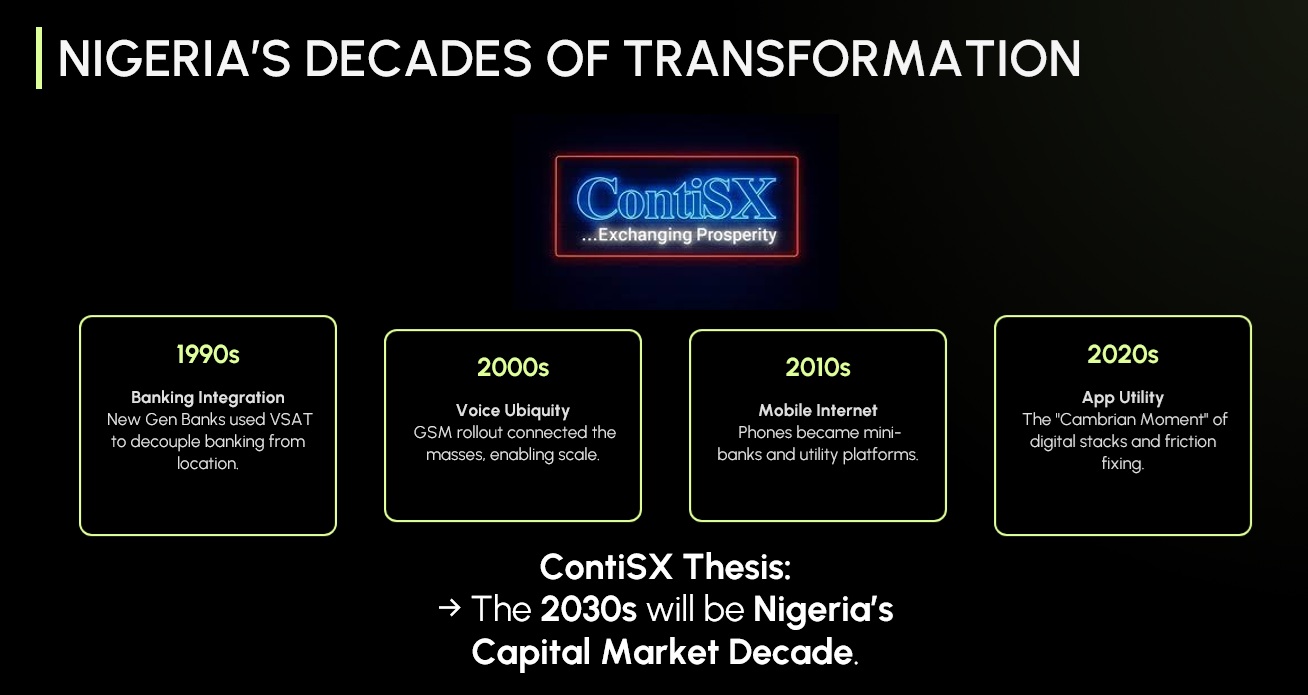
The 2030s will usher in the era of investment inclusion, a shift where Nigeria moves beyond financial inclusion to fully capitalizing assets in all forms. That decade will be defined by the transformation of money into capital, unlocking shared prosperity and abundance across cities, communities, and villages.
 
At Contisx Securities Exchange, our mission is to build the capital market infrastructure, at the lowest possible marginal cost, to enable that future where everyone can rise, not just a few.
 
With our launch set for September 2026, after SEC’s AIP, we are engaging companies and issuers (in extenstion the issuing houses, brokers, dealers, etc) ready to access the capital market.
 
The invitation is open: Build, list, and trade on ContiSX. Let us ring the bell together, and exchange prosperity. Visit contisx.com and contact us via email therein; our Team will schedule to learn about your mission.
 

Alphabet’s Breakout Quarter Redraws AI Pecking Order, Exposes Fault Lines in Big Tech’s $700bn Bet

0

A blowout quarter from Alphabet is forcing a more discriminating lens on the artificial intelligence boom, as investors begin to separate narrative from execution across the largest U.S. technology firms.

According to a Reuters report, the company’s 63% surge in Google Cloud revenue has not only exceeded expectations but also altered the competitive framing of the AI race. For much of the past decade, cloud leadership was defined by scale, with Amazon and Microsoft firmly ahead. Alphabet’s latest results suggest that the next phase will be defined less by installed base and more by the ability to monetize AI workloads at speed.

Markets reacted accordingly. Alphabet shares advanced sharply, while Meta, Amazon, and Microsoft all declined, underscoring a reassessment of where returns are materializing most clearly.

At a structural level, the divergence points to a maturing investment cycle. The four hyperscalers (large cloud companies) have now committed to more than $700 billion in combined capital expenditure this year, up from roughly $600 billion, as they race to build out data centers, secure advanced chips, and scale AI models. That escalation underscores a shared view that AI infrastructure is no longer optional.

“The risk of sitting it out is bigger than the risk of leaning in,” said Daniel Newman, CEO of tech research firm Futurum Group. “Every hyperscaler understands that under-investing in this cycle is an extinction-level risk.”

Yet Alphabet’s performance highlights a critical shift in investor expectations. Capital intensity alone is no longer sufficient. The market is demanding evidence that spending is translating into incremental revenue, not just future potential.

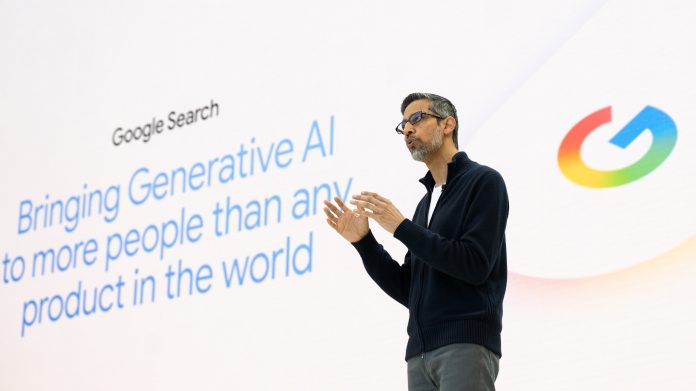
Chief executive Sundar Pichai framed the company’s progress as a turning point.

“Our enterprise AI solutions have become our primary growth driver for cloud for the first time,” he said, signaling that Alphabet’s years of investment in machine learning research are now being commercialized at scale.

That transition is particularly significant because Alphabet entered the cloud market later than its rivals and remains smaller in absolute terms. Its acceleration, therefore, suggests it is capturing a disproportionate share of new demand, rather than simply expanding within an existing base.

Industry analysts indicate that much of this growth is being driven by fresh workloads tied to AI adoption.

“It is capturing new workloads for the most part — sometimes from companies new to cloud, often additional workloads from customers of other clouds who want to be less dependent on a single cloud provider or who like Google data, analytics and AI offerings,” said Lee Sustar, principal analyst at Forrester.

This dynamic introduces a competitive complication for incumbents. Multi-cloud strategies are becoming more prevalent, reducing switching costs and allowing enterprises to allocate AI workloads to providers offering the best performance or economics. In that environment, differentiation is shifting toward full-stack integration.

Alphabet’s approach, combining proprietary chips, large-scale infrastructure, advanced models, and developer tools, is increasingly resonating with customers. Its decision to commercialize its custom silicon places it in more direct competition with Nvidia, while also lowering dependency on third-party suppliers.

“Customers are going to Google because its AI is seen as more accurate and trustworthy than Copilot and because its full-stack approach is likely to drive greater economies of scale,” said Rebecca Wettemann, CEO of Valoir, an industry analyst firm.

For Microsoft, the issue is not demand but conversion. Azure continues to post strong growth and is forecast to expand between 39% and 40% in the current quarter, ahead of expectations. However, investor scrutiny is increasingly focused on how effectively its AI products, particularly Copilot, are translating into sustained revenue streams.

Chief financial officer Amy Hood acknowledged the supply-side constraints shaping the market. “Broad and growing customer demand continues to exceed supply,” she said, pointing to ongoing shortages in compute capacity.

Those constraints are central to understanding the current cycle. Across the sector, demand for AI infrastructure is outpacing available supply, creating a feedback loop in which companies must continue investing heavily simply to keep up. Alphabet itself indicated that cloud growth would have been higher if not for capacity limits, prompting it to raise capital expenditure guidance to as much as $190 billion and signal further increases in 2027.

Amazon’s position is somewhat distinct. Its cloud growth remains solid, but its strategy increasingly emphasizes ecosystem breadth. Partnerships with OpenAI and Anthropic are designed to position AWS as the default infrastructure layer regardless of which AI model customers choose. That approach mitigates model risk but also dilutes direct monetization from proprietary AI offerings.

Meta, by contrast, is facing a more immediate tension between spending and returns. While its advertising business continues to perform, investor concerns are mounting over the scale of its AI investment and the absence of a clearly defined monetization pathway beyond its core platforms. Additional pressure from regulatory risks tied to content and user safety has compounded the negative sentiment.

“Google’s really the shining star so far in tech earnings,” said Ken Mahoney, CEO of Mahoney Asset Management.

The broader implication is that the AI boom is entering a more disciplined phase. Early enthusiasm was driven by the transformative potential of the technology and the urgency of participation. Now, attention is shifting to execution metrics: revenue growth, customer adoption, pricing power, and capital efficiency.

Alphabet’s results suggest it is currently ahead on that curve. But the sustainability of that lead will depend on its ability to maintain momentum while scaling infrastructure and managing rising costs. At the same time, the sheer scale of industry-wide investment indicates that competition is likely to intensify rather than consolidate in the near term. Capacity constraints, evolving enterprise demand, and rapid innovation cycles mean that leadership positions remain fluid.

What has changed is the market’s tolerance. The era of unquestioned spending is giving way to a more exacting standard, one where the winners are those who can demonstrate that the AI buildout is not just necessary, but immediately productive.

Hundreds of Dormant Ethereum Virtual Machine Wallets Exposed to Exploits, as Solana Continues 7 Months of Bearish Sentiment

0

A recent wave of coordinated exploits targeting hundreds of dormant Ethereum Virtual Machine (EVM) wallets has sent a chill through the crypto ecosystem, highlighting a largely overlooked vulnerability: the long tail of inactive accounts. Unlike high-profile hacks that typically focus on exchanges or active decentralized finance (DeFi) protocols, this incident represents a quieter, more insidious threat—one that capitalizes on neglect, outdated security assumptions, and the persistence of private key exposure over time.

Dormant wallets, by definition, are accounts that have seen little to no activity for extended periods. These wallets often belong to early adopters, forgotten users, or entities that have moved on from crypto but left assets behind. In many cases, such wallets are presumed safe due to their inactivity. However, this exploit demonstrates the opposite: inactivity can be a liability. Without regular monitoring or updated security practices, these wallets become soft targets for attackers who are willing to play the long game.

Preliminary on-chain analysis suggests that the attacker—or group of attackers—used a methodical approach. Rather than deploying a single exploit, they appear to have aggregated a database of compromised private keys over time. These keys may have been sourced from old data breaches, phishing campaigns, malware infections, or even publicly exposed repositories where users mistakenly uploaded sensitive information. Once enough keys were collected, the attackers likely automated a sweeping operation, scanning the blockchain for wallets with non-zero balances and initiating transfers to consolidate funds.

What makes this event particularly concerning is the sophistication of timing. Many of the exploited wallets had been inactive for years, indicating that the attackers waited until the value of assets—especially tokens and NFTs—had appreciated significantly. This patience suggests a strategic mindset, where attackers treat compromised keys as long-term options rather than immediate cash-outs. It also raises the possibility that more such time bomb wallets exist, already compromised but not yet exploited.

The broader implication is a fundamental challenge to the assumption of self-custody security. In theory, owning your private keys ensures complete control over your assets. In practice, however, the security of those keys is only as strong as the weakest moment in their history. A key exposed even briefly—years ago—remains vulnerable indefinitely unless the assets are moved to a new wallet. This creates a persistent attack surface that grows over time as more users enter and exit the ecosystem.

Moreover, the exploit underscores the limitations of current wallet infrastructure. Most wallets do not provide proactive alerts for unusual activity, especially for long-dormant accounts. Nor do they offer mechanisms for periodic key rotation or automated migration to safer addresses. As a result, users who are not actively engaged with their wallets receive no warning until it is too late.

From a systemic perspective, this incident may accelerate the adoption of more advanced security models. Multi-signature wallets, hardware-based custody, and smart contract wallets with social recovery features could become more mainstream as users recognize the risks of static private keys. Additionally, there may be increased interest in wallet monitoring services that track dormant accounts and flag suspicious movements in real time.

Regulatory implications could also emerge. While decentralized systems resist direct oversight, repeated incidents of large-scale theft—especially involving inactive users—may prompt calls for better consumer protection standards. This could include guidelines for wallet providers to implement stronger default security measures or educational initiatives to ensure users understand the long-term risks of key exposure.

Ultimately, the exploitation of dormant EVM wallets serves as a stark reminder that in crypto, security is not a one-time action but an ongoing process. The blockchain may be immutable, but the threats surrounding it are constantly evolving. For users, the lesson is clear: if a wallet holds value, it must be actively secured, monitored, and, when necessary, refreshed. Otherwise, what appears to be safely stored wealth may, in reality, be quietly waiting to be claimed by someone else.

Solana Continued Seven Straight Months of Bearish Sentiment

The recent performance of Solana has drawn growing concern across the crypto ecosystem, as the asset records its seventh consecutive monthly red candle—a rare and telling signal in a market often defined by volatility but punctuated by cyclical recoveries. This sustained downward trajectory reflects not just short-term bearish sentiment, but a convergence of structural, macroeconomic, and ecosystem-specific pressures that continue to weigh heavily on the network’s native token, $SOL.

At a technical level, seven straight months of negative price action underscores persistent selling pressure and a lack of meaningful bullish momentum. In traditional financial markets, such a streak would often be interpreted as a prolonged downtrend, signaling weak investor confidence and the absence of strong support levels. In crypto, where sentiment can shift rapidly, such extended declines are less common and therefore more psychologically impactful.

Traders and long-term holders alike begin to reassess their positions, often leading to further capitulation. One of the core drivers behind Solana’s decline is the broader macroeconomic environment. Global liquidity conditions have tightened significantly over the past year, with central banks maintaining elevated interest rates to combat inflation. Risk-on assets like cryptocurrencies tend to suffer under such conditions, as capital flows toward safer, yield-bearing instruments.

As a result, even fundamentally strong projects are not immune to sustained drawdowns. Solana, despite its technological advantages, has been caught in this macro drag. However, macro factors alone do not fully explain the depth and persistence of Solana’s downturn. The network has faced its own set of challenges, particularly around reliability and perception.

Historically, Solana has struggled with network outages and congestion issues, which have raised concerns about its robustness as a high-performance blockchain. While improvements have been implemented, reputational damage tends to linger longer than technical fixes. For institutional participants and developers choosing a platform, reliability is paramount, and any lingering doubts can slow ecosystem growth.

Additionally, the competitive landscape has intensified. Other layer-1 blockchains and scaling solutions have continued to evolve, offering improved security, decentralization, and developer tooling. Networks like Ethereum’s layer-2 ecosystem have gained traction, drawing liquidity and developer activity away from alternative chains. This fragmentation of attention and capital has diluted Solana’s once-dominant narrative as the go-to high-throughput blockchain.

Another factor contributing to the prolonged decline is the unwinding of speculative excess from previous cycles. During its peak, Solana benefited from a surge in NFT activity, DeFi expansion, and retail enthusiasm. As those sectors cooled, so too did the demand for SOL. Many projects that once thrived on Solana have either scaled down, migrated, or failed entirely, reducing on-chain activity and weakening the fundamental demand for the token.

Despite these headwinds, it would be premature to declare Solana’s trajectory as irreversibly negative. Extended downtrends often lay the groundwork for eventual recovery, particularly if the underlying technology continues to improve and developer engagement remains intact. Solana still boasts one of the most active developer communities in the crypto space, and its high throughput and low transaction costs remain compelling advantages.

Moreover, market cycles in crypto are notoriously unforgiving but equally capable of sharp reversals. A shift in macro conditions—such as easing monetary policy—or a resurgence in on-chain activity could quickly alter sentiment. For Solana, key indicators to watch include network stability, developer growth, and the return of meaningful user activity across DeFi, NFTs, and emerging sectors like decentralized infrastructure.

Solana’s seven-month streak of red candles is a reflection of both external pressures and internal challenges. It highlights the fragility of market sentiment and the importance of sustained fundamentals in navigating prolonged downturns. Whether this period marks a prolonged decline or the foundation for a future rebound will depend on how effectively the network adapts, innovates, and rebuilds confidence in the months ahead.

Anthropic Releases Beta Version of its New Claude Security AI Tools

0

The release of Claude Security in public beta by Anthropic marks a significant inflection point in the evolution of enterprise cybersecurity. As artificial intelligence systems grow more capable—not only in generating software but also in identifying and exploiting its weaknesses—the need for equally advanced defensive tools has become urgent.

At its core, Claude Security is an AI-powered system designed to scan software repositories for vulnerabilities and automatically generate patches. Unlike traditional security tools that rely heavily on static analysis and predefined rules, Claude Security applies reasoning capabilities akin to those of a human security researcher. It can trace data flows, interpret business logic, and analyze how different components of a system interact, enabling it to detect complex and previously overlooked vulnerabilities. This shift from pattern matching to contextual reasoning is crucial, as modern software systems are too intricate for rule-based systems alone to adequately protect.

The timing of this release is not incidental. AI models have recently demonstrated an unprecedented ability to uncover software flaws at scale, raising concerns that malicious actors could leverage similar technologies to accelerate cyberattacks. Anthropic itself has acknowledged that future AI systems may be capable of autonomously discovering and exploiting vulnerabilities with minimal human intervention.

Claude Security is positioned not merely as a productivity tool, but as a defensive necessity—an attempt to tilt the balance of power back toward defenders in an increasingly automated threat environment. Claude Security builds upon earlier iterations such as Claude Code Security, which began as a research preview earlier in 2026. The transition from preview to enterprise beta signals a maturation of the technology, with expanded features tailored for organizational use.

These include scheduled and targeted scans, integration with audit systems, and workflows for tracking and validating identified issues. The system is also designed to fit seamlessly into existing development pipelines, allowing security teams to incorporate AI-driven analysis without overhauling their infrastructure. A defining feature of Claude Security is its ability to not only identify vulnerabilities but also propose actionable fixes.

This closes a critical gap in traditional security workflows, where detection and remediation are often handled by separate tools and teams. By generating patches automatically, Claude Security reduces the time between discovery and resolution—an essential advantage in a landscape where the window between vulnerability disclosure and exploitation continues to shrink. However, Anthropic emphasizes a human-in-the-loop approach, advising organizations to review AI-generated patches before deployment, particularly in mission-critical systems.

The enterprise focus of the beta release is also noteworthy. Large organizations, with their sprawling codebases and complex dependencies, stand to benefit the most from AI-driven security tools. By initially limiting access to Claude Enterprise customers, Anthropic can refine the system in high-stakes environments while gathering feedback from sophisticated users. Broader availability to smaller teams and individual developers is expected in the future, indicating a phased rollout strategy.

Beyond its immediate utility, Claude Security reflects a broader trend toward the specialization of AI systems. Rather than serving as general-purpose assistants, models are increasingly being tailored for specific domains such as cybersecurity, finance, and scientific research. This specialization allows for deeper integration with domain-specific workflows and higher performance on targeted tasks.

In the case of cybersecurity, it also introduces new ethical and regulatory considerations, particularly around the dual-use nature of vulnerability discovery technologies. The launch of Claude Security in enterprise beta underscores the growing convergence of artificial intelligence and cybersecurity. As AI continues to reshape both offensive and defensive capabilities, tools like Claude Security will play a critical role in determining how organizations adapt to this new reality.