DD
MM
YYYY

PAGES

DD
MM
YYYY

spot_img

PAGES

Home Blog Page 4000

No Reason To Stand In the Way of Spot Bitcoin ETF, Grayscale Enters Transfer Agency and Service Agreement with BNY Mellon

0

In a recent interview, SEC Commissioner Hester Peirce expressed her support for a spot Bitcoin ETF, which would track the price of the cryptocurrency directly. She said that the SEC should not interfere with the market’s demand for such a product, and that the agency’s role is to protect investors from fraud and manipulation, not to dictate their investment choices.

Peirce, who is known as “Crypto Mom” for her pro-crypto stance, argued that there is no reason for the SEC to stand in the way of a spot Bitcoin ETF, as long as the applicants meet the legal requirements and disclose the risks involved. She said that the SEC has been too slow and cautious in approving crypto-related products, and that this has hindered innovation and competition in the industry.

She also pointed out that the SEC has already approved several ETFs that track Bitcoin futures, which are derivatives contracts based on the price of Bitcoin. She said that these products are more complex and costly than a spot Bitcoin ETF, and that they may not reflect the true value of the underlying asset. She said that a spot Bitcoin ETF would provide investors with a simpler and more direct way to access the crypto market, and that it would also increase liquidity and transparency in the sector.

BlackRock filed an S-1 form with the SEC for the iShares Ethereum Trust

BlackRock, the world’s largest asset manager, has taken a step closer to launching an Ethereum-based exchange-traded fund (ETF). The company filed an S-1 form with the US Securities and Exchange Commission (SEC) for the iShares Ethereum Trust, a fund that will track the performance of the second-largest cryptocurrency by market capitalization.

The iShares Ethereum Trust will offer investors exposure to Ethereum without having to buy, store, or manage the digital asset themselves. The fund will hold Ethereum and value its shares based on the current market price of the cryptocurrency. The fund will also charge a management fee, which has not been disclosed yet.

The filing comes as the SEC is reviewing several applications for Bitcoin ETFs, which have been pending for years. The regulator has repeatedly delayed or rejected such proposals, citing concerns over market manipulation, custody, and investor protection. However, some analysts believe that the SEC may finally approve a Bitcoin ETF this year, as the crypto industry has matured and gained more institutional adoption.

If the SEC approves a Bitcoin ETF, it could pave the way for other crypto ETFs, such as the iShares Ethereum Trust. Ethereum is the second-most popular cryptocurrency after Bitcoin, and it powers a wide range of decentralized applications (dApps) and smart contracts on its network. Ethereum is also undergoing a major upgrade, known as Ethereum 2.0, which aims to improve its scalability, security, and energy efficiency.

BlackRock is not the only company that is eyeing an Ethereum ETF. In Canada, three Ethereum ETFs have already been launched this year, following the approval of four Bitcoin ETFs. In Europe, several Ethereum ETPs (exchange-traded products) are also available on various exchanges. However, the US market is still waiting for its first crypto ETF, which could attract more investors and liquidity to the crypto space.

Peirce’s comments come at a time when several companies are seeking approval from the SEC for a spot Bitcoin ETF, including VanEck, Valkyrie, and WisdomTree. The SEC has not yet made a decision on any of these applications, and it is unclear whether it will do so before the end of the year. Peirce said that she hopes that the SEC will act soon, and that she will continue to advocate for a more open and welcoming approach to crypto regulation.

Peirce is not the only one who supports the spot Bitcoin ETF. Several prominent figures in the crypto space have also voiced their opinions in favor of such a product, including Michael Saylor, the CEO of MicroStrategy, Cathie Wood, the founder of ARK Invest, and Anthony Pompliano, the co-founder of Morgan Creek Digital. They have all argued that a spot Bitcoin ETF would benefit both investors and the crypto ecosystem as a whole, and that it would help legitimize Bitcoin as an asset class.

Grayscale Enters Transfer Agency and Service Agreement with BNY Mellon

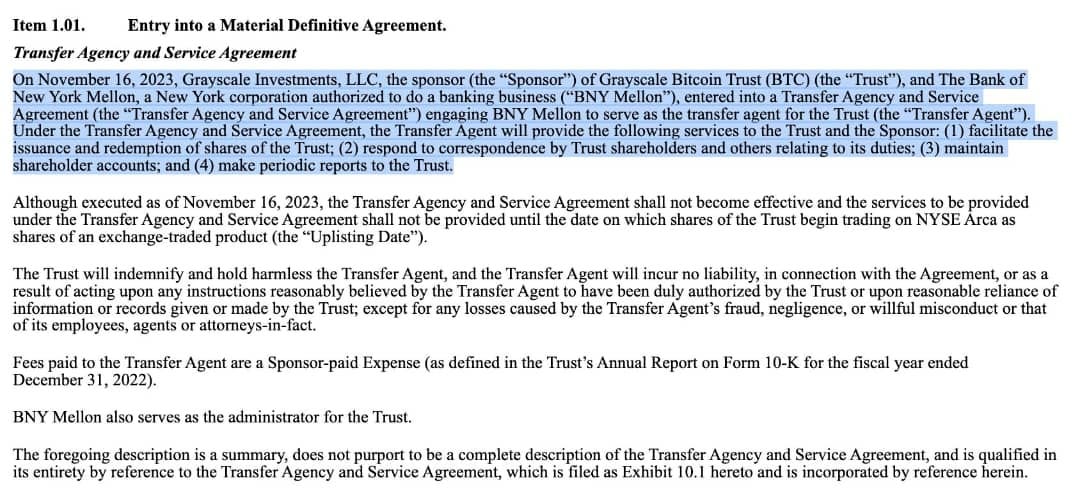
In a major development for the cryptocurrency industry, Grayscale Investments announced that it has entered into a Transfer Agency and Service Agreement with The Bank of New York Mellon Corporation (BNY Mellon) for its proposed spot Bitcoin ETF. This means that BNY Mellon will provide fund accounting and administration services for the ETF, as well as transfer agency and ETF services, if and when it is approved by the U.S. Securities and Exchange Commission (SEC).
Grayscale is the largest digital asset manager in the world, with over $50 billion in assets under management as of November 2023. It currently offers several products that allow investors to gain exposure to cryptocurrencies, such as the Grayscale Bitcoin Trust (GBTC), which is a private placement that holds bitcoin and trades on the OTCQX market. However, GBTC is not an ETF, which means that it does not track the price of bitcoin directly, and often trades at a premium or discount to its net asset value (NAV).

An ETF, on the other hand, is a type of investment fund that is traded on a stock exchange and tracks the performance of an underlying asset or index. An ETF typically has lower fees, higher liquidity, and more transparency than a private placement. A spot Bitcoin ETF would allow investors to buy and sell shares of a fund that holds bitcoin directly, without having to deal with the complexities and risks of storing and transferring the cryptocurrency themselves.

Grayscale has been pursuing a spot Bitcoin ETF for several years, and has filed multiple applications with the SEC. However, the regulator has not approved any such product yet, citing concerns about market manipulation, investor protection, and custody issues. The SEC has also rejected several other proposals for Bitcoin ETFs from other companies, such as VanEck, Valkyrie, and WisdomTree.

However, Grayscale believes that the market conditions have changed significantly since its last filing in April 2021, and that it has addressed the SEC’s main concerns by partnering with BNY Mellon. BNY Mellon is one of the oldest and most respected financial institutions in the world, with over $45 trillion in assets under custody and administration. It is also the first major global bank to announce plans to provide integrated services for digital assets, such as custody, transfer, issuance, redemption, and servicing.

By working with BNY Mellon, Grayscale hopes to demonstrate to the SEC that its spot Bitcoin ETF will have robust operational and regulatory safeguards, as well as enhanced liquidity and efficiency. Grayscale also stated that it will continue to engage with the SEC and other regulators to educate them about the benefits of a spot Bitcoin ETF for investors and the broader crypto ecosystem.

Grayscale’s announcement comes at a time when there is growing demand and interest for Bitcoin ETFs in the U.S. In October 2021, the SEC approved the first Bitcoin futures ETFs, which are funds that track the price of bitcoin futures contracts traded on regulated exchanges.

These products have attracted billions of dollars in inflows since their launch, indicating a strong appetite for crypto exposure among institutional and retail investors. However, many experts argue that futures ETFs are inferior to spot ETFs, as they are more expensive, less efficient, and less reflective of the actual price of bitcoin.

Therefore, many investors are eagerly awaiting the approval of a spot Bitcoin ETF in the U.S., which could potentially unleash a wave of capital into the crypto market and boost the adoption and legitimacy of bitcoin as an asset class. Grayscale’s partnership with BNY Mellon is a significant step towards achieving this goal and could pave the way for other crypto companies to follow suit.


Binance settlement ‘positive’ as it eliminates potential systemic risk- JPMorgan

0

JPMorgan analysts have welcomed the recent settlement between Binance and the U.S. Securities and Exchange Commission (SEC), saying it reduces the possibility of a major disruption in the crypto market if Binance were to collapse.

In a note to clients, JPMorgan said the settlement was “positive” for Binance, the world’s largest crypto exchange by trading volume, as it removes a major regulatory uncertainty and allows it to continue operating in the U.S. market.

The settlement, announced on Nov. 17, resolved a long-running dispute between Binance and the SEC over whether Binance had violated securities laws by offering unregistered digital asset securities to U.S. investors. Binance agreed to pay $4.3 Billion and CZ to pay $175 million in penalties and disgorgement, and to register with the SEC as a broker-dealer and report its transactions.

JPMorgan said the settlement also benefits the crypto industry as a whole, as it eliminates the potential systemic risk from a hypothetical collapse of Binance, which accounts for about 20% of the global crypto trading volume.

The CFTC’s action against Binance is not an isolated case. In recent months, several other regulators around the world have taken steps to crack down on the crypto industry, citing concerns over consumer protection, financial stability, tax evasion, and illicit activities. Some examples include:

China: The Chinese government has intensified its efforts to ban all forms of crypto trading and mining, as well as to block access to foreign crypto platforms and services. The move is part of China’s broader strategy to promote its own digital currency, the e-CNY, and to curb capital outflows and financial risks.

India: The Indian government is reportedly planning to introduce a bill that would prohibit all private cryptocurrencies in the country, except for those issued by the central bank. The bill would also impose penalties on anyone who mines, holds, transfers, or trades cryptocurrencies. The government has previously expressed concerns over the potential use of cryptocurrencies for money laundering, terrorism financing, and tax evasion.

UK: The UK Financial Conduct Authority (FCA) has banned Binance from conducting any regulated activity in the country and has warned consumers that they should be wary of investing in crypto assets. The FCA has also issued several warnings to other crypto firms that have failed to comply with its registration requirements or have engaged in misleading advertising.

EU: The European Commission has proposed a comprehensive framework for regulating crypto assets, known as Markets in Crypto-Assets (MiCA). The proposal aims to create a harmonized set of rules for crypto service providers across the EU, covering aspects such as authorization, supervision, consumer protection, market integrity, and prudential requirements. The proposal also introduces a pilot regime for testing and experimenting with crypto-based market infrastructures.

These developments indicate that the crypto industry is facing a critical moment in its evolution. On one hand, the increased regulatory attention reflects the growing recognition and adoption of crypto assets as a new asset class and a potential driver of innovation and economic growth. On the other hand, the regulatory challenges pose significant risks and uncertainties for crypto businesses and investors, who may face legal sanctions, operational disruptions, or market losses.

The question then is: what’s next for crypto regulation? How can the industry balance the need for compliance and legitimacy with the need for innovation and flexibility? How can regulators ensure that their actions are proportionate, consistent, and effective?

There are no easy answers to these questions, but some possible directions include:

Dialogue and cooperation: The crypto industry and regulators should engage in constructive dialogue and cooperation to foster mutual understanding and trust. The industry should proactively communicate its value proposition, challenges, and best practices to regulators, and seek their feedback and guidance. Regulators should acknowledge the benefits and potential of crypto assets and adopt a risk-based and technology-neutral approach to regulation. Both sides should also collaborate on developing common standards and frameworks for addressing cross-border issues and enhancing global coordination.

Education and awareness: The crypto industry and regulators should invest in education and awareness campaigns to inform and empower consumers and investors about the opportunities and risks of crypto assets. The industry should provide clear and accurate information about its products and services, as well as the rights and responsibilities of its users. Regulators should provide guidance and resources on how to safely access and use crypto assets, as well as how to report any problems or complaints.

Innovation and experimentation: The crypto industry and regulators should foster a culture of innovation and experimentation within a safe and controlled environment. The industry should continue to explore new ways of improving its products and services, as well as addressing its challenges and limitations. Regulators should support such efforts by creating regulatory sandboxes or innovation hubs that allow crypto businesses to test their ideas and solutions without facing undue regulatory burdens or penalties.

The CFTC’s fine on Binance is a wake-up call for the crypto industry. It signals that regulators are serious about enforcing their rules and protecting their jurisdictions. It also presents an opportunity for the industry to mature and evolve in a more responsible and sustainable manner. The future of crypto regulation depends on how well the industry and regulators can work together to achieve their common goals.

“Binance is a key player in the crypto ecosystem, and its failure would have significant negative spillovers to other platforms, liquidity providers, and investors,” JPMorgan wrote. “The settlement reduces this tail risk and provides more clarity on the regulatory framework for crypto exchanges in the U.S.”

JPMorgan added that the settlement could also pave the way for more cooperation and collaboration between Binance and other regulated entities, such as banks, custodians, and market makers, which could enhance the efficiency and stability of the crypto market.

Nigerian e-Publishing and BookSelling Platform Okadabooks, Announces Plans to Shut Down Operations Citing Macroeconomic Conditions

0

Nigeria’s e-publishing and bookselling platform, Okadabooks, has announced its plan to shut down on November 30, 2023, citing tough macroeconomic conditions.

The company announced that it was forced to make the difficult decision after it explored various avenues to keep its virtual bookshelves alive, but, unfortunately, the challenges it faced were insurmountable.

Announcing their closure on X, the company wrote,

“Dear OkadaBook Family, I hope this message finds you well. It is with a heavy heart and a sense of profound gratitude that I reach out to you today. After much consideration and reflection, we have come to a difficult decision. OkadaBooks will be closing its virtual doors on November 30, 2023. This has not been an easy choice. We’ve explored various avenues to keep our virtual bookshelves alive, but, unfortunately, the challenges we face are insurmountable.

“Over the years, we’ve experienced incredible journeys together-delving into new worlds, discovering diverse voices, and fostering a community of readers and writers that we are immensely proud of. Each one of you has played a crucial role in making OkadaBooks what it is today, and for that, we are truly grateful. Your support and passion have been everything to us.

“We’ve witnessed amazing stories unfold celebrated the triumphs of authors, and, most importantly, built a community that cherishes the written word. Although this chapter is coming to an end, the stories, memories, and connections will endure. We understand that this news might come as a shock, and we are here to assist with any questions or concerns you may have. Please feel free to reach out to our support team at okadabooks@gmail.com.”

Several Nigerians reacting to the news, have expressed their sadness following the shutdown of one of Nigeria’s prestigious self-publishing and book-selling platforms, which provided a platform for thousands of writers and readers to flourish.

Founded by Okechukwu Ofili in 2013, Okadabooks housed a library of over 40,000 original books and 400,000 registered readers.   From romance to crime, to sci-fi and several other book genres, that platform got users covered.

With its Android application and online platform, authors could share their books directly with readers and profit from their work, taking a 30% commission on every sale.

The Startup created many impacts in Nigeria, as part of its contribution to empowering the society which saw it significantly impact the counrty’s reading culture and helped over 8,000 writers become authors for free.

In May 2019, Okadabooks partnered with Lafarge Africa Plc to kick start a digital literacy outreach by teaching pupils in primary schools how to read with their smartphones. The startup introduced digital literacy to pupils and explained to them how they can leverage it to become digital literates in the future.

With this outreach, the startup aimed to change the impression most people have about smartphones being objects of distraction, but rather see them as tools for improving and promoting literacy.

Also, in its drive to improve literacy across Nigeria, it partnered with Teach For Nigeria, an organization that trains and sends teachers across Nigeria, to educate children in low-income communities.

Nigeria Unveils Startup Support And Engagement Portal to Foster Startup Act Implementation

0
The coat of arm of Nigeria

The federal government of Nigeria has recently unveiled a dedicated Startup Support and Engagement online portal, aimed to promote and support the implementation of the Startup Act.

The launch was announced by Nigeria’s minister for communication, innovation, and digital economy, Bosun Tijani, who described the launch of the Startup Support and Engagement portal, as a key requirement for the implementation of the Nigeria Startup Act.

In his words,

“We are pleased to announce the launch of the  Startup and Engagement Portal, which is a key requirement for the implementation of the Nigeria Startup Act. The startup portal will drive the identification and aggregation of Nigerian startups, venture capital companies, hubs, and innovation centers in order to facilitate engagement and support for ecosystem players”.

He also added that the Startup support and engagement portal will also enable the selection of representatives to the National Council for Digital Innovation and Entrepreneurship to facilitate discourse and consensus among ecosystem players.

All Nigerian startup venture capital companies, hubs, and innovation centers have been urged to register, and look forward to working with all industry stakeholders to ensure that the Startup Act is fully implemented for the benefit of Nigeria’s ecosystem.

The launch of the Startup support and engagement portal is coming a year after, Nigeria’s immediate past President Muhammadu Buhari signed the Nigeria Startup Bill (NSB) into law to govern the multibillion-dollar tech ecosystem in the country.

The recent launch of the Startup portal is a key requirement for implementing the Nigeria Startup Act, which is meant to drive the identification, aggregation and registration of startups in Nigeria.

It is also intended to serve as a central hub for fostering the various initiatives and measures outlined in the Startup Act, reinforcing the country’s commitment to nurturing and advancing its startup ecosystem.

Also, the portal is expected to play a crucial role in streamlining processes, providing information, and facilitating collaboration among stakeholders to ensure the effective execution of the Startup Act’s provisions.

Notably, the launch of a dedicated startup online portal has been lauded by several Nigerians who commended the government on its efforts to keep pushing the boundaries and incorporating innovative Nigerians.

The portal is expected to serve as a comprehensive information hub, offering details about the various components of the Startup Act. This could encompass regulatory provisions, incentives for startups, and guidelines for entrepreneurs looking to benefit from the legislative framework.

In essence, the launch of the Startup Support and Engagement Portal, represents a proactive approach by the Nigerian government to not only enact favorable legislation for startups but also to create a digital infrastructure that actively supports and propels the successful implementation of these measures.

Covenant University Approves 20% Salary Increase for Workers

0

Covenant University, one of the leading private universities in Nigeria, has announced a 20% salary increase for its workers. The decision was made by the Board of Regents of the university, following the recommendation of the Chancellor, Dr. David Oyedepo.

The salary increases, which will take effect from January 2024, is aimed at motivating and rewarding the workers for their dedication and hard work. The university said that the increase was also in line with its vision of becoming one of the top 10 universities in the world by 2030.

The Vice-Chancellor of the university, Prof. Abiodun Adebayo, expressed his gratitude to the Board of Regents and the Chancellor for their generosity and foresight. He said that the salary increase would boost the morale and productivity of the workers, as well as attract and retain the best talents in the academic and non-academic sectors.

He also urged the workers to reciprocate the gesture by giving their best to the university and its students. He said that the university was committed to providing quality education and research that would impact positively on the society and humanity.

Why Salary Increase is Paramount in Nigeria

Nigeria is a country with a population of over 200 million people, and a GDP of about $448 billion. However, despite its abundant natural and human resources, Nigeria is still plagued by poverty, unemployment, insecurity, and poor living standards. One of the major factors that contribute to these challenges is the low and stagnant salary structure of the public and private sectors.

According to the National Bureau of Statistics, the average monthly minimum salary of a Nigerian worker in 2020 was N40,000. This means that most Nigerians earn less than $2 per day, which is below the international poverty line. Moreover, the minimum wage in Nigeria is N30,000, which is about $28. This is far below the living wage, which is the amount of income needed to meet the basic needs of a person and their family.

The low salary of workers in Nigeria has several negative implications for the economy and society. First, it reduces the purchasing power and consumption of workers, which affects the demand for goods and services and slows down economic growth. Second, it increases the inequality and poverty gap between the rich and the poor, which fuels social unrest and violence.

Third, it discourages productivity and innovation among workers, who have little incentive to work hard or improve their skills. Fourth, it encourages corruption and fraud among workers, who resort to illegal means to supplement their income. Fifth, it affects the health and well-being of workers and their families, who cannot afford quality food, health care, education, and housing.

Therefore, it is paramount that the government and employers in Nigeria increase the salary of workers to a level that reflects their contribution to the economy and society. A salary increase would have several positive effects for Nigeria.

First, it would boost the purchasing power and consumption of workers, which would stimulate economic growth and create more jobs. Second, it would reduce the inequality and poverty gap between the rich and the poor, which would enhance social cohesion and peace.

Third, it would motivate productivity and innovation among workers, who would have more incentive to work hard or improve their skills. Fourth, it would discourage corruption and fraud among workers, who would have less need to engage in illegal activities. Fifth, it would improve the health and well-being of workers and their families, who would be able to afford quality food, health care, education, and housing.

The workers of Covenant University have expressed their joy and appreciation for the salary increase. They said that it was a rare privilege and a blessing to work in such a prestigious and progressive institution. They also pledged their loyalty and support to the university and its leadership.

Salary increase is paramount in Nigeria because it would benefit not only the workers but also the economy and society as a whole. It is time for the government and employers in Nigeria to recognize the value of workers and reward them accordingly.