DD
MM
YYYY

PAGES

DD
MM
YYYY

spot_img

PAGES

Home Blog Page 4002

Most African Habitat Norms Emerged from Deep Understanding of Natural Philosophy

1

Sure, great feedback on my piece on African culture and how some of the norms emerged as a way to preserve communities. Of course, the ancient African culture had some unfortunate components, due to lack of knowledge, just as European and American cultures also did. As twins were killed in Africa, European culture enslaved humans and treasured on genocides. So, across human history, many bad things happened. But as knowledge systems deepen, the liberation of the mind marches.

As many noted in the comments, someone has to explain some of the norms so as to help the new generation to understand better. In other words, when they say “do not fish in that stream”, it may not be connected to any belief system or deity. I can give you cases, using streams in Ovim, my village.

In Ovim, while the Tantuta Ugwunta stream has an ordinance of not to fish therein, the Iyinta Obayi banned both fishing and using large buckets to scoop water. Examining the two streams, Tantuta flows from a higher level to a lower one which means there was no need to restrict on the scooping method since if you stir the lower level, it would not affect the source of the freshwater. But when you go to Ide (a bigger water body), all those rules vanish, allowing you to fish and do whatever you want!

The implication? The fishes of smaller streams are protected while the larger ones are not. But in reality, examining the structures of the streams, you can draw one conclusion: the elders do not want you to fish them so as not to mess up a shallow, slow-flowing freshwater for the community. But in the big water bodies like the Ide and Nne-ochia, you can do whatever you want because they flow fast and are big!

(Ask yourself, why are the protected fishes for the gods always in the small streams and not in the big ones?)

fetching water in a village

Check that big tree which everyone is tasked not to harm. Look at the geography and you will notice that it is pivotal in controlling gully erosion. If you destroy that tree, you can wipe out another community because of gully erosion. In Ovim again, the Akpurachi tree in Ugwunta village square protects the community from erosion from Agbo-ngele which is a small valley.

Of course today, there are alternatives to build concrete defenses but when you go deeper, the villagers put some rules on that small valley: you are only allowed to plant trees, harvest oranges, grapes, etc for personal benefits, but NEVER to sell anything from this small valley. In other words, the village did not want any commercialization of anything in that place in order to avoid any risk of chopping down trees and over-harvesting things which could trigger destruction via gully erosion. Till today, you do not take anything home from Agbo-ngele even if you planted the fruit, but you are fine to harvest and enjoy right there.

This goes across communities in Africa. Some trees have medical/ herbal value and you are not to destroy them. Some served as moats during ancient wars and gathering “halls”. As you look deeper, there is one conclusion: Most African Habitat Norms Emerged from Deep Understanding of Natural Philosophy. Yes, they understood physics, geography and our world! Of course, nothing was documented because they failed to invent writing, triggering confusions and distortions.

Artificial Intelligence and Machine Learning in Personal Finance

0

Artificial intelligence (AI) significantly changes how we handle our finances. It is quickly altering the traditional methods of getting financial advice and making investment decisions. Financial advisors no longer have exclusive control over financial knowledge. Now, AI and machine learning technologies provide personalized financial advice and more intelligent investment options.

Adding to the discussion of technology in finance, VPN apps have become increasingly relevant as they are crucial for protecting financial transactions conducted over the Internet. They offer a secure connection, encrypting data and shielding personal information from potential cyber threats. Using authentication tools is also important for protecting financial accounts from unauthorized access.

The Essence of AI and Machine Learning

Artificial intelligence, in the context of personal finance, refers to the capability of machines to perform tasks that typically require human intelligence. Machine learning is a subset of AI, focusing on using data and algorithms to imitate how humans learn, gradually improving its accuracy. Unlike traditional computing, AI doesn’t just follow a set of rules. It learns from vast amounts of data, identifying patterns and making decisions with minimal human intervention.

AI-Powered Personal Financial Management

Personal Financial Management (PFM) tools have become widely used, and artificial intelligence (AI) is adding advanced features. These AI-enhanced tools are capable of examining how you spend your money. They can advise you on budgeting more effectively and even estimate your future financial state.

These tools use AI to understand your spending habits over time. With this information, they can provide personalized advice to help you manage your money better. They can suggest where to cut expenses or how to adjust your budget to meet your financial goals.

An example is how an AI system can alert you to the risk of spending more money than you have in your account. By doing so, it helps you avoid overdrawing your account and the high fees that come with it. This predictive feature of AI-driven PFM tools can be a significant aid in preventing financial missteps.

Machine Learning and Investment Decisions

Machine learning excels in sifting through complex market data to identify investment opportunities. By recognizing subtle patterns and trends, it can predict market movements with significant accuracy. For example, AI-driven investment platforms utilize algorithms like neural networks to forecast stock performance, giving individual investors insights once available only to professionals.

Tailoring Financial Advice with AI

Robo-advisors, automated financial advising systems using artificial intelligence, are changing the way financial advice is given. They collect information about your financial objectives and how much risk you’re willing to take. Then, they offer investment advice that fits your profile. These digital advisors make it easier for you to get personalized investment help without needing a human financial advisor.

According to data from Statista, it’s expected that robo-advisors will have $2.76 trillion in assets under management by 2023. This large amount indicates that more people are beginning to trust these AI-driven systems, often preferring them over the traditional, human-centric advising methods. The convenience and tailored advice robo-advisors provide are significant factors in their growing popularity.

Challenges and Responsibilities

Introducing artificial intelligence into personal finance brings certain difficulties. One of the main issues is data privacy. People are concerned about how their financial information is handled and kept secure. They want to be assured that their sensitive data is not misused or improperly accessed.

Additionally, the laws and regulations that govern financial advice are trying to adapt to the rapid advancement of AI technology. These rules are being updated to guarantee that the financial guidance provided by AI is fair and that the processes behind AI decisions are clear to users and regulators alike.

The Road Ahead for AI in Finance

The trajectory for AI in personal finance points to a future rich with innovation. We’re looking at the advent of technologies that not only automate transactions but also provide foresight into financial health. The job market for financial advisors will undoubtedly evolve as AI takes on more analytical load, freeing professionals to focus on more complex client needs.

Conclusion

The integration of AI into personal finance is not a fleeting phenomenon. It’s a significant shift in how individuals engage with financial institutions and manage their wealth. Embracing AI in personal finance is becoming not just an option but a necessity for those seeking to maximize their financial potential. AI will undoubtedly lead us to a future where financial advice is more accessible, investments more strategic, and personal finance management more intuitive.

Getting Through Russia’s Elections in 2024

0
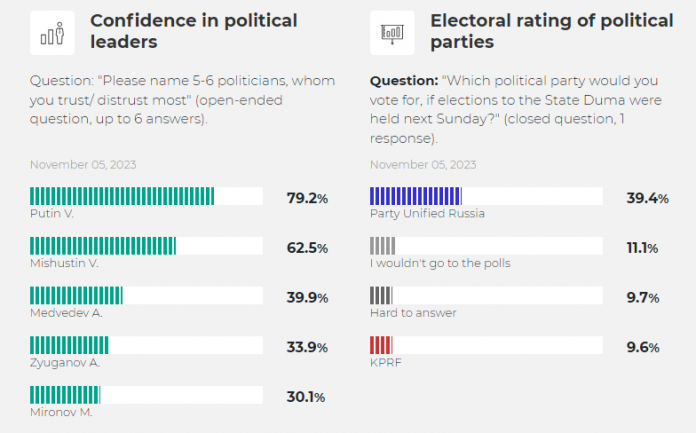
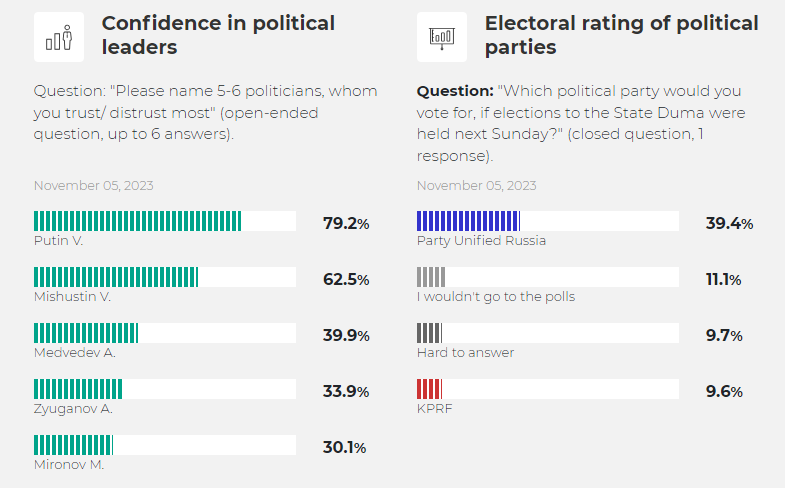
Figure 2: Confidence in political leaders and electoral rating of political parties Source: Russian Public Opinion Research Center, 2023


The Russian Federation has held seven presidential elections since the role of President of Russia was established in 1991. The country will have its eighth presidential election in 2024. Under President Vladimir Putin’s leadership, Russia has exhibited endurance in the face of economic hardships, international sanctions, and isolation. President Putin, a visionary political leader, has guided the country through crises, demonstrating that nations can weather the storm of global sanctions and isolation with the correct measures.

Despite the obstacles provided by sanctions, isolation, and the pandemic, President Putin’s crisis leadership style has received plaudits from a variety of local and international groups. Despite hurdles, the pillars used to judge his national and global success have stayed consistent from 2020 to the present. President Putin’s skillful handling of internal political intricacies has promoted solidarity among political and economic elites, resulting in greater economic well-being for both citizens and outsiders.

Russia has shown economic resilience in the face of sanctions and greater isolation. President Putin’s careful allocation of the country’s resources to sectors with significant benefits for Russians and allies across the world has been critical in sustaining economic stability. Despite Western isolation, Russia has maintained connections with governments around the world, increasing its network of allies. Putin and his staff have skillfully handled the socioeconomic environment, keeping it under control, through vigorous diplomatic measures targeted at mutual advantage.

Notably, two prominent Russian sociological centres, the official Russian Public Opinion Research Centre and the private Public Opinion Foundation, came to the same conclusion about Putin’s widespread support among Russian residents. Their analysis agrees on one critical point: if President Vladimir Putin declares his intention to compete for re-election, no plausible rival will emerge.

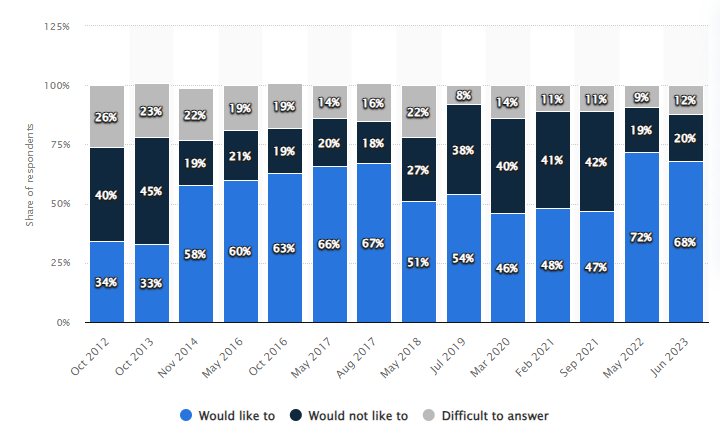
Figure 1: Like to see Vladimir Putin as a president of Russia after the expiration of his current presidential term, after 2024?
Source: Statista, July, 2023

A survey conducted in June 2023 indicated that approximately 70% of 1,634 Russians, primarily those aged 18 and older, wanted Vladimir Putin to be reelected as the country’s president in 2024, when his current term would expire. This represented a four percent reduction from May 2022, but a significant 21 percent gain from September 2021. Furthermore, between September 2021 and June 2023, the percentage of individuals opposed to Putin serving another term substantially halved.

President Putin’s stanch backing shows a solid endorsement of his leadership and programmes. The decline in opposition over time reflects a greater acceptance and approval of his leadership. This degree of popularity demonstrates Putin’s ability to navigate the complexity of global politics while maintaining stability in the face of external threats.

As Russia approaches its eighth presidential election in 2024, the landscape is marked by a political environment where Putin appears to have a firm grip on public opinion. The combination of economic resilience, diplomatic finesse, and domestic political acumen positions President Putin as a formidable candidate. While challenges may persist, Putin’s double-edged national-geopolitics strategy seems to be steering Russia toward continued stability and global influence.

Figure 2: Confidence in political leaders and electoral rating of political parties
Source: Russian Public Opinion Research Center, 2023

On Photography and Desensitized Society

0

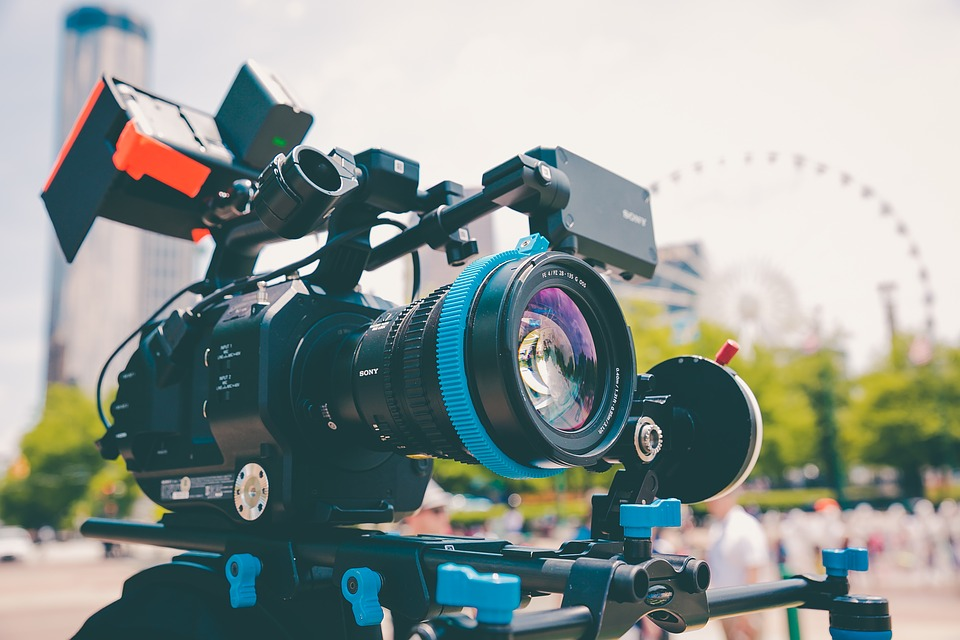
In the age of photography, a tool originally created to capture and preserve beloved memories has mutated into a double-edged sword, one that not only immortalizes the joys of life but also catches the stark realities of human misery. While the camera remains a valuable device for documentation, its pervasive presence has inadvertently contributed to the desensitization of society, numbing our moral sensitivity, particularly in times of crisis such as public lynchings.

With the development of photography, individuals were able to capture the essence of human experiences by freezing moments in time. Photography was a revolutionary invention. But as the lens changed from being a luxury to a feature on every smartphone, the nature of photography changed as well. Because taking pictures was instantaneous, people could record not just their own joys but also the happenings in society, even the cruelest and most agonizing occasions.

The camera has taken on dual roles in the context of public lynchings, acting as a moral degradation perpetrator and witness. People frequently prioritize the process of capturing over intervening, making the very tool that should elicit empathy and motivate action a passive observer. The photographer loses sight of the moral need to step in and help when they are focused on getting the ideal shot or creating viral content, and they stop caring about the suffering of people in front of them.

This problem is made worse by the widespread use of social media, where horrifying pictures spread quickly and are no longer contextualized. Instead of evoking a sense of shared outrage and compassion, these images frequently become just pixels on a screen, deafening viewers to the underlying tragedy of humankind. The constant barrage of upsetting pictures also contributes to the desensitization of society, making empathy seem insignificant in the face of so much photographic content.

Taking pictures of a crisis can cause attention to change from the victim to the image’s composition. The importance of framing, lighting, and angles increases, dehumanizing the subjects. This change in viewpoint pulls viewers away from the unfiltered feelings of the situation, turning real empathy into an objective appreciation of art.

In the quest of drawing attention in a visually saturated internet scene, there is a tendency to favor graphic material over ethical considerations. Public lynchings, which previously shocked the whole world, are occasionally reduced to being nothing more than spectacles that are watched and then forgotten like a feed on social media. The appeal of engagement numbers overrides the human agony depicted in these pictures.

The photographer’s role in these circumstances is also an ethical one; although documentation is essential for accountability and justice, it can be difficult to draw a distinction between bearing witness and taking advantage of the weak. Taking pictures can occasionally reinforce a voyeuristic culture in which people put their duty as documentarians ahead of their duty as fellow human beings.

In order to address the decline of moral sensibility in the era of photography, there needs to be a mental shift among people. It demands a return to the fundamental ideas of moral obligation, empathy, and compassion. Photographers and viewers alike must be conscious of the potential harm caused by the thoughtless dissemination of distressing images and strive to reclaim the human element within the frame.

While it remains a powerful tool for capturing the essence of the human experience, its pervasiveness has inadvertently led to a desensitization of society, particularly in the face of crises such as public lynchings. Reclaiming our moral sensibility necessitates a reevaluation of our relationship with the camera, emphasizing empathy over spectacle and ethical responsibility over virality.

The Fallen 300-Year-Old Tree in Ghana and the Physics of African Culture

1

It was a major news story on BBC Newshour on Monday. Yes, someone had chopped down a famous 300-year-old kola tree in Ghana. Many Ghananians especially in the town of Feyiase were outraged because this tree was like a deity with mystical and healing powers. You cannot write the history of the legendary Ashanti Kingdom without mentioning this tree, indicating the treasured nature of this tree.

Who might have chopped it? And for what?

If you lived in the village as I did, you might have encountered young men who wanted to test their new belief by challenging and demonstrating that the gods are not indeed capable of defending themselves. Yes, they will go to the village stream to harvest fishes (abominations!) or draw water from streams with basins violently, when you are expected to gently scoop the water with small native bowls.

I was a member of my secondary school Scripture Union and we were part of the “anointed ones”, baptized and protected by the Blood. But going into a shallow freshwater village stream to kill fishes made no sense. I felt there was a Physics in the ordinance passed by the elders, despite anything the gods or norms or beliefs might have held.

In Ovim, while the Tantuta Ugwunta stream has an ordinance of not to fish therein, the Iyinta Obayi banned both fishing and using large buckets to scoop water. Examining the two streams, Tantuta flows from a higher level to a lower one which means there was no need to restrict on the scooping method since if you stir the lower level, it would not affect the source of the freshwater. But when you go to Ide (a bigger water body), all those rules vanish, allowing you to fish and do whatever you want!

Indeed, if you fish in shallow village streams, you will distort a source of drinking water, causing problems for the whole village. If you use a large bucket to scoop the water, you will distort its flow and it will take time to settle in slow flowing streams. So, to stop people from doing those things, norms are invented, scaring people. And most times, it was a tradition which has emerged as a means for people to preserve a way of living, and not necessarily connected to any absolute deity. So, when you kill those fishes, you may not be annoying any god; you are simply a stupid person who does not want people to have clean water!

People, do not chop native trees. Some of those trees may be the only survival herbs which have medicinal value. When people boil their leaves, they get better, and due to that villagers will come together to protect them. That tradition is passed from generation to generation. You do not need to destroy them just to prove your new faith because doing that is stupidity since most of the time, there is really nothing religious about them! 

It is all part of the physics of African culture; if they had invented a way of writing to chronicle them, you may be studying for a PhD to master them.

(Sure, some trees, fishes, etc have powers. Do not try)