DD
MM
YYYY

PAGES

DD
MM
YYYY

spot_img

PAGES

Home Blog Page 4022

Global Entrepreneurship Trends And How Africa Can Support Founders and Startups

0

With the rise in the number of startups, it always makes for an interesting discussion when one begins to look at entrepreneurship trends in the Ecosystem. What is making some businesses survive and thrive? And what makes others get choked out of the space?

The Global Startup Ecosystem Report compiled by Startup Genome ranks various ecosystems to see their trends and changes year on year. The yearly report shows that the top five ecosystems have remained the same for the last few years, even though a couple of them swapped positions. One interesting data to consider is that while the top five ecosystems accounted for an Ecosystem Value of $3.8 trillion as of 2022, the next 25 (being #6 to #30) were worth $2.3 trillion in Ecosystem Value.

OPay’s $400 million Series C in August 2021 was the region’s biggest deal, while Flutterwave’s $250 million Series D in February 2022 saw its valuation increase to over $3 billion.

India’s ecosystem continued to show significant growth, with Delhi, Mumbai, Bangalore-Karnataka, and Pune collectively generating 25 unicorns between 2019 H2 and the end of 2021. Another remarkable finding is that while Silicon Valley remained the world’s leading ecosystem, its share of early-stage investment by dollar amount has declined in the last decade from 25% to 13%.

The implication of this trend in the early stage funding is that the rest of the world is catching up in terms of tech growth, and this would likely continue, going forward. One region continues to dominate the Global Rankings, with about 47% of the top 30 ecosystems in North America. Then, there’s Asia with 30%.

The big question now is – how can Africa join in the catching up and improve her numbers beyond what we have already?

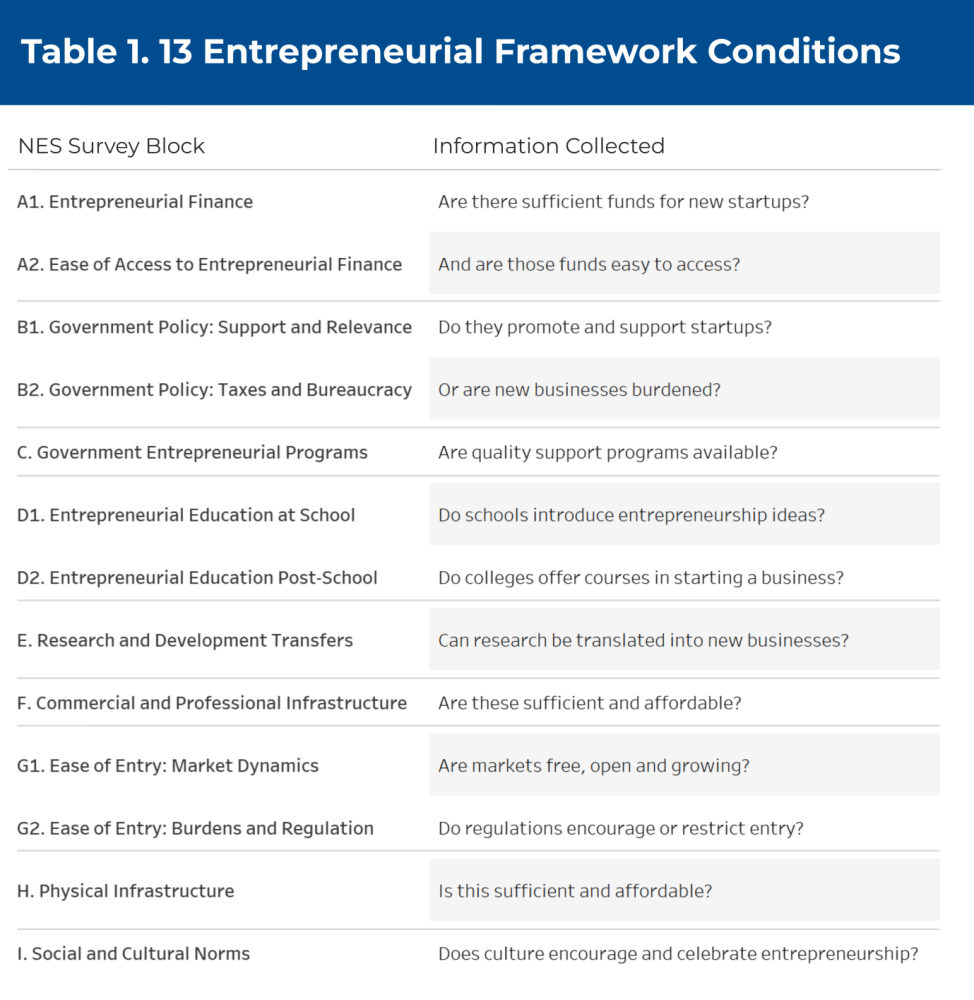
Let’s look at the Global Entrepreneurship Index for some insights. The Global entrepreneurship monitor ranks countries by seeking answers to the questions below.

These questions basically seek to find out how easy it is for a business or startup to start, survive and thrive in a country. The more positive answers a country can provide to these questions, the better the ranking. More Yeses would mean that there are modalities in place to ease the startup journey overall. No wonder high-income economies perform better than middle and low-income economies on the scores.

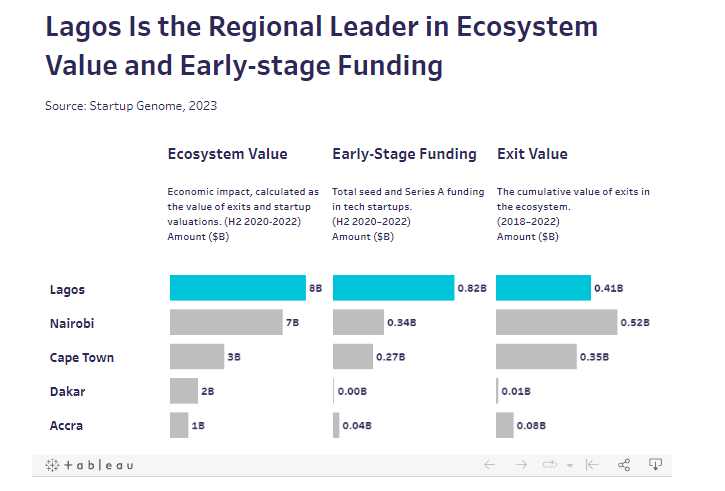
  • No sub-Saharan ecosystems made it into the top 30 + runners-up ranking, but this doesn’t mean the region is without significant activity. Sub-Saharan Africa was up 227% in early-stage funding amount and up 43.8% in early-stage deal count from 2018 to 2022, highlighting the rapid development of the region’s tech startup scene.
  • Nairobi produced the region’s biggest exit and the second biggest deal also emerged from the Kenyan ecosystem: Payments startup DPO was acquired by Network International in 2021 for $2.9 million and Sun King, which sells, installs, and finances solar home systems, has raised $577 million over nine rounds, with its latest a April 2022 Series D round of $330 million. Nairobi’s Ecosystem’s Value is up an impressive 281% from from July 1, 2019–December 31, 2021 to July 1, 2020–December 31, 2022.
  • Lagos held its place in the 51–60 range of the Emerging Ecosystems ranking. OPay’s $400 million Series C in August 2021 was the region’s biggest deal, while Flutterwave’s $250 million Series D in February 2022 saw its valuation increase to over $3 billion.
  • Cape Town has entered the top 100 Emerging Ecosystems for the first time, in the 91–100 category and aided by a 23% increase in Ecosystem Value, a 26% growth in the count of early-stage deals, and 22 new Life Sciences disciplines.

The United Arab Emirates (UAE), with the highest score and a wide margin, emerged as the best place to start a new business in 2022, followed by the Netherlands, Finland, Saudi Arabia, and Lithuania. Keep in mind, that the UAE took intentional steps to improve in 11 of the 13 framework conditions since 2020.

And this is why I think Africa can step up.

Entrepreneurial funding

The governments of African countries need to start making more funds available, and easily accessible to startup founders.

Government Policy

By reducing the burdens of new businesses through tax reliefs and holidays, and providing them with adequate support and education, Africa could speed up the growth of its startup ecosystems.

Government Entrepreneurial Programs & Education

We need to put in place adequate entrepreneurial training and support programs in Africa. Introducing entrepreneurial education in schools at different levels can also help to start the transformation from a very young age. Entrepreneurship education and support programs will play a huge role in nurturing the next generation of global entrepreneurs.

Research and development transfers

Isn’t it high time we move the research findings from the library shelves in our institutions, and translate them into real-time businesses?

Ease of Entry

How easy is it to start a business? Are there regulations to encourage entry? Or are the regulations restricting entry? Is it possible to make it easier on new businesses, by having markets that are open and growing across the continent?

Infrastructure

Compared to other continents, Africa has to establish more infrastructures to be able to catch up. Importantly too, such infrastructure should be affordable to startup founders and entrepreneurs who need them to further their business. Even infrastructure such as stable power supply and internet penetration would make a major difference for entrepreneurship on the continent.

In conclusion

If Africa does not rise to the challenge, the continent will be playing catchup for a long time coming. A look at India and the United Arab Emirates shows that truly if the government pays the right kind of attention to these issues, the results can become visible within the next decade.

Some may argue that these challenges are in themselves, opportunities for entrepreneurs to jump on. However, there are limits to what entrepreneurs and investors can do, without the right regulatory environment.

Case Study on the Trend

See how the world has changed, using a US case study: “The entrepreneurship bug is going around. New business applications soared to more than 5 million in 2022, notching a 42% increase from pre-pandemic levels. Also encouraging: 1.7 million of those companies are considered “likely employers,” meaning they’re expected to join the more than 30 million small businesses that have created most of the country’s new jobs since 1995. In some ways, launching a business is easier than ever. E-commerce sites can be up and running in hours, and, as one South Carolina entrepreneur told Bloomberg, “99%” of what is taught in MBA programs is now “on YouTube for free.” Sure, but self-employment is not all smooth sailing right now. Loans are difficult to get and expensive as a result of interest-rate increases, consumers are scaling back on spending due to inflation, and a high demand for workers is inflating labor costs.”

For more on the report, go here.

Relevant Provisions of the 2023 CBN Code of Corporate Governance For Banks in Nigeria – Part 2

0

Finance Law :- Relevant Provisions of the CBN Guidelines on Corporate Governance For Commercial/Merchant Non-Interest Payment Service Banks and Finance Holding Companies  – External Auditors & Shareholders

This chapter of the CBN Corporate Governance article series will be focused on the provisions of the CBN Guidelines on external auditors, general meetings and shareholders.

External Auditors

– The appointment and removal of the external auditor shall be the responsibility of the board, subject to the approval of the Central Bank of Nigeria (CBN).

–  The external auditor shall report annually in the financial statements, the extent of the bank’s compliance with the provisions of Nigerian Code of Corporate Governance (NCCG) 2018 and the CBN Guidelines.

– The external auditors shall render annual reports to the Director, Banking Supervision Department (BSD) on the bank’s risk management practices, Internal controls and level of compliance with regulatory directions.

– The report stated in S.18.3 of the guidelines shall in the case of an Non-Interest Bank (NIB) , include an assessment of the process of identification and disposal of NPI(Non-Permissible Income), the treatment of PSIAHs and income smoothing (if any).

– In addition to the requirement this section, the external auditors of an NIB shall review the :-

a). Compliance of the bank with the decisions of the ACE & FRACE.

b). Work of the ISA & ISCO.

– The external auditor shall forward copies of the report together with Its management letter on the bank’s audited financial statements, to the Director, Banking Supervision Department, latest March 31st following the end of every accounting year.

– Banks are required to publish their annual audited financial statements in 2 National daily newspapers and on their websites.

– External auditors of banks shall not provide client services that could amount to conflict of interest, including the following :-

a). Book-keeping or other services related to the accounting records or financial statements of the audit client.

b). Valuation services, Business opinion or contribution-in-kind reports.

c). Actuarial services.

d). Internal audit outsourcing services.

e). Management or human resource functions including broker or dealer services, investment banking services and legal or expert services

f). Board evaluation & appraisal services.

g). IT & system audit.

h). Software sales, consulting and management.

– Where the CBN is satisfied that an external auditor of a bank has engaged in any unethical practice or illegal activity, the CBN shall request the board of the bank to remove the external auditors, or it may impose any other sanction on the bank in line with the provisions of extant laws and regulations.

General Meetings

– The board shall ensure that the venue of a general meeting is convenient and easily accessible to the majority of shareholders.

– The board may consider rotating the venue of general meetings where it promotes better access to the majority of shareholders.

– Banks may hold their general meetings virtually where physical meetings are not feasible.

What are the provisions of the CBN Guidelines regarding shareholders?

Shareholders Engagement

– The board of a bank with institutional investors shall ensure that such investments carry out the responsibilities details in Recommended Practice 22.3 of NCCG 2018.

– The board shall ensure that dealings of publicly listed banks with shareholders’ associations are in strict adherence with the code of conduct for shareholders’ associations issued by the Securities and Exchange Commission (SEC).

– Where a bank is not publicly quoted, its dealings with shareholders shall be transparent and in line with best practices.

Protection of Shareholders’ Rights

– Except where prior CBN approval is granted, no individual, group of individuals, their proxies or corporate entities shall own controlling interest in more than one bank.

– The CBN’s prior approval and no objection shall be sought and obtained before any acquisition of shares of a bank (including through the capital market) that would result in equity holding it 5% and above by any investor.

– Where the CBN has an objection on any acquisition as stated above, notice of the objection shall be communicated to the bank and the bank shall notify such investors within 48 hours.

– Government’s direct and indirect equity holding in a bank shall not be more than 10% which shall be divested to private investors within a maximum period of 5 years from the date of investment

– For existing investments above 5 years, the bank shall within 2 years from the effective date of the guidelines comply with the provisions mentioned above.

Relevant Provisions of The CBN Guidelines on Corporate Governance For Commercial/Merchant Non-Interest Payment Service Banks and Financial Holding Companies –  Business Conduct & Ethics, Related Party Transactions, Conflicts of Interest, Sustainability, and Stakeholder Communication.

This chapter in the CBN Corporate Governance series will be focused on the provisions of the Central Bank of Nigeria Corporate Governance Guidelines on business conduct & ethics, related party transactions, conflicts of interest, sustainability and stakeholder communication.

Business Conduct & Ethics

– Banks shall establish a code of business conduct and disclose in the code, such information &  practices necessary to maintain confidence in the bank’s integrity.

– The code referenced in S. 21.1 shall take into account the legal obligations and reasonable expectations of the bank’s shareholders, as well as the responsibility and accountability of individuals reporting on issues or unethical practices.

– The code so mentioned in this provisions is to be renewed at least once every 3 years.

What are the provisions of the guidelines concerning related party transactions?

– Banks shall establish a policy concerning insider trading and related payment transactions by directors, senior executives and employees as well as publishing the policy or a summary of that policy on their website.

– The policy shall contain appropriate standards and procedures to ensure it is effectively implemented.

– In addition to the requirements above, there shall be an internal review mechanism carried out by the internal audit function of the bank, to assess the compliance and effectiveness of the policy.

– Any director whose facility or that of his related interests remains non-performing in any Financial Institution (FI) for more than 1 year shall cease to be on the board of the bank and shall be blacklisted from sitting on the board of such bank and that of any other FI under the purview of the CBN.

– No director-related loans and/or interest shall be written off without the CBN’s prior approval.

– In the case of a Payment Service Bank (PSB) :-

a). Where a PSB is a related company to an existing infrastructure provider which provides services to other FIs, the PSB shall ensure that its dealings with the infrastructure provider is at arms-length.

b). The following conditions shall guide business conduct between PSBs , their parent companies and other related entities (where applicable) :- 

– A parent company or any other related entity of a PSB, which renders services to the PSB may extend similar services to other entities that so desire on the same terms and conditions.

– A parent company or any other related entity of a PSB is prohibited from giving any preferential treatment to the PSB.

– Preferential treatment by a parent company or any other related entity shall, among others, include :-

a). Precluding its subsidiary’s competitor from using its infrastructure or services.

b). Offering lower quality of service to its subsidiary’s competitors.

c). Offering such infrastructure or services at differential pricing levels.

– Failure of any PSB to abide by these fair competition clauses may lead to revocation of its license.

– All services between the parent company and its PSB shall be guided by SLAs and/or shared services arrangements in line with the CBN Guidelines For Shared Services Arrangements for Banks and Other Financial Institutions (OFIs).

– A PSB shall submit the SLAs mentioned above to the CBN for prior approval before implementation.

What are the provisions of the guidelines on conflicts of interest?

– Banks shall develop and adopt a policy to guide the board and individual directors in conflict of interest situations, which shall cover the following areas :- 

a). Approval & revision date

b). Definition of conflict of interest

c). Purpose of the policy

d). Procedures to follow and situations of conflict of interest.

– The board shall be responsible for managing conflicts of interest of directors and senior management in a bank.

– Any concern raised by a director on the activities of his/her Financial Holding Company (FHC) shall be recorded in the minutes of the board/board committee meetings.

What are the provisions of the guidelines on sustainability?

The guidelines provide that banks shall comply with the provisions of Recommended Practice 26 of the Nigerian Code of Corporate Governance (NCCG) 2018 as well as the requirements of the Nigerian Sustainable Banking Principles.

What are the provisions of the guidelines on stakeholder communication?

– In addition to the traditional means of communication, banks shall have a website and are encouraged to communicate with stakeholders via the website and other official channels.

– The board shall develop stakeholder communication policies and post same on the bank’s website.

– The board shall ensure that stakeholders have the freedom to communicate their concerns on illegal or unethical practices to the board. Where the concerns relate to the activities of the board, such individuals may present a complaint to the CBN.

Relevant Provisions of the 2023 CBN Guidelines on Corporate Governance for Commercial/Merchant Non-Interest Payment Service Banks and Financial Holding Companies –  Disclosures, Returns and Sanctions.

In this article being the final chapter of the Corporate Governance series, the focus will be on the provisions of the CBN Guidelines on Corporate Governance For Commercial/Merchant/ Non-Interest Banks (CMNIBs), Payment Service Banks (PSBs) and Financial Holding Companies regarding :- 

– Disclosures

– Returns

– Sanctions

Disclosures

– Disclosure in the annual report shall include but not limited to, material information on :-

a) Directors, including –

– Remuneration policy for members of the board and executives

– Total remuneration of Non-Executive Directors (NEDs), including fees and allowances

– Total executive compensation, including bonuses paid/payable

– Details and reasons for share buybacks, if any, during the period under review

– Board of Directors performance evaluation

– Shares held by directors and their related parties

– Details of directors, shareholders and their related parties who own 5% and above of the bank’s shares as well as other beneficial owners who in concert with others, control the bank.

b). Corporate Governance Structure

– Appointment and tenure of directors

– Composition of board committees including names of the chairman and members of each committee.

– Total number of board and its committees meetings held in the financial year and attendance by each director.

– A summary of details or training and induction for directors.

– For Non-Interest Banks (NIBs):-

a). Shari’a governance mechanisms

b). A statement on compliance with internal shari’a review mechanism

c). Composition of the ACE and the number of meetings attended by each member

d). ACE certification of compliance with principles of Islamic Finance

c) Risk Management :- which includes-

– All significant risks including risks specific to NIBs

– Risk management practices indicating the board’s responsibility for the entire process of risk management as well as a summary of the lapses to be observed by external auditors, if any

– Information on strategic modification to the core business of the bank

– All regulatory/supervisory contraventions, sanctions and penalties during the year under review and infractions through whistle blowing

– Capital Structure/Adequacy

– Opening and closing of branches/outlets

– Any service contract and other contractual relationships with related parties

– Frauds and forgeries

– Contingency planning framework

– Contingent assets and liabilities (off-balance sheet items))

– The details of parent/holding institutions, subsidiaries, affiliates, Joint Ventures (JVs) and Special Purpose Vehicles (SPVs) where applicable

– Any matter not specifically mentioned in this guidelines, but which may materially affect the financial position or going concern status of the bank

– NIBs in addition to all the above shall make disclosures on :-

a). Returns paid to PSIAHs and amount of income smoothing (if any)

b). Non-Permissible Income if any and its disposal

– To foster good corporate governance, banks are encouraged to make robust disclosures beyond the statutory requirements contained in the Banks and Other Financial Institutions Act (BOFIA) 2020 and other applicable laws and regulations

– Annual reports of NIBs are required to contain certification of the ACE that the operations of the NIB are in line with the principles of Islamic Finance

What are the provisions of the CBN Guidelines concerning returns?

– Banks shall submit to the Director, Banking Supervision Department, CBN, periodic returns as specified in the extant guidelines for licensing and regulation of Financial Holding Companies in Nigeria.

– When required, every bank shall render electronic submission of each of these regulatory returns to a dedicated web portal as may be prescribed by the Financial Reporting Council (FRC). 

What are the provisions of the guidelines on sanctions?

-The failure of a bank to comply with any of the requirements under the guidelines and the Recommended Practices in the Nigerian Code of Corporate Governance (NCCG) 2018, constitutes a regulatory breach and shall attract a penalty as may be prescribed by the CBN.

The rendition of false, misleading and/or incomplete information to the CBN shall attract appropriate sanctions including monetary penalties and administrative sanctions on the individual and the bank.

– A breach of any of the provisions of this Guidelines by a director, manager or officer shall attract appropriate sanctions including monetary penalties and administrative sanctions on the individual responsible for the breach. 

-In addition to the provision of Section 28.3, such director, manager or officer of the bank shall be suspended for six months in the first instance and possible removal from the Board of the bank in the event of continued reoccurrence of the breach.

Apple Fiscal Third Quarter Report Beats Analysts Expectations, But Year-Over-Year Sales Drop

0

Tech giant company, Apple, reported its fiscal third quarter result, beating analysts’ expectations, but year-over-year sales dropped.

The company posted quarterly revenue of $81.8 billion, down 1 percent year-over-year, and quarterly earnings per diluted share of $1.26, up 5 percent year-over-year.

Also, revenue in the company’s iPhone, Mac, and iPad lines were all down from a year earlier, which saw its shares fall more than 2% in extended trading.

Here’s how Apple did versus Refinitiv consensus estimates on a year-over-year basis: 

  • EPS: $1.26 vs. $1.19 estimated
  • Revenue: $81.8 billion vs. $81.69 billion estimated, down 1%
  • iPhone revenue: $39.67 billion vs. $39.91 billion estimated, down 2%  
  • Mac revenue: $6.84 billion vs. $6.62 billion estimated, down 7%  
  • iPad revenue: $5.79 billion vs. $6.41 billion estimated, down 20%  
  • Other Products revenue: $8.28 billion vs. $8.39 billion estimated, up 2%  
  • Services revenue: $21.21 billion vs. $20.76 billion estimated, up 8%  
  • Gross margin: 44.5% vs. 44.2% estimated. 

Apple’s CEO Tim Cook speaking on the company’s Third Quarter performance said,

“We are happy to report that we had an all-time revenue record in Services during the June quarter, driven by over 1 billion paid subscriptions, and we saw continued strength in emerging markets thanks to robust sales of iPhone.

“From education to the environment, we are continuing to advance our values, while championing innovation that enriches the lives of our customers and leaves the world better than we found it.”

Also speaking, Apple’s CFO, Luca Maestri said,

“Our June quarter year-over-year business performance improved from the March quarter, and our installed base of active devices reached an all-time high in every geographic segment. During the quarter, we generated a very strong operating cash flow of $26 billion, returned over $24 billion to our shareholders, and continued to invest in our long-term growth plans.”

Apple’s fiscal third-quarter results, indicated a strong operating cash flow of $26 billion during the quarter. The Cupertino giant demonstrated its commitment to its shareholders by returning over $24 billion to them, while simultaneously investing in long-term growth plans.

The company has held its ground while still managing to generate profits. It has also laid the groundwork for potential growth, recently unveiling a sleek $3,500 virtual headset, which many analysts believe will introduce the still-geeky realm of virtual reality to a wider audience.

Several of these Analysts don’t expect Apple’s headset to turn into a significant source of revenue immediately, but they believe Apple is dipping a toe into a market that could one day be worth billions.

In conclusion, while Apple’s results for the third quarter of fiscal 2023 showed a slight decrease in revenue, the company’s overall performance demonstrated resilience and growth potential.

With strong sales in emerging markets, a record number of active devices, and a robust operating cash flow, Apple continues to be a formidable player in the tech industry. The company announced that it will provide a live streaming of its Q3 2023 financial results conference call, beginning at 2:00 p.m. PT on August 3, 2023.

Shares of Amazon jumped Friday after the e-commerce giant issued an upbeat forecast for next quarter and said its revenue hit double-digit growth. Apple also released results after markets closed Thursday, reporting its third straight quarterly revenue drop. Record-setting services sales, however, topped estimates. Results from the two companies — worth a combined $4 trillion — cap a slew of earnings reports from large tech companies that overall point to “improving health” in the sector after a period of slower growth and widespread layoffs, notes The Wall Street Journal. Demand for some tech services appears to be stabilizing and new AI developments have boosted investor optimism.

Amazon’s earnings report echoed strong results last week from Alphabet and Meta, showing a recovery in digital-advertising revenue. Semiconductor giant Intel also posted a surprise quarterly profit after two quarters of record losses, and Uber Technologies posted the first operating profit in its history earlier this week. If Apple’s stock declines hold through Friday’s trading, its market value is set to dip below the $3 trillion level. (LinkedIn News)

Top 3 Books Every New Options Trader Should Read

0

Options trading is an exciting yet complex avenue within the financial world. With its unique terminology and strategies, it might seem daunting for beginners. The good news is that there are several educational resources to guide those new to the field, especially books written by industry experts. Let’s explore some of the top books that every new options trader should read to help them master the techniques required for successful options trading.

The Complete Guide to Option Selling by James Cordier

If you are interested in selling options, then James Cordier’s Complete Guide to Option Selling is a must-read. Unlike many other books that cover a broad spectrum of strategies, Cordier’s work is solely dedicated to option selling. He breaks this unique method down, explaining both the benefits and potential pitfalls, offering a full picture of what option selling entails. You can also expect:

  • Practical insights and real-world examples: As a seasoned options trader, Cordier doesn’t just talk about theory in this book. He shares real-world examples and experiences. Plus, he offers practical insights and tips into constructing and managing an option selling portfolio, demonstrating how it’s done in the actual trading world.
  • Simplicity for beginners: This book can be particularly appealing to beginners, as the concept of option selling is presented in an easy-to-understand manner. Complex topics are explained using simple language, making it an accessible read for those new to the field.

Options as a Strategic Investment by Lawrence G. McMillan

Options as a Strategic Investment is often regarded as the Bible of options trading. McMillan’s work has served as a cornerstone for many traders, both novice and professional. From basic concepts to advanced techniques, McMillan leaves no stone unturned. He dives into various options, including stock index options, futures options, and much more. Here’s what you can expect from this essential book:

  • Theoretical insight and practical application: This book expertly bridges the gap between theory and practice. Concepts aren’t merely explained, but it also teaches you how to apply them in real trading scenarios.
  • Clear language and structured approach: While the content of the book is dense, McMillan’s writing style is clear and well-organized. It begins with the fundamentals and gradually builds towards more complex topics, ensuring a smooth learning curve for readers.

Option Volatility and Pricing by Sheldon Natenberg

Sheldon Natenberg’s Option Volatility and Pricing is a book that stands out among options trading literature. Focusing on the interplay between volatility and pricing in options trading, it’s an invaluable resource for traders who want to understand these intricate concepts. Some of the main things to like about this book include:

  • Comprehensive yet understandable: This book covers a broad range of topics related to volatility, from basic concepts to advanced trading strategies. With a simple writing style and approach, these complex topics are made understandable even for those new to trading.
  • Practical strategies and tools: The theories behind volatility aren’t just explained in this book; actionable strategies and practical tools are also provided. Specific trading strategies that rely on understanding volatility are explained in detail, allowing readers to easily implement what they learn.

Whether you are just beginning your journey or looking to refine your skills, these three books offer a wealth of knowledge tailored to different aspects and levels of options trading.

For Nigeria Youth: Learn from Carlos Slim and Templeton, and Believe the FUTURE [video]

1

As Nigeria goes through a challenging season of economic paralysis, I want you to remember that nations rarely kaput. In this video, I introduce two men I study – Carlos Slim (Mexican billionaire) and Franklin Templeton (stock picker of the 20th century). These men demonstrated tenacity at a time their respective nations were under stress. Yes, even in the miry clay, they saw an unbounded future – and believed. The green pastures came for them, and you can also experience the same because the sun will always rise, from the eastern corridor. Rarely rarely kaput!

Franklin Templeton began a firm in 1947, against all odds, at the ruins of World War II. Mr Slim bought anything in his sight at one of the lowest points in Mexican history – the peso was down and markets in ruins. Templeton trusted the human race and bought “useless” stocks. Slim’s father told him that countries do not fail; they always come back.

Becoming successful in life is not about being busy; it is understanding things and making sense of them, more meaningfully. There are acres of diamond in Nigeria today, across many areas. Look for them. If you do not believe in humans and the aspiration spirits, it is unlikely you can see opportunities in life. 

This moment will go and like the cryolite, the beautiful gems out of periwinkle, new moments will emerge. Unless you crack the periwinkle, the cryolite rarely emerges. Do not lose confidence because abundance remains in the future. The key is productive exploration of opportunities. Think and thrive; Nigeria has acres of “diamond” you can mine.