DD
MM
YYYY

PAGES

DD
MM
YYYY

spot_img

PAGES

Home Blog Page 4036

Tinubu Requests Approval of Fresh $7.8bn, €100m Loan from Senate Amid Criticism Over Extravagant Spending

0

President Bola Tinubu has requested the approval of the Senate for an additional $7.8 billion and €100 million borrowing plan, a mere 24 hours after seeking approval for the N2.18 trillion Supplementary budget.

This move comes amid economic challenges exacerbated by low revenue and what has been described as imprudent government spending.

The President’s request was conveyed in a letter read during a plenary session by Senate President, GodsWill Akpabio, on Wednesday. Just a day prior, President Tinubu had presented the N2.18 trillion supplementary budget to the National Assembly.

A few months ago, the National Assembly approved a total of N819.5 billion presented by the President. This allocation included a N500 billion palliative package to mitigate the impact of recent economic policies.

The President’s letter stated, “The Senate may wish to note that the past administration approved the 2022 – 2024 borrowing plan at the Federal Executive Council which was held on the 15th day of May 2023.”

The borrowing plan encompasses a range of sectors, with a specific focus on infrastructure, agriculture, health, education, water supply, security, employment, and financial management reforms, among others. The total facility for the projects and programs under the borrowing plan amounts to $7,864,508,559 and €100 million.

President Tinubu highlighted that the removal of fuel subsidy and its impact on the economy prompted interest from the African Development Bank and the World Bank Group to assist the country, offering sums of $1 billion and $2 billion respectively.

“The Senate is invited to note that following the removal of fuel subsidy and its impact on the economy in the country, the African Development Bank and the World Bank Group have indicated interest to assist the country in mitigating the economic shores and recent reforms with a sum of $1 billion and $2 billion respectively.

“In addition to the Federal Executive Council approved 2022-2024 external borrowing plan. Consequently, the required approval is 7,864,508,559 dollars, and in terms of euros, 1000 million euros.

“I would like to underscore the fact that the projects and programmes borrowing plans were selected based on positive technical economic evaluations as well as the expected contribution to the social economic development of the country, including employment generation, skills acquisitions, supporting the emergence of more entrepreneurs, poverty reduction and food security to improve the livelihood of an average Nigerian,” he said in the letter.

The president emphasized that the projects were selected based on positive technical economic evaluations and their expected contributions to the socio-economic development of the country, including employment generation, skill acquisition, support for entrepreneurship, poverty reduction, and food security.

He assured that the projects and programs would be implemented across all 36 states of the federation and the Federal Capital Territory, focusing on critical infrastructure projects such as power, railway, and health, among others.

Given the current economic realities facing the country, President Tinubu emphasized the urgency of the Senate’s consideration and approval of the 2022-2024 external borrowing plans to enable the government to fulfill its responsibilities to Nigerians through prompt disbursement and efficient project implementation.

However, the fresh loan request is coming at a time when the federal government’s use of public funds is under serious scrutiny. On Tuesday, it was revealed that the supplementary budget of N2.17 trillion the federal government requested from the National Assembly includes billions of naira budgeted for vehicles.

In the budget allocation, there is an allocation of N2.9 billion for Sport Utility Vehicles (SUVs) for the Presidential Villa. Additionally, another N2.9 billion is set aside for the replacement of operational vehicles for the presidency. Renovation projects for the presidential and vice-presidential residences are also included, with N4 billion allocated for the president’s residence and N2.5 billion for the vice president’s residence.
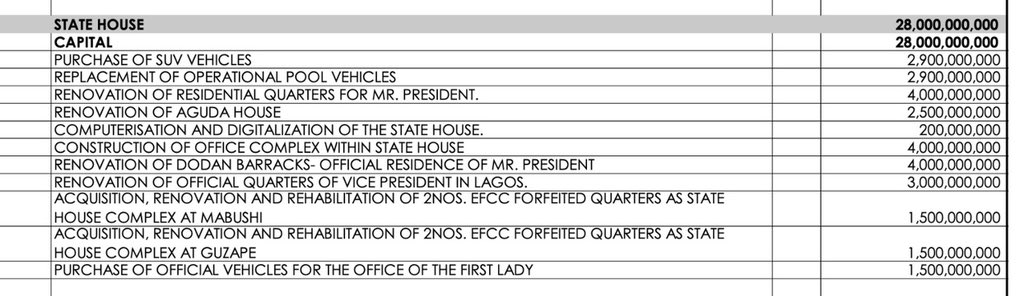
The State House, which encompasses various aspects of the presidency, is proposed to receive a total of N28 billion, and the Presidential Air Fleet is allocated N12.5 billion for its operations and maintenance.

The budget has faced additional criticism due to the allocation of N5.5 billion for an education loan fund and N5.095 billion for the Nigerian Navy, specifically for the acquisition of a presidential yacht.

These allocations have sparked controversy and raised questions about their prioritization in the budget, especially as the government needs to borrow to fund them.

The Nigerian Police Must Work Professionally and Follow The Constitution

1

Two things:

#1: Firing water cannons to the Governor of Rivers State: “Some civilians, apparently the governor’s political supporters, also walked along with Mr Fubara as the police continued to fire teargas and water cannons towards the governor”

#2: Arresting the President of the Nigerian Labour Congress: “President of the Nigeria Labour Congress, Joe Ajaero, was picked up a few minutes ago from NLC state council secretariat by heavily armed policemen in Owerri and taken to an unknown destination,”

To the Nigerian Police, these stories are not just right. What is really wrong with Nigeria? How do we lose our souls because of allegiances to powers? Many things are not defensible including firing teargas to a Governor who ideally is the Chief Security Officer of the state. Then, the leader of the Labour Union, being picked up in a secretariat.  This is simply painful for Nigeria!

Nigeria needs a professional police force which takes orders from the Constitution and not big men. We must do better!

Treat Every Gunshot Wound Without Police Clearance in Nigeria

0

About three weeks ago, I heard and read the story of a young girl in her mid-20s who died as a result of the negligence and nonchalant attitude of some hospitals in Abuja. From what I heard, they said that the lady entered a “one chance” vehicle, the “one chancers” did not just rob her of all her belongings, they also stabbed her multiple times and threw her off of the moving vehicle when they were done with her. 

Some good Samaritans saw her and rushed her to the hospital since she was still alive although in critical condition with the hope that she would get urgent medical help and get stabilized.

I was told that about three hospitals turned down treating her on the grounds that they did not come with a police report and those hospitals demanded police clearance before she could be attended to. Since it was already late in the night and there was no way in hell they could have gotten a police report from any police station; from taking her from one hospital to another hoping that she could be attended to, she gave up the ghost. 

This happened in Abuja, barely three weeks ago and I’m certain you must have heard of a similar story of a robbery victim or an accident victim or someone who was shot being refused Medicare by hospitals on the grounds that the victim might be an armed robber who got shot by the police hence why the hospitals always insist on the victim providing a police report or police clearance before he or she can be attended to. These encounters have led to the loss of numerous lives and it keeps happening. 

The truth is some of these hospitals are just being negligent. By the implication of the Hippocratic Oath health workers swore to, their first job is to save lives whether the patient is a criminal or not or whether there is a police report or not, that is what is expected but reverse has been the case. 

In 2017 a bill was passed called Compulsory Treatment and Care for the Victims of Gunshot Wound Act 2017. By the provisions of Section One of this act, hospitals, clinics, pharmacies and other health outlets are mandated to treat and render every required and necessary medical assistance to any victim of a gunshot wound without requesting or demanding a police report or police clearance. 

This section one provides thus; “As from the commencement of this Act, every hospital in Nigeria whether public or private shall accept or receive, for immediate and adequate treatment with or without police clearance, any person with a gunshot wound”. 

Section two went on to place a duty of care and legal obligations on both hospitals and law enforcement agents to render every help necessary for the survival and recovery of a victim of a gunshot. In fact, hospitals are asked to treat every victim without first demanding a monetary deposit. 

Here is the provision of Section 2 

2(1) Every person, including security agents, shall render every possible assistance to any person with gunshot wounds and ensure that the person is taken to the nearest hospital for immediate treatment.

(2) Accordingly-

(a) a person with a gunshot wound shall be received for immediate and adequate treatment by any hospital in Nigeria with or without initial monetary deposit.

By reason of this act, any hospital that refuses to treat a person with a gunshot wound faces both civil liabilities from the victim and criminal liabilities from the government for their negligence. 

The icing on the cake is that the Inspector General of police recently ordered the full enforcement of this act, so whenever any hospital insists on seeing a police clearance before they can attend to a gunshot victim please draw their attention to this act and also draw their attention to the current directive of the IG of police for the full enforcement of this act with no exceptions. 

Notable Provisions Of The Regulatory Framework Governing Heliports In Nigeria

0

Aviation Law :- The Regulatory Framework Governing Heliports In Nigeria

This article deals with the regulatory provisions governing Heliports in Nigeria from applicability to certification to regulatory provisions as outlined by the Nigerian Civil Aviation Authority (NCAA).

Applicability of Regulations

NCAA Regulations provide that:-

(a) The regulations shall apply to the certification and operation of heliports in Nigeria with the exception of military heliports.

Operation Of Heliports

– No person shall operate a heliport (mobile or fixed) for the takeoff and landing of helicopters in Nigeria unless he is a holder of a Heliport Certificate (HC) granted under these Regulations for the said operation.

Exemptions

The NCAA provides that:-

(a) The Authority may exempt, in writing, a heliport operator from complying with specific provisions of these Regulations.

– Before the Authority decides to exempt the Heliport Operator, the Authority will take into account all safety related aspects.

Establishment of Heliports In Nigeria

NCAA Regulations provide that :-

(a) The Minister may approve the establishment and development of heliport anywhere in Nigeria;

(b) Roads, approaches, apparatus, equipment, buildings and other accommodations in connection to such heliports shall be maintained by the owners in conformity with these regulations and any other requirement as may be prescribed by the Authority from time to time.

Design/Operation Of Heliports

(a) No person or corporate entity shall commence construction or reconstruction of an heliport without approval of the Authority.

(b) Pursuant to relevant provisions of the NCAA regulations, the Heliport operator shall submit to the Authority the following information for assessment:

(1) heliport layout and markings, lights and signs plans;

(2) architectural drawings of the terminal and other operational buildings.

Restrictions/Prohibitions

-Except with the approval by the Authority, no helicopter shall operate at a heliport.

– No heliport operator shall operate in the night except for emergency purposes granted by the Authority.

-Subject to the approval, the Authority will restrict or prohibit flights at any heliport at which aviation facilities for emergency night flights are lacking; or where the terrain, landing surface conditions or other objects in the vicinity of the heliport could cause a hazard to the operation of helicopters.

– The Authority will restrict or prohibit operation at an Heliport either absolutely or subject to any exceptions or conditions that the Authority will specify, if the restriction is necessary for aviation safety and/or in the public interest.

Requirements to hold Heliport Certificate

-The operator of a heliport intended for landing and take-off of helicopters in Nigeria shall be in possession of a heliport certificate. This also applies to heliports owned by Corporate entities engaged in business activities.

– A person shall not operate a Heliport if the Heliport is not certified by the NCAA.

Application for Heliport Certificate

– An application for the issuance of heliport certificate shall be:

(a) made to the Authority in the appropriate form as prescribed by the Authority.

(b) accompanied by:-

(1) the heliport manual; and statement of compliance demonstrating the heliport Operator’s manual is in compliance with the relevant provisions in this volume;

(2) the plans of heliport; including obstacle chart A showing details of obstructions marked /lighted ;

(3) security clearance from the Federal Government;

(4) written approval from the town planning authority where applicable;

(5) Environmental Impact Assessment approval from the (relevant State entity );

(6) proof of payment of the appropriate fee prescribed by the Authority; and

(7) adequate insurance cover;

(8) Particulars of non-compliance with, or deviations from the standards prescribed in this Regulation.

Grant of Heliport Certificate

-The Authority may approve the application and accept the heliport manual of the applicant for a heliport certificate subject to the provisions in this section and grant a Heliport Certificate to an applicant if:

(a) the Heliport facilities and equipment are in accordance with the applicable heliport standards;

(b) The heliport manual prepared for the applicant’s heliport accurately describes the facilities, services and equipment at the Heliport;

(c) the heliport operating procedures make satisfactory provision for the safety of helicopters;

(d) the applicant would, if granted a certificate, have the necessary competence, experience and resources to operate and maintain the heliport;

(e) an acceptable safety management system is in place at the heliport.

Refusal to Grant Heliport Certificate

If the NCAA refuses to grant a heliport certificate to an applicant, the authority will give the applicant notice of the refusal, and the reasons for it, not later than 14 days from the date of refusal.

Siam Commercial Bank acquires 97% stake off Bitkuba crypto Exchange in Thailand

0

In a major development for the Thai crypto industry, Siam Commercial Bank (SCB), the second-largest bank in the country, has announced that it is acquiring a 97% stake in Bitkub, a leading local Bitcoin and crypto exchange. The deal, which is subject to regulatory approval, is expected to close by the end of the year.

SCB is one of the oldest and most prestigious banks in Thailand, with a history dating back to 1906. It has over 1,000 branches and 16 million customers nationwide. It also has a strong presence in the Southeast Asian region, with operations in Cambodia, Laos, Myanmar and Vietnam.

Bitkub is the largest crypto exchange in Thailand by trading volume and user base. It was founded in 2018 and offers over 30 digital assets, including Bitcoin, Ethereum, Binance Coin, Cardano and Dogecoin. It also provides crypto-related services such as lending, staking, wallet and education. Bitkub has over 1.8 million registered users and handles over $2 billion in monthly transactions.

The acquisition will enable SCB to tap into the fast-growing crypto market and offer its customers a seamless and secure way to access digital assets. SCB plans to integrate Bitkub’s platform with its own digital banking services, such as SCB Easy, SCB Wealth and SCB 10X. The bank also aims to leverage Bitkub’s expertise and technology to develop innovative crypto products and solutions for the Thai market and beyond.

According to SCB’s president and CEO, Arthid Nanthawithaya, the acquisition is part of the bank’s vision to become a leader in digital banking and innovation. He said:

“We are delighted to partner with Bitkub, the leading crypto exchange in Thailand. This strategic investment will allow us to offer our customers a comprehensive range of digital asset services that meet their needs and expectations. We believe that crypto assets will play an increasingly important role in the future of finance, and we are committed to supporting the development of this industry in Thailand and the region.”

Bitkub’s founder and CEO, Jirayut Srupsrisopa, also expressed his excitement about the deal. He said:

“We are honored to join forces with SCB, one of the most respected and trusted banks in Thailand. This partnership will bring tremendous value to our users and the crypto community as a whole. We share the same vision of empowering people with digital assets and creating a more inclusive and accessible financial system. Together, we will be able to offer more innovative and convenient crypto services to millions of people across Thailand and beyond.”

This acquisition is not only a milestone for SCB and Bitkub, but also a sign of the growing acceptance and adoption of crypto assets in Thailand. The country has been one of the most progressive and supportive jurisdictions for crypto regulation and innovation in the region. It has established a clear and comprehensive legal framework for crypto businesses and investors, as well as a supportive ecosystem of regulators, banks, startups and educational institutions.

According to a recent report by Chainalysis, Thailand ranked 10th in the world in terms of crypto adoption, with over 6.5 million crypto users and over $4 billion in annual crypto transactions. The report also highlighted that Thailand has one of the highest rates of women crypto users in the world, at 44%. Moreover, Thailand has seen a surge in institutional and corporate interest in crypto, with several publicly listed companies investing in Bitcoin and other digital assets.

The future of crypto in Thailand looks bright and promising, as more people and businesses embrace the benefits and opportunities of this new asset class. SCB’s acquisition of Bitkub is a testament to this trend and a catalyst for further growth and innovation.