DD
MM
YYYY

PAGES

DD
MM
YYYY

spot_img

PAGES

Home Blog Page 4056

The Evolving Nigeria’s Economic and Human Geography; The Latent Opportunity of Uyo

0

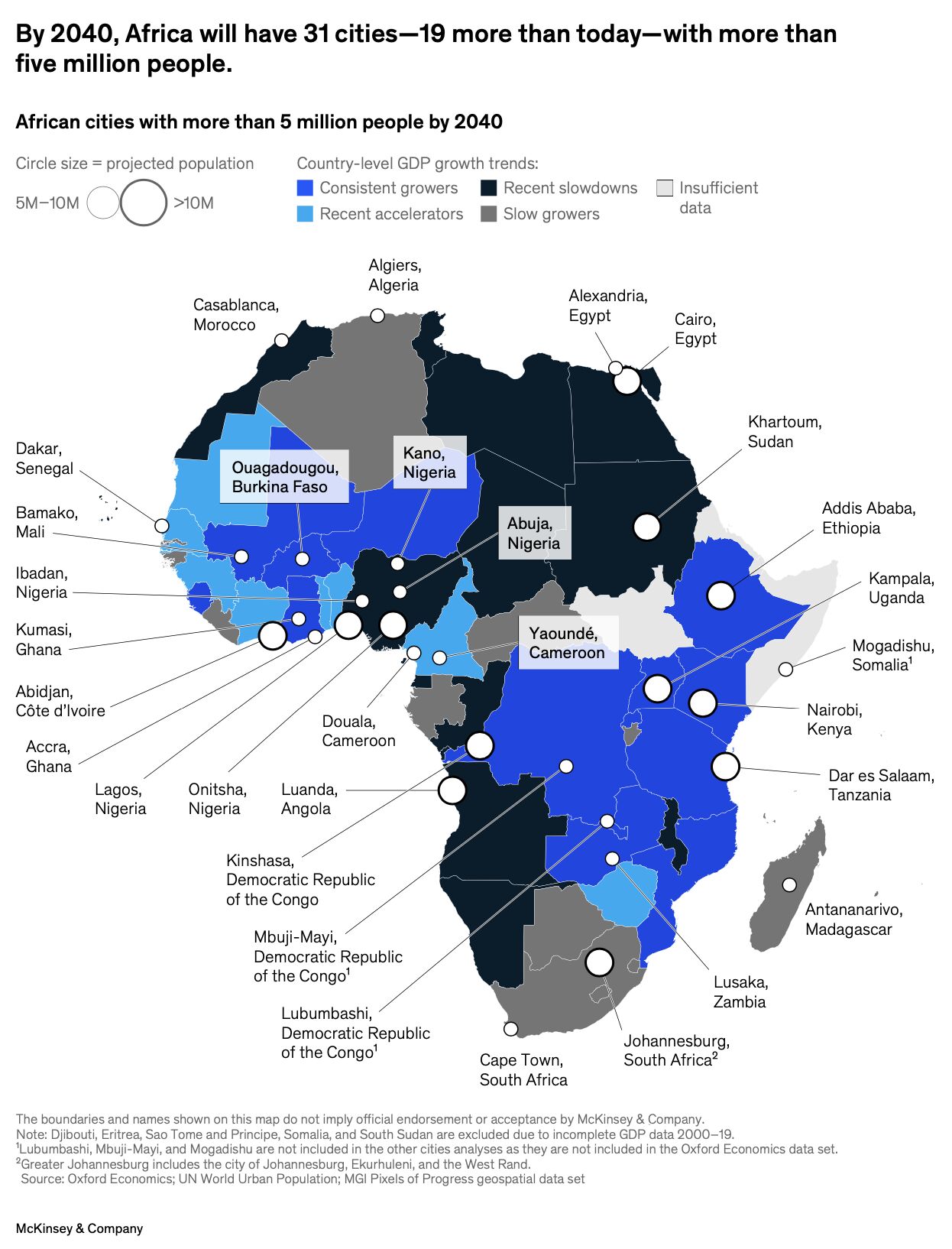
McKinsey, a consultancy, thinks that Nigeria’s HUMAN geography will be rewired within two decades. Today, the tier 1 cities are Lagos, Abuja and Port Harcourt when you are planning a  “broad” growth strategy (for some sectors, those vary) within economic opportunity geography. Kano, Ibadan, Onitsha and Kaduna come along, with Aba, Ilorin and a few others tagging.

But by 2040, McKinsey thinks Lagos and Onitsha will become dominant in human geography. Onitsha, the largest market in Africa (the first wow in my secondary school Geography class, reminding me that geography could be local) is repositioning. Ibadan, Africa’s largest indigenous city (another geography class discovery) is also going to expand, marginally. But for Kaduna and Kano, Abuja will gain from both. Abuja could become one of the largest cities in Nigeria due to infrastructure which is unrivaled in Nigeria.

While I think the models for Onitsha and Lagos are right on the money, I think the report ignores the latent potency of Uyo. If Nigeria builds a deep seaport which I think Akpabio, now the senate president will make a priority, Uyo will grow massively and Onitsha could become even larger. With a deep seaport in Akwa Ibom, Uyo, Aba and Onitsha will become bigger cities for trade and commerce.

I am long on Uyo and Aba because if Ibom deep seaport takes off, more than 20% of Lagos port traffic will move to Akwa Ibom and Uyo will become super-vital to Nigeria’s economy. A container transport from Uyo to Maiduguri will cost less than Lagos to Maiduguri (a tie for Kano). So, Uyo wins to most of Northeast and NorthCentral Nigeria (east axis). May Nigeria advance and bring prosperity to all.

A Lesson on Growth Innovation – Soulmate Industries Nigeria

0

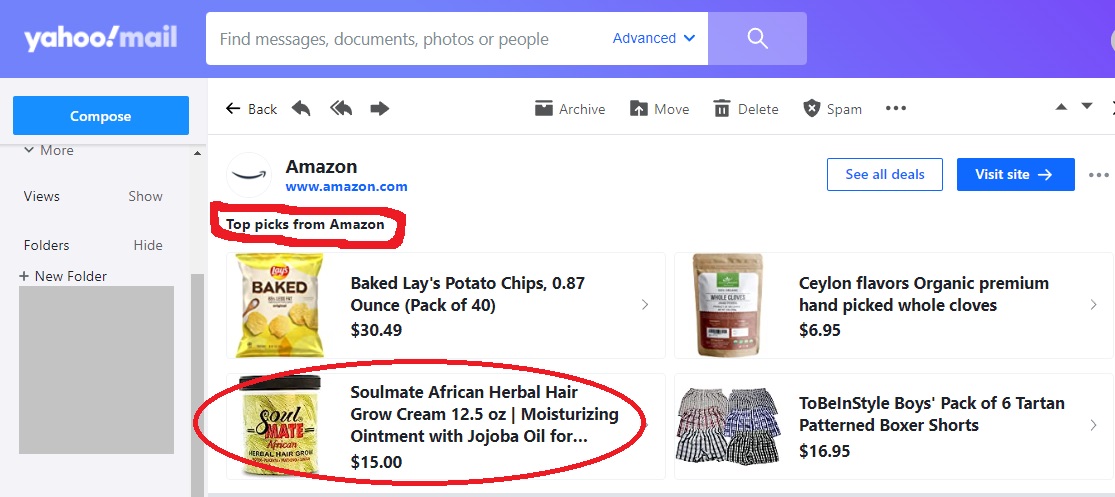
Just opened my Yahoo and saw this promo from Amazon. Yes, Soulmate’s haircare product is one of Amazon’s top picks, and it is pushing that message to American customers. It remains like yesterday when we encouraged Soulmate Industries, led by our big FUTO Alumni, Chief Ndukwe Osogho-Ajala, to go global. Soulmate Industries is Africa’s largest indigenous haircare brand.

The products are breaking sales records on Amazon, demonstrating that when you take care of your hair, that additional soul mate of beauty arrives.

Soulmate was the first corporate client which signed up when we began Tekedia Mini-MBA and more than 100 of its staff have co-learned with us. A key focus on the Growth Hour was “This Product Has To Be Everywhere”. They executed the playbook, and I know so because Amazon is promoting this African brand as one of its Top Picks. #thinkBIG

Comment on Feed

Comment on Feed  A bank stole my idea when I pitched it to it

My Response: Even though I do not know the bank which did this, I can assure you that nothing is new. The idea you pitched possibly came from somewhere. If you share it, we will share where someone has done it. Personally, I post my own business ideas on my blog. Anyone is free to pick. 

To win in the market, the difference is execution because nothing is really new (Sure, that is not to say you do not protect IPs or ideas). So, I will suggest that you TAKE ACTION and build. We tell our startups to go to events and tell people what they do so that they can get help. Some cannot even tell their staff their visions because they could be “stolen”. 

Focus on execution; and do not pitch banks. Rather, take a product to them and ask for partnerships. 

Politics and Ethics of Cancelling Davido Over Extramarital Affairs

0

The intertwining worlds of politics, ethics, and cancel culture have converged in the case of Nigerian artist Davido, who faced public backlash due to allegations of engaging in extramarital affairs. This piece examines the complexities of the politics and ethics surrounding the act of canceling Davido over his personal choices, exploring the broader implications and the need for nuanced discussions in our society.

The Context of Cancel Culture

Cancel culture, a phenomenon marked by public disapproval and withdrawal of support for individuals due to objectionable behavior, has become a prevalent aspect of our digital age. While it is crucial for society to hold public figures accountable, cancel culture often tends to oversimplify complex issues, offering little room for redemption or personal growth. The case of Davido and his alleged extramarital affairs brings these dynamics into sharp focus.

Ethical Considerations

When examining the ethics of canceling Davido, it is vital to distinguish between personal choices and professional conduct. Extramarital affairs, while deemed ethically questionable in the context of committed relationships, do not necessarily equate to professional misconduct. Ethical judgment should be tempered by an understanding of the distinction between an artist’s private life and their public persona.

Navigating Politics and Public Opinion

The politics surrounding Davido’s alleged extramarital affairs are multifaceted. As a prominent Afromusician, Davido’s personal life intersects with his public image and cultural influence. Critics argue that his actions are incongruous with the values he purportedly represents, while others contend that personal choices should not overshadow an artist’s creative contributions. Understanding the dynamics of power, societal expectations, and the influence of public opinion is crucial when evaluating the politics at play.

The Limits of Cancel Culture

While cancel culture aims to promote accountability, it often operates without a comprehensive understanding of the individual’s journey towards growth and redemption. The act of canceling Davido raises questions about the fairness of permanently tarnishing a person’s reputation for their personal shortcomings. It is essential to recognize that individuals are capable of change and should be given an opportunity to learn from their mistakes, without being eternally defined by them.

Balancing Accountability and Forgiveness

Striking a balance between accountability and forgiveness is key when evaluating the actions of public figures. Holding Davido accountable for his alleged extramarital affairs is a legitimate concern, but it is equally important to allow space for introspection, growth, and the possibility of redemption. Engaging in nuanced conversations about the consequences of one’s actions and supporting individuals in their efforts to rectify past mistakes can be a more constructive approach than outright cancellation.

Solana, Stacks (STX), Tradecurve making waves in the crypto community, how high can they go?

0

Solana is one of the SEC affected coins, resulting in a price drop to an attractive place for investors.  Stacks is in an opposite position, being SEC approved, and benefiting from its status.  Tradecurve is a decentralized trading platform that also looks to profit from the current regulatory situation.

>>BUY TCRV TOKENS NOW<<

Solana picks itself up and continues to develop

With the news that the SEC was declaring Solana as a security, the price went down by about 36%, falling from preannouncement levels of around $22 per coin to around $14.  This seems to have encouraged traders looking to buy the dip, as the price has been slowly rebounding to $17 with many traders suspecting that it is going to keep appreciating beyond the $20 mark.

Despite its regulatory woes, Solana has been trying to stay relevant, hosting and participating in various hackathons and competitions, and a social project located in one of the world’s largest slums – Kiberia located in Nigeria.

On the 17th of June Messari tweeted that Solana’s NFT activity is on the rise, outperforming both Polygon and Ethereum, and therefore indicating that Solana is still king of the NFTs.

>>BUY TCRV TOKENS NOW<<

Stacks – Interesting use case, interesting status.

Stacks is the coin on the blockchain based platform Blockstack. Stacks and Blockstack seek to offer people privacy by offering decentralized servers where people can upload and share their photos, videos, text files and more with family and friends. This is in contrast to now where most people use things like Whatsapp or Socials or FB Messenger to share their private pictures and data.

Furthermore, in a landscape where over 60 coins, including Solana, are now considered securities, Stacks parent company Blockstack has achieved a significant milestone by becoming the first company authorized by the SEC to conduct an initial public offering of bitcoin-like tokens.

Before this approval, Stacks raised over $50 million through authorized token sales exclusively to accredited investors. The IPO raised $23 million and was granted approval under Regulation A+ of the 2012 Jumpstart Our Business Startups Act, which facilitates capital generation for emerging companies with reduced disclosure requirements. Stack’s success sets an example for other cryptocurrency and blockchain startups looking to raise funds.

>>BUY TCRV TOKENS NOW<<

Tradecurve – decentralized and privacy oriented.

Whether you want to buy Solana or Stacks, the message is clear – privacy oriented solutions are needed in the current regulatory climate.  Tradecurve focuses on this with its decentralized trading platform that seeks to offer the perks of a CEX with the benefits of a DEX, and a trading brokerage, all in one place.

As Tradecurve is located in St Vincent and Kitts (where financial derivatives trading is allowed), and is a DeFi protocol, they are able to offer traders a legal way to trade everything from forex, bonds, commodities, indices and crypto, without requiring KYC.

The result is a privacy based platform that respects the anonymity of its users, and therefore opens up the options for people looking to trade, regardless of their country or socioeconomic situation.

Tradecurve can also assist the unbanked and possibly people like the residents of Kibera, in giving them a way to interact with the global financial world, especially if they team up with an on-ramp such as the Strike app, which does not require a bank account.

Tradecurve is in presale, with aims to raise $20 million, so that they can complete their platform with all its features.

At time of writing stage 4 has sold over 36%, bringing it closer to stage 5, at which point the price will rise from $0.018 to $0.025.

This means that investors are still very early, as the minimum launch price alone is $0.088 and the token is forecasted to reach a 100x once the token goes live and as the platform develops.

Learn more about Tradecurve and the TCRV token below:

Click Here For Website

Click Here To Buy TCRV Presale Tokens

Follow Us Twitter

Join Our Community on Telegram

Visa Acquires Payment Startup Pismo For $1 Billion, to Provide Core Banking Offerings For Clients

0

Global leader in digital Payments, Visa, has acquired payments infrastructure tech startup Pismo for $1 billion, to provide core banking and issuer processing capabilities across debit, prepaid, credit, and commercial cards for clients.

Through this acquisition, cloud-based payment startup Pismo will allow Visa to offer support and connectivity for emerging payment platforms like Pix, an instant payment platform created and managed by the monetary authority of Brazil, the Central Bank of Brazil.

The deal which will be paid in cash and is expected to close by the end of the year, is suggested to be one of the largest fintech M&A deals taking place this year.

Speaking on the acquisition of Pismo, Visa wrote via a statement that “It will be positioned to provide core banking and issuer processing capabilities across debit, prepaid, credit and commercial cards for clients via cloud-native APIs. The startup’s platform will also enable Visa to provide support and connectivity for emerging payment rails, like Pix in Brazil, for financial institution clients”, the company added.

Visa Chief Product and Strategy Officer Jack Forestell said,

“Through the acquisition of Pismo, Visa can better serve our financial institution and fintech clients with more differentiated issuer solutions they can offer their customers. The deal, which is subject to regulatory approvals and other customary closing conditions, is slated to close by year’s end. Pismo will retain its current management team, who will remain based in São Paulo”.

Also commenting on the deal, Co-founder and CEO of Pismo Ricardo Josua said,

“At Pismo, we aim to enable our clients to launch cutting-edge payments and banking products within a single cloud-native platform regardless of rails, geography, or currency. Visa provides us unrivaled support to expand our footprint globally and help shape a new era for banking and payments”.

Pismo is an all-in-one platform that offers a variety of products in a cloud-native environment to help clients future-proof their business. Its clients include tier-1 banks, major retailers, and game-changing neo-banks from around the globe.

Digital lending is part of Pismo’s cloud-native and API-based platform. It brings agility and flexibility to accelerate the creation of new products, covering traditional business and consumer offerings, as well as new opportunities such as Buy Now Pay Later (BNPL), for banks and fintechs of all sizes.

Since its Series B funding round led by SoftBank, Amazon, and Accel, which raised $108 million in October 2021, Pismo has grown exponentially.

As Visa positions itself to provide core banking and issuer processing capabilities, the acquisition of Pismo will see both companies better positioned to provide core banking and issuer processing capabilities across debit, prepaid, credit, and commercial cards for clients via cloud-native APIs.

Pismo’s platform will also enable Visa to provide support and connectivity for emerging payment rails, like Pix in Brazil, for financial institution clients.