DD
MM
YYYY

PAGES

DD
MM
YYYY

spot_img

PAGES

Home Blog Page 4073

4 Best Altcoins to Invest In Now Before The Next Crypto Bull Run Begins

0

The crypto market has been bearish for quite some time now, but there are slight changes occurring that are leading crypto experts to believe a bull run is on the way once again. Investors and crypto enthusiasts alike are gearing up for the next bull run and looking for the best investment opportunities to get in on now. This article will explore four promising altcoins. These digital assets have the potential to provide impressive returns, making them must-watch investments before the next crypto surge.

4 Best Altcoins

  1. Scorpion Casino Token
  2. Ethereum
  3. Solana
  4. Shiba Inu

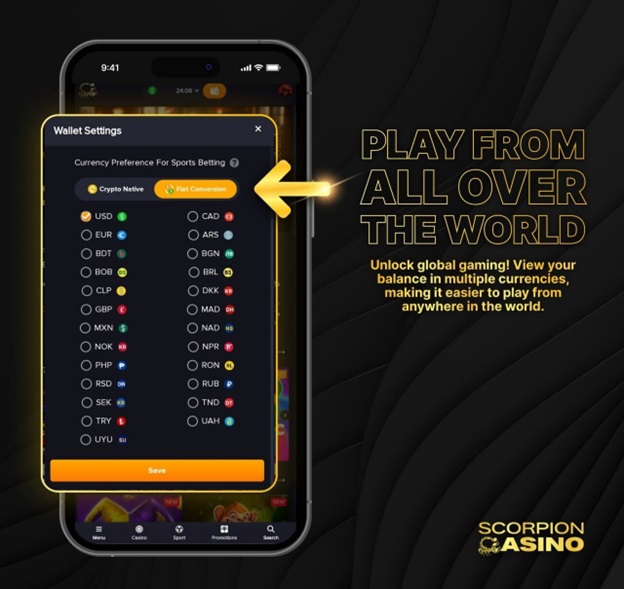
?Scorpion is currently undergoing a whole new look and the latest feature to be revealed is the ‘Multi-currency balance with up to 20 different currencies’.  This gives users a chance to use more currencies, which will increase deposits and boost profits for holders.?

1.  Scorpion Casino Token (SCORP): Presale Now Live

Participating in a cryptocurrency presale, like $SCORP, is a wise choice for multiple reasons. It offers the opportunity to purchase tokens at their lowest price before they hit the public exchanges. Additionally, presale participants receive up to 40% in free casino credits for Scorpion.Casino, get exclusive access to the 250k Giveaway, and even start earning daily passive staking income right from the presale period. This combination of early affordability and enticing benefits makes joining a presale a strategic move for crypto investors.

2.  Ethereum (ETH): The Blockchain Giant With Room to Grow

While Ethereum may not be a new player in the crypto market, it’s still one of the most promising projects. As the leading platform for decentralized applications (DApps) and smart contracts, Ethereum continues to gain traction. Its upcoming transition to Ethereum 2.0, which promises improved scalability and energy efficiency, has many investors excited. This upgrade is expected to further boost its value, making it a solid pre-bull run investment.

3.  Solana (SOL): Speed, Scalability, and a Bright Future

Solana has been a standout performer in the crypto market, with a focus on speed and scalability. Its high throughput and low transaction costs have made it a favorite for decentralized applications and decentralized finance (DeFi) projects. As the DeFi sector continues to grow, Solana’s utility and potential for growth become even more pronounced.

4.  Polkadot (DOT): Revolutionizing Blockchain Interoperability

Polkadot is another altcoin that’s been steadily gaining popularity. It offers a unique approach to blockchain interoperability and scalability through its parachain architecture. With growing interest in cross-chain functionality, Polkadot’s potential to connect various blockchains and foster a more cohesive crypto ecosystem is a compelling reason to consider it for your portfolio.

If You Remember One Thing, It’s This:

We’ve explored four top altcoins, each with its unique strengths and potential. Among them, Scorpion Casino Token (SCORP) stands out as an intriguing addition to any well-diversified portfolio. Its distinctive use case in the world of online gaming and gambling, combined with the attractive incentives offered during its presale, presents a compelling case for consideration. While the other altcoins hold promise, the niche that SCORP occupies is an area poised for growth, offering a distinctive opportunity for investors.

For more information, check out the links below.

Presale: https://presale.scorpion.casino/

Twitter: https://twitter.com/ScorpionCasino

Telegram: https://t.me/scorpioncasino_official
The Next Pepe Coin? Scorpion Casino Token Shows Off It’s New Casino and Toncoin Could Help Mass Adoption

0

In crypto, innovation drives attention and adoption. In early 2023, Pepe Coin took the crypto world by storm. Based on the controversial Pepe meme, Pepe Coin soared by more than 7000% in a matter of weeks. A natural drop-off followed, but PEPE’s rapid and seemingly random success put the rest of the market on high alert.

Two tokens, Scorpion Casino Token (SCORP) and Toncoin, are making strides to be the next PEPE, each in its own unique way. SCORP is in its presale and is part of an ecosystem set to redefine online gaming with its new casino, while Toncoin positions itself as a key player in achieving widespread crypto acceptance, and has recently announced a landmark partnership with Blockchain.com.

Scorpion Casino Token (SCORP): A Casino Revolution

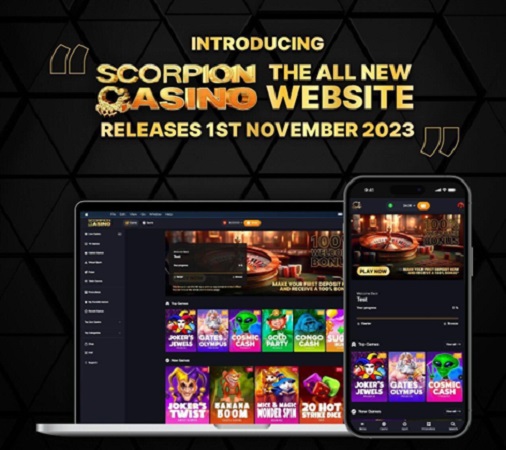
SCORP is more than just a token; it’s a gateway to a thrilling gaming experience. The recent unveiling of its new and improved casino marks a significant milestone. Users can enjoy

?Over 200 casino games

?Over 160 live events

?Over 35 sports on which to bet

?Over 30,000 betting opportunities per month

?Over 20 currencies to deposit and play with

?Auto currency conversion so anyone can play

?A 40% casino bonus code for presale buyers

?A fully licensed and transparent gaming experience

The SCORP community, almost 20,000 strong, is palpably buzzing with all these developments and there are more coming. Through exciting industry partnerships, huge bonuses, and big-money competitions, Scorpion Casino emphasises its commitment to a vibrant ecosystem in both the short and long term.

Toncoin: Fostering Crypto Mass Adoption

Toncoin enters the scene with a broader ambition – to facilitate mass crypto adoption. With a focus on user-friendly features, fast transactions, and scalability, Toncoin addresses the hurdles hindering widespread use. As a project built on the Free TON blockchain, Toncoin has attracted attention from big fish in the crypto pond.

Recently it was announced that TON holders (outside of the United States) who use Telegram will be able to access their wallets directly from the Telegram menu and enjoy a simple and user-friendly way to buy and sell.

Comparison and Synergy

SCORP takes the entertainment route, positioning itself as the next big thing in gaming, and adds in a cryptocurrency that has raised $1.4 million in presale so far. Toncoin adopts a broader strategy of simplifying crypto use. Both tokens contribute uniquely to the evolving narrative of crypto adoption. SCORP’s casino introduces a novel way to engage users, while Toncoin’s emphasis on accessibility aligns with the broader goal of bringing cryptocurrency into everyday transactions.

The crypto space continues to witness diverse projects aiming to redefine norms and capture the imagination of users. SCORP’s casino launch and Toncoin’s potential Telegram partnership exemplify the innovation driving this industry forward, promising an exciting and dynamic future.


Find out more about SCORP:

Presale: https://presale.scorpion.casino/

Twitter: https://twitter.com/ScorpionCasino

Telegram: https://t.me/scorpioncasino_official

Quantum Correlation and Difference in MDGs and SDGs Realisation: A Multi-Country Analysis

0

In 2015, the United Nations adopted the Sustainable Development Goals (SDGs), a set of 17 global objectives to address a wide range of socio-economic and environmental challenges by 2030. Five years earlier, the Millennium Development Goals (MDGs) had paved the way for these ambitious targets, marking a significant step in international development efforts. As we reach the halfway mark to 2030, the Sustainable Development Report (SDR) 2023 provides a comprehensive analysis of the progress made in realizing the SDGs and, in a groundbreaking revelation, highlights a remarkable quantum difference between the MDGs and SDGs’ realization.

The Sustainable Development Report 2023

The Sustainable Development Report (SDR) is an annual publication that evaluates the progress made by 193 UN Member States in achieving the SDGs since their adoption in 2015. It provides an essential tool for assessing the world’s collective efforts in addressing some of the most pressing challenges of our time, such as poverty, inequality, environmental sustainability, and access to education and healthcare. Published on the eve of the 2023 Paris Summit for a New Global Financial Pact, this year’s report places particular emphasis on the urgent need to scale up development finance and reform the global financial architecture to support the SDGs.

Selected Countries: A Global Perspective

Using the Sustainable Development Report 2023, we examine the progress of 19 countries: Argentina, Australia, Brazil, Canada, China, Germany, France, United Kingdom, Indonesia, India, Italy, Japan, Korea, Mexico, Russian Federation, Saudi Arabia, Türkiye, United States, and South Africa. These countries, while not representing the entire global community, offer a representative sample of diverse regions, economies, and developmental challenges. The analysis of these countries provides valuable insights into the global landscape of SDG realization.

Quantum Correlation: MDGs vs. SDGs

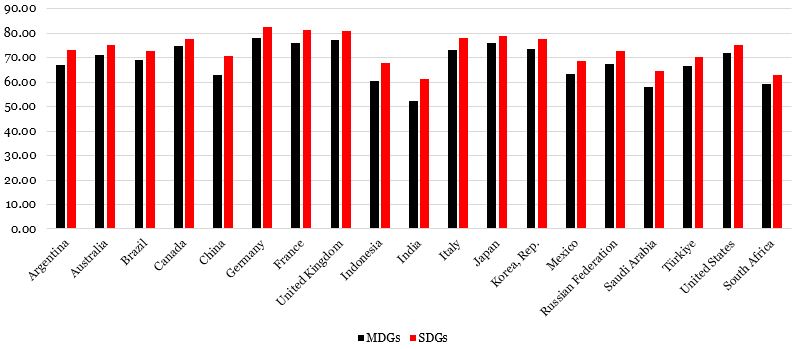
One of the most intriguing findings of the Sustainable Development Report 2023 is the substantial correlation observed between the realization of the MDGs from 2001 to 2007 and the progress made in the SDGs from 2015 to 2022. The correlation of average scores between these two periods is an astonishing 99.6%, indicating an almost perfect alignment in progress. This revelation highlights the enduring commitment of the international community to addressing global challenges over two distinct developmental agendas.

Furthermore, analysing the average score difference in the first eight years of MDGs and SDGs realization revealed a significant positive correlation. An impressive 97.9% correlation was found between the two global development agendas. This underscores the remarkable consistency in the achievements of the MDGs and the SDGs, despite the different timeframes and evolving global dynamics.

Exhibit 1: The difference in MDGs 2000 to 2007 and SDGs 2015 to 2022 performance

Source: Sustainable Development Report 2023; Infoprations Analysis, 2023

Implications and Key Takeaways

The exceptional correlation between the MDGs and SDGs realization brings forth critical insights into the global development landscape. It suggests that the international community, including the 19 selected countries, has shown a sustained commitment to tackling poverty, inequality, environmental sustainability, and other global challenges. This remarkable alignment in progress underlines the consistency of purpose and effort over the years.

Global Unity. The correlation between the MDGs and SDGs showcases the importance of international cooperation. While the world has witnessed significant shifts in geopolitics, economics, and technology, the commitment to global development goals has remained steadfast. This unity of purpose has the potential to drive the world closer to achieving the SDGs by 2030.

Call for Increased Financing. The Sustainable Development Report 2023 emphasizes the need to scale up development finance and reform the global financial architecture to support the SDGs. As we move forward, it is imperative that countries and international organizations enhance their efforts to mobilize resources, provide aid, and ensure equitable access to development finance, especially in the face of ongoing challenges such as the COVID-19 pandemic.

The Sustainable Development Report 2023 provides a remarkable insight into the ongoing progress in achieving the SDGs and the enduring commitment of the international community to global development goals. The quantum difference observed in the correlation between the MDGs and SDGs realization underscores the consistency of purpose and effort over time of the selected countries. As we strive to achieve the ambitious SDGs by 2030, this alignment of progress serves as a beacon of hope and a testament to the power of global unity in addressing some of the world’s most pressing challenges.

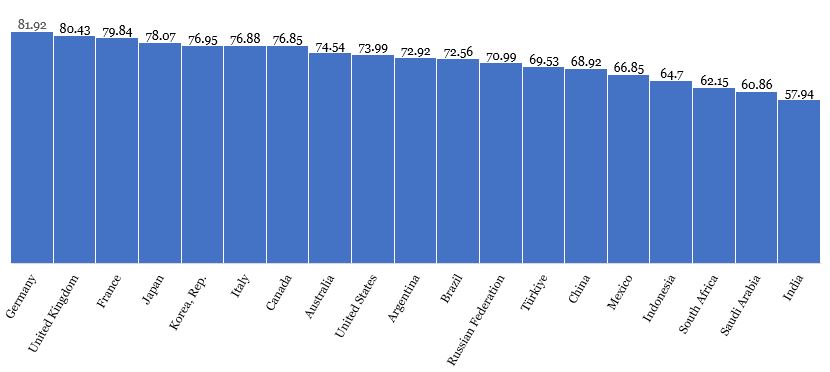
Exhibit 2: Pareto performance of SDGs 2015-2022

Source: Sustainable Development Report 2023; Infoprations Analysis, 2023

Bitcoin holds onto momentum as Coinbase Opens Perpetual Trading for Non-US Customers

0

Bitcoin continues to show strength as it trades near its all-time high, following a positive week that saw several developments in the crypto space. One of the most anticipated events was the launch of the first Bitcoin futures ETF in the US, which attracted over $1 billion in assets under management in its first two days of trading.

The ProShares Bitcoin Strategy ETF (BITO) tracks the price of Bitcoin futures contracts, not the spot price of Bitcoin itself. However, many analysts see this as a stepping stone for a potential approval of a Bitcoin spot ETF, which would directly track the price of the underlying asset and offer lower fees and tracking errors.

A Bitcoin spot ETF would be a game-changer for the crypto industry, as it would provide an easy and regulated way for retail and institutional investors to gain exposure to Bitcoin without having to deal with the technical and security challenges of buying and storing it. Moreover, it would boost the liquidity and efficiency of the Bitcoin market, as well as its legitimacy and adoption. Several applications for a Bitcoin spot ETF are pending with the US Securities and Exchange Commission (SEC), which has until November 14 to make a decision on one of them, filed by VanEck.

Some observers believe that the success of the Bitcoin futures ETF could pave the way for a positive outcome for the spot ETF, as it shows that there is strong demand and interest for such products. Moreover, it could alleviate some of the concerns that the SEC has expressed about the Bitcoin market, such as fraud, manipulation, volatility and lack of regulation.

The SEC chairman Gary Gensler has indicated that he is more open to approving a futures-based ETF than a spot-based one, but he has also acknowledged that the crypto space is evolving rapidly, and that the agency is willing to adapt to the changing landscape.

Therefore, the launch of the Bitcoin futures ETF could be seen as a dress rehearsal for a possible approval of a Bitcoin spot ETF in the near future. If that happens, it could trigger a new wave of adoption and innovation in the crypto space, as well as a significant increase in the value of Bitcoin and other cryptocurrencies. For now, Bitcoin holders can enjoy the momentum that the futures ETF has created, and hope that it will lead to more positive developments down the road.

Coinbase retail customers outside USA can now trade perpetuals.

Coinbase, the leading cryptocurrency exchange platform, has announced a new feature for its retail customers outside the US: the ability to trade perpetual contracts. Perpetual contracts are a type of derivative product that allow traders to speculate on the price movements of cryptocurrencies without having to own or deliver the underlying asset. Unlike futures contracts, which have a fixed expiration date, perpetual contracts have no expiry and are settled on an ongoing basis.

Perpetual contracts offer several advantages for traders who want to gain exposure to the volatile crypto market. They can amplify their profits (or losses) by using leverage, which means borrowing funds from the exchange to increase their trading power. They can also benefit from price movements in both directions, by going long (buying) or short (selling) the contract. Additionally, they can avoid the hassle and risk of storing and transferring cryptocurrencies, as they only need to deposit and withdraw fiat currency or stablecoins.

Coinbase’s perpetual contracts are based on the Coinbase Index, which tracks the weighted average price of Bitcoin and Ethereum across multiple Coinbase markets. The contracts are denominated in USDC, a stablecoin pegged to the US dollar, and have a maximum leverage of 10x. Coinbase charges a funding rate every eight hours to keep the contract price aligned with the spot price, as well as a trading fee of 0.075% for makers and 0.25% for takers.

Coinbase’s launch of perpetual contracts is part of its broader strategy to expand its product offerings and reach new markets. The exchange already offers spot trading, margin trading, staking, lending, and custody services for its customers, as well as institutional-grade products and services for professional traders and investors. By adding perpetual contracts, Coinbase aims to compete with other platforms that already offer this feature, such as Binance, BitMEX, and FTX.

Coinbase’s perpetual contracts are currently available for retail customers in over 40 countries outside the US, including Canada, Mexico, Brazil, UK, Germany, France, Japan, Singapore, and Australia. The exchange plans to roll out this feature to more countries and regions in the future, as well as to add more cryptocurrencies to its index. Coinbase also intends to launch perpetual contracts for its US customers in the near future, pending regulatory approval.

Nigerian Government to Introduce “Green Surcharge” on Imported Vehicles to Boost Tax Revenues

0

The Nigerian federal government is set to implement a “green surcharge” on imported vehicles as part of its ambitious plan to increase tax revenues.

This move, revealed in the Medium Term Expenditure Framework (MTEF), has been introduced amidst growing concerns over the impact of multiple taxation on businesses in Nigeria.

The MTEF serves as a blueprint for the proposed N26 trillion 2024 budget, which has garnered significant attention due to its scale and scope. The green surcharge represents a pivotal element of the government’s strategy to generate approximately N2.6 trillion in net taxes through Nigerian Customs.

President Bola Tinubu, in August, expressed his commitment to reducing the country’s heavy reliance on borrowing to finance public spending by improving revenue generation through tax reforms.

The MTEF document outlines a total of 18 strategies aimed at enhancing Customs revenue collection between 2024 and 2026. Point XIII specifically focuses on the introduction of a green surcharge on imported vehicles, stating, “Introduction of green surcharge on imported vehicles and excise duty on gambling and lotteries, including online betting.”

While the specific details of this green surcharge remain somewhat unclear as the document does not provide a comprehensive explanation, earlier this year, the Buhari administration hinted at the introduction of additional taxes for imported vehicles. Consequently, the Federal Government had already implemented the Import Adjustment Tax (IAT) levy on motor vehicles, with a 2% rate applied to vehicles with 2-liter engines (ranging from 2000 cc to 3999 cc) and a 4% rate imposed on vehicles with engines exceeding 4 liters (4000 cc and above), effective from June 1, 2023.

Furthermore, starting from the same date, certain categories of vehicles were exempted from this levy. These included vehicles with engines below 2000cc, mass transit buses, electric vehicles, and locally manufactured vehicles.

In terms of significance, the government’s move to introduce a green surcharge on imported vehicles underscores its commitment to enhancing revenue generation and possibly encouraging more environmentally friendly transportation alternatives. However, this approach has faced criticism from business leaders who view it as an additional burden on already-choking businesses in Nigeria.

Critics have repeatedly called on the government to reduce the cost of governance, which consumes a significant portion of the nation’s revenue. Nigerian lawmakers, in particular, have faced scrutiny for allocating a substantial budget of N54 billion to purchase cars while the country grapples with revenue shortfalls and borrowing dependencies.

Notably, in the first quarter of 2023, Nigeria’s net earnings from crude oil and gas amounted to N486 billion, while net earnings from Solid Minerals were N1.99 billion. The N54 billion spent by lawmakers on cars accounted for 12% of the total government’s revenue in Q1, leading to concerns about the allocation of resources in light of the nation’s fiscal challenges.