DD
MM
YYYY

PAGES

DD
MM
YYYY

spot_img

PAGES

Home Blog Page 4091

Nigeria’s President Tinubu’s Speech at the 78th UN General Assembly

0

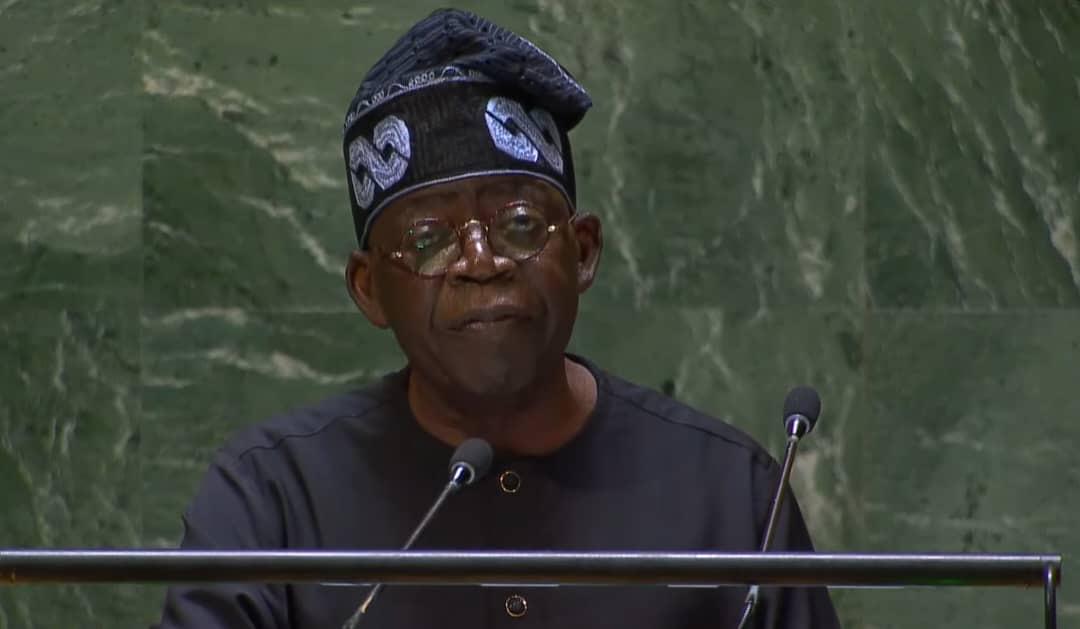
President Tinubu addressed the 78th General Assembly of the United Nations in the morning of Wednessday, September 20, 2023.

In his maiden address to the UN General Assembly, the Nigerian President stressed on the need for Africa to overcome the limitations of foreign exploitation to reach its lofty potential.

President Tinubu’s speech encapsulates five cogent points needed to strengthen Africa’s position and contribution in the global economy. These are enumerated as follows:

  1. International organizations and other nations of the world with their private sector players must consider Africa’s development as a priority.
  2. Democracy must be well entrenched in Africa and upheld as the best form of governance for Africa’s progress.
  3. Global leaders should work with Africa to curtail the illegal inflow of arms and violent individuals into the region who pose security threats to the bonafide African people.
  4. African nations should work closely together to secure the continent’s mineral rich areas from pilfering and conflict.
  5. Africa must look inward for solutions to locally address its Climate change problems

The President’s full speech is below:

On behalf of the people of Nigeria, I congratulate you on your well-deserved election as President of this Session of the United Nations General Assembly.

We commend your predecessor, His Excellency, Mr. Csaba Korosi for his able stewardship of the Assembly.

We also commend His Excellency, Antonio Guterres, Secretary General of the United Nations, for his work seeking to forge solutions to humanity’s common challenges.

This is my first address before the General Assembly. Permit me to say a few words on behalf of Nigeria, on behalf of Africa, regarding this year’s theme.

Many proclamations have been made, yet our troubles remain close at hand. Failures in good governance have hindered Africa. But broken promises, unfair treatment and outright exploitation from abroad have also exacted a heavy toll on our ability to progress.

Given this long history, if this year’s theme is to mean anything at all, it must mean something special and particular to Africa.

In the aftermath of the Second World War, nations gathered in an attempt to rebuild their war- torn societies. A new global system was born and this great body, the United Nations, was established as a symbol and protector of the aspirations and finest ideals of humankind.

Nations saw that it was in their own interests to help others exit the rubble and wasteland of war. Reliable and significant assistance allowed countries emaciated by war to grow into strong and productive societies.

The period was a highwater mark for trust in global institutions and the belief that humanity had learned the necessary lessons to move forward in global solidarity and harmony.

Today and for several decades, Africa has been asking for the same level of political commitment and devotion of resource that described the Marshall Plan.

We realize that underlying conditions and causes of the economic challenges facing today’s Africa are significantly different from those of post war Europe.

We are not asking for identical programs and actions. What we seek is an equally firm commitment to partnership. We seek enhanced international cooperation with African nations to achieve the 2030 agenda and Sustainable Development Goals.

There are five important points I want to highlight.

First, if this year’s theme is to have any impact at all, global institutions, other nations and their private sector actors must see African development as a priority, not just for Africa but in their interests as well.

Due to both longstanding internal and external factors, Nigeria’s and Africa’s economic structures have been skewed to impede development, industrial expansion, job creation, and the equitable distribution of wealth.

If Nigeria is to fulfil its duty to its people and the rest of Africa, we must create jobs and the belief in a better future for our people.
We must also lead by example.

To foster economic growth and investor confidence in Nigeria, I removed the costly and corrupt fuel subsidy while also discarding a noxious exchange rate system in my first days in office. Other growth and job oriented reforms are in the wings.

I am mindful of the transient hardship that reform can cause. However, it is necessary to go through this phase in order to establish a foundation for durable growth and investment to build the economy our people deserve.

We welcome partnerships with those who do not mind seeing Nigeria and Africa assume larger roles in the global community.

The question is not whether Nigeria is open for business. The question is how much of the world is truly open to doing business with Nigeria and Africa in an equal, mutually beneficial manner.

Direct investment in critical industries, opening their ports to a wider range and larger quantity of African exports and meaningful debt relief are important aspects of the cooperation we seek.

Second, we must affirm democratic governance as the best guarantor of the sovereign will and well-being of the people. Military coups are wrong, as is any tilted civilian political arrangement that perpetuates injustice.

The wave crossing parts of Africa does not demonstrate favour towards coups. It is a demand for solutions to perennial problems.

Regarding Niger, we are negotiating with the military leaders. As Chairman of ECOWAS, I seek to help re-establish democratic governance in a manner that addresses the political and economic challenges confronting that nation, including the violent extremists who seek to foment instability in our region. I extend a hand of friendship to all who genuinely support this mission.

This brings me to my third crucial point. Our entire region is locked in protracted battle against violent extremists. In the turmoil, a dark channel of inhumane commerce has formed. Along the route, everything is for sale. Men, women and children are seen as chattel.

Yet, thousands risk the Sahara’s hot sand and the Mediterranean’s cold depths in search of a better life. At the same time, mercenaries and extremists with their lethal weapons and vile ideologies invade our region from the north.

This harmful traffic undermines the peace and stability of an entire region. African nations will improve our economies so that our people do not risk their lives to sweep the floors and streets of other nations. We also shall devote ourselves to disbanding extremist groups on our turf.

Yet, to fully corral this threat, the international community must strengthen its commitment to arrest the flow of arms and violent people into West Africa.

The fourth important aspect of global trust and solidarity is to secure the continent’s mineral rich areas from pilfering and conflict. Many such areas have become catacombs of misery and exploitation. The Democratic Republic of the Congo has suffered this for decades, despite the strong UN presence there. The world economy owes the DRC much but gives her very little.

The mayhem visited on resource rich areas does not respect national boundaries. Sudan, Mali, Burkina Faso, CAR, the list grows.

The problems also knocks Nigeria’s door.

Foreign entities abetted by local criminals who aspire to be petty warlords have drafted thousands of people into servitude to illegally mine gold and other resources. Billions of dollars meant to improve the nation now fuel violent enterprises. If left unchecked, they will threaten peace and place national security at grave risk.

Given the extent of this injustice and the high stakes involved, many Africans are asking whether this phenomenon is by accident or by design.

Member nations must reply by working with us to deter their firms and nationals from this 21st century pillage of the continent’s riches.

Fifth, climate change severely impacts Nigeria and Africa. Northern Nigeria is hounded by desert encroachment on once arable land. Our south is pounded by the rising tide of coastal flooding and erosion. In the middle, the rainy season brings floods that kill and displace multitudes.

As I lament deaths at home, I also lament the grave loss of life in Morocco and Libya. The Nigerian people are with you.

African nations will fight climate change but must do so on our own terms. To achieve the needed popular consensus, this campaign must accord with overall economic efforts.

In Nigeria, we shall build political consensus by highlighting remedial actions which also promote economic good. Projects such as a Green Wall to stop desert encroachment, halting the destruction of our forests by mass production and distribution of gas burning stoves, and providing employment in local water management and irrigation projects are examples of efforts that equally advance both economic and climate change objectives.

Continental efforts regarding climate change will register important victories if established economies were more forthcoming with public and private sector investment for Africa’s preferred initiatives.

Again, this would go far in demonstrating that global solidarity is real and working.

CONCLUSION

As I close, let me emphasize that Nigeria’s objectives accord with the guiding principles of this world body: peace, security, human rights and development.

In fundamental ways, nature has been kind to Africa, giving abundant land, resources and creative and industrious people. Yet, man has too often been unkind to his fellow man and this sad tendency has brought sustained hardship to Africa’s doorstep.

To keep faith with the tenets of this world body and the theme of this year’s Assembly, the poverty of nations must end. The pillage of one nation’s resources by the overreach of firms and people of stronger nations must end. The will of the people must be respected. This beauty, generous and forgiving planet must be protected.

As for Africa, we seek to be neither appendage nor patron. We do not wish to replace old shackles with new ones.

Instead, we hope to walk the rich African soil and live under the magnificent African sky free of the wrongs of the past and clear of their associated encumbrances. We desire a prosperous, vibrant democratic living space for our people.

To the rest of the world, I say walk with us as true friends and partners. Africa is not a problem to be avoided nor is it to be pitied. Africa is nothing less than the key to the world’s future.
How Lido DAO (LDO), Rocket Pool (RPL), Everlodge (ELDG) Are Changing the Passive Income Game

0

Three projects at the forefront of the passive income game are Lido DAO (LDO), Everlodge (ELDG), and Rocket Pool (RPL). Particularly noteworthy is Everlodge, which is currently in its presale phase and is poised to make substantial waves in this emerging market. Let’s examine these projects to understand how they change the passive income game.

Join the Everlodge presale and win a luxury holiday to the Maldives

Everlodge (ELDG): Luxury Meets Passive Income

Everlodge enables fractional ownership of luxurious properties by selling fractionalized NFTs representing ownership in a physical property. This allows the average person to purchase a fraction of a luxury property.

The crucial ownership data, such as titles and deeds, is securely embedded within this digital asset. This property-NFT is then segmented, opening doors for fractional ownership at just $100. And as the real estate market flourishes, so does the worth of your NFT share.

Yet, Everlodge offers more than just a slice of luxury. It’s also a springboard for budding property developers to amass funds and a marketplace for trading these novel property-based NFTs. Moreover, Everlodge provides a lending feature, allowing users to use their real estate NFTs to secure loans.

The cherry on top? Everlodge’s exclusive Rewards Club. Here, members can bask in complimentary stays at diverse luxurious properties or monetize these nights, establishing an avenue for consistent income. Envision an investment realm where your stakes appreciate and grant you access to the world’s most sought-after getaways.

The ELDG token is the driving force behind the Everlodge ecosystem. It plays a vital role in the platform by facilitating transactions, staking, and earning rewards. Holders can earn passive returns in different digital currencies by betting their ELDG.

So Everlodge users generate income from the property-backed NFTs they buy and sell and can capitalize on the ELDG token’s unmatched staking rewards. Everlodge is the ultimate passive income dream come true!

With the ELDG token priced at $0.018 in phase 3 of the presale, it’s a golden opportunity for potential investors. This price is set to increase further as more users join the presale. Market experts are excitedly buzzing, projecting a monumental surge of up to 3,000% for ELDG in the upcoming year.

Lido DAO (LDO): Diverse Staking in a Decentralized World

Lido DAO has shown outstanding performance in the constantly evolving space of decentralized staking. Lido DAO offers varying rewards for staking, with a current APR of 3.6% for Ethereum and 6.4% for Solana.

In the first quarter of 2023, the excitement surrounding the Lido V2 protocol propelled Lido DAO’s value from $0.93 to $3.32. However, the bear market swept altcoins to the side, and Lido DAO’s value has settled at $1.58.

Chart technicians quickly note that the price of Lido DAO is moving within a sizeable symmetrical pattern on the daily chart. The apex of this chart is positioned for mid-October, so Lido DAO will likely break out of this pattern soon enough.

If the market’s sentiment is positive and this breakout transpires, Lido DAO could reach a price of $3 again. However, Lido DAO still follows the price movements of Ethereum to some extent, so it’s essential to keep a close eye on Ethereum’s price and the market’s volatility.

Meanwhile, Everlodge appears to be dancing to its rhythm, disregarding the bearish whispers of Bitcoin. Its upward trajectory, despite market challenges, has captivated many. Everlodge’s resilience may guide investors in navigating this turbulent crypto landscape.

Rocket Pool (RPL): Amplifying Ethereum Staking with High Returns

Rocket Pool is a major player in the world of Ethereum staking, offering a decentralized solution for crypto enthusiasts to earn rewards from ETH2 staking. Its platform has prompted many retail investors to notice, thanks to its attractive offer of up to 7.28% APR.

The buzz surrounding the impending Ethereum 2.0 transition has played a pivotal role in Rocket Pool’s rise in its brand and valuation. From an initial $16, Rocket Pool’s market price made an impressive leap to $55 in just six months.

However, the inherent volatility of the crypto market became evident when Rocket Pool’s valuation took a hit, dropping to $22.37 recently. This Rocket Pool downturn has sparked discussions questioning Rocket Pool’s ability to sustain consistent growth over extended periods.

Rocket Pool’s financial trajectory is intrinsically linked to the fate of Ethereum 2.0. Moreover, Ethereum’s price must surpass the $2,100 resistance level for Rocket Pool and the entire ecosystem to attract increased investment.

Find out more about the Everlodge (ELDG) Presale

Website: https://www.everlodge.io/

Telegram: https://t.me/everlodge

Axie Infinity (AXS) and Pepe Coin (PEPE) Face Uphill Battle as Pomerdoge (POMD) Speeds Towards Astounding $5 Million Milestone

0

While Axie Infinity (AXS) and Pepe Coin (PEPE) have been facing challenges, Pomerdoge is making good progress towards an impressive goal. Let’s look at how these tokens are doing right now.

Summary

  • Axie Infinity’s (AXS) new features struggle to lift price despite social gameplay.
  • Pepe Coin (PEPE) faces controversy, and price drops as investors sell.
  • Pomerdoge raises $4.8 million with a unique mix of fun and practicality.

Click Here To Find Out More About The Pomerdoge (POMD) Presale

Axie Infinity’s (AXS) New Additions Fail to Lift Token Price

Axie Infinity (AXS) is having trouble even though it has introduced new gameplay features. The game promised a more social experience for players inside the Axie Infinity (AXS) universe. Through its Project T prototype, players could interact with each other, and strengthen their bond with the whimsical axolotls.

However, the price of Axie Infinity (AXS) has gone down since the new features were introduced. In the past week, Axie Infinity’s (AXS) price has decreased by 3.71%, and has dropped by 2.58% in the last 24 hours. Axie Infinity (AXS) is currently priced at $4.72, which is 97.14% below its all-time high. Despite the efforts to enhance gameplay, Axie Infinity’s (AXS) value faces a challenging trend.

Pepe Coin (PEPE) Deals with Problems and Lower Prices

A major investor’s move to cash out an astounding 1 trillion Pepe Coins (PEPE) for Ethereum worth $885,000 has turned heads. Moreover, Pepe Coin’s (PEPE) recent price movement is less inspiring. A decline of 21.05% in the last 7 days, along with a 3.87% drop in the past 24 hours, hints at a bumpy road ahead for Pepe Coin (PEPE).

Additionally, Pepe Coin’s (PEPE) developers have been involved in troubling activities that have raised eyebrows in the community. Reports of massive token movements from a multi-signature wallet followed by a price plunge have raised doubts. With a trading volume exceeding $219 million in 24 hours, Pepe Coin’s (PEPE) volatility is clear. In order to regain its potential, Pepe Coin (PEPE) must navigate its way through the challenges.

Pomerdoge (POMD) Raises $1.7 Million in Presale: Excitement Builds for Q4 2023 Launch

While other meme coins like AXS and PEPE have had problems, Pomerdoge is gaining popularity as a new cryptocurrency that combines meme culture with practical applications. The project is building Pomerplace, a marketplace and battle arena. Additionally, it is also building Pomergame, a play-to-earn (P2E) game where players can earn rewards by playing.

The platform is different from other meme coins. It is a Play-to-Earn (P2E) platform that combines entertainment with valuable rewards. POMD token is the in-game currency in Pomerplace, and gives token holders exclusive perks.

The tokens are currently selling for $0.0165 each, which is a good price to get in on the project. The platform is scheduled to launch in Q4 2023, and has already raised $4.8 million in its presale.

The game has a lot of features that will appeal to gamers, and crypto enthusiasts. Some of them include character development, item creation, and a marketplace. With weekly giveaways and excitement building for the game’s release, Pomerdoge is a promising new project. It combines entertainment, and cryptocurrency innovation.

As POMD gets closer to an amazing $5 million goal, it’s doing well in the changing world of digital money. This growth aligns with the broader trend of the global Blockchain Gaming Market, which crossed $4.6 billion in revenue in 2022. Moreover, it is projected to reach about $65.7 billion by the end of 2027.

Click Here to Buy Pomerdoge (POMD) Tokens.

Visit the links below for more information about Pomerdoge (POMD):

Website: https://pomerdoge.com/

Telegram Community: https://t.me/pomerdoge

ChatGPT Best Crypto Picks for September: Polygon (MATIC), Avalanche (AVAX), Kangamoon (KANG)

0

ChatGPT, the AI chatbot, has its finger on the pulse of the crypto world, and for this month, it recommends keeping an eye on Polygon (MATIC), Avalanche (AVAX), and Kangamoon (KANG). With so many cryptocurrencies battling for attention, these tokens offer the best growth potential.

Summary

  • Polygon to announce new developments
  • Avalanche launches the Multiswap DEX
  • Kangamoon (KANG) to dominate the crypto Play-to-Earn sector

Don’t Miss Out On The Kangamoon (KANG) Presale – Reserve Your Spot!

Polygon (MATIC): Hype Rises

Polygon (MATIC) is generating quite a buzz in the crypto space, and ChatGPT has been closely monitoring its rise. This week, Polygon has a packed schedule that promises significant developments, adding to the growing hype. The much-anticipated zkEVM upgrade, set to enhance Polygon’s Layer 2 scalability solution, is in the spotlight.

ChatGPT says Polygon has exciting plans as part of Asia Crypto Week in Singapore. During this event, the project is set to make big announcements and release exclusive collectibles, setting the stage for Polygon’s future endeavors. Topics such as Polygon 2.0 and zkEVM will be on the agenda, further fueling the excitement surrounding MATIC.

Due to all these reasons, buyers are keeping a close eye on Polygon as it continues to evolve. Additionally, experts foresee the Polygon price between $0.79 and $0.87 within Q4 of 2023.

Avalanche (AVAX): Multiswap Launch

Avalanche (AVAX) has also caught ChatGPT’s attention as a top cryptocurrency pick for September. A notable development contributing to this choice is the launch of Multiswap, a unique “multi-asset ” decentralized exchange, on the Avalanche platform.

Developed by the CavalRe, Multiswap takes full advantage of Avalanche’s rapid transaction speeds and flexibility. It introduces an innovative AMM model, allowing traders to swap a multitude of tokens all in one seamless transaction.

This innovation showcases Avalanche’s technical prowess and its potential to reshape the DeFi landscape. With Multiswap and other exciting developments on the horizon, Avalanche appears poised for a promising month ahead. Therefore, market analysts forecast a surge to $16.26 by December 2023 for the Avalanche crypto price.

Kangamoon (KANG): Play-to-Earn Gaming with a Twist

Kangamoon (KANG) brings a unique concept to the crypto space, combining meme culture with play-to-earn (P2E) elements. This innovative approach has quickly garnered attention and a growing community of meme enthusiasts and gamers alike.

One of Kangamoon’s standout features is its P2E integration. Players step into the virtual shoes of Kangamoon, a spirited and boxing-loving kangaroo. Players can build their characters, develop unique abilities, and connect with fellow gamers worldwide in this all-immersive gaming universe. But here’s where it gets exciting: you can monetize your gaming time.

Kangamoon allows players to earn virtual currency and rare in-game items through various activities. Whether winning matches or completing challenging quests, you’re rewarded with valuable in-game assets. These items can then be traded or sold within the game’s marketplace, allowing you to monetize your gaming time effectively.

Kangamoon doesn’t stop at just the game. It’s building a thriving ecosystem around its native token, KANG. With a low market cap ChatGPT believes that KANG could soar much faster than Polygon and Avalanche. One token costs only $0.005 as it is in Stage 1 of its presale, but experts foresee a 22x growth by its completion.

Discover the Exciting Opportunities of the Kangamoon (KANG) Presale Today!

Website: https://Kangamoon.com/

Join Our Telegram Community: https://t.me/Kangamoonofficial

Rethinking Democracy in Africa

0

In recent years, Africa has witnessed a resurgence of military coups and coup attempts, leading many to wonder whether the continent is on the brink of a return to the era of military rule. The emergence of what some are calling the “West African Coup Belt” and the “Sahel Coup Zone” has raised concerns about the stability of democratic governance in the region. Surprisingly, in some East African countries, there are citizens who express frustration with the state of affairs and are even praying for coups. To understand this phenomenon, we must delve deeper into the underlying reasons why some Africans see military government as an alternative to democratic rule.

A Historical Perspective

Africa’s history is marked by a series of military coups and authoritarian regimes, which have left a lasting impact on the collective memory of its people. The coups of the past often claimed to be driven by the need to rectify the failures of civilian governments, promising to bring stability, development, and prosperity. While many of these coups failed to deliver on their lofty promises, they did succeed in perpetuating the idea that the military could be a source of salvation in times of crisis.

The 1969 Libyan revolution led by Colonel Muammar Gaddafi and the 1960 Ethiopian coup attempt against Emperor Haile Selassie serve as examples of successful military takeovers that garnered popular support. These coups were perceived as responses to entrenched corruption, mismanagement, and socioeconomic problems. Even more recently, the 2017 Zimbabwean “non-coup” saw elements of the military seize control in a bid to address the socio-economic challenges facing the country.

The Perceived Failure of Democracy

One of the key reasons why some Africans view military government as an alternative to democracy is the perceived failure of the latter to deliver on its promises. In many African countries, democracy has been associated with corruption, political instability, and a lack of accountability. Citizens have grown disillusioned with elected leaders who often prioritize personal gain over the welfare of the nation.

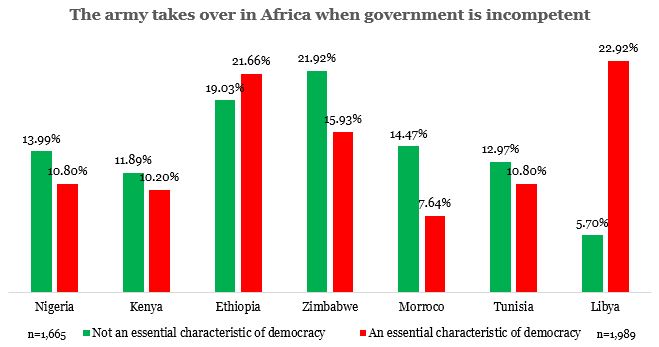
Source: World Values Survey, 2017-2022; Infoprations Analysis, 2023

This disillusionment is further exacerbated by economic disparities and the persistence of poverty in many African nations. When people perceive their government as ineffective in addressing these issues, they may turn to the military as a force that can restore order and enact necessary reforms. The World Values Survey reveals that a significant number of citizens in countries like Libya, Ethiopia, Morocco, Nigeria, and Tunisia see the military as a potential solution when governments prove incompetent.

The Role of Perception

Perception plays a crucial role in shaping the view of the military as an alternative to democratic governance. When citizens witness successful military takeovers that promise to address their grievances, it reinforces the belief that the military can be a viable alternative. Conversely, when coups fail or lead to prolonged periods of instability and repression, these perceptions can change.

The media and political discourse also influence how the military is perceived. In some instances, military leaders may present themselves as saviours, framing their actions as necessary interventions to protect the nation. This narrative can resonate with a frustrated population seeking change.

A Way Forward

While some Africans may see military government as an alternative to democracy, it is crucial to recognize that coups often come at a steep price. Military rule can lead to human rights abuses, erosion of civil liberties, and a lack of political pluralism. Sustainable solutions to Africa’s governance challenges must prioritize strengthening democratic institutions, improving governance, and addressing economic disparities.

Ultimately, the cycle of coups and counter-coups is not a path to lasting stability and prosperity. It is imperative that African nations work toward building accountable and responsive democratic systems that can deliver on the promises of good governance. Only then can the allure of military government as an alternative be replaced with confidence in the democratic process.