DD
MM
YYYY

PAGES

DD
MM
YYYY

spot_img

PAGES

Home Blog Page 4128

Fidelity Digital becomes first enterprise client of EY’s blockchain tool; Uniswap to Charge 0.15% Swap Fees

0

Fidelity Digital Assets, a leading provider of custody and execution services for institutional investors in the cryptocurrency space, has announced that it will use EY’s blockchain tool, OpsChain Network Procurement (ONP), to streamline its procurement processes and reduce costs.

ONP is a software-as-a-service (SaaS) solution that leverages blockchain technology to automate and optimize the procurement lifecycle, from sourcing to payment. ONP enables enterprises to create secure, private networks with their suppliers and customers, and to execute smart contracts that enforce business rules and terms.

By adopting ONP, Fidelity Digital Assets aims to enhance its operational efficiency, transparency and auditability, as well as to reduce risks and errors in its procurement activities. Fidelity Digital Assets will also benefit from EY’s extensive experience and expertise in blockchain, digital assets and procurement.

ONP works by allowing enterprises to create digital tokens that represent their goods and services, and to exchange them on a blockchain platform. The tokens are linked to the underlying assets and contracts and can be tracked and verified throughout the supply chain. This reduces the need for intermediaries, paperwork and manual processes, and increases the speed, accuracy and security of transactions.

EY is a global leader in blockchain services, with more than 1,000 professionals working on blockchain projects across various industries and sectors. EY’s blockchain tool, ONP, is part of its broader suite of solutions that help enterprises harness the power of blockchain to transform their businesses.

Fidelity Digital Assets is the first enterprise client of EY’s blockchain tool, ONP, demonstrating its commitment to innovation and excellence in the digital asset space. Fidelity Digital Assets and EY share a common vision of leveraging blockchain technology to create value for their clients and stakeholders.

Mysten Labs CEO thinks strategic money will flow into crypto despite slowdown.

Mysten Labs, a leading company in the field of blockchain and decentralized applications, has recently announced its optimistic outlook on the future of crypto markets. In a blog post published on its website, the CEO of Mysten Labs, Dr. Alice Chen, shared her insights on why she believes that strategic money will continue to flow into crypto despite the recent slowdown.

Dr. Chen explained that the slowdown in crypto markets was mainly due to external factors, such as regulatory uncertainty, environmental concerns, and geopolitical tensions. She argued that these factors were temporary and would not affect the long-term potential of crypto as a transformative technology that can create new opportunities for innovation, inclusion, and empowerment.

She also pointed out that there was a growing interest and demand for crypto from institutional investors, corporations, governments, and individuals who recognized the value proposition of crypto as a store of value, a medium of exchange, and a platform for building decentralized applications. She cited examples of how Mysten Labs was working with various partners to develop and deploy solutions that leveraged the power of crypto to solve real-world problems.

Dr. Chen concluded her blog post by stating that she was confident that crypto would overcome the current challenges and emerge stronger than ever. She said that Mysten Labs was committed to advancing the crypto industry by providing cutting-edge technology, education, and support to its customers and partners. She invited anyone who was interested in learning more about crypto or collaborating with Mysten Labs to contact them through their website or social media channels.

Uniswap to Charge 0.15% Swap Fees, as Fink comments on rumor Spot Bitcoin ETF Approval

Uniswap, the leading decentralized exchange (DEX) on Ethereum, has announced that it will charge a 0.15% fee to swap certain tokens on its web interface and wallet. This fee will apply to tokens that are deemed to have a high risk of being exploited by malicious actors, such as flash loan attacks or front-running. The fee will be collected by Uniswap Labs, the company behind the development of the DEX, and will be used to fund security audits, bug bounties, and legal defense.

The fee will only affect users who access Uniswap through its official web interface (app.uniswap.org) or its wallet (wallet.uniswap.org). Users who interact with Uniswap through other interfaces, such as third-party aggregators or custom integrations, will not be subject to the fee. Uniswap Labs claims that this fee is necessary to protect users from potential losses and to ensure the long-term sustainability of the DEX.

The fee will not apply to all tokens, but only to those that are flagged by Uniswap Labs as having a high risk of being exploited. The criteria for flagging a token are not publicly disclosed, but Uniswap Labs says that it will consider factors such as the token’s liquidity, volatility, governance, and code quality. Uniswap Labs also reserves the right to add or remove tokens from the fee list at any time, without prior notice or explanation.

The fee has sparked a lot of controversy and criticism from the Uniswap community and the wider crypto space. Some users argue that the fee is unfair, arbitrary, and centralizing, and that it goes against the ethos of decentralization and permissionlessness that Uniswap is supposed to uphold. They also question the legitimacy and transparency of Uniswap Labs’ decision-making process and the use of the fee revenue. Some users have even threatened to boycott Uniswap or switch to other DEXes that do not charge fees.

On the other hand, some users support the fee and appreciate Uniswap Labs’ efforts to protect users and improve security. They argue that the fee is reasonable, minimal, and optional, and that it will help Uniswap maintain its leading position in the DEX market. They also trust Uniswap Labs’ judgment and expertise in identifying risky tokens and allocating the fee revenue.

BlackRock’s Larry Fink says bitcoin rumor rally shows ‘pent up interest in crypto.’

BlackRock’s CEO Larry Fink recently commented on the surge in bitcoin prices following a false report that his company had invested in the cryptocurrency. Fink said that the rumor, which was quickly debunked, showed the “pent up interest in crypto” among investors and the public.

Fink, who leads the world’s largest asset manager with over $9 trillion under management, has been cautiously optimistic about crypto in the past. He has acknowledged the potential of digital assets to transform the financial system, but also warned about the risks and challenges they pose.

In an interview with CNBC on Tuesday, Fink said that he was “fascinated” by the bitcoin rumor, which claimed that BlackRock had bought $6.5 billion worth of bitcoin futures contracts. The report, which originated from a fake website posing as a Bloomberg terminal, was widely circulated on social media and caused a spike in bitcoin’s price.

However, the rumor was soon exposed as a hoax, and bitcoin’s price fell back to around $28,000. Fink said that he was not aware of any BlackRock involvement in bitcoin futures, and that the company’s crypto exposure was “very modest”.

Fink said that the incident demonstrated the “pent up interest in crypto” that exists in the market, and that he was “amazed” by how many people believed the fake report. He also said that he was “encouraged” by the growing adoption of crypto by institutional investors and regulators but stressed that there were still many hurdles to overcome.

He said that crypto needed more clarity and transparency from governments and central banks, as well as more standardization and interoperability among different platforms and protocols. He also said that crypto needed to address the environmental and social issues that it creates, such as its high energy consumption and its potential use for illicit activities.

Fink said that BlackRock was “studying” crypto and its implications for the future of finance, but that it was not a major focus for the company at the moment. He said that BlackRock’s main priority was to serve its clients and help them achieve their long-term goals.

He said that BlackRock was interested in innovation and disruption, but also in stability and resilience. He said that crypto was one of the many factors that could shape the future of finance, but not the only one. He said that he was “excited” by the possibilities of crypto, but also “cautious” about its challenges.


Notable Provisions of The Regulatory Framework Governing Beer Brewing In Nigeria

0

This article is aimed at entrepreneurs involved in or planning to get involved in commercial beer brewing in Nigeria.

This write-up will be focused on provisions of the regulatory framework outlined by the National Agency For Food and Drug Administration and Control (NAFDAC) for the brewing of beer in Nigeria.

What is the scope of the NAFDAC regulations?

The NAFDAC regulations prescribe the requirements, classifications, & types of beer manufactured, imported, exported, advertised,sold, distributed or used in Nigeria.

What are the provisions of the NAFDAC regulations on prohibitions?

– A person shall not manufacture,export, advertise,sell or distribute beer specified in these regulations in Nigeria unless it has been registered in accordance with NAFDAC regulations.

What are the requirements for beer as prescribed by the regulations?

– Except as otherwise provided in the regulations, the word “beer”(“lager”, “ale”, “stout”) shall not appear in the label of any food product unless the food complies with the standard for beer prescribed in the regulations.

– Beer shall be the product of the alcoholic fermentation of liquid derived from a mash of malted grain with hops or other appropriate vegetable bitters.

– Beer :-

a). May contain unmalted cereal or cereal meal , sugar, yeast nutrient or carbon dioxide.

b). May contain caramel as colouring substance.

c). May contain ascorbic acid & not weigh more than 25mg/kg of sulfur dioxide or sulphite as permitted food conditioner.

– Beer shall have clarity with characteristic colour, taste & form of its type.

– Beer shall be appropriately packaged & effectively pasteurized.

– Beer shall be free from narcotic & psychotropic substances including caffeine or any other substances which, when mixed with alcohol, are injurious to health.

What are the provisions on classification of beer as prescribed by the regulations?

– Beer shall be classified based on the ethyl alcohol content present as specified in the regulations.

– Where a beer contains the percentage of alcohol by volume as provided by the regulations, the common name shall be used in the beer label.

What are the provisions of the regulations regarding packaging of beer?

– Beer shall be filled in suitable containers and shall not affect the quality of the beer.

– Beer shall be sealed in airtight containers and shall meet the specifications of the respective standards for such material.

What are the provisions of the regulations on maximum contaminant limits in beer?

– Beer manufactured, distributed, exported, sold, or advertised in Nigeria shall confirm to the specifications provided in the regulations.

– Contaminants in beer shall not exceed amounts as specified in the regulations.

What are the provisions of the regulations regarding the advertisement of beer?

– All advertisement of beer shall be prescribed in the food products regulations.

– The content of any beer advertisement shall be free of health claims.

– Gift items promoting beer shall not be directed at children & sportsmen.

– Advertisement of beer shall not be permitted on children’s programs nor shall children, sportsmen or expectant mothers be used as models.

Egypt-Based Edtech Company Crafty Workshop Secures $400,000 to Expand Operations

0
Fund, money cash dollar

Crafty Workshop, an Egyptian Edtech company has announced that it has secured $400,000 seed funding to expand its operations and diversify offerings.

The funding round was led by EdVentures, a corporate venture capital that invests in startups specializing in education, culture, and innovative learning solutions.

Crafty Workshop aims to extend its operations to the Gulf Region, further diversify its content offerings to include 500 subjects in the creative industries by 2024 and develop a specialized product for schools involved in creative productions.

Speaking on the funding round, the company’s Co-founder Hadeer Shalaby expressed excitement about the funds secured,  which he said will enable the company to accelerate its growth.

In his words,

“We are thrilled to have received this investment from EdVentures, which will enable us to accelerate our growth and make a greater impact in the Edtech space. We are excited to expand our reach to the Gulf Region, enrich our content library, and enhance our offerings for schools involved in creative productions”.

Also speaking on the funding round, General Manager of EdVentures Maged Harby said,

“We are delighted to continue our support for Crafty Workshop. Our initial investment in 2019 marked the beginning of a successful partnership, and since then, Crafty has made remarkable strides in both the Egyptian market and the Gulf region. At EdVentures, we are committed to investing in endeavors that foster innovation in the ed-tech ecosystem and contribute to the development of human capabilities. Crafty Workshop aligns perfectly with our vision and mission”.

Crafty’s latest investment is the second investment round that the company has received from EdVentures, having received an initial investment from the MENA leading Edtech investor back in 2019. The General Manager of the VC company, Maged Harby noted that it has been a successful partnership since then as the startup has taken giant strides.

Founded in 2019 by Hadeer Shalaby and Amgad Moustafa, Crafty Workshop is a corporate venture capital that invests in startups specializing in education, culture, and innovative learning solutions.

The company offers a diverse range of creative courses and workshops, catering to individuals interested in art, design, illustration, programming, game development, photography, animation, handicraft, and more.

In addition to its role as an educational platform, Crafty Workshop also serves as a vocational skills training provider, addressing the pressing issue of youth unemployment.

By offering vocational training programs, the company equips learners with the necessary knowledge and skills, helping them secure job placements and career opportunities.

Crafty remains committed to its mission of empowering individuals and organizations to thrive in the creative sector.

US Senator Elizabeth Warren urges White House to regulate crypto

0
White House

In a letter addressed to President Joe Biden, US Senator Elizabeth Warren expressed her concerns about the risks posed by the unregulated cryptocurrency market. She argued that crypto is a national security threat that can be used to fund terrorism, evade sanctions, and undermine the US dollar.

Warren, who is the chair of the Senate Banking Subcommittee on Economic Policy, cited several examples of how crypto has been used for illicit purposes, such as ransomware attacks, money laundering, and terrorist financing. She also pointed out the environmental and consumer protection issues associated with crypto, such as high energy consumption, price volatility, and fraud.

The senator acknowledged that crypto also has some potential benefits, such as increasing financial inclusion, innovation, and efficiency. She noted that some crypto projects are trying to address the challenges and limitations of the current system, such as reducing transaction costs, enhancing privacy, and improving cross-border payments. She stated that she supports the development of responsible and beneficial crypto technologies that can serve the public interest.

However, Warren stressed that these benefits cannot be realized without proper regulation and oversight. She called on the White House to use its executive authority to coordinate a comprehensive regulatory strategy for crypto.

She urged the administration to appoint a “Crypto Czar” who would oversee the development and implementation of a clear and consistent framework for crypto regulation. She also recommended that the White Housework with Congress to enact legislation that would address the gaps and challenges in the current regulatory landscape.

Warren stated that crypto regulation is necessary to protect the national security, economic stability, and democratic values of the US. She warned that if the US fails to act, it will cede its leadership and influence on other countries that are more proactive in regulating crypto.

She concluded her letter by saying that “the longer that the United States waits to adapt to the growing role of cryptocurrencies in the global financial system, the more likely it becomes that digital assets will become so intertwined in our financial system that there could be potentially serious consequences if we fail to act.”

Gas station in Florida first in the U.S. to accept Bitcoin Lightning payment

A new milestone for cryptocurrency adoption has been reached in Florida, where a gas station in Jacksonville has become one of the first in the U.S. to accept Bitcoin Lightning payments.

The station, which is located on Atlantic Boulevard, has installed a Bitcoin ATM that allows customers to buy and sell Bitcoin, as well as pay for gas and other items using the Lightning Network.

The Lightning Network is a second-layer solution that enables fast and cheap transactions on top of the Bitcoin blockchain. It works by creating channels of payment between users, who can send and receive Bitcoin without having to wait for confirmation on the main chain.

This reduces the fees and congestion that often plague Bitcoin transactions, especially during periods of high demand.

The owner of the gas station, Raj Patel, said he decided to embrace Bitcoin after learning about its potential benefits for his business and customers. He said he was impressed by the speed and convenience of the Lightning Network, which allows him to process payments in seconds, without having to worry about chargebacks or fraud. He also said he hopes to attract more customers who are interested in using or learning about Bitcoin.

“I think Bitcoin is the future of money, and I want to be part of it,” Patel said. “I believe that more people will start using Bitcoin once they see how easy and fast it is. I want to offer them a place where they can buy gas, snacks, and Bitcoin all in one stop.”

Patel said he plans to add more Bitcoin ATMs and Lightning-enabled terminals at his other gas stations in the area. He said he has received positive feedback from his customers, some of whom have already used the Lightning Network to pay for their purchases.

“It’s amazing how simple it is. You just scan a QR code, and the payment is done”, a regular customer who paid for his gas using Bitcoin. “I think this is a great way to support Bitcoin and also save some money on fees.”

Patel said he hopes that his gas station will inspire other businesses to adopt Bitcoin and the Lightning Network, and that he is happy to share his experience and knowledge with anyone who is interested.

“I think this is a win-win situation for everyone. I can offer better service and lower prices to my customers, and they can enjoy the benefits of using Bitcoin,” Patel said. “I think this is the beginning of a new era for cryptocurrency adoption.”

Be Your Brand And Recommend Yourself in your Absence

0

A great conversation today on visibility and invisibility of business leaders and their companies. As I noted, you must find what works for you. Without visibility, one of the Kardashians might not have built KKR Beauty which she grew to $1 billion before Coty Inc came along. Her market was her social media handles; she outsourced manufacturing and logistics. 

Young People, get this from me: the most important factor today in the digital era is not Supply of products. Yes, there is nothing in the market, people do not have options. The most catalytic element in the market is the ability to influence DEMAND. What does that mean? In the golden era of newspapers, Supply of news was controlled by publishers and editors. And to reach readers, you needed to compete for the small print space in newspapers. In that space, the newspapers influenced demand, and advertisers paid huge money in order  to reach those readers.

But in this area, Supply of news is unbounded and unconstrained since anywhere you go, there is a channel to consume news. So, the real issue now is no more who supplies news but who makes it manageable (i.e. aggregate or filter) for people to pick the right ones. That is where Google, Facebook, LinkedIn, Twitter, etc become the lords. Magically, power moves to them and advertisers follow their commands, crippling the old business models of the newspapers.

If you extrapolate that, you will notice that you have a higher chance of getting a new job if you have professional articles on Linkedin on that subject matter than someone who has no digital footprint. It is the same thing when people work in companies and hope that their work will just speak for them, even if they make no effort to tell them about their work.

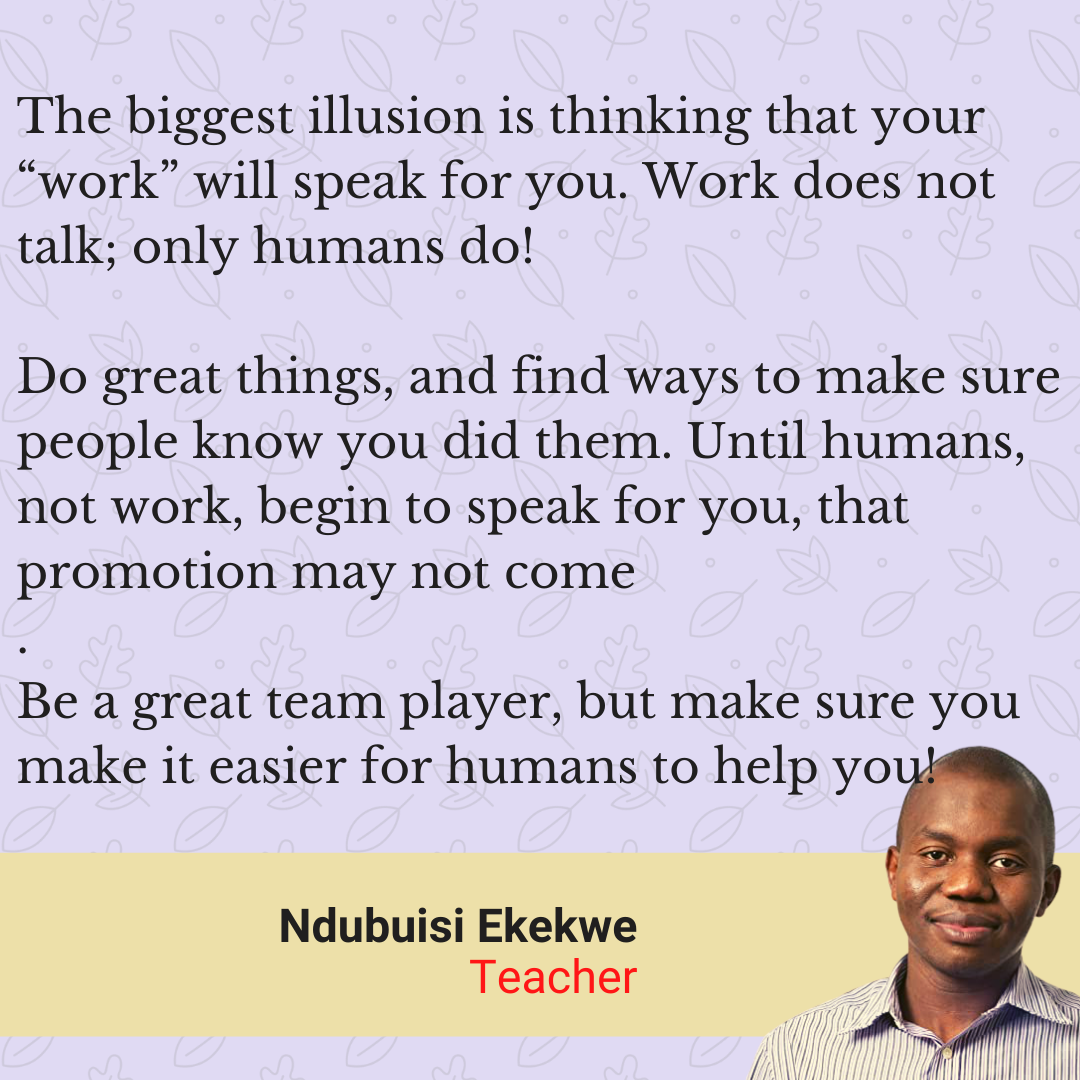
Humans Talk, Not Work

Humans talk; work does not! Make humans know what you are doing. Yes, until humans know what you are doing, none will recommend you in your absence. And there is no career which can advance if it cannot get some recommendations in absence.

For founders: when you promote your product, do not be ashamed. If you believe your product is the best, you are serving society by making sure people know the best product out there. If you do not do that, you are depriving humans the opportunity to use the best product. That is why I promote Tekedia Mini-MBA, Tekedia Capital, Fasmicro Intel partnership,  etc because those are the best. Period.

Think about this: if Ndubuisi Ekekwe does not do just that, I am not fair to people who are not aware of our services. Rethink your position as a business leader; it is not just a title; you are the chief marketing officer, chief product officer, despite other people who may have those titles in the firm.

Tell us what you do. You can do it and must not hire a PR machine. For me, I run a business school which attracts more students than any university in Africa!

Comment on Feed

Comment 1: Your insight is as accurate as it is brilliant. America is a society that is given to hyperbole, possibly because of the cut throat competition that is an inbred characteristic of capitalism. Even at that, as Ndubuisi Ekekwe subterraneanly suggests, you will be addressed the way you elect to address yourself. No one can, or will, for that matter, market you as well as yourself. The world is under no obligation to burnish a brand that even you do not appear particularly enthusiastic about buffing. Nothing is to be gained by making yourself look small, other than to manifest smallness in your life. To indulge in ineffectual grandstanding, in order to exhibit a humility which you probably do not even remotely feel, is to curry a potential client’s instant devaluation of his conceptual estimation of you. Thank you, I will advise the young artist accordingly.

Comment 2: ?! Learn first to be your own best advocate before expecting others to do the same for you. Ensure you are seen and heard. No matter how “fantastic” your work is, it’s only a small part in the equation. We should deliver, but also pride ourselves on it and let it be known (chest pump!) when opportunities arise. Create opportunities to show and introduce yourself. Visibility, image, advocacy matter more!!