DD
MM
YYYY

PAGES

DD
MM
YYYY

spot_img

PAGES

Home Blog Page 4186

Nigerian Crypto Company Patricia Issues Statment Regarding Security Breach on Platform

0

Africa’s largest gift card and Bitcoin Marketplace Patricia has issued a statement regarding a security breach on the platform.

The platform reportedly suffered a security breach on its cryptocurrency processing platform, losing bitcoin and naira assets, while it stated that other crypto assets were unaffected. This prompted it to temporarily halt withdrawals while it tried to rectify the issue.

In response to the security breach the company wrote,

“Over the last five years, we have become synonymous with Bitcoin and crypto trading. We have been at the forefront of crypto adoption in Africa, and despite governmental and environmental challenges that have tested our efforts to drive adoption in Nigeria and Africa, we have remained resolute

“Our efforts did not go unnoticed, as we quickly became a household name, garnering prestigious awards across the world. However, public recognition comes with its fair share of risks. 

Our services are divided into three arms: Patricia Personal, Patricia OTC Desk, and Patricia Business. Not long ago, we were victims of a breach. Patricia Personal, the retail trading application, was solely affected by this breach; BTC and Naira assets were compromised. Every other crypto balance remains unaffected, and we assure the public that all our customers and merchants’ assets are secure. 

“In light of this, we are undergoing internal restructuring and temporarily suspending withdrawals on our app (mobile and web). We understand how this has affected our customers, and are truly appreciative of your patience through this inconvenience. We assure you that we are working to strengthen our security measures. 

“Our security team, with the help of law enforcement agencies, has been able to identify an individual among the syndicated group responsible for this breach. We will continue to pursue this lead and work with security agencies and other partners to ensure a thorough audit of the situation and recover the assets. 

“Our users remain at the heart of what we do, and we will continue to provide updates on this situation to all stakeholders. Patricia Technologies Limited”.

Reports reveal that while Patricia has chosen not to reveal specific details about the breach suffered, the company disclosed that it has identified an individual within the syndicated group responsible for the breach.

Launched in 2017, Patricia has innovated refreshing solutions for crypto users globally. The company launched Africa’s Crypto Debit card and also allowed crypto users to experience day-to-day uses through the introduction of utility bill payments facilitated by crypto.

Patricia harnesses the power of cryptocurrency to create alternative solutions to financial infrastructure, digital payments, and global E-commerce. The platform is known to embody its popular slogan “Do The Most” in every way possible, and its willingness to show its human side, production process, and consumer-first approach has won the heart of many crypto lovers.

Nigerian Senate Approves the Amendment of CBN Act, Reviews Ways and Means Borrowing from 5% to 15%

0

The Nigerian Senate has approved the upward review of the Ways and Means loan from the Central Bank of Nigeria (CBN) to the Federal Government from five to 15 percent.

The approval for the amendment of the CBN Act follows the emergency plenary session held by the red chamber on Saturday, less than two days to the inauguration of the tenth national assembly.

The bill, which was sponsored by Senator Gobir Ibrahim Abdullahi, representing Sokoto East Senatorial District, was first introduced on Wednesday May 24, 2023.

During the plenary session which was presided over by the Senate President Ahmed Lawan, Abdullahi said the upward review of the Ways and Means was prompted by the need to help the federal government meet its financial obligations through loans from the CBN.

“The Bill seeks to amend the Central Bank of Nigeria, CBN, Act to increase the total CBN advances to the Federal Government from five percent (5%) to a Maximum of fifteen percent (15%),” he said.

“The Bill was read for the first time in this Chamber on Wednesday, 24th May, 2023.

“The very essence of this Bill my respected colleagues is to enable the Federal Government meet its immediate and future obligation in the approval of the ways and means by the National Assembly and advances to the Federal Government by the Central Bank of Nigeria.”

Most of the senators agreed with the assertion that the bill will help the federal government to execute many of its functions, including important projects that will contribute to economic growth.

Given the agreement of the majority of the senators on the floor, Lawan thanked the lawmakers and passed the bill into law.

Section 38(2) & (3) of the CBN Act stipulates “that Ways and Means shall not exceed 5% of the previous year’s revenue of the Federal Government.”

But in the past seven years, the CBN governor Godwin Emefiele has flagrantly flouted the CBN Act by lending more than N23 trillion to the President Muhammadu Buhari administration through Ways and Means.

The loan, which experts have fingered as part of the reasons the nation’s inflation has hit record high, was recently approved by the Senate to be restructured.

The illegality of the loan, which has generated a lot of criticism from many quarters – who say it further underlines the present government’s no regard for the rule of law, is believed to have inspired the amendment of the CBN Act as a parting legislative function of the ninth senate.

The amendment will now make it possible for the incoming administration to borrow more from the CBN without breaking the law. Already, the president-elect, Bola Tinubu, has hinted that his government will rely on money supplies from the central bank as Nigeria’s revenue generation dwindles.

Twitter Withdraws From European Union’s Code of Practice on Disinformation

0

Micro-blogging platform Twitter has withdrawn from the voluntary European Union’s code of Practice on Disinformation.

This was disclosed by the European commissioner for the internal market Thierry Breton via a tweet, stating that the social media platform can’t hide from its obligations, despite its exit from the EU code of practice.

He wrote,

“Twitter leaves EU voluntary Code of Practice against disinformation. But obligations remain. You can run but you can’t hide. Beyond voluntary commitments, fighting disinformation will be a legal obligation #DSA as of August 25. Our teams will be ready for enforcement”.

The pan-EU law, which entered into force in November last year, mandated several social media platforms, Twitter inclusive, to assess and mitigate systemic risks to civic discourse and electoral processes such as disinformation.

This saw Google, TikTok, Microsoft and Facebook and Instagram parent company Meta among the top social media platforms that signed up to the EU code, which required them to measure their work on combating disinformation and issue regular reports on their progress.

The EU’s idea is to use mandatory algorithmic transparency requirements to drive accountability, which implies that regulated platforms won’t be able to turn a blind eye to Al-amplified harms as the law also requires they put in place reasonable, proportionate, and effective mitigation measures for identified risks.

Their reporting and mitigation plans will be subject to independent audit and oversight by the European Commission with the support of a newly opened European Center for Algorithmic Transparency while penalties for non-compliance can scale up to 6% of global annual turnover.

In a request for comment emailed to Twitter’s press office, the commission was reported to receive a despicable reply where Twitter used the poop emoji as a response.

Reports reveal that earlier this year, Twitter was the only major tech platform that didn’t send a report to the European Union under the code, which the company had agreed to follow before it was taken over by Elon Musk last year October. Its report was short of data and didn’t include commitments from the social media company that it would empower fact-checkers, the EU’s executive arm disclosed in February.

Meanwhile, previous management at Twitter had signed the platform up to the voluntary EU Code on Disinformation back in 2018, but Twitter’s current owner, Elon Musk, looks intent on picking a fight with the EU over speech moderation.

Experts reveal that this is an expensive fight for Musk to pick as breaches of the commission law can attract penalties of up to 6% of global annual turnover. The Commission has also warned that serious, repeated non-compliance could lead it to block access to a service which dangles the prospect of Twitter losing access to a region with some 440 million consumers.

The original EU Disinformation Code had committed Twitter to take steps to combat the spread of false information on its service by targeting associated ad revenue, tacking bots and fake accounts, and providing consumers with tools to report disinformation and empowering researchers to study.

But Musk’s antics of promotional encouragement for conspiracy put him on a direct collision course with regulators in the EU who have set their stall against blatant anti-democratic manipulation. Musk’s massive job cuts at Twitter, including the exodus of the company’s entire Brussels office raised concerns about whether it will be able to make the necessary changes to comply with the EU’s rules.

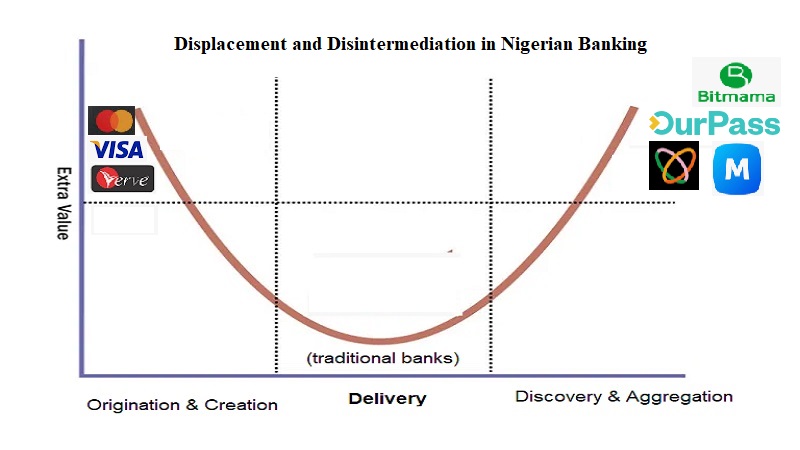
Displacement and Disintermediation in Nigerian Banking – Why Many Microfinance Banks Will Continue to Fade [video]

0

In this video, I respond to some of the questions on the piece where I noted that more microfinance banks in Nigeria will continue to fade. And the banking institutions which will win will be technology companies which offer banking services, and NOT banks which use technology. This is the video for this article.

(In Tekedia Mini-MBA, I explained the Smiling Curve deeper with positioning implications across sectors like manufacturing, etc)


Cessation of Non-Permissible Activities of Microfinance Banks in Nigeria

The Central Bank of Nigeria (CBN) on the 19th of August, 2021 released a circular in response to observed activities of microfinance banks that went beyond the limits of their operating licenses.

This article will be looking at the provisions of this circular which focuses on the non-permissible activities most commonly engaged in by microfinance banks(especially digital microfinance banks), mainly wholesale banking and foreign exchange transactions. These transactions are as follows :-

– The CBN Circular is based on the consideration of comparatively low capitalization of microfinance banks dealing in FX and wholesale banking transactions which carry a huge risk for financial system stability.

– The circular is thus as a result of the need to remind Microfinance Banks (MFBs) to comply with the 2012 CBN MFB Guidelines.

– Consequently, MFBs are prohibited from FX transactions.

– MFBs are to focus on rendering services to retail clients and micro-clients.

– Microcredit and retail transaction services rendered or carried out by MFBs are limited to 500 Thousand Naira per Tier 2 unit MFB transaction and 1 Million Naira for other MFB categories.

– Microcredit facilities shall constitute a minimum of 80% of total loan portfolios for MFBs.

– A disregard or violation of the directions contained in this circular can lead to sanctions that include the revocation of an MFB license.

The CBN Guidelines on the Non-Oil Export Proceeds Repatriation Scheme in Nigeria

0

First released on the 22nd of February,2022, the Central Bank of Nigeria (CBN) Guidelines on Non-Oil Export Proceeds Repatriation aims to raise $200 Billion Naira in foreign exchange from Non-Oil proceeds over the next 3-5 years.

These guidelines which will form the focus of this article are anchored on a 5-point agenda and are designed to incentivize exporters in the Non-Oil export sector to encourage repatriation and the sale of export proceeds into the FX market.

The guidelines are also aimed at earning more stable and sustainable inflows of FX in order to insulate the Nigerian economy from shocks and FX shortages.

This article will be looking at :-

– The objectives of the CBN Guidelines.

– Eligibility criteria for this scheme regarding beneficiaries and transactions.

– Application procedures relevant for this scheme.

What are the objectives of the CBN Guidelines on Non-Oil Export Proceeds Repatriation?

The objectives of the guidelines are :-

  1. The enhancement of FX (Foreign Exchange) inflow.
  1. The diversification of the sources of FX inflow.
  1. Ensuring stability and sustainability of FX inflow.
  1. To encourage the increase in the level of contributions of Non-Oil exports economically.

Which government agency is in charge of administration of the scheme by virtue of the CBN Guidelines?

The CBN’s (Trade & Exchange Department) shall be responsible for the day-to-day administration of the scheme. 

What is the eligibility criteria for the scheme regarding beneficiaries?

Eligible beneficiaries for this scheme are :-

– Exporters of finished and semi-finished goods.

– Exporters shall qualify for rebate where repatriated export proceeds are sold at the Investors & Exporters (I & E) window. 

What is the eligibility criteria for this scheme regarding transactions?

Eligible criteria for transactions under this scheme by virtue of the CBN Guidelines are:-

– The transactions must involve the export of finished and semi-finished goods wholly or partly processed or manufactured in Nigeria, except otherwise stated by the CBN.

– The transactions must involve the export of goods and services (I.T & creative businesses) that are permissible and excluded under the existing export prohibition list.

– The sale of repatriated export proceeds at the I & E window.

– The completion of e-form NXP.

– Registration with the Corporate Affairs Commission (CAC) & the Nigerian Export Promotion Council (NERC). 

What are the features of the scheme?

The scheme revolves mainly around incentives in the form of :-

(i). 65 Naira for every $1 repatriated and sold at the I & E window to Authorized Dealer Banks for 3rd party use.

(ii). 35 Naira for every $1 repatriated and sold into the I & E for own use on eligible transactions only. The spread should not be more than 10 Kobo.

What is the application procedure for taking part in the scheme?

The application procedure involves the following :-

  1. The submission of written requests from the exporter through the Authorized Dealer Bank (ADB)where the e-Form NXP was established. It shall be the responsibility of the ADB to authenticate all documents submitted for rebates.

This request will be accompanied by :-

a). A completed application form to be designed by the CBN & forwarded to the exporter through his ADB.

b). Documentation requirements for exports as stipulated in the FX manual.

c). Evidence of repatriation and sale of export proceeds at the I & E window.

The ADB shall forward the application within 5 days, after consummation of the export proceeds sale transaction at the I & E window.