DD
MM
YYYY

PAGES

DD
MM
YYYY

spot_img

PAGES

Home Blog Page 421

Ethereum Breaks Resistance, Astar Hits $2.12, BlockDAG Builds $1 Momentum! Which Is the Best Long-Term Crypto Buy?

0

Investors often ask which project will dominate the next cycle, and three competitors have appeared at the forefront. Astar (ASTR) rally news has shocked markets with meteoric gains and ongoing speculation about further upside. At the same time, Ethereum (ETH) breakout levels are capturing headlines as analysts predict price targets as high as $8,400, though not without risks of correction.

Yet the most compelling story may be BlockDAG. With nearly $420M already raised, tokens priced at $0.0015 in Batch 31, and predictions placing it at $1 post-listing, it is gathering momentum as the best long-term crypto investment. Add the Awakening Testnet, miner adoption, and DAG-powered technology, and BlockDAG is quickly proving it’s not just hype.

The market now faces a defining question: will investors stay with established players like Ethereum and Astar, or turn toward BlockDAG’s breakout future?

Astar Climbs To $2.12: Will This Surge Hold?

Few projects have generated as much attention this year as Astar. The latest Astar (ASTR) rally news revealed a startling 2,347% surge in one week, pushing its price to a new all-time high of $2.12. At its peak, Astar’s market cap touched $3.48 billion, making it one of the most discussed tokens in the crypto space. Analyst Kyle Chasse, unfazed by the surge, predicts another 4–6x upside, suggesting Astar’s climb may be far from finished.

The optimism behind the Astar (ASTR) rally news is fueled by speculation of an upcoming Binance listing, which has historically boosted tokens by as much as 80% in a single move. More importantly, Binance founder CZ has voiced strong support for Astar, bolstering market sentiment.

Long-term, Astar is building its own chain and expanding its ecosystem, giving it potential beyond short-term hype. For many traders, these developments put Astar firmly in the conversation for the best long-term crypto, especially when compared to weaker rivals.

Ethereum Risks 15% Pullback After Breakout

While Astar steals headlines, Ethereum (ETH) breakout levels remain critical for the broader market. After years of battling resistance near $4,100, Ethereum finally broke through and flipped this level into support, confirming one of its most bullish chart moves in recent memory. Analysts like Merlijn the Trader believe this shift could trigger a rally toward $6,000 and eventually $8,400, provided momentum holds.

Still, Ethereum (ETH) breakout levels also highlight risk. The coin recently slipped from a symmetrical triangle, raising the possibility of a 15% correction toward the $3,550–$3,750 zone. Analyst Michaël van de Poppe sees this as a healthy reset, arguing that Ethereum’s rising trendline could set the stage for a major rebound. Historically, this kind of compression has preceded gains of 90–125%.

For investors, the mix of short-term caution and long-term opportunity is clear. Ethereum continues to anchor discussions about the best long-term crypto, but it faces growing competition from newer players like Astar and BlockDAG.

BlockDAG Targets $1 Milestone With Tech And Adoption!

While Astar (ASTR) rally news and Ethereum (ETH) breakout levels dominate short-term conversations, BlockDAG is building a case for lasting impact and positioning itself as the best long-term crypto.

The project has already raised nearly $420 million in presale, with 26.5 billion coins sold! Now, Batch 31 is priced at $0.0015 for a limited time, while the launch price is confirmed to be $0.05. Analysts predict the token could climb to $1, representing an extraordinary return for early backers and signaling its potential to outpace rivals.

This momentum is not based on hype alone. The Awakening Testnet has gone live, activating critical blockchain functions, introducing real-time explorer tools, and implementing a UTXO removal upgrade to streamline scalability. This early demonstration of core technology provides rare transparency before mainnet, reinforcing investor trust.

BlockDAG’s foundation is its multi-parent DAG architecture, capable of processing 2,000–15,000 transactions per second. Coupled with a hybrid consensus model merging Proof-of-Work and Proof-of-Engagement, the system offers scalability, decentralization, and security. Adoption is already global: more than 20,000 X-Series miners have shipped across 130+ countries, embedding Proof-of-Work validation into households and businesses.

Confidence is further amplified by whale activity. Single buys of $4.4 million and $3.6 million have reshaped BlockDAG’s leaderboard, highlighting commitment from large investors. Analysts argue that this combination of miner adoption, whale conviction, and breakthrough technology makes BlockDAG unique among presales.

For many, these achievements prove BlockDAG is not just another speculative project but a frontrunner for the best long-term crypto, capable of surpassing both Ethereum and Astar.

Wrapping Up!

Investors now face a critical choice. Astar (ASTR) rally news excites with rapid gains and exchange speculation. Ethereum (ETH) breakout levels inspire confidence, but also warn of corrections before higher targets can be tested. BlockDAG, meanwhile, has raised nearly $420M, shipped miners, launched its Awakening Testnet, and confirmed a $0.05 listing, with bullish predictions eyeing $1.

For those searching for the best long-term crypto, the contrasts couldn’t be clearer. Astar promises speed and hype, Ethereum provides stability with growth potential, but BlockDAG blends transparency, innovation, and adoption into one package.

With both whales and retail participants backing it, BlockDAG is no longer just a presale story; it’s a future competitor for dominance. As the market shifts, the question isn’t just whether BlockDAG will reach $1, but how quickly it will redefine the world of the best long-term crypto.

Presale: https://purchase.blockdag.network

Website: https://blockdag.network

Telegram: https://t.me/blockDAGnetworkOfficial

Discord: https://discord.gg/Q7BxghMVyu

Nigerian Media as an Intelligence Conduit for Managing Banditry

0

The news cycle around banditry now forms a living archive of situational awareness. Each headline, update, and community report contains data points about violence patterns, institutional weaknesses, and public sentiment. Unlike classified intelligence systems that rely on internal reports, media intelligence is built from public observation and institutional discourse. It reveals how incidents are perceived, how state agencies react, and how communities adapt. In this way, Nigerian media function as the connective tissue between security events and public understanding. Their framing and frequency of reporting indirectly shape resource allocation, humanitarian interventions, and policy priorities.

The analysis of coverage between April and July 2025 shows that the media systematically document bandit attacks, government responses, and community resistance. These recurring narratives offer analysts and policymakers a continuous map of insecurity, one that extends beyond formal intelligence channels.

How Media Types Shape the Flow of Intelligence

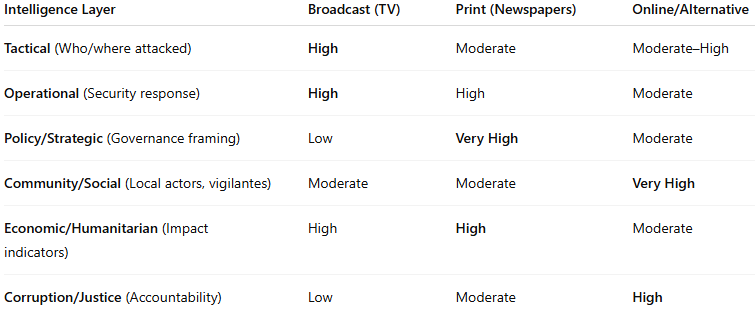
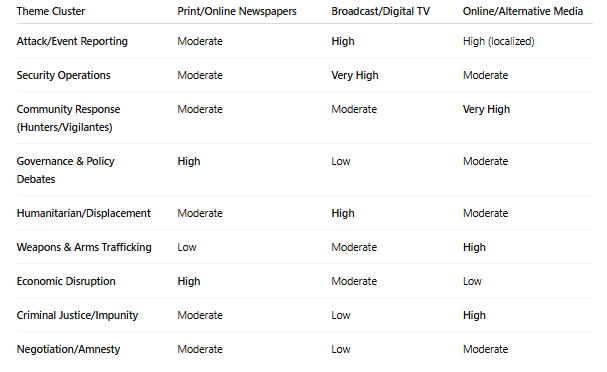
Each media type (print, broadcast, and online) plays a distinct role in producing actionable intelligence. Print and online newspapers such as Daily Trust, Business Day, and Blueprint provide institutional and policy-oriented intelligence. They report on governance failures, weak security capacity, and economic losses arising from banditry. For policymakers, these stories serve as barometers of political will and public accountability. When newspapers repeatedly highlight poor coordination or inadequate funding for security operations, they offer indirect signals of systemic breakdowns that need strategic correction.

Source: Nigerian Newspapers, 2025; Infoprations Analysis, 2025

Broadcast and digital television, represented by Channels TV, Arise News, and others, act as the real-time sensors of Nigeria’s security ecosystem. They document incidents of attacks, military raids, and humanitarian crises almost as they unfold. This immediacy gives them high value as situational intelligence sources. Security analysts can detect geographical hotspots and tactical shifts from such reporting long before official figures are published.

Online and alternative platforms, including blogs and citizen-reporting sites, complement the system by covering community-level realities. Their reports on vigilante groups, displaced persons, and illicit trade networks highlight aspects of banditry that mainstream outlets often miss. This digital ecosystem extends the intelligence perimeter by giving visibility to micro-incidents and informal actors that shape the security terrain.

From News to Intelligence: What Stakeholders Learn

When viewed collectively, Nigerian media outlets form a distributed intelligence network. Print media offer strategic insights into governance and policy patterns, television delivers operational updates, and online channels reveal local dynamics.

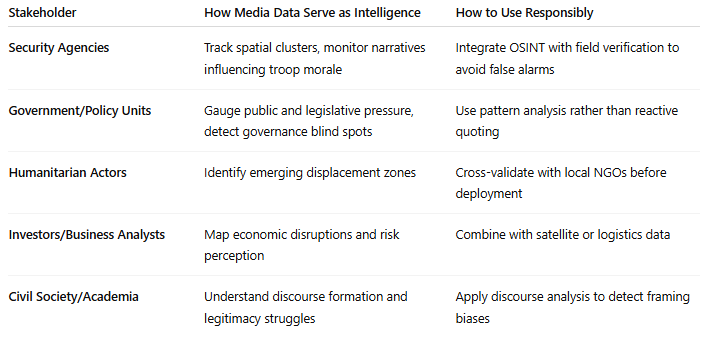
For security agencies, this layered reporting provides an open-source complement to field intelligence. The repetition of attack locations across different outlets helps identify emerging clusters. For policymakers, the narratives highlight public dissatisfaction and expose the policy gaps that drive insecurity. Humanitarian organizations rely on displacement and casualty reports to plan relief operations, while researchers and civic groups use media discourse to map power relations and community resilience.

Source: Nigerian Newspapers, 2025; Infoprations Analysis, 2025

This ecosystem is not without limitations. Information gaps, sensationalism, and political filtering can distort reality. Yet, even biased reporting has analytical value, as it exposes the framing strategies that shape national conversations on insecurity. The diversity of sources allows triangulation and verification, ensuring that decision-makers can extract credible intelligence from the public information environment.

By learning to interpret media data critically, stakeholders can anticipate conflict escalation, assess state responses, and design interventions that reflect both ground realities and public perceptions. In other words, the media not only mirror insecurity but also enable its management through knowledge circulation.

Building a Smarter Intelligence Culture through Media

Treating Nigerian media as an intelligence conduit requires a shift in how stakeholders engage with information. Instead of dismissing news reports as reactive storytelling, they should be integrated into early warning systems and strategic communication plans. The value lies not only in single headlines but in patterns—the recurrence of attacks, the geography of insecurity, and the tone of policy commentary.

Source: Nigerian Newspapers, 2025; Infoprations Analysis, 2025

Government communication offices can establish data pipelines that track and analyze media coverage of security incidents. Security agencies can complement this by training analysts to use open-source media data for spatial mapping and community profiling. Humanitarian groups can also develop media dashboards to monitor emerging needs in conflict-affected regions.

Ultimately, Nigeria’s fragmented media system offers a comprehensive and democratic form of intelligence. It distributes visibility across different levels of society and ensures that no single narrative monopolizes the understanding of insecurity. By embracing this potential, Nigeria can transform its media landscape into a structured intelligence resource for managing banditry and strengthening national security.

Pi Coin Collapses, Monero Stalls, BlockDAG’s Presale Surges to $420M! Here’s Why Experts Back BDAG as the Best Crypto of 2025

0

The Pi Coin (PI) market crash has raised concerns about the sustainability of community-driven tokens, while the Monero (XMR) price forecast reflects uncertainty within the privacy-focused sector. These contrasting developments illustrate the challenges facing older and newer digital assets alike, forcing investors to rethink strategies as they evaluate the most popular cryptocurrency for 2025.

Amid this market turbulence, BlockDAG has captured investor attention with a presale that continues to deliver historic results. With nearly $420 million raised by Batch 31 and more than 26.5 billion coins sold, it demonstrates measurable adoption and momentum.

By securing funding and building a growing community, BlockDAG has set itself apart from projects showing weakness. This performance positions it as one of the strongest contenders for the most popular cryptocurrency in the year ahead.

Why Pi Coin Is Losing Market Support Fast

The Pi Coin (PI) market crash has become a key reminder of the risks tied to projects with unproven utility. Initially promoted as a mobile-first mining experiment, Pi Coin attracted millions of users who hoped to benefit from free token accumulation. However, without clear exchange listings and limited ecosystem development, the Pi Coin (PI) market crash was inevitable.

Analysts point out that the Pi Coin (PI) market crash highlights how projects that rely too heavily on community hype can face sudden collapses when demand weakens. This has damaged confidence and reduced its presence among candidates for the most popular cryptocurrency.

For investors, the Pi Coin (PI) market crash demonstrates the importance of fundamentals. While user enthusiasm once pushed growth, the absence of meaningful adoption has left it vulnerable. As a result, Pi Coin has struggled to regain stability and is no longer considered a strong option for the most popular cryptocurrency.

Monero’s Niche Use-Case Slows Expansion

The Monero (XMR) price forecast reflects the ongoing challenges for privacy coins in a regulatory-heavy environment. Known for its focus on transaction anonymity, Monero remains popular with niche users but struggles to maintain momentum. Analysts observing the Monero (XMR) price forecast point to increasing restrictions on privacy tokens, which reduce adoption on major exchanges.

Despite these obstacles, the Monero (XMR) price forecast suggests resilience. The token continues to be supported by a loyal community that values security and privacy, keeping it relevant among certain investor groups. However, its growth prospects are limited compared to broader adoption projects.

For those considering the most popular cryptocurrency in 2025, Monero presents both strengths and risks. The Monero (XMR) price forecast highlights its unique value but also underscores its inability to scale in the same way as tokens with mainstream recognition. This balance leaves Monero more of a niche investment than a market leader.

BlockDAG’s Presale Momentum Defines Market Confidence!

BlockDAG’s presale performance has been one of the standout events in the crypto sector. The project has already raised nearly $420 million and sold more than 26.5 billion coins in record time! Plus, its Batch 31 rate has been slashed to $0.0015 for a limited time, unlocking massive upside for current buyers! These achievements and price offer have fueled massive demand, creating confidence among buyers seeking the most popular cryptocurrency in 2025.

What separates BlockDAG from weaker projects is its presale strategy. By delivering a structured, transparent rollout, it avoids the volatility that undermines many early-stage tokens. This consistency reinforces BlockDAG’s long-term potential, ensuring it is seen as more than a speculative play.

Adoption figures strengthen this momentum. With over 3 million users mining through the X1 app and 20,000 hardware miners already shipped from the X Series, BlockDAG has proven that it is building real engagement. These numbers reflect an ecosystem that extends well beyond financial fundraising.

Investor trust is also secured through rigorous security measures. Independent audits by CertiK and Halborn validate its infrastructure, while 20 confirmed exchange listings guarantee liquidity once trading begins. This combination of presale funding, adoption, and security makes BlockDAG one of the most convincing candidates for the most popular cryptocurrency in 2025.

Final Thoughts

The Pi Coin (PI) market crash shows the risks of hype-driven tokens, while the Monero (XMR) price forecast reflects the struggles of niche assets under regulatory scrutiny. Both offer lessons but fall short of delivering the momentum needed to claim the title of the most popular cryptocurrency.

BlockDAG, however, presents a different story. With nearly $420 million raised, over 26.5 billion coins sold, a limited-time price of $0.0015, and millions of active miners, it combines adoption with security and transparency.

Supported by CertiK and Halborn audits and backed by confirmed exchange listings, it offers clarity and growth potential. For investors weighing their options in 2025, BlockDAG stands as the most compelling and well-positioned candidate for the most popular cryptocurrency.

Presale: https://purchase.blockdag.network

Website: https://blockdag.network

Telegram: https://t.me/blockDAGnetworkOfficial

Discord: https://discord.gg/Q7BxghMVyu
6 Top 1000x Crypto Coins of 2025 You Should Watch Before They Explode

2
Blazpay – presale tokens

The crypto market has always rewarded early movers. From Bitcoin’s meteoric rise to Ethereum’s dominance, presales and early entries have consistently proven to be the gateway to generational wealth. In 2025, the theme continues, with investors eyeing presales as the best way to secure exposure before tokens take off.

This year, a handful of projects stand out as the best pre sales crypto plays and potential top 1000x crypto coins 2025. At the center of it all is Blazpay ($BLAZ), a DeFi super app that has already built a massive user base before its exchange debut. Alongside it, established giants like Bitcoin and BNB, as well as rising stars like Sui, Moonbeam, and DUSK, round out the list of opportunities every serious investor should be monitoring.

Blazpay ($BLAZ)

Blazpay has quickly emerged as one of the most talked-about token presale opportunities. With more than 1.2 million users, 10 million transactions, and 100 integrations across Layer 1 and Layer 2 blockchains, Blazpay is already proving its staying power before its token even hits major exchanges.

What sets it apart is its combination of perpetual trading with flexible leverage, gamified DeFi rewards, and B2B API/SDK support. This mix not only creates a retail-friendly platform where users can earn rewards through interactive engagement, but also positions Blazpay as an enterprise-ready solution capable of scaling across multiple industries — a broader adoption potential than most presale crypto projects can claim.

Blazpay – pre sales crypto

How to Buy Blazpay ($BLAZ)

  1. Visit the official Blazpay presale site.
  2. Connect your Web3 wallet (MetaMask recommended).
  3. Purchase $BLAZ using ETH, USDT, or BNB.
  4. Hold tokens safely for distribution after the presale closes.

As one of the best token presale entries in 2025, Blazpay stands out for its fundamentals and growth trajectory. Early buyers could be sitting on one of the top 1000x crypto coins 2025 if adoption continues at this pace.

2. Bitcoin (BTC) – The Market Giant

Bitcoin remains the gold standard of crypto. Trading at around $112,150, with a market cap surpassing $2.23 trillion, Bitcoin continues to dominate institutional flows.

While not a pre-sales crypto project, Bitcoin’s importance lies in its role as a liquidity driver. Most new projects and the best token presale launches benchmark their progress against Bitcoin’s price cycles. As the oldest and strongest crypto, it anchors investor sentiment and provides a benchmark for the top 1000x crypto coins 2025.

3. Binance Coin (BNB) – Utility Powerhouse

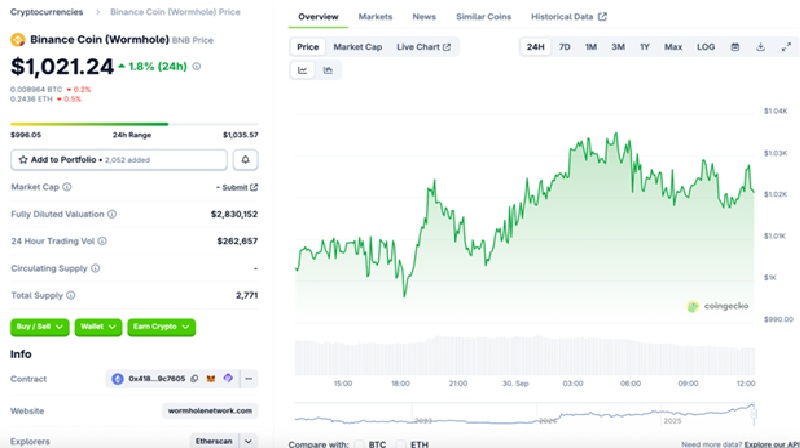
Currently priced near $1,021, BNB has proven itself as more than just an exchange token. With a market cap of over $147 billion and consistent growth in its ecosystem, BNB is essential for gas fees, trading, and presale participation on Binance Smart Chain.

BNB’s strength comes from its utility and steady price growth. For investors hunting the best token presale opportunities, many pre-sale crypto projects still launch on Binance’s network, making BNB indispensable. Its 65% growth over the past year shows why it belongs among the top 1000x crypto coins 2025.

Blazpay – top 1000x crypto coins 2025

4. Sui (SUI) – Web3 Scalability Leader

Sui is one of the fastest-growing Layer 1 blockchains, priced around $3.25 with a market cap of $8.45 billion. Known for its scalability and Move programming language, Sui offers a developer-friendly ecosystem.

With predictions ranging from $2.50 short-term dips to $17+ long-term potential, Sui has strong growth prospects. For investors chasing pre-sales crypto, Sui’s ecosystem regularly hosts new launches. This makes Sui not just a token play, but a base layer for many best token presale opportunities in 2025.

5. Moonbeam (GLMR) – Cross-Chain Smart Contracts

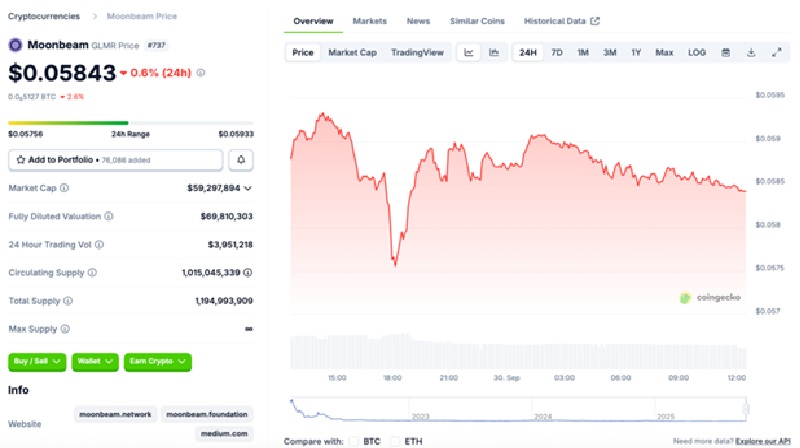
Moonbeam, trading near $0.058, plays a critical role in the Polkadot ecosystem. Its focus on cross-chain smart contracts and DeFi integration has made it a launchpad for innovative projects.

Recent partnerships and bridging upgrades have improved adoption, reinforcing Moonbeam’s relevance. For investors scouting the top 1000x crypto coins 2025, Moonbeam’s ecosystem provides fertile ground for the next best token presale projects.

6. DUSK Network (DUSK) – Privacy and Compliance

Priced at $0.22 with a market cap of $43 million, DUSK specializes in privacy-preserving and compliance-focused blockchain solutions. Its enterprise-first approach positions it differently from hype-driven meme coins.

Network upgrades and strategic partnerships are fueling modest but steady growth. With regulatory interest in compliant DeFi increasing, DUSK could quietly emerge as one of the pre-sales crypto ecosystems to watch, while also ranking among the top 1000x crypto coins 2025 for patient investors.

The Bottom Line: Secure Blazpay Before the Next Price Jump

The best token presale of 2025 is clearly Blazpay ($BLAZ). With its unique blend of DeFi tools, gamified rewards, and enterprise integrations, it’s one of the most compelling pre sales crypto opportunities this year. Yet, projects like Bitcoin, BNB, Sui, Moonbeam, and DUSK each play their role in shaping the market narrative and providing fertile ground for growth.

For investors, the message is clear: presales continue to be where fortunes are made. Among the top 1000x crypto coins 2025, Blazpay stands out as the one with the greatest potential upside.

Join the Blazpay presale today-secure your allocation before the next phase price increase.

Blazpay – best token presale

Join the Blazpay Community


Website – https://blazpay.com

Twitter – https://x.com/blazpaylabs

Telegram – https://t.me/blazpay


Managing Banditry in Nigeria: Insights from Bandits and State Actors

0

The persistent wave of banditry across Nigeria, particularly in the northern and north-central regions, has evolved from a security challenge into a complex socio-political and humanitarian crisis. Using data extracted from newspaper reports between April and July 2025, in this report, our analyst examines how media discourses construct the problem of banditry, the nature of responses from both state and non-state actors, and the broader implications for governance, security management, and social resilience. The findings draw on coded themes such as attacks, community responses, military operations, and policy interventions, revealing deep-seated patterns of insecurity and state fragility.

Nature and Framing of Banditry in the Media

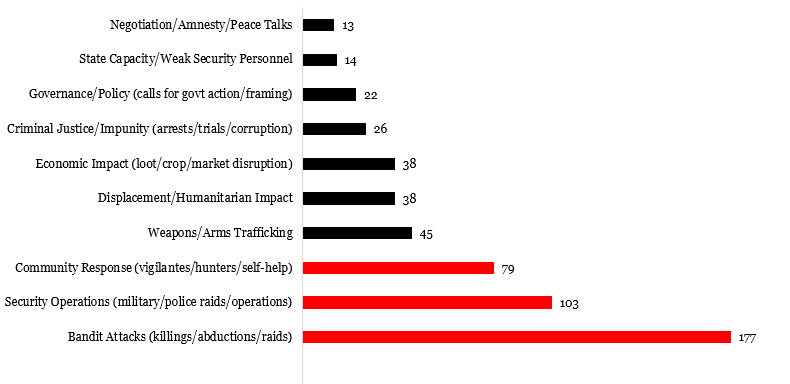
Our dataset, comprising 261 reports from diverse media outlets such as Channels TV, Daily Nigerian, Blue Print, and Business Day, reveals that bandit attacks dominate the coverage. Most headlines and extracts revolve around killings, abductions, and raids on villages, farms, and highways. Through this framing, the media present banditry primarily as a problem of escalating violence and insecurity, rather than a manifestation of socio-economic deprivation or political neglect. This heavy focus on attacks shapes public perception by emphasizing fear and urgency while obscuring the structural conditions, such as poverty, unemployment, and rural marginalization, that sustain violent networks.

Exhibit 1: Top 10 themes reported between April and July, 2025

Source: Nigerian Newspapers, 2025; Infoprations Analysis, 2025

Also, the media’s crisis-oriented reporting often privileges sensational narratives over analytical ones. While such coverage raises awareness and mobilizes attention, it can also contribute to desensitization, fatigue, and policy responses driven by emotion rather than evidence. Thus, the way the media define and circulate stories about banditry significantly influences how society and the government understand the crisis and prioritize solutions.

Community Responses and Informal Security Systems

One of the most striking insights from the dataset is the increasing visibility of community-based responses to banditry. Across multiple reports, local vigilante groups, hunters, and youth organizations emerge as frontline defenders of their communities. The media depict them as courageous and morally justified actors stepping in where the state has failed. This discourse underscores widespread disillusionment with official security agencies and reflects a shift from dependence on the state to self-organized protection networks.

However, the rise of informal security groups raises complex governance questions. While they provide immediate protection, they also risk escalating cycles of violence, reprisal attacks, and human rights violations. Reports of vigilantes demanding government recognition or access to arms demonstrate how non-state actors increasingly operate within the grey zone between legality and necessity. In the absence of coherent state coordination, these groups have become essential yet destabilizing elements of Nigeria’s fragmented security order.

State Responses and the Question of Capacity

Media coverage of state responses shows that Nigeria’s approach to banditry remains largely reactive and militarized. The reports highlight frequent airstrikes, raids, and troop deployments, often followed by renewed attacks and civilian casualties. This pattern suggests that state action, while visible, has limited deterrent impact. The government’s dependence on force rather than intelligence, negotiation, or socio-economic intervention reflects institutional weakness and policy fragmentation.

Moreover, the themes of weak security capacity and poor coordination recur across the dataset. Journalists frequently report inadequate training, low morale, and corruption among personnel. Public officials, governors, and legislators are often quoted appealing for federal intervention or resource allocation, an indication of vertical disconnection between national and subnational security structures. These portrayals reinforce the perception that Nigeria’s state institutions are overstretched and reactive, operating without a coherent long-term counter-banditry framework.

Socioeconomic and Governance Dimensions

Beyond security operations, the reports contain scattered but critical references to the humanitarian and economic fallout of banditry. Communities across Zamfara, Katsina, Niger, and Kaduna face large-scale displacement, destruction of farmlands, and declining agricultural productivity. Although underreported, these consequences deepen poverty and food insecurity, locking rural populations in a vicious cycle of vulnerability. The economic dimension is thus central to the persistence of banditry, yet it receives less sustained media attention compared to the violence itself.

Governance issues also permeate the narratives. Political leaders’ repeated calls for federal action, without visible results, expose performative governance practices that emphasize rhetoric over implementation. The occasional inclusion of surrender initiatives or amnesty programs reflects a contradictory policy landscape, oscillating between coercion and negotiation. Consequently, the state’s legitimacy remains contested, with both bandits and communities perceiving it as distant or ineffective.

Going Forward

The evidence from media reporting reveals that managing banditry in Nigeria requires a multidimensional approach that moves beyond the military paradigm dominating current discourse. The crisis is as much about governance and legitimacy as it is about violence. Sustainable management depends on rebuilding trust between state and citizens, integrating community-based security structures into regulated frameworks, and addressing the socio-economic roots of rural unrest.