DD
MM
YYYY

PAGES

DD
MM
YYYY

spot_img

PAGES

Home Blog Page 4211

Setting Sail with Yachtify (YCHT): Outperforming Uniswap (UNI) in the Cryptocurrency Investment Arena

0

Yachtify (YCHT) has hoisted its sails and embarked on an impressive voyage through the cryptocurrency investment arena, leaving Uniswap (UNI) trailing in its wake. With a groundbreaking platform and an innovative approach to digital asset investments, Yachtify (YCHT) is swiftly making its mark as a top contender in the crypto world.

Discover the key factors that propel Yachtify (YCHT) ahead of Uniswap (UNI) and learn how this trailblazing project is revolutionizing the cryptocurrency investment landscape for discerning investors.

>>>> BUY YACHTIFY TOKENS <<<

Setting Sail with Yachtify (YCHT): Investors are Excited About This Emerging Project

Yachtify (YCHT) is charting new waters in the realm of digital assets, aiming to democratize the exclusive yacht ownership market. This groundbreaking project seeks to establish a marketplace for anyone interested in earning passive income through fractional boat ownership. With Yachtify, investors can own a share of a boat and earn income proportional to their share when the boat is rented out.

No longer an asset reserved solely for the wealthy, Yachtify is introducing the world’s first fractional yacht investment platform, allowing the community to buy, sell, and rent real-world yachts. The Yachtify Protocol offers a unique opportunity for investors to participate in a recession-proof maritime industry with multiple income streams, thereby making the elite yacht market accessible to cryptocurrency users.

Through the native token, $YCHT, investors can purchase fractional NFTs representing physical yachts, which are insured and stored in high-security ports worldwide. Existing yacht owners can list a minimum of 25% of their private yachts for fractional sale, and members can trade yacht hour smart NFTs that decrease as the hours are used. Each NFT represents a real-world yacht, allowing the community to purchase a stake for as little as $100. Private yachts are sold or leased to high-net-worth individuals and charter businesses, enabling investors to earn income or capital growth.

The Yachtify team has undergone a rigorous KYC process, with the founder’s identity verified. The project has been audited by SolidProof, ensuring liquidity will be locked for life, and team tokens are locked for three years. Yachtify has the potential to become a blue-chip crypto with significant growth prospects, especially for presale investors who can earn a revenue share of platform fees as long as they hold the tokens.

With Yachtify, users can rent, sell, and buy various boats on the blockchain, earning a share in the platform’s revenue. This innovative project could be an opportunity to invest in a future blue-chip cryptocurrency at an attractive price point of just $0.10. Experienced investors know that investing in solid projects early is where significant gains are often made, making Yachtify a promising investment opportunity worth checking out.

Uniswap (UNI) Experiences Market Turbulence: Volatility Uncovers Fresh Possibilities for Traders

In recent times, Uniswap (UNI) has witnessed considerable price fluctuations, leading investors to explore alternative investment opportunities. Uniswap (UNI) has built a solid reputation as a platform that enables the trading of Ethereum-based tokens since its inception. However, the Uniswap (UNI) coin’s value has nosedived from an astounding $44 to a mere $6.32, even though it saw an 11% increase recently. This downturn in Uniswap (UNI) value has raised questions among investors about its potential for sustained growth and the chances of reclaiming its past glory.

Consequently, numerous investors are shifting their focus to Yachtify (YCHT), which showcases more enticing growth potential. While optimism for Uniswap (UNI) persists, its capacity to attract investor attention and compete with other rising contenders in the ever-changing crypto landscape remains uncertain.

Join Presale: https://buy.yachtify.market

Website: https://yachtify.market

Telegram: https://t.me/yachtify

Twitter: https://twitter.com/yachtify_market

On Nigeria’s ARCON approval for skit maker; the clarification

0

The Advertising Regulatory Council of Nigeria (ARCON) took Meta Platforms Inc, the parent company of Facebook, Instagram and WhatsApp to court the other day, joining AT3 Resources Limited to the suit.

This suit was commenced as an enforcement of Act No. 23 of 2022 which has provided guidelines for advertisers and advertising agencies.

Basically, ARCON is suing AT3 Resources Limited for running an advertisement which was not vetted by the advertising panel (APCON) and Meta Platform Inc is joined as a party to the suit for allowing an agency to run an advertisement on their platform that has not been vetted by the government agency.

In a meeting that I participated in today, this issue was raised, asking as to the way forward for skit makers and content creators who engage in advertising and here is my professional legal opinion/advice as I submitted in the meeting.

After painstakingly going through the extant law ( Act No. 23 of 2022) purportedly requesting skit markers to obtain approvals and licenses from the advertising panel (APCON) before they can engage in an advertisement: there is nowhere this was expressly provided that skit makers, content creators or influencers should obtain approvals from the panel before making a post. In fact, under S. 63 of the act which is the interpretation section, Advertising agency was stated to mean an agent or organization that engages in express advertisement; skit markers, influencers, or content creators were never added as advertising agency nor advertisers.

Secondly, content creators and influencers although engage in the promotion and endorsement of products which can be interpreted to be a form of advertisement, they never engage in express or overt advertising; they have crafted a unique style of making “funny skits/content” while covertly infusing the product or brand they intend to promote and endorse. This, in my professional opinion and to every reasonable person’s opinion cannot be said to be advertising that approval is needed for.

As for the suit between ARCON v. Meta & Anor which has raised this recent panic amongst advertisers and content creators, this suit may have been misunderstood; “ARCON is suing META the parent company of Facebook, Instagram and WhatsApp mainly for allowing their platform to be used engaging in advertising that was never vetted by the panel, the next defendant in the suit is AT3 Resources ltd, a lagos based media agency that engages in outdoor and social media advert and public relation.

This case should totally be distinguished from what content creators and skit makers do hence why they do not need approval from the panel to post their funny skits or content. They are just agents of laughter and one should not be needing approval from the government to spread happiness through laughter.

Finally, I am fully aware that this whole brouhaha of skit makers obtaining approvals from APCON before advertising started off when the DG of ARCON in a press briefing last December charged skit makers and social media content creators to adhere to the Nigeria advertising code of practice but nowhere is it provided in the act that skit makers or content creators should secure approvals. I strongly believe that the DG was greatly misquoted by news blogs.

On that note, I advise that APCON licenses and approvals do not apply to content creators and skit makers because they do not engage in the express form of advertisement.

Gmail Introduces Blue Checkmark to Help Users Identify Messages From Legitimate Senders

0

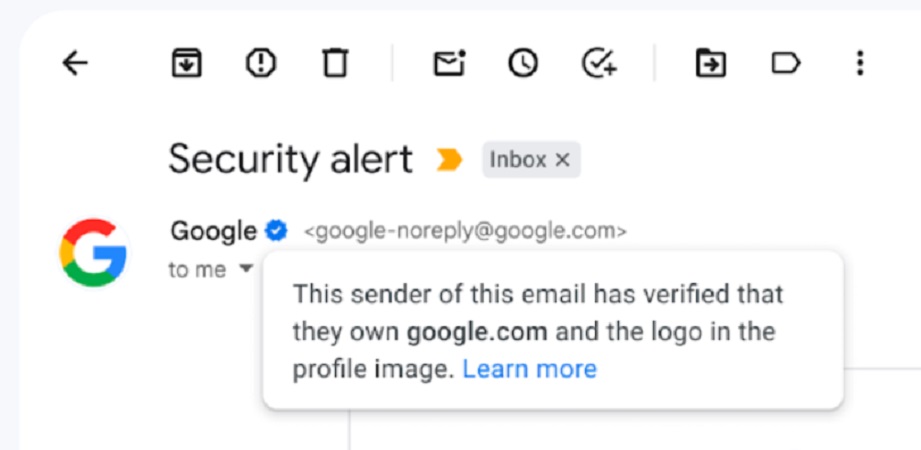
Tech giant Google began to introduce Twitter-like blue check marks next to select senders’ names on Gmail to verify that they are identified and to also help users identify messages from legitimate senders.

The tech giant via a blog post announced on Wednesday that the new blue check marks will appear next to companies that have adopted Gmail’s existing Brand Indicators for Message Identification (BIMI) feature.

The blog post which is titled “Expanding upon Gmail security with BIMI” reads,

“In 2021, we introduced Brand Indicators for Message Identification (BIMI) in Gmail, a feature that requires senders to use strong authentication and verify their brand logo in order to display a brand logo as an avatar in emails. Building upon that feature, users will now see a checkmark icon for senders that have adopted BIMI. This will help users identify messages from legitimate senders versus impersonators”.

Google via Twitter advised users to look out for the blue checkmark next to a company’s name in their emails to make sure they’re the real deal before they respond. It is worth noting that once users hover over the blue checkmark next to a sender’s name, they will see a blurb that says “the sender of this email has verified” that they own the domain and logo in the profile image.

The tech giant revealed that this strong email authentication feature was rolled out to help users and email security systems identify and stop spam, and also enables senders to leverage their brand trust. The company also disclosed that this will increase confidence in email sources and give readers an immersive experience, creating a better email ecosystem for everyone.

This feature which has started rolling out is available to all Google Workspace customers, as well as legacy G Suite Basic and Business customers. It is also available to users with personal Google accounts. Google’s introduction of Blue Checkmarks for Gmail accounts is coming at an interesting time, with the rise of ubiquitous Email scams especially in the wake of ChatGPT, which can pose a serious threat to online safety.

These scams are often hard to trick people into revealing sensitive financial information by responding to messages or clicking on links, which leads to loss of money. Now with the introduction of blue check marks, users will be very of divulging vital information to accounts without it.

Google joins the like of Twitter, YouTube, and Pinterest, which are using Blue Checkmarks to authenticate users. Recall that in March this year, Meta also launched paid verification check marks as well as LinkedIn with the introduction of verification badges. It wouldn’t come as a surprise if more companies jump on the trend of verification checkmarks to ensure the highest level of trust is maintained with customers.

The Call to Business Execution

0

This is Tekedia Mini-MBA Graduation Week. In our live session today, I will deliver a message titled “The Call to Business Execution”. Largely, it is ACTION time and we need to go to markets, and apply all that we have mastered in this 12-week program. Yes, until it is done, it has not been done! #DoIT. We’re Tekedia Institute, and we’re a temple for mastery of business!

The next edition begins in June; register here

Welcome! At Tekedia Institute, we co-learn with thousands of professionals and students, from 41 countries, on the mechanics of business, connecting innovation, growth and operational execution, across market territories and industrial sectors. Our Faculty members come from Microsoft, Google, Shell, Flutterwave, Nigerian Breweries, NNPC, Jobberman, Coca Cola, PwC, and other great organizations. Besides pre-recorded courseware, thrice weekly, we hold live Zoom sessions (Tue, Thur and Sat at 7pm WAT). REGISTER and join us! – Prof Ndubuisi Ekekwe, Tekedia Institute Lead Faculty.

British Financial Technology Company Revolut Expands Operation Into Brazil

1

British-Lithuanian neo-bank and financial technology company that offers banking services, Revolut has expanded its operation into its first Latin American country Brazil, offering a multi-currency account and crypto investments in the country.

With over 10 million individual investors in Brazil, the fintech company will provide Bitcoin investments to consumers, citing a growing demand for access to cryptocurrencies in the region. Customers in the queue will be encouraged to sign up for the app in a gradual deployment.

Speaking on its expansion into the Latin American country, CEO of Revolut Nik Storonsky said,

Our mission is to unlock a borderless economy with financial products that are accessible and easy to use and that allow products that are accessible and easy to use and that allow our customers to use their money efficiently. We will start with the global account and crypto investments, but this is just the beginning”.

With Brazil’s population of over 200 million people and a growing demand for crypto, the country is an exceedingly reasonable target for Revolut’s expansion plans. Also, with a customer base of approximately 29 million worldwide, Revolut is making a move to establish a stronghold in Brazil which is Latin America’s most populous country.

Revolut will however face stiff competition from several established digital banks in Brazil which include Nubank, Banco Inter, and Neon. Nubank is reportedly the largest digital bank in Brazil, with over 34 million customers. The bank’s recent introduction of crypto currency trading has been well received by the public, garnering over a million users in just one month. However, Revolut is seeking to stand out from the crowd by offering a wider range of financial services and features.

The company already has over 16 million customers worldwide, with a valuation of $33 billion. It plans to continue to expand its services and features to meet the needs of its growing customer base. In September last year, Revolut announced its expansion into Mexico and Brazil, with plans to hire 250 additional people in each country by 2025. The attempt to strengthen Revolut’s foothold in Latin America follows the release of its LiteApp in Ecuador and Chile. In India, the firm has built a team of 400+ employees for its forthcoming launch.

In January 2023, Revolut announced it would transfer its 2 million Irish customers to a new Irish branch and move these customers from Lithuanian IBANs to Irish IBANs, in a bid to compete with the remaining incumbent banks following the exit of RBSand KBC Bank from Ireland.

The company also says it is set to go live in New Zealand in the next few months, to complement its existing operations in Australia. It is interesting to note that Revolut’s mobile app supports spending and ATM withdrawals in 120 currencies and transfers in 29 currencies directly from the app. Payments at weekends incur an extra fee of 0.5% to 2%, protecting Revolut against exchange rate fluctuations.