DD
MM
YYYY

PAGES

DD
MM
YYYY

spot_img

PAGES

Home Blog Page 4222

Blockchain is for All Purpose

0

Blockchain is not just for cryptocurrencies, Defi and Nft. Each transaction or data entry on the Blockchain is verified by a network of nodes and stored in a block, which is linked to the previous block, forming a chain. Blockchain is immutable, meaning that once something is recorded, it cannot be changed or deleted. This makes it resistant to fraud, corruption, and hacking.

It can be used for a variety of purposes, such as supply chain management, digital identity, voting systems, smart contracts, and more. Blockchain is a distributed ledger that records transactions in a secure and transparent way. It allows multiple parties to share and verify data without intermediaries or central authorities. Blockchain can improve efficiency, trust, and security in many domains and industries.

In this post, we will explore some of the use cases and benefits of blockchain technology for different sectors and applications. We will also discuss some of the challenges and limitations of blockchain, and how they can be overcome or mitigated.

What are some of the use cases of Blockchain

Blockchain technology can be used for various purposes, such as:

Supply Chain Management; involves the coordination and integration of activities and processes across multiple entities, such as suppliers, manufacturers, distributors, retailers, and customers. Supply chain management aims to optimize the flow of goods and services, reduce costs and risks, and increase customer satisfaction.

Blockchain can enhance supply chain management by providing a shared and immutable record of transactions and events along the supply chain. Blockchain can enable traceability, provenance, quality control, compliance, and dispute resolution. For example, blockchain can help track the origin and movement of products from farm to fork, ensuring food safety and authenticity. Blockchain can also help prevent counterfeiting, fraud, theft, and waste in the supply chain.

Education: Blockchain can provide a verifiable and tamper-proof record of academic credentials and achievements, such as degrees, certificates, diplomas, and transcripts. This can simplify the verification process and prevent fraud and forgery. Blockchain can also enable new models of learning and assessment, such as peer-to-peer learning, micro-credentials, and badges.

Digital Identity; refers to the online representation of a person or an entity. Digital identity can include personal information, credentials, preferences, reputation, and activities. Digital identity can be used for authentication, authorization, verification, and communication purposes. Blockchain can provide a decentralized and self-sovereign identity system that allows users to control their own identity and data. Users can create their own digital identity.

Voting: Blockchain can enhance the security and integrity of voting systems by ensuring that votes are recorded accurately and transparently. Blockchain can also enable online voting and remote participation, which can increase voter turnout and convenience.

Healthcare: Blockchain can enable secure and seamless sharing of medical records and data among different parties, such as patients, doctors, hospitals, insurers, and researchers. This can improve patient care, privacy, and security, as well as facilitate innovation and collaboration in the healthcare sector.


Why Workers Have Continued to Hunt for Flexible Hours Since the Covid-19 Pandemic

0

Since the breakout of the Covid-19 Pandemic, the mode of production and the social relation of production have taken a new turn. The Pandemic inspired a new order and paradigm shift as to how people conduct themselves or are engaged and organised for economic activities. This also significantly impacted the global demand and supply of labour.

Between 2019 and 2021, there was increased voluntary and involuntary turnover in many companies across the world due to new skills on high demand for adaptability in the post Covid-19 economy and a resultant increase in the expectation of workers about what should constitute a good working condition in the new normal. This period witnessed global labour attrition which was essentially alarming in the global north.

The US Labour Department reported about 4 million people quitted their jobs in the first quarter of 2021. McKinsey report shows since April 2021, more than 19 Million of US workers have turned in their resignation. Consequently, many fast-foods and grocery stores in the US wounded up in disturbing frequency. And we saw brands like McDonalds increased hourly wages by 50 percent and offered additional perks like a free bus pass to attract and retain workers.

A notable challenge experienced in Africa and the global south generally was a culture lag or slowness of businesses in adapting to the new normal.

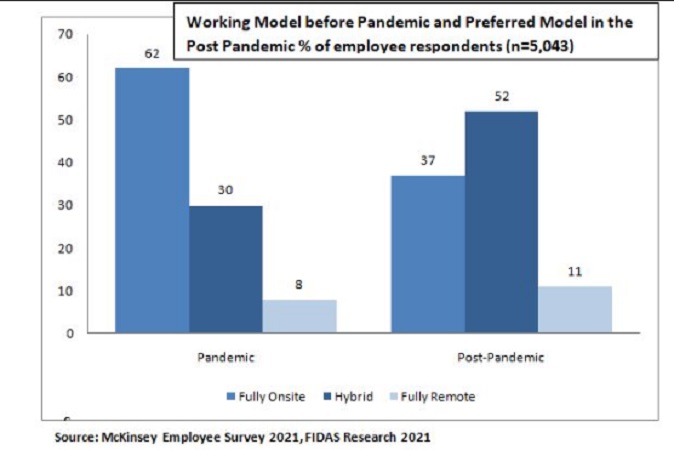
Thus, as ideas of ‘’telecommuting’’, ‘’remote working’’ and ‘’hybrid work rule’’ were unlocking new possibilities, many workers were seeking escape from the monotony of the 9hour conservative work rule and the limited opportunities it offered.

Essentially, as people were fast experiencing how interesting it was to take in more jobs and earn more money within the same 9 hours or less without having to leave the comfort of their homes and their loved ones, they were leaving their jobs in huge numbers in search for more money, more flexibility and more happiness. Many started to rethink what work meant to them, how they were valued and how they used their time.

This writer interviewed Femi Adekanbi, a full stack developer at a Fintech Startup in Nigeria on his perception about remote working and having flexible work hours. The interaction was quite revealing.

Femi disclosed he may have experienced the deepest feeling of productivity and career fulfilment while remote working during the lock down. Femi who lives with his family in the mainland of Lagos travels several kilometres to his work place in the Ireland every day. Due to the tedious traffic, sometimes he’d prefer to not go home after office hours but lodge in a hotel to brace for an important meeting or presentation at work the following morning. According to him, ‘’work life in Lagos is a hell’’.

‘’I’ve always described my job as a hell. But quite surprisingly, during the lockdown, I took in a couple of contract and part-time jobs in addition to my main job. And having more jobs not only meant more money and exposure, it was an escape from the usual monotony.

‘’Besides, working remotely presented the most relaxing atmosphere to work. And the company of my family was also a great source of motivation and relaxation. I learnt to deal with the distractions too. The new experience made me realize that the 8 to 5 thing is all a farce, so I had to quit for more flexible hours’’ Femi recounted.

However, it is ironic that up until this moment, many conservative entrepreneurs and managers would rather attribute employee attrition and turnover to employee disloyalty and search for better pay than subject the problem to structural analysis and system thinking. This kind of mindset does not offer opportunity to uncover a resilient system.

Therefore, African entrepreneurs and business owners are advised to be more open-minded in terms of their employees’ engagement in the Post-Covid era and they must constantly seek to adjust their business model to suit their current realities. Also, they should be willing to incorporate hybrid model and encourage flexible hours for their employees.

Wear Your Tekedia Institute T-Shirt; Hello The United Kingdom

0

Well done Tai Fadipe-Davids (B.Eng. MIET, MNSE, MBA). More and more people are wearing Tekedia Institute t-shirts. We have co-learners from 41 countries; more countries to go! Showcase your Tekedia heritage; we’re a temple for the mastery of entrepreneurial capitalism.  #Ready2Lead

Advance your career, take your business to the next level with Tekedia Mini-MBA here

Dangote Refinery to Reduce Nigeria’s Dependence on Imported Petroleum Products, Set to be Inaugurated on May 22, 2023

0

Dangote’s newly completed refinery which is located in the Lekki Free Trade Zone area of Lagos state, is said to reduce Nigeria’s dependence on imported petroleum products as it is set to be inaugurated on May 22, 2023.

The 650,000 barrels per day refinery, which is the world’s largest single-train refinery according to analysts, could save up $10 billion in foreign exchange (FX) and generate another $10 billion in exports when it begins operation.

While speaking during an interview with a special edition of London-based Economists Magazine, titled ‘The World Ahead 2023’, Aliko Dangote disclosed that as a major oil producer, Nigeria currently imports over 80 percent of its refined petroleum products, which amounted to roughly $10 billion in imports in 2022.

While this has impacted a lot of businesses in the country, Dangote notes that more prosperity could be created by locally refining Nigeria’s resources, with the newly completed refinery being a major step in the right direction to reduce the country’s high dependence on imported refined petroleum products. He added that the refinery will not only create direct and indirect jobs but also lead to skills transfer and technology acquisition opportunities that will benefit the downstream sector.

Speaking on how the refinery will stimulate the development of other industries, he said,

“The refinery’s production of critical products like naphtha and polypropylene will stimulate the development of other industries, such as cosmetics, plastics, and textiles. Refineries on this scale could save Nigeria up to $10 billion in foreign exchange and generate approximately $10 billion from exports.

“We see room for development of added value in agribusiness too. Here, initiatives like our Sugar Backward Integration Projects look to create a strong localized supply in the sugar industry. With a goal to produce around 0.5 million tons of sugar per annum from locally grown sugar cane, benefits will be created across the sugar value chain for local suppliers.”

Dangote stressed that Nigeria presents an attractive investment opportunity for international investors, saying with the country’s abundance of natural resources, diversifying and digitizing economy, youthful demographics, and vibrant society, investors will find Nigeria a country of many possibilities.

The soon-to-be-inaugurated Dangote refinery according to analysts is a huge relief to Nigerians and stakeholders who have long yearned for refineries in Nigeria to enhance the federal government efforts to make Nigeria self-sufficient in the refining of petroleum products which will save the scarce foreign exchange used for their importation.

Also, leading independent investment banking, securities trading, and investment management firm Chapel Hill Denham has expressed optimism on the soon-to-be-launched Dangote refinery after it disclosed that if fully utilized, it believes the refinery can redefine Nigeria’s domestic production of white products such as petrol, Automotive Gasoline Oil, AGO and Dual-Purpose Kerosene, DPK, and could potentially turn the country into a net exporter.

On completion, the refinery is expected to meet 100 percent of Nigeria’s requirement of all refined products and also have a surplus of each of these products for exports, thereby increasing the country’s revenue.