DD
MM
YYYY

PAGES

DD
MM
YYYY

spot_img

PAGES

Home Blog Page 4238

How Crypto Reacts to Changes on the Consumer Price Index

0

The Consumer Price Index (CPI) is a measure of the average change over time in the prices paid by urban consumers for a market basket of consumer goods and services. It is widely used as an indicator of inflation, which is the general increase in the prices of goods and services over time.

Inflation affects the purchasing power of money, meaning that a higher inflation rate reduces the value of money and erodes its ability to buy goods and services. This can have significant implications for the crypto industry, which is often seen as a hedge against inflation and a store of value.

One of the main reasons why some investors choose to invest in crypto is because they believe that crypto can protect their wealth from the effects of inflation. Unlike fiat currencies, which can be printed by central banks at will, most cryptocurrencies have a fixed or limited supply that cannot be manipulated by any authority. This makes them scarce and deflationary, meaning that their value tends to increase over time as demand outstrips supply.

However, the relationship between inflation and crypto is not so straightforward. There are several factors that can influence how crypto reacts to changes in the CPI, such as:

  • The expectations of investors: If investors expect a higher inflation rate in the future, they may shift their assets from fiat currencies to crypto, driving up the demand and price of crypto. Conversely, if investors expect a lower inflation rate in the future, they may shift their assets from crypto to fiat currencies, driving down the demand and price of crypto.

  • The actions of governments and central banks: If governments and central banks adopt policies to combat inflation, such as raising interest rates or tightening monetary supply, they may reduce the attractiveness of crypto as an alternative asset class. Higher interest rates can make fiat currencies more appealing to investors who seek higher returns, while tighter monetary supply can reduce the amount of liquidity available for crypto trading. On the other hand, if governments and central banks adopt.

One of the main implications of the CPI on the crypto industry is its impact on the interest rates. The interest rates are determined by the central banks based on the inflation expectations and the economic growth. When the CPI is higher than expected, it indicates that the inflation is rising faster than the target level, which may prompt the central banks to raise the interest rates to curb the inflation and cool down the economy. Higher interest rates make borrowing more expensive and reduce the money supply in the market, which can have a negative effect on the crypto industry.

Higher interest rates can lower the demand for crypto assets, as they increase the opportunity cost of holding them. Crypto assets are usually seen as alternative investments that offer higher returns than traditional assets, such as bonds, stocks, and real estate. However, when the interest rates rise, these traditional assets become more attractive and competitive, as they offer higher yields and lower risks. Therefore, some investors may shift their funds from crypto to traditional assets, which can cause a decline in the crypto prices.

Another implication of the CPI on the crypto industry is its influence on the exchange rates. The exchange rates are determined by the supply and demand of different currencies in the global market. When the CPI is higher than expected, it implies that the domestic currency is losing its purchasing power relative to other currencies, which may lead to a depreciation of the domestic currency. A depreciating currency can have a mixed effect on the crypto industry.

On one hand, a depreciating currency can increase the demand for crypto assets, as they can serve as a hedge against inflation and currency devaluation. Crypto assets are decentralized and independent of any government or central authority, which means they are not affected by inflation or monetary policies. Therefore, some investors may prefer to hold crypto assets rather than fiat currencies that are losing their value. This can boost the crypto prices and adoption.

On the other hand, a depreciating currency can also reduce the supply of crypto assets, as they become more expensive to produce and acquire. Crypto assets are usually created through a process called mining, which involves solving complex mathematical problems using specialized hardware and software. Mining requires a lot of electricity and other resources, which are denominated in fiat currencies. Therefore, when the domestic currency depreciates, it increases the cost of mining and reduces the profitability of miners. This can lead to a lower supply of crypto assets in the market.

In conclusion, the CPI has significant implications on the crypto industry, as it affects both
the demand and supply sides of the market. The CPI reflects the inflation rate and influences
the interest rates and exchange rates, which can have positive or negative effects on
the crypto prices and adoption. The CPI is usually released by the US Bureau of Labor Statistics around the 10-15th of each month, which can cause volatility and uncertainty in
the crypto market. Therefore, crypto investors should pay attention to
the CPI data and its potential impact on the crypto industry.


How to Uncover the Devils in Companies Before Investing in them

0

The continuous scramble for investment opportunities constitutes an essential characteristic of wealth oriented people. What business to invest in, when to invest and what portion of one’s capital should be earmarked for investment purposes are some of the general factors investors consider before investing their money. However, given the growing incidence of investment scam, a rational and experienced investor moves beyond these generic considerations to rummage the possible devils in the books, the process and the people of the company they decide to invest in.

As a prospective investor, you are required to carry out a number of background checks on the businesses you have in mind. It is often advised that you have more than one business for the background checks as this will give you an opportunity to weigh various options and select the most appropriate before investing your hard-earned money. In doing a background check, you have to look out for certain things which include the following:

History of the Company

The history of the company plays an important role while considering or planning on investing with the company. However, understanding the company’s history in the aspect of the company’s prioritized product and how they have been able to accomplish their projected returns in the past and also giving attention to their track record since their existence. This will give you an in-depth insight on the history of the company to avoid falling into the hands of fraudsters.

Location of the Business/Project

While identifying the physical existence of a business is almost the priority of most investors, the location or positioning of the business is often taken for granted. A successful and profitable business or project must be located in an optimal location with all necessary resources for its specific needs. You need to look out for the location of their projects and how suitable it is to accomplish their said goals and objectives.

Management Structure

You should also be conscious of how the business is managing its projects, peoples and products. A company without modern methodologies and techniques which could help in managing uncertainties effectively would likely default in paying the promised return on investment.

Capital Structure

The financial strength and records of a company invariably have a strong connection with the company’s ability to meet their financial obligation or commitment with their investor(s). Therefore, while reviewing the company’s financial records, you should pay attention to their past three years’ budgets and tax returns, a balance sheet, current accounts receivables, cash flow projections and profit and loss statements. Examine these to determine the business’s current net worth, its sales and expense trends and where the company’s strengths and weaknesses are.

Consult with Experts

In addition to working with your lawyer, you are advised to communicate with investment and financial analysts in the domain or industry you expect to invest. Being with one of the analysts is an opportunity to understand the type(s) of risk you are exposed to, and how it can be mitigated or completely avoided. To get secured with investment you have to communicate with people, ask questions, get acquainted with the company and also ask brilliant questions you might end up knowing what you didn’t know before.

Risk-Reward Analysis

As an investor, you should understand the possible risks the businesses are experiencing and how they are managing them towards sustainable growth or otherwise. In other words, assessing the relationship between risk and returns plays an important role in your investment decision. Most investors focus on the risk side of an investment but don’t assess the potential for and magnitude of returns. You need to know which of the projects or products being pushed to you by the businesses has a low or a high risk.

Conversely, the investment opportunities you may see most frequently are those with high risk and low returns. These are not the ones in which you are interested in investing. The investments in which you may be interested in investing are the ones where the rewards match the risk (low risk/low returns, high risk/high returns). Meanwhile, your ability to make an assessment of the risk/return profile is important in making successful investment decisions.

Resources

The Rules of Investing In Nigerian Agritech Business. 2021. FIDAS Africa. Available here

VC Firm Ascend Raises $25 Million Pre-Seed Fund to Invest in AI Startups

0
Fund, money cash dollar

Venture Capital firm Ascend has raised a $25 million pre-seed fund to invest in Artificial Intelligence (AI) startups.

The company’s pre-seed fund raising was led by seasoned startup operator and angel investor Kirby Winfield. With the new fund, Ascend is placing a bigger bet on artificial intelligence, joining other venture capital firms investing money into the growing sector boosted by recent generative AI advancements.

Founding General Partner at Ascend Kirby Winfield disclosed that the firm will invest in pre-seed AI and Machine learning (ML) companies largely based in the Pacific Northwest.

Speaking on investment in AI startups, Winfield said,

AI is having a platform-shift moment. It would be irresponsible not to double down. I would imagine that is probably another downward correction in valuations in the next year. We have become even more convicted around investing at pre-seed. This is where we want to play. We want to take more ownership at that stage. We have really found some conviction around our thesis”.

The fund raised in the pre-seed round was 100% from individuals and consists of two vehicles, one that raised $22.5 million and another that raised $2.5 million from existing portfolio company founders. Ascend CEO Windfield raised a majority of the new fund at the beginning of 2022, just before the startup funding dried up amid the tech downturn.

Speaking on his investments in AI startups, Wingfield said that he isn’t looking for AI companies to invest in, but instead is focused on startups that will utilize the tech to find a better solution to problems.

In his words, “AI doesn’t matter, what matters is the solution you are selling to your customers. Many founders and investors are getting wrapped around the axle and putting the technology and solution before the benefit”.

Winfield expects to invest in around 40 companies from the new fund, which will also target startups building e-commerce infrastructure and B2B software. It is interesting to note the AI industry has been poised to grow to an estimated $126 billion by 2025. Today, AI has become essential for an increasing number of businesses as remote work and reliance on technology are the new daily norm.

According to a survey conducted by Accenture last month, 63% of organizations are now prioritizing AI over all other digital technologies. The survey shows that more than half of companies are investing more than 5% of their digital budgets in AI. Sixty-three percent, meanwhile, say that they expect their investment to increase over the next three years.

Subsequently, generative AI startups are rapidly gaining traction, and venture capital investors are keen to capitalize on their potential. Investors this year have been pouring funds into companies specializing in generative AI systems that can create humanlike conversation, imagery and computer code.

Major tech companies such as Meta, Google, and Microsoft are investing heavily in generative AI research in hopes of achieving a breakthrough that would put them at the forefront of the race. 

The heat around AI deals has intensified so much that many investors are worried the startups will falter due to the pressure to deliver. Several investors have disclosed that startups raising seed rounds are pushing for valuations of tens of millions of dollars or more. Some companies are raising back-to-back rounds of funding. 

Analysts at research firm PitchBook predict that venture investment in generative AI companies will easily be several times last year’s level of $4.5 billion. 

The Twitter’s New Offense Is A Better Strategy for Its Survival

0

They taught us in economics that companies have to specialize and build core competencies. They need to do things really well, and be the best possible in the domains. But today, we think that does not make a lot of sense in the digital space.

For technology companies, everyone is doing everything, even at top-level. Alphabet, Google parent company, is a car company, a search company, a medical company, an advertising juggernaut, etc. Amazon.com is an e-commerce firm, a publisher, a movie producer, a drone maker, etc.

Today, Twitter is going after Skype, WhatsApp, etc even as Bluesky and others are coming after it: “Twitter CEO Elon Musk has announced new features that will allow users of the social media platform to make voice and video calls, marking a new entrant in the chat and instant messaging business.”

Elon Musk is playing offense, making it clear that he would not stay here frozen for his blue bird to be attacked and eaten alive. This is the new age: offense is the best defense and no company is safe. Meta (parent of WhatsApp and Facebook) will now have to update a line in its competition sheet, with a new company named Twitter!

Comment on Feed

Comment 1: In the tech industry, fierce competition is ubiquitous, and companies are always on the lookout for ways to distinguish themselves. As a result, new entrants are constantly disrupting the market, prompting established players to elevate their game and bring fresh ideas to the table. This perpetual cycle of innovation and adaptation ultimately culminates in users having the final say on which companies emerge victorious.

How China is Changing the Narrative of the Struggle for World Power

0

Since the cold war era, the global economy has been highly driven by western capitalism, and the United States of America has been the vanguard of the hegemony and the power dynamics of the increasing globalization. Before the second world-war, Americans such as, John D. Rockefeller, Andrew Carnegie, Cornelius Vanderbilt etc had characterised the American value and work ethic, creating the path for the next generation entrepreneurs to achieve incremental innovation.

However, in recent periods, much has been said about the imminent rupture of the American hegemony and the Western Capitalism largely due to the daunting acceleration of China which has been leading development from the Eastern part of the world. Over the last two decades, China has been seen to continuously demonstrate grit and innovate toward changing the narrative.

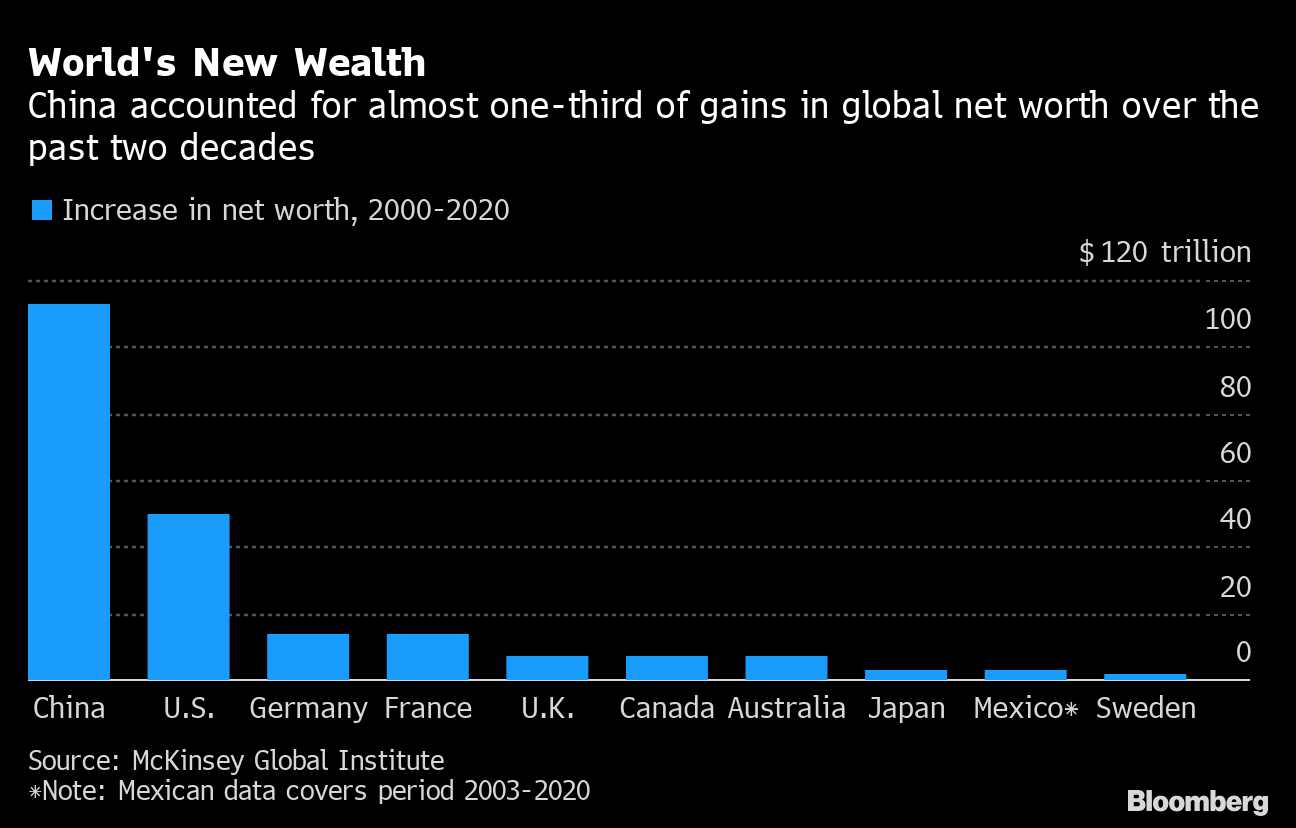
According to a 2021 McKinsey report, the global wealth more than tripled in the year 2020 rising to $514trillion from $156trillion in 2000. Over the course of this period, China has significantly advanced its economic strength to displace the US from the top spot worldwide after many years in 2020. The report shows the national balance sheets of ten countries (i.e. USA, China, Germany, France, UK, Japan, Sweden, Mexico, Canada, and Australia) which represent more than 60 percent of the world’s economies were analysed, and China emerged as accounting for almost one-third of the gains in the global net worth over the last 20 years.

‘’As net worth worldwide rose to $514trillion in 2020 from $156trillion in 2000, china wealth plunged to 120 trillion from 7 trillion in 2000 and the US experienced muted increase property prices but almost doubled its net worth to 90 trillion over the same period’’ McKinsey analysis as reported by Bloomberg reveals.

The report goes further to show that in the two biggest economies, USA and China, more than two-thirds of the wealth is concentrated in just 10 percent of the richest households

In another analysis, Yu Minhong, Chairman of New Oriental Education and Technology Group presents his view of the Chinese economic expansion which implies much of the great things that have been witnessed or said about China may represent only an insignificant achievement compared to what have yet to be discovered. According to him:

‘’…the upside is even greater. For the private sector in China only 10 percent of the potential has been tapped into. For thousands of years, businessmen were prevented from doing business. Now they are making up for the lost time with a vengeance, capitalizing on the size and quality of the workforce, China’s lower cost base and huge hunger for industrial consumption.’’