DD
MM
YYYY

PAGES

DD
MM
YYYY

spot_img

PAGES

Home Blog Page 4250

A Historical View of Ethnomethodology

2

Following Alfred Schutz’s phenomenological theories in the 1960s, the field of ethnomethodology was born. It could be suggested further that Erving Goffman, who was born in Alberta, Canada, on June 11, 1922, played an invaluable role in the establishment of the intellectual scheme. Owing to his stance on free thought, Goffman was regarded as a cult figure and an essential theorist in sociological theory (Williams, 1986).

In 1982, he passed away at the height of his popularity – as president-elect of the American Sociological Association. However, he was unable to deliver the Goffmanian presidential address due to his failing health. It is, indeed, challenging to fit Goffman’s theoretical perspective into a single sociological category because his distinctive orientation was derived from a variety of sources (Ritzer, 2011).

In spite being taught by Symbolic Interactionists, Collins (1986) and Williams (1986) linked Goffman more with the field of social anthropology in a bid to categorize him. To support their position, Collins studied an earlier paper done by Goffman and found that social anthropologists were cited more often than symbolic interactionists. Nevertheless, the Goffmanian perspective was inspired by the descriptive studies conducted at Chicago, which combined their point of view with that of social anthropological research to create his distinctive perspective.

A symbolic interactionist, for instance, might examine how people construct or negotiate their self-images, whereas Goffman was interested in how society compelled people to present themselves in a certain way, ultimately leading to their being inconsistent, untruthful, and dishonourable (Collins, 1986:107). Despite having a different viewpoint, Goffman had a significant impact on symbolic interactionism.

The phrase “civil inattention” was first used by Goffman, and it refers to an experience we all have on a daily basis. As an illustration, commuters regularly congregate at different time interval, every day, to go from the parking lot of the University of Ibadan (first gate) to various places on campus. When necessary, some people will nod, smile, or establish eye contact as a sign of mutual goodwill. However, some people will act differently than expected, disembarking when they arrive at their bus stops to begin their various tasks.

These activities, which Erving Goffman refers to as civil inattention, were of fundamental significance to the social life of the University system. The exchange of greetings and other small talk are largely unconscious. Like when someone briefly glances at another person before turning their gaze elsewhere. Giddens and Sutton (2013) contend that this civil inattention is distinct from ignoring another individual and should not be interpreted in the same way. However, why should sociologists be interested in such trivial aspects of behaviour? The practise of acknowledging others’ existence while avoiding overt gestures (Goffman, 1967; 1971). All of these tasks are done by us every day without a second thought. The fact that we do not have to take into account our everyday activities, however, does not mean that they are not subject to sociological analysis (Giddens & Sutton, 2013).

I believe, we can all relate to this concept of civil inattention; in fact, Alfred Schutz (1899–1959) saw it as the fundamental beginning point for phenomenology, the study of how people come to have that attitude of taking things for granted and how it is reflected in social interaction. The interaction between people is one of the most fascinating or absorbing topics in sociology, far from it being uninteresting. The majority of social experiences involve talk – casual verbal exchange – carried out in conversation with others, although we frequently use non-verbal cues in our own behaviour and in understanding the behaviour of others. Language has always been acknowledged by sociologists, particularly symbolic interactionists, as being essential to social life (Giddens & Sutton, 2013).

But in the latter half of the 1960s, a method was developed that pays close attention to how people use language in regular settings of daily life and how this usage generates social order. An ethnomethodologist investigates the social interaction mechanisms that give rise to this social order. According to Haralambos, Holborn, Chapman, and Moore (2013), social order is only an apparent order created by individuals of an ecosystem. Thus social life only seems organized to society’s members because they actively participated in making meaning of it.

Much like many other people who came of age during the Great Depression and later World War II, Harold Garfinkel had to go through a difficult process to join the field of sociology. He was born on October 29, 1917, to a small merchant in Newark, New Jersey. Even though his father advised him to seek a trade, Garfinkel wanted to go to college. Several different social theories were presented to Harold Garfinkel, but most notably the writings of phenomenologists (Ritzer, 2011). As one of Alfred Schutz’ student, Harold Garfinkel, was known to have coined the term “ethnomethodology” (Giddens & Sutton, 2013), ascribing its origin to his research on the jury’s members in 1954 (Garfinkel, 1974).

His intention was to outline the logical strategies jury members use to present themselves in a jury chamber as a jury. Garfinkel (1984) asserts that these methods support the social order of serving as a juror for the jury members as well as for academics, researchers, and other interested parties in that particular social context. It is interesting to note that Talcott Parsons also taught Garfinkel; as a result, this ostensibly novel body of knowledge was oriented in a way that combined Schutzian and Parsonsian ideas.

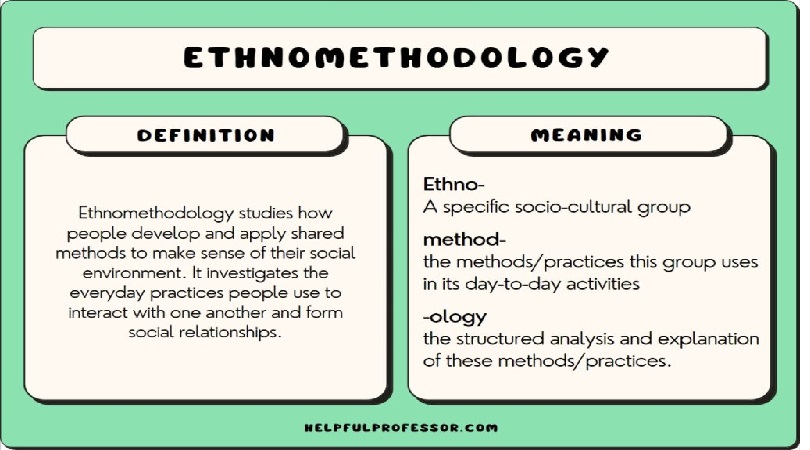
In its basic form, the word “ethnomethodology” refers to the cultural practices employed by locals (constituents of a specific society) to create their social universe. However, by reviewing the founders’ viewpoint, Garfinkel (1988; 1991), we can delve deeper into the essence of ethnomethodology. Garfinkel, like Emile Durkheim, views “social facts” as a crucial sociological occurrence (Hilbert, 2005). But Garfinkel’s sociological findings diverge significantly from Durkheim’s.

According to Durkheim, social facts are external to and coercive of individuals. To put it another way, social realities are imposed on people from without. People who embrace this focus frequently believe that actors are constrained or determined by societal structures and institutions and have little to no ability to make independent decisions. In the sarcastic language of ethnomethodologists, these sociologists frequently refer to actors or individuals as “judgmental dopes” or “cultural dopes” – the man in the sociologist’s society who merely enacts the prescribed behaviours dictated by their society’s culture. The objectivity of social facts, however, is treated by ethnomethodology as members’ achievements (Ritzer, 2011; Haralambos et al., 2013).

These members are not considered independently, but rather “strictly and solely, in their collective membership activities – the artistic processes by which they create what’s for them, which includes small-scale interpersonal or interactional structure and large-scale organisational structure” (Hilbert, 1992:193). The organisation of everyday life, or as Garfinkel (1988:104) puts it, “immortal, ordinary society,” is still a concern in ethnomethodology despite its primary micro orientation to actors and their action and behaviour. In conclusion, ethnomethodologists are more interested in the artistic practises that give rise to both macro and micro structures rather than either one being of particular interest to them.

In order to address the traditional concern of sociology with objective structures, both micro and macro, Garfinkel and the ethnomethodologists have looked for novel approaches (Maynard & Clayman, 1991). In light of this, ethnomethodology is the study of “the body of common knowledge and the variety of procedures and considerations [the techniques] by which the ordinary members of society make sense of, find their way around, and act on the circumstances in which they find themselves” (Heritage, 1984:4). A good example would be the common or casual approaches people use to interpret the actions and, more specifically, the speech, of others. But in order to understand what was said in a discussion, it is wise to be aware of the social context.

These implicit expectations include how a typical discussion is structured. For instance, understanding when to speak and when to remain silent, what to assume without explicitly saying it, and other situations (Giddens & Sutton, 2013). Our ability to continue existing depends heavily on our ability to pretend we are unaware of what is being said and why. In Garfinkel’s view, this sharing of unstated assumptions gives our daily lives stability and meaning. Meaningful dialogue would be very difficult if we were unable to accept these as givens. Any query or comment would have to be followed by a significant “search procedure” of a similar kind. Thus, what initially appeared to be unimportant conventions for talking right now reveal themselves to be essential to the very foundation of social life, which is why their violation is so severe.

REFERENCES

Collins, R. 1986. Is 1980s sociology in the doldrums? American Journal of Sociology 91: 1336-1355.

Garfinkel, H. 1974. The origins of the term ethnomethodology. In R. Turner (ed.). Ethnomethodology Harmondsworth: Penguin. 15-18

Garfinkel, H. 1984. Studies in ethnomethodology. Cambridge: Polity Press.

Garfinkel, H. 1988. “Evidence for locally produced, naturally accountable phenomena of order, logic, reason, meaning, method, etc., in and as of the essential quiddity of immortal ordinary society (I of IV): an announcement of studies.” Sociological Theory 6:103-109.

Garfinkel, H. 1991. “Respecification: evidence for locally produced, naturally accountable phenomena of order, logic, reason, meaning, method, etc., in and as of the essential haecceity of immortal ordinary society (I): an announcement of studies.” In G. Button (ed.). Ethnomethodology and the Human Sciences Cambridge, England: Cambridge University Press. 10-19

Giddens, A. & Sutton, P. W. 2013. Sociology. 7th ed. Hoboken, New Jersey: John Wiley & Sons, Inc. 317-319

Goffman, E. 1967. Interaction ritual. New York: Doubleday/Anchor.

Goffman, E. 1971. Relations in public: microstudies of the public order. London: Allen Lane.

Haralambos, M., Holborn, M., Chapman, S., & Moore, S. 2013. Sociology themes and perspectives. 8th ed. London: HarperCollinsPublishers Limited. 982

Heritage, J. 1984. Garfinkel and ethnomethodology. Cambridge, England: Polity Press.

Hilbert, R. A. 1992. The Classical Roots of Ethnomethodology: Durkheim, Weber and Garfinkel. Chapel Hill: University of North Carolina Press.

Hilbert, R. A. 2005. Ethnomethodology. In G. Ritzer (ed.). Encyclopedia of Social Theory Thousand Oaks, California: Sage. 252-257

Maynard, D. W. & Clayman, S. E. 1991. The Diversity of Ethnomethodology. Annual Review of Sociology 17: 385-418.

Ritzer, G. 2011. Sociology theory. 8th ed. New York: McGraw-Hill.

Williams, S. J. 1986. Appraising Goffman. British Journal of Sociology 37:348-369.

A 2023 Price Prediction For Uniswap (UNI), Collateral Network (COLT) and Litecoin (LTC) – Which Crypto Will Pump?

0

The positive momentum that the crypto market saw after the collapse of Signature and Silicon Valley Banks is slowly dying down, with coins such as Uniswap (UNI) and Litecoin (LTC) showing red charts. But, as they have lost some ground, others have gained it, and today we will discuss one in particular, Collateral Network (COLT), the first crypto-challenger lender in stage 1 of its presale that could bring holders 35x the gains. Let’s compare all three cryptos and see what’s in store for them in 2023.

>>BUY COLT TOKENS NOW<<

Uniswap (UNI)

According to a recent Uniswap (UNI) tweet, 92% of all Arbitrum (ARB) holders chose Uniswap (UNI) over other DEXs to swap their given tokens. With this data in mind, it is evident that Uniswap (UNI) remains desirable for plenty of users in the crypto sphere.

Nevertheless, the Uniswap (UNI) token price still leaves much to be desired as it now trades for $6.01, a fall in the past 24 hours. On a positive note, the number of active addresses utilizing Uniswap (UNI) has increased recently, as per data from Santiment.

Analysts remain bullish for Uniswap (UNI) as they forecast a rise to $8.12 by December 2023. However, Uniswap (UNI) holders are searching for new projects with long-term growth potential.

>>BUY COLT TOKENS NOW<<

Litecoin (LTC)

The hashrate for Litecoin (LTC) has recently hit a new all-time high of 891.39 TH/s. This is a great technological accomplishment for Litecoin (LTC) as the second-oldest crypto continues improving its network.

But, the Litecoin (LTC) coin has not been performing up to par as it now has a value of $92.49, down in the last day alone. Moreover, the Litecoin (LTC) technical analysis also shows a bearish pattern forming with all Litecoin (LTC) technical indicators and moving averages displaying strong sell signals.

Looking on the bright side, the Litecoin (LTC) trading volume has increased in the past 24 hours and now sits at $587,173,157. Bullish experts foresee Litecoin (LTC) rising to $112.82 by 2023.

Collateral Network (COLT)

Collateral Network (COLT) will revolutionize the pawnbroking industry by creating the first blockchain-based peer-to-peer lending platform where borrowers may unlock liquidity from physical assets. Lenders can also receive fixed income simply from .

fractionalized NFT-based lending. 

Let’s paint the picture – you require a loan of a sum of money but are also an owner who  possesses valuable tangible assets such as a watch, art or even cars. You can use one such asset as collateral by taking it to Collateral Network (COLT), which will mint an NFT representing the physical version of that item, resulting in it being 100% asset-backed, store it on-chain, fractionalize it, and then allow anyone to become mini banks as they buy portions of this NFT for a predetermined weekly interest rate. This process, called fractional lending by the Collateral Network (COLT) team, has never been done before and ensures that both lenders and borrowers can earn from the process.

Worried about safety? Collateral Network (COLT) will lock its liquidity pool for 33 years and team tokens for 2. Additionally, an audit has already been performed on the token smart contract – meaning that Collateral Network (COLT) could be one of the safest investment prospects available.

The Collateral Network (COLT) platform will be powered by its native token, COLT, now available for only $0.01. You will receive a 50% deposit bonus, staking rewards, and more for this price – excellent value. But hurry, COLT has plans to list on Uniswap (UNI) in stage 2 of its presale, and the value of Collateral Network (COLT) could soar by 100x.

Follow the links below and purchase a potential blue-chip token that some analysts predict could reach $0.35 in the next six months.


Find out more about the Collateral Network presale here:

Website: https://www.collateralnetwork.io/

Presale: https://app.collateralnetwork.io/register

Telegram: https://t.me/collateralnwk

Twitter: https://twitter.com/Collateralnwk

How has crypto industry affected gambling?

0

In recent years, the gambling industry has been significantly impacted by the cryptocurrency industry. As a means of payment for online gambling sites, cryptocurrencies like Bitcoin and Ethereum have grown in popularity. The blockchain technology that powers cryptocurrencies has the potential to completely transform the market. In this article, we’ll look at how the cryptocurrency sector has impacted the gambling sector and what the future may hold for both.

Prior to anything else, it’s crucial to comprehend what cryptocurrencies are and how they operate. Cryptography is used by cryptocurrencies to secure and verify transactions, as well as to regulate the creation of new units.Digital or virtual tokens are called cryptocurrencies. Cryptocurrencies, as opposed to conventional money like the US dollar or the Euro, are decentralized and not issued by a single entity. As a result, they can be transferred directly between people without the need for a middleman like a bank and are not under the control of any governmental or financial institution.

Many benefits exist for both players and operators when cryptocurrencies are used in the gambling sector. Because transactions are encrypted and don’t require sharing personal information, cryptocurrencies provide players with anonymity and security. This is crucial because it enables players in nations where online gambling is prohibited to gamble without worrying about being found out or facing legal repercussions. Moreover, compared to conventional payment methods, cryptocurrencies provide quicker transaction times and lower transaction costs, making it easier for users to fund their accounts at gambling websites and withdraw their winnings. Despite the advantages of cryptocurrencies, regular online slots, such as wild shark, are still very popular.

The use of cryptocurrencies has a number of advantages for gambling operators as well. Since cryptocurrencies aren’t linked to any one nation or jurisdiction, it enables them to provide their services to players everywhere. Additionally, it enables operators to process transactions more quickly and avoid the high fees linked to conventional payment methods, leading to improved efficiency and cost savings. Last but not least, the use of cryptocurrencies enables operators to provide provably fair games, in which the results are decided by blockchain technology, are transparent, and cannot be altered.

Cryptocurrencies have a lot to offer the gambling industry, but there are also a lot of risks and difficulties that come with using them. The absence of oversight and regulation in the cryptocurrency sector is one of the major problems because it can result in fraud and scams. Additionally, because cryptocurrencies’ value can quickly fluctuate, resulting in losses or gains in value, this can put players and operators at risk. Finally, due to the anonymity of cryptocurrencies, it may be challenging for operators to confirm that their clients are of legal gambling age and are not engaged in money laundering or other illegal activities.

Despite these difficulties, it is anticipated that in the upcoming years, cryptocurrency use in the gambling sector will only increase. More gambling sites are probably going to accept cryptocurrencies as payment as more people become aware of them and their advantages. Additionally, new gambling platforms and games that are more transparent, secure, and fair are probably going to be made as a result of the development of blockchain technology.

Finally, it can be said that the cryptocurrency sector has recently had a big impact on the gambling sector, and this development is likely to continue. Anonymity, security, quicker transaction times, and lower fees are just a few of the advantages of using cryptocurrencies in the gambling sector. However, their use also comes with a number of risks and difficulties, such as volatility, anonymity, and a lack of oversight and regulation. Despite these difficulties, the adoption of cryptocurrencies in the gambling sector is anticipated to increase as more people become familiar with them and as blockchain technology advances. It’s crucial to gamble responsibly and be aware of the risks when engaging in any type of gambling.

Decentralization of Financial Transactions: Can Signuptoken.com, Stellar, and XRP Delineate Crypto Verse?

0

Since the year 2009, the world has witnessed a drastic shift from traditional currencies to digital ones – popularly known as cryptocurrencies. The advent of Bitcoin marked the beginning of a new era of decentralized digital currencies.

For starters, cryptocurrency is a digital asset designed to work as a medium of exchange which uses cryptography to secure and verify transactions and to control the creation of new units.

Unlike traditional currencies, this new one operates independently of a central bank and is decentralized; irrespective of a central controlling authority. However, this anonymity of transactions leaves room for many people to question the security of this digital age currency.

Thus, it becomes essential for us to examine this view before diving head-first into this opportunistic investment realm.

Decentralization has indeed been a buzzword in the financial industry but before you question its reliability, read this out!

Now it might come as a surprise but decentralization of financial transactions enhances security in reality. Rather than putting the authority in the hands of a single unit, decentralization distributes power and decision-making among the network, storing the transaction records on a network of computers rather than in a single place.

This drastically reduces the risk of fraud and hacking since the distributed ledger technology makes the records less sacred. Now that this concern is winded down, let’s set you up for crypto success!

Currently, three cryptos are doing rounds in the crypto market, namely Signuptoken.com, Stellar (XLM), and Ripple (XRP). Let’s find out more about these cryptos and why they are the must-have digital currencies in your crypto wallet! 

Stellar – The Crypto Star

Stellar (XLM) is an open-source, decentralized blockchain network that was created in the year 2014. Its primary aim is to make transactions faster, more secure, and cost-effective.

True to its aim, Stellar works at a lightning speed and each transaction takes only about 3-5 seconds to process!

Stellar’s native currency is Lumens (XLM) and currently, in an extremely bearish market, XLM is one of the few cryptos that are showing drastic gains.

In the last seven days, XLM registered 21.5% gains which are massive as compared to the crashing conditions of the market.

This depicts that Stellar truly has a bright future in the crypto market! 

XRP – The Ripple That’s Creating Ripples

Similar to Stellar, XRP is also a crypto that was designed to resolve the issues of slow transactions.

This crypto made its debut in the year 2012 and since then, it has successfully managed to make its way to the chart of the top cryptos.

Its technology uses a consensus algorithm to validate transactions which allow faster and more secure transactions.

Similar to the former, this crypto is also doing exceptionally well in the bearish crypto market by registering bullish gains.

In the last seven days, this heroic crypto has managed to register 24.17% gains! 

Signuptoken.com – Leading the Start of a New Era 

If you are bedazzled with the phenomenon of cryptos but are afraid of financial losses, you’re in for a treat!

Signuptoken.com is the new game changer in the crypto ecosystem. It is providing a unique opportunity for anyone to become a millionaire by simply signing up – yep, you read it just right!

No prepayment, no presale frenzy, no unnecessary madness – just an eye on financial gains.

By simply signing up with your email, you can become a part of the millionaire community and gain massive financial gains!

The platform’s marketing tactics are pretty unique and intriguing and have gained a lot of traction, making it a hot topic in the crypto ecosystem.

What makes Signuptoken.com distinctive from other cryptos is that it doesn’t ask for any sort of upfront investment/payment to become a part of its community.

The token is currently gearing up in silence to launch and intends to launch as soon as it reaches the target of one million signups.

The best part is that the people who sign up during the current period will be the only ones to have access to the information regarding the official launch!

So, what are you waiting for? Don’t waste this opportunity and instantly sign up using your email at Signuptoken.com before time runs out!


For More Info on Signuptoken.com:

Website: https://www.signuptoken.com

Twitter: https://twitter.com/_SignUpToken_

Telegram: https://t.me/SignUpToken

What Does 2023 Hold For NFTs? Big Eyes Coin’s BULLRUN250 Bonus Code & NFT Collection Launch Could Mean A Potential Bull Market

0
A woman looks at a NFT by Mad Dog Jones titled "SHIFT//" during a media preview on June 4, 2021, at Sotheby's for the Natively Digital: A Curated NFT Sale Online Auction to take place June 10, 2021. - They are technology enthusiasts on the hunt for opportunities in the Wild West market surrounding NFTs: the popular certified digital objects that have spawned a new generation of collectors convinced of their huge potential. (Photo by TIMOTHY A. CLARY / AFP) / RESTRICTED TO EDITORIAL USE - MANDATORY MENTION OF THE ARTIST UPON PUBLICATION - TO ILLUSTRATE THE EVENT AS SPECIFIED IN THE CAPTION

The cryptocurrency industry suffered a major setback in 2022 due to the bear market and the NFT market was no exception. It resulted in a sharp decline in sales, the departure of key figures, and a reluctance by consumer brands to introduce their non-fungible products. However, the new year has brought some hope for the industry.

The $32 billion FTX crash in November 2022 severely impacted and set the tone for downward momentum across the industry. But since the beginning of 2023, investors have found new hope as Bitcoin (BTC) and Ethereum (ETH) have surged by approximately 70%. In addition, the NFT market has also witnessed a jump in trend with data from January showing that global NFT sales volume had increased by 43%.

Despite the bear market in 2022, the NFT market has shown resilience, and the trend is not expected to continue. The new year has brought renewed hope to the industry, and investors are anticipating a positive outlook for NFTs in 2023.

Big Eyes Coin (BIG), having recognized the potential and impact NFTs have on the industry, is one of the best examples of a meme token that is building a blockchain ecosystem that self-propagates for hyper-growth using NFTs.

The Power Of NFTs In Cryptocurrency

Non-Fungible Tokens have been around in the cryptocurrency industry since 2014 and are defined as digital assets that can come in the form of art, music, in-game items, videos, and more. They are bought and sold online, often with cryptocurrency, and are generally encoded with the same underlying software as many cryptos.

As is the case of cryptocurrency as a whole, NFTs too are gaining notoriety now because they are becoming an increasingly popular way to buy and sell digital artwork. In 2021 the NFT market was worth an estimated staggering $41 billion, an amount that could perhaps be the total value of the entire global fine art market. NFTs exist on a blockchain and are typically held on the Ethereum blockchain, although other blockchains support them as well. An NFT is created, or “minted” from digital objects that represent both tangible and intangible items.

Big Eyes Coin – NFT Collection Ahead Of Live Launch

Big Eyes Coin (BIG) is an ERC-20 meme token created on the Ethereum network and since its presale launch, the token has garnered a lot of attention from meme coin enthusiasts, particularly among those who are fond of cats in the crypto industry.

The primary objective of Big Eyes Coin is to move its community’s wealth into the Decentralized Finance (DeFi) ecosystem. And in its latest initiative, the project is rewarding its loyal customers with a new range of Non-Fungible Tokens (NFTs) that can be minted on the Ethereum blockchain. These NFTs can be obtained by opening Loot boxes, which contain custom and unique cards that can be minted as NFTs. Additionally, users will also receive BIG tokens upon opening the Loot boxes. Each card can only be minted once, making them a valuable and exclusive addition to any collection.

The NFT collection will be listed on Opensea, an Ethereum-based NFT market. The minting cost for each NFT is 0.05 ETH, which is a reasonable price for collectors and traders on the platform.

The presale of the meme token is in its final stages and has so far raised $32.92 million in presale tokens. During this stage, the project has a bonus code, ‘BULLRUN250,’ which provides users with a massive 250% bonus on top of a BIG token or Loot Boxes purchase.

Big Eyes Coin’s Loot Boxes is an ongoing gaming feature that offers users a maximum return of 5000%. The feature comprises five different loot boxes, namely Saver Tin, Cute Box, Kitty Vault, Super Saiyan Box, and Excali-Paw Master Chest. Each box can be opened for a specific price ranging from $10 to $10,000. Buyers have to spin the loot box of their choice for a maximum prize of $500 to $1,000,000 worth of BIG tokens. However, even if a loot box does not result in any prize, the buyer is guaranteed to receive back money staked at a minimum.

NFTs are essentially like physical collector’s items, only digital and Big Eyes Coin has created a unique community that has attracted many crypto enthusiasts with its focus on DeFi and creative NFT offerings. The project’s ongoing Loot Boxes feature is an exciting opportunity for collectors and traders to participate in the BIG token ecosystem while potentially earning substantial returns.


Find out more about Big Eyes Coin (BIG):

Presale: https://buy.bigeyes.space/

Website: https://bigeyes.space/

Telegram: https://t.me/BIGEYESOFFICIAL