DD
MM
YYYY

PAGES

DD
MM
YYYY

spot_img

PAGES

Home Blog Page 4304

Elon Musk: The Master of the Physics of Pricing – And Winning With It

1

Another price cut by Tesla: “Tesla has slashed the prices of all of its electric vehicles in the U.S. for the fifth time this year, Reuters reports, as it tries to woo new drivers. The biggest price cuts went to its most expensive but slowest-selling models..” But look deeper, pricing is Elon Musk’s finest skill in business.

Tesla pioneered new pricing models, making selling cars to mirror the ways the world sells software. They have this business model where a buyer of your car must call Tesla to acquire new “licenses'” since the ones you have are not transferable.

More so, if you want more “capacity” in that car, you can send more money to Tesla and they will add more. If you check it, Tesla has a Basic Plan, Premium Plan and Enterprise Plan – and it is a car company. But if you open the books, that is how you price software.

People, the main reason why Tesla is valued more than most companies in the world combined is because of pricing innovation, not just the engineering feats! It makes selling cars look like selling software. Because of that, investors give it the same multiples as software companies because every car produced by Tesla will keep earning money until it is moved to landfill. No other car brand can say that at scale. So, when it is playing with cuts, do not think it is coming from the angle of pure weakness.

Of course, if Musk succeeds in the new pricing model he is pioneering in the social media world through subscriptions in Twitter, that would be another big one. The blue tick is no more free and if that works, expect Facebook, Instagram and others to copy it at scale. LinkedIn does not give ticks that much and it may not even have to do that. But my point is this: Elon Musk is using Pricing Strategies to Win in markets.

Tesla has slashed the prices of all of its electric vehicles in the U.S. for the fifth time this year, Reuters reports, as it tries to woo new drivers. The biggest price cuts went to its most expensive but slowest-selling models, the S sedan and the X SUV, which were reduced $5,000; it’s bestselling Y crossover SUV was cut by $2,000; and the 3 compact sedan was reduced $1,000. Some analysts have expressed concerns that the price cuts will eat into Tesla’s healthy profit margin.

Innovation does not end in engineering; pricing innovation could be catalytic.

Comment on Feed

Comment (inmail): Interesting article – aren’t around 84% of new autos financed in the USA? How are the USA based Auto funders reacting to the large pricing movements? In the U.K. the sudden discounting has materially impacted the residual value of the vehicles.

Tesla has reduced the vehicles by a similar value in GBP to $. But the lease value has barely moved (ie not dropped) as the funders have seen the residual value move by a similar amount – this doesn’t yet look like pricing mastery.

How is the used market for Tesla in the USA – the used market in the U.K. is not really supported in the same way as over OEMs meaning that they are not yet an attractive used buy in the U.K. as the servicing cost is much higher than the other OEMs.

It’s not yet looking like pricing mastery in the U.K. – how did you think it will evolve?

My Response: Tesla has limited choices right now because its products are largely expensive. It is not doing this in the position of strength. Yet, since Wall Street has focused on the number of vehicles shipped or sold to value the worth of the company, it can do this and get away with it. The core playbook is to increase volume even if the margin drops.

Tesla will lose a huge market cap if investors think no one wants to buy its cars. So, to avoid that, it has to make sure it can sell, and then can use inflation to explain margin challenges.

On the second hand value issue, that is for current owners, not for NEW owners who are getting better deals to drive Tesla. More so, by absorbing this margin hit, it forces Ford, GM, etc who are unveiling EVs to struggle to differentiate on price. Many people who did not consider Tesla in Dec for an EV, will not put it there.

EV will become a commoditized class in years. Tesla will use pricing to compete. Tesla is not built for the used market. Most drivers will like to have the new thing since relatively most Tesla owners have more cash to spare.

What Tesla could do is to buy these used vehicles via trade-in and open new markets in Africa and LatAm where it can get a premium. But for price conscious second hand buyers, I do not see that evolving at scale in the US.

Comment 1RIt will be interesting to see how it plays out….

I guess the issue though could be that no one will want to finance Tesla’s as the RV becomes too unpredictable, which becomes a problem for them if 84% of the USA auto market is financed (similar in the U.K.).

If Tesla is not managing and considering it’s used values or providing market aligned pricing for its servicing (this makes it high risk for anyone offering residual value based pricing) which in the U.K. is the vast majority of the new car retail finance market.

So this quickly becomes a problem for the new car buyer wanting to sell their car or for the funder taking the RV risk – the new and used car market are very closely aligned. I am not sure an OEM can just think about the new market and ignore what happens in the used market (for any period of time)

Ie Will the new car market for Tesla be sustainable if they can’t be sold at a value comparable in percentage depreciation terms to its peers?

A 3 year old Tesla Model S has a residual value of c £30k – is there is a market for this value of car in the markets you suggest?

Ps There was a really interesting article in the FT on Tesla’s problems in China – I suspect it will be the Chinese OEMs that give Tesla the biggest headache in the future

“Tesla’s price war in China backfires as BYD sales surge” on 28 March

My Response: Tesla’s moat is not forever. Very soon, this market will become a commoditized one.

Sui, Aptos, and Linera: Who will be the first dark horse on Layer 1

0

Diem is a blockchain-based licensed stable coin payment system As a crypto project launched by social giant Meta, Diem has attracted attention since its debut.

The market has placed high expectations on Diem and believes its launch will change the world’ s payments landscape. Social media, e-commerce, ride-sharing, music, travel, payments and other supergiants, such as Visa, Uber, eBay, Spotify, Coinbase and others, have become Diem’s partners.

But the project provoked strong opposition from government regulators in the EU, the US and other countries based on issues of monetary sovereignty, financial stability, privacy and anti-monopoly. Diem, which was due to be released in 2020, was renamed, suspended and finally retired at the end of January.

But Diem left behind a number of important technical “legacies”, the most important of which is its design of a new programming language, Move.

The Programming language — — Move

Move is a rust-based programming language originally developed by Facebook for the Diem blockchain. Currently, Move’s Github code base is mainly managed by Mysten Labs. Aptos and Sui team members are also the core development team of Move.Move wants to be the Javascript of Web3, enabling more developers to quickly build blockchain products.

While Three protocols under review is promising not to use any Diem IP owned by Silvergate in building the blockchain, comparing Diem’s white paper, you will find that the three public chain projects, Sui, Aptos and Linera, inherit some aspects of the development language or technical logic.

Next, we will compare the development progress and technical highlights of these three public chain projects.

1. Sui/Mysten Labs

Sui’s development team came from Mysten Labs, the founding team includes Evan Cheng, Adeniyi Abiodun, Sam Blackshear, George Danezis, and Kostas Kryptos, all of whom worked on Novi and Diem projects at Meta. Among them, CEO Evan Cheng served as Director of Engineering and Technology for the development of the Meta blockchain from 2018 until September of this year.

Last December, Mysten Labs received $36 million in a funding round led by a16z, with participation from Coinbase Ventures, NFX, Slow Ventures, Scribble Ventures, Samsung NEXT, Lux Capital, and others.

In May, Mysten Labs released its first test network Sui DevNet and the token economics model, announcing that it would launch a total of 10 billion Sui tokens.

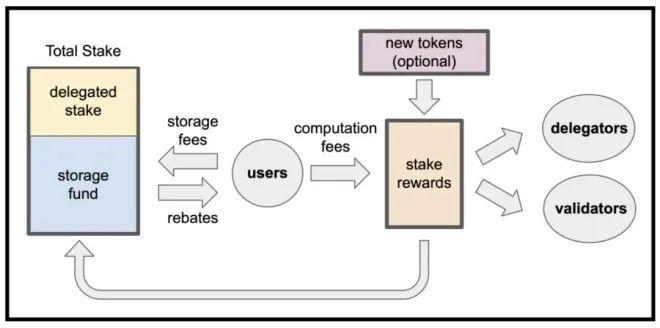
The network economic model of Sui

In July, Mysten Labs was seeking to raise at least $200 million in Series B funding at a $2 billion valuation, led by FTX Ventures, which has already raised $140 million in that round.

At present, Sui Network has launched two encrypted wallets for testing: Sui Wallet, an official Chrome plug-in Wallet, and Ethos Wallet, a third-party wallet that allows users to experience the Sui Network for transferring and casting NFTs. Sui will launch the motivation test network in August.

The key to Sui performance is transaction Parallelization. In most blockchains, transactions must be ordered and placed in blocks for sequential execution. Sequential execution unnecessarily limits throughput on these chains, since most transactions are independent of each other. Because Sui requires the subordination of the transaction to be explicitly stated, it is able to process them in conjunction with each other. In cases where a few transactions are intertwined, Sui can still sort them and execute them sequentially.

In terms of technology, Sui uses Move language to realize smart contract, ensuring standardization and security. In terms of consensus protocol, Sui uses BFT consensus for affiliated transactions and uses Byzantine broadcast algorithm for parallel verification of independent transactions. Therefore, high TPS is guaranteed while communication between nodes is reduced to achieve extremely low latency. Simple transactions can be verified immediately, and complex transactions take less than 3 seconds.

2. Aptos

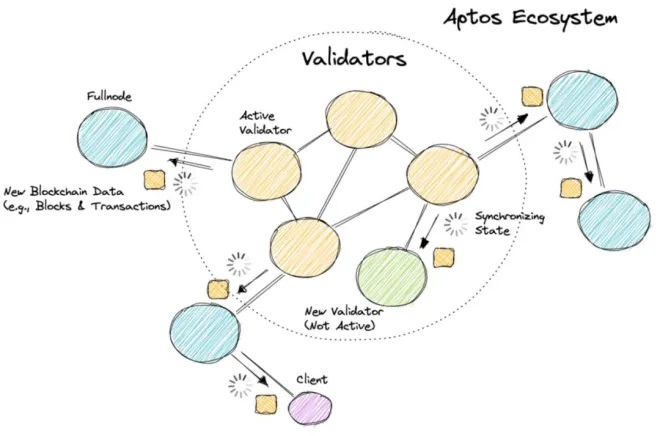
Aptos is the fastest growing public chain of the three in terms of development progress and the start of the ecosystem. Technically, Aptos also uses the Byzantine Fault Tolerance (BFT) consensus protocol and the Move programming language to build a more scalable blockchain.

Source: Aptos Blog

In March, 2022, Aptos closed a $200 million round of funding led by A16Z, Tiger Global, Katie Haun, Multicoin Capital, Three Arrows Capital, FTX Ventures, Coinbase Ventures and other prominent VCs. Since then, Binance Labs has announced an investment in Aptos Labs. Payment giant PayPal also said it was involved in the venture, which is PayPal Ventures’ first Layer1 public chain project.

In May, Aptos launched its Incentive Test Net registration. The Incentive Test network has four rounds in Aptos roadmap and is currently in the second aIT-2 pledge testing phase.

In a blog post, Aptos said its test network has reached more than 20,000 nodes, making it the largest community of proof-of-stake nodes. At the same time, the test network can validate and synchronize over 10,000 transactions per second (TPS) with sub-second latency, and is on its way to reach over 100,000 TPS. Aptos expects to launch the Aptos mainnet by the end of September.

In terms of eco-incentives, Aptos has hosted a hackathon and also launched an eco-funding program in late June to grow its ecosystem, which according to Aptos has over 100 projects built on the web with use cases covering DeFi, NFT, games, and more. In addition, Austin, the former head of marketing at Solana, recently announced that he will officially join Aptos in August as the ecosystem director. Austin spent most of his web3 career focusing on incubating and expanding the global community, and his experience may be of great help to Aptos’ ecological expansion.

3. Linera

Linera is the latest to get off the ground compared to the other two projects and is still in the early stages of development. Its goal is to create a low-latency blockchain that can scale as easily as Web2 applications, enabling most account-based operations to be confirmed in a fraction of a second.

Linera founder Mathieu Baudet previously worked as an engineer at Meta and helped create the Diem blockchain. As a principal researcher and engineer at Novi, he was a central figure in inventing the FastPay and Zef protocols These two protocols speed up transactions by completely removing memory pools and minimizing interactions between authenticators, and Linera continues to build on these two protocols. In addition, Linera’s founding team is comprised primarily of former Zcash and former Meta/Novi engineers and researchers.

On June 29, Linera completed a $6 million seed round led by A16Z, with the participation of Cygni Capital, Kima Ventures and Tribe Capital.

As mentioned above, Linera’s name is a direct indication of its characteristics; Linera will develop and promote new execution models for “linear scaling”. Linear scaling means that it is always possible to double the capacity of a system by doubling the number of machines. Currently, blockchains give preference to a model of “sequential” execution, which allows an account and a smart contract to interact arbitrarily in a series of transactions, but prevents linear scaling.

In Linera’s linear model, operations for different user accounts run simultaneously in different threads of execution, by which execution can always be scaled by adding new processing units to each verifier. At present, Linera has not explicitly developed in Move language in its the public documentation, only stated that it is based on Rust language. But from the technical characteristics of Linera, the logic of the two is very similar.

Meta Reportedly Paying Huge Sums of Money to Developers Building Its Metaverse

0

Facebook parent company Meta is reportedly paying huge sums of money to developers building its Metaverse.

Sources close to the company reveal that Meta’s programmers working on the company’s virtual reality suite earn a total compensation from $600,000 to packages approaching $1 million.

The tech giant which has been eyeing expansion into the metaverse for some time now, however, had a rough start, incurring billions in losses. Last February, Meta’s CEO Mark Zuckerberg revealed that the company has spent more than 10 billion dollars in the process of developing the Metaverse.

It includes a variety of products which includes Reality Labs Division, which makes virtual reality goggles, and smart glasses, all of these products are key to Zukerberg’s vision of the Metaverse, a next generation of the internet where people would share virtual worlds and experiences across different software and hardware platforms.

Zuckerberg revealed that the investment in Metaverse so far is more than ten times the amount of money it paid to purchase Instagram in 2012. In the first three quarters of 2022, Meta lost more than $9.4 billion in the development of its Reality Labs. Somehow, between last year’s third and fourth quarters, the rate of VR spending increased even more. The company lost an additional $4.28 billion on its Reality Labs in the last three months of 2022, compared with about $3.67 billion in losses in the preceding three months.

Due to all the spending on Metaverse, it dragged down the company’s quarterly profits which fell by 8% to $10.3 billion in the three months that ended in December last year. Despite all the losses incurred, Mark Zuckerberg has kept pushing towards virtual reality, even with little to show for the efforts thus far. 

Regardless of all its investment in Metaverse which is yet to become a reality, Zuckerberg has disclosed that the company doesn’t have any plans to change its long-term vision for the Metaverse. It is also interesting to note that at the beginning of the year, Meta was approved by a judge in the U.S. to go ahead with acquiring a virtual reality company.

Before the ruling, Meta was slammed with a lawsuit from the Federal Trade Commission against Meta and the company’s CEO Mark Zuckerberg in an attempt to block its ultimate goal of owning the entire Metaverse.

In 2023, the company expects its total expenses to be lower than previously forecast. However, Meta didn’t specify if that means it will be backing off of Metaverse spending. In efforts to calm investors in November, Zuckerberg said that WhatsApp and Messenger would be the company’s future focal points for boosting income.

Nigerian Medical Practitioners Vow to Fight Bill Seeking to Stop Them from Emigrating

0

The Medical and Dental Consultants Association of Nigeria (MDCAN) has reacted to the move by the House of Representatives to enact legislation, prohibiting medical practitioners from moving abroad for work within five years after leaving school or training.

On Thursday, the amendment of the Medical and Dental Practitioners Act, sponsored by Ganiyu Johnson, (APC Lagos) passed second reading in the House of Representatives. The bill seeks to withhold practicing licenses from medical practitioners until they have worked for five years in Nigeria.

Its intent is to fight brain-drain in the health sector by limiting the number of healthcare workers moving abroad in search of better work conditions.

“The bill is titled ‘A Bill for an Act to Amend the Medical and Dental Practitioners Act, Cap. M379, Laws of the Federation of Nigeria, 2004’ is to mandate any Nigeria-trained medical or dental practitioner to practice in Nigeria for a minimum of five years before being granted a full license by the Council to make quality health services available to Nigeria; and for related matters (H B.2130),” Johnson, who represents Oshodi/Isolo Constituency, said.

But the amendment bill has triggered a backlash, with both the general public and medical professionals in Nigeria condemning it.

In a statement signed by its President, Dr Victor Makanjuola, and Secretary-General, Dr Yemi Raji, MDCAN described the bill as discriminatory, harsh and not in the people’s interest. The association said the bill is misdirected and ill-informed, adding that it was poorly thought through and serves an excellent example of modern-day slavery.

“In fact, this bill can do the exact opposite: aggravating the exodus which we have been working with the executive arm of government to mitigate. It is pertinent to state that none of the suggestions of the inter-ministerial committee on brain drain and bonding of health workers has been implemented to date.

“Perhaps, a simple consultation with the primary constituency affected by the bill would have afforded the honorable member a clearer understanding of the hydra-headed nature of the problem he is trying to solve.

“This bill, without making any assumptions about the ill intent of the proposer, simply lacks the basic ingredients of good faith in the sense that it is both discriminatory and harsh, to say the least, and not in the interest of the people,” MDCAN said in the statement.

Nigerian medical professionals have been leaving in droves, exacerbating the country’s poor healthcare system. While the reasons behind their exodus have been centered on poor pay, work tools and residency training, the lawmakers believe that passing the bill will force Nigeria-trained doctors to stay behind for 5 years and will stop them from mass-emigrating.

The President, Nigerian Association of Resident Doctors, Dr Emeka Orji, said the move is as selfish and anti-people, asking the House to withdraw it.

“Some people want to cause trouble for this government before they leave. NARD is averse to such an anti-people bill and it is unfortunate that an honorable member will be thinking about that. That is selfishness.

“Have they come up with bills to stop public officials from seeking medical services abroad at taxpayers’ expense? They will not do that because it is affecting them directly and instead of addressing the root causes of brain drain, they are going to the symptom, and that is totally unacceptable.

“We know that the Speaker of the House of Representatives is someone that reasons a lot and we intend to reach out to him, that bill needs to be withdrawn,” he said.

The medical practitioners said they’re ready to fight the bill using every legal means necessary, amid the rising controversy trailing it.

APC Responds to Chimamanda Ngozi Adichie On Her Open Letter to Joe Biden

0

The APC team has responded to the open letter Nigerian novelist wrote to Joe Biden, asking the US leader not to recognize Bola Tinubu’s victory in Nigeria’s 2023 presidential election.

CHIMAMANDA – NIGERIA’s POSITIVELY GROWING DEMOCRACY

By Dele Alake

The noted and internationally acclaimed Nigerian novelist and essayist, Chimamanda Ngozi Adichie, deserves a great deal of pity and sympathy for her so utterly biased piece titled ‘Nigeria’s hollow democracy’ published in the latest edition of ‘The Atlantic’ magazine. It is a piece that does little credit to the image and reputation of a leading Nigerian thinker who ought to be a voice of truth and reason in a time when passions run high and truth is almost indistinguishable from falsehood, in a situation in which many people are heavily emotionally invested in an election which, unfortunately, has not gone the way they expected. But that is the often difficult to anticipate way of elections in liberal democracies at varying levels of development. Chimamanda’s piece is a sad reminder that the possession of brilliance and high intellect by an individual provides no immunity against prejudice, bias and bigotry albeit disguised in the deceptive garb of elevated and high minded discourse.

Chimamanda at least makes one honest admission in a write up made up largely of rumours, hearsay, presumptuous conjectures and outright falsehood. She supported Mr Peter Obi, candidate of the Labour Party (LP) in Nigeria’s February 25, 2023, presidential election and hoped he would win “as many polls had predicted “. Peter Obi did not win. He came third in a closely fought election in which Bola Tinubu of the All Progressives Congress (APC) came first and Atiku Abubakar of the main opposition, the Peoples Democratic Party (PDP) came second. Chimamanda had pinned her hopes on a possible Obi victory partly on predictions of flawed opinion polls some of which were predicated on statistically negligible and thus unreliable sample sizes and others on no discernible empirical basis whatsoever. Opinion polls do not win elections. After all, most opinion polls had predicted a Hilary Clinton victory in the 2016 presidential election in America. Donald Trump won and that did not make America’s democracy hollow.

The writer can of course afford the luxury of pronouncing Nigeria’s democracy ‘hollow’ from the distance of her foreign abode all because her favoured candidate, Peter Obi, fell short in the election. She avers that Nigerians went out to vote on the morning of February 25 with high hopes mainly because of the promise by the electoral umpire, the Independent National Electoral Commission (INEC) to upload results of the exercise online from polling units in real time to enhance transparency. The INEC has admitted that its system suffered unanticipated glitches on that day which made it impossible for it to upload the polling units results of the presidential elections on its portal immediately as promised but it began to do so once the technical hitches had been resolved. Chimamanda gives her readers the impression that the deployment of technology implies that some machine would magically conjure puritanical results online, portraying and guaranteeing the transparency and credibility of the exercise. No, it is the results as recorded physically on INEC forms provided for the purpose from the polling units, signed by polling agents of political parties, electoral officials and security agents that are uploaded and there is ample opportunity for parties contesting the outcome of the elections to prove if there are discrepancies between the figures on those physical result sheets and the electronic results uploaded on the INEC portal.

Without the slightest shred of evidence, Chimamanda avers that INEC’s inability to upload results of the presidential elections online as promised on February 25 was not due to technical hitches but rather deliberate human mischief and manipulation to rig the election. In her words, “If results were updated right after voting was concluded, then the ruling party, the All Progressives Congress (APC), which has been in power since 2015, would have no opportunity for manipulation. Technology would redeem democracy. Results would no longer feature more than voters. Nigerians would no longer have their leaders chosen for them”. This is a mischievous distortion of reality and utterly laughable. The introduction of the Bimodal Voters Accreditation System, BVAS, in the 2023 election for the first time ever indeed helped to ensure that only duly accredited voters could vote. It was now no longer possible for party agents in collusion with unscrupulous electoral officials and security agents to simply thumbprint ballot papers and stuff ballot boxes in favour of certain parties and candidates. This is one of the reasons for the significantly lower vote count in this election relative to previous elections where millions of votes, substantially imaginary, were allotted to parties in various state constituencies.

To demonstrate that the February 25 presidential election was discredited, Chimamanda writes that “There were reports of a shooting at a polling unit, and of political operatives stealing or destroying ballot boxes. In Lagos, a policeman stood idly by as an APC spokesperson threatened members of a particular ethnic group who he believed would vote for the opposition “. It is unfortunate that an intellectual of Chimamanda’s stature would rely on rumours and hearsay to pronounce authoritatively on an issue as important as the 2023,elections in her country. She quotes “cousins” and “relatives” in Lagos to back up grievous allegations of violence and massive vote rigging in the election. For crying out loud, there are over 176,000 polling units across Nigeria. From what percentage of these polling units did she get her reports and how credible were these sources? In Lagos State, there are approximately 13,500 polling units. The exaggerated reports of violence and malpractices in the state did not occur in up to 1% of these polling units in one or two local government areas. How reliable and accurate then is the information which the writer feeds her readers?

In any case, a careful scrutiny of the results of the elections shows that it was a close and tight contest which speaks to its credibility. The winner, Bola Tinubu won in 12 states just like the second placed Atiku Abubakar who also won in 12 states. Peter Obi who came third won in 11 states and the Federal Capital Territory, Abuja, which for the purpose of the election counts as a state. Tinubu scored 8,794,726 votes, Atiku had 6,984,520 votes while Peter Obi won 6,202,533 votes. The candidate who came fourth, Rabiu Kwankwaso of the New Nigerian Peoples Party (NNPP) recorded 1,496,687 votes, the majority of which he got from Kano State, his political stronghold in the North. It was however only Tinubu who met the constitutional requirement of scoring 25% of the votes cast in each of at least two-thirds of the states of the federation including the FCT, which translates to 24 states. Tinubu met the 25% requirement in 30 states, Atiku in 21 and Obi in 15. If the APC’s votes in the election, according to Chimamanda’s narrative, were rigged and fictitious, what does she say about the votes recorded by the other parties particularly her favourite candidate, Peter Obi?

It is instructive that Peter Obi and Rabiu Kwankwaso broke away from the PDP to contest the election on the platforms of the LP and NNPP respectively. Had the PDP contested the election as one with Obi and Kwankwaso in its fold, winning the election would have been an uphill, almost impossible, task for the APC. But contesting on three separate platforms against the ruling party as they did, the victory of the APC was logically and empirically inevitable.

Chimamanda betrays her ignorance of Nigerian politics and unwittingly misled her readers when she wrote that “Nigerian democracy had long been a two-party structure -power alternating between the APC and the PDP – until this year, when the Labour Party, led by Peter Obi, became a third force. Obi was different; he seemed honest and accessible, and his vision of anti-corruption and self-sufficiency gave rise to a movement of supporters who called themselves “Obi-dients”. Unusually large, enthusiastic crowds turned up for his rallies”.

First, politics in this dispensation in Nigeria since 1999 has not always alternated between the APC and PDP. In 1999, Nigeria had a virtual three party system with the PDP and All Nigeria Peoples Party (ANPP) splitting the North, the PDP dominant in the South-East and South-South and the Alliance for Democracy controlling the South-West. After the 2003 elections, the polity became a one-party dominant system with the PDP in control of large swathes of the country, the ANPP with reduced influence in the North and the AD reduced to controlling only Lagos State in the South-West. In the 2007 and 2011 elections, the PDP remained nationally dominant although the AD had been rebranded into the Action Congress of Nigeria (ACN) and regained control of the South-West while the Congress for Progressive Change (CPC) and the All Progressives Grand Alliance (APGA) had emerged as powerful regional political parties in the far North and South-East respectively. It was not until 2013 that the APC was created as a merger of the CPC, ACN, a faction of the PDP and a faction of the APGA, which then went on to win the 2015 elections and has since then been the ruling party at the centre.

Secondly, contrary to the romantic picture of Peter Obi painted by the writer, he has always been part and parcel of Nigeria’s political establishment. He was governor of Anambra State for eight years on the platform of the APGA, a period during which he recorded no remarkable accomplishments beyond claims that he saved humongous amounts for the state while leaving behind largely decrepit and dilapidated infrastructure. After his tenure as governor of Anambra state in 2006, Obi promptly dumped the APGA, decamped to the then ruling PDP and became an appointee of the President Goodluck Jonathan administration. He was the Vice presidential candidate of the PDP in the 2019 election and had the party won, he would have been seeking reelection along with his principal, Atiku, in this year’s election. It was only in May last year that Obi quit the PDP and joined the LP when he saw that he could not win the PDP primaries. There is absolutely nothing new or fresh about Obi except in the jaundiced eyes of the Chimamandas of this world. The novelist does not hesitate to regurgitate rumours and baseless innuendos about the President-elect but chose to be silent on widely publicized revelations in the Panama Papers of Peter Obi hiding humongous questionable wealth in notorious tax havens around the world.

Thirdly, Chimamanda writes most laughably about “Unusually large, enthusiastic crowds” that turned up for Obi’s rallies. This is comic. Did larger crowds turn up for Obi’s rallies than for Tinubu or Atiku? How did Chimamanda measure the enthusiasm of one party’s campaign crowd relative to the other? Yes, Obi received excited and enthusiastic receptions in the various church assemblies that he concentrated his campaign on in the run up to the election. Large and enthusiastic crowds received him in the various South-East states where his Igbo kith and kin are found as well as many of the South-South states with close ethno-cultural and Christian religious affinity to the South-East. It is not surprising that those were the only two out of the country’s six geopolitical zones that he won despite his marginal victories in Lagos in the South-West as well as Nasarawa and Plateau states in the North-Central. By the way, Chimamanda does not explain Obi’s victory in Lagos, Tinubu’s stronghold, in an election she says was badly rigged and lacking credibility. Nor does she throw logical light on Atiku’s victories in states like Katsina, Kaduna, Jigawa, Yobe, Kebbi or Osun in the South-West in the presidential election.

Obi targeted Igbo and Christian votes in his campaigns and he got his victories in the South-East and South-South. He won two out of six states in the North-Central and did not have up to 25% of the votes cast in either the North-West or North-East. He had no realistic electoral path to victory in the presidential election. Victory in two out of the six geopolitical zones cannot give any candidate victory in a presidential election in Nigeria. What is most tragic about Chimamanda’s letter to President Joe Biden is that she wrote as an unrepentant Igbo jingoist masquerading as an objective intellectual and patriotic Nigerian. The point is that she is Igbo like Peter Obi and wanted him to win for purely primordial reasons. Many allude to her novel on the Nigerian civil war, ‘ Half of a Yellow Sun’, as depicting her essentially ’Igbocentric’ perception of reality. This is understandable. After all, she is human.

That Obi did not win the election does not make Nigeria’s democracy hollow. From 2011, there have been incremental and noticeable improvements in the country’s elections as witnessed in 2015, 2019 and now 2023. It can credibly be argued that Nigeria’s democracy is positively growing as we have had 24 years of civil rule uninterrupted by the military interventions that had hitherto been so detrimental to the country’s political development. The writer argues that the INEC Chairman should have paused the collation of results process to investigate grievances by political party agents as she alleged was done in the governorship elections of March 18. Grievances raised at the national collation Centre ought to have been addressed at the previous levels of the collation at local government and state levels. The governorship elections were declared inconclusive in Adamawa and Kebbi states and shifted to April 15 because the margin of victory was lower than the number of registered voters in areas where it was not possible to conduct elections on March 18, not because of grievances with the collation process. In any case, the Electoral Act provides for aggrieved parties in elections to seek redress through the judicial process and that is currently under way. So what exactly is the point of Chimamanda’s letter to President Biden? Is it to seek external intervention in the ongoing process?

Still stressing that the failure to upload the results of the presidential elections substantially marred the exercise and insinuating that this was deliberate, Chimamanda wrote, “Curiously, many polling units were able to upload the results of the House and Senate elections, but not the presidential election…The Senate and House results were easily uploaded. So why couldn’t the presidential results be uploaded on the same system?” We can thus presume that she finds the National Assembly elections credible and acceptable because they were uploaded. But the Senate and House of Representatives elections results reflected the electoral supremacy of the APC in the elections. They were a validation of the outcome of the presidential election which incidentally took place on the same day and at the same time as the legislative elections. 98 of 109 Senate seats have so far been declared. The APC won 57, PDP 28 and LP won 6. In the House of Representatives, 325 out of 360 seats have been declared. The APC won 162, the PDP 102 and the LP 34. Truth is the APC’s victory in this election cannot be credibly denied.

Amazingly, throwing all caution to the winds, Chimamanda writes “Many believe that the INEC Chair has been “compromised” but there is no evidence of the astronomical US-dollar amounts he is rumored to have received from the President-elect”. This is incredible. Chimamanda will be lucky if she does not have to prove this weighty allegation in court.

~Alake former editor of Nigeria’s Sunday Concord newspaper is the Special Adviser Communications to President-elect Bola Tinubu