DD
MM
YYYY

PAGES

DD
MM
YYYY

spot_img

PAGES

Home Blog Page 4349

Winning Beyond Technology, Expanding Innovation Nexus in Firms

1

Most times, we think of innovation as all about technology. I have a message: you can innovate across many domains, including technology, pricing, business model, etc. As I noted in Harvard Business Review (here), as I examined the Intel microprocessor business, I posited that the marketing team which came up with the sticker “Intel Inside” must have contributed as much as the team which wired the transistors.

Indeed, before the “Intel Inside” campaign, the competition was about processors and their specifications. But when Intel unveiled the campaign, shaping the perceptions, it found new markets and created a new basis of competition, leaving behind AMD and other competitors. Yes, the tech was there, but the branding made a huge difference, as Intel won the PC age.

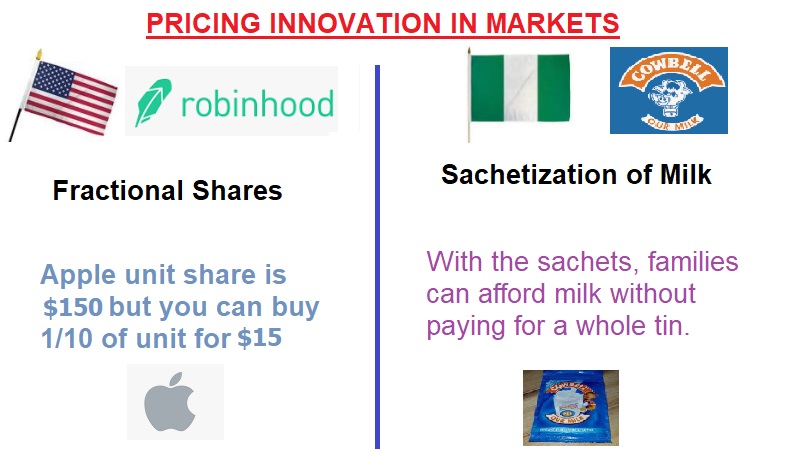
Who came up with the idea to package milk in sachets in Nigeria? Who did the same thing in detergent, knocking Omo and Elephant brands out of their positions? Cowbell offered an alternative in the dairy universe, and Ariel bulldozed itself into the detergent game. Indeed, just repackaging products in small units unlocked new opportunities.

My summary: innovation goes beyond tech. Your pricing innovation can unlock new growth opportunities. Think beyond technology and win.

A Major Nigeria’s Economic Challenge

4

I attended a private event and provided this perspective after a question. Question: “What do you think is Nigeria’s major problem now?”

Ndubuisi: “One of Nigeria’s major problems used to be that the public sector could not attract and retain its best talent, losing the finest to the private sector, with banking, oil & gas, telecoms, and recently VC-backed startups, dominating.  Today, the challenge has evolved that Nigeria – both the private and the public sectors – cannot retain its young people. 

“This poses an existential economic threat to the nation…. Across many sectors, by 5 years, the nation could have a severe gap, at top leadership, as middle managers continue to relocate to the UK, Canada, Australia and US. The healthcare sector in rural areas is largely fading. Even in tech, the executive pipeline is drying up as most tech leaders are leaving the nation.

“I have a file here where I track leading venture-funded startups in Nigeria. My data shows that most of the top 5% startups are hiring foreigners at senior leadership…”

Comment on Feed

Comment 1: Our major economic problem is poor policy design and implementation, Corruption which has dampened local and international investment, nepotism that put wrong people as drivers of vital sectors of the economy, poor infrastructure, low level of capital and technology adoption in businesses. We have a high non productive population which needs to be equipped with the right tools. If we can put right people in right places in all sectors of the economy, reduce corruption maximally, we will start to experience phenomenal growth.

Comment 2: Perhaps, why Nigeria’s problem for the time being appears to be unsolvable is because it’s foundational. Moreover, since it benefits the political elite class who can positively reconstruct this defect at their behest, they’re willing to draw blood and die maintaining the status quo.

Comment 3: It’s such a shame that most of the politicians have failed to see things in the way we see it. If this brain drain syndrome continues, I’m afraid it might be the beginning of the end for us.

ACADEMIC INSIGHTS: My Response to Olivier’s Radical Construction of “People” in the Face of Ukraine Invasion

0
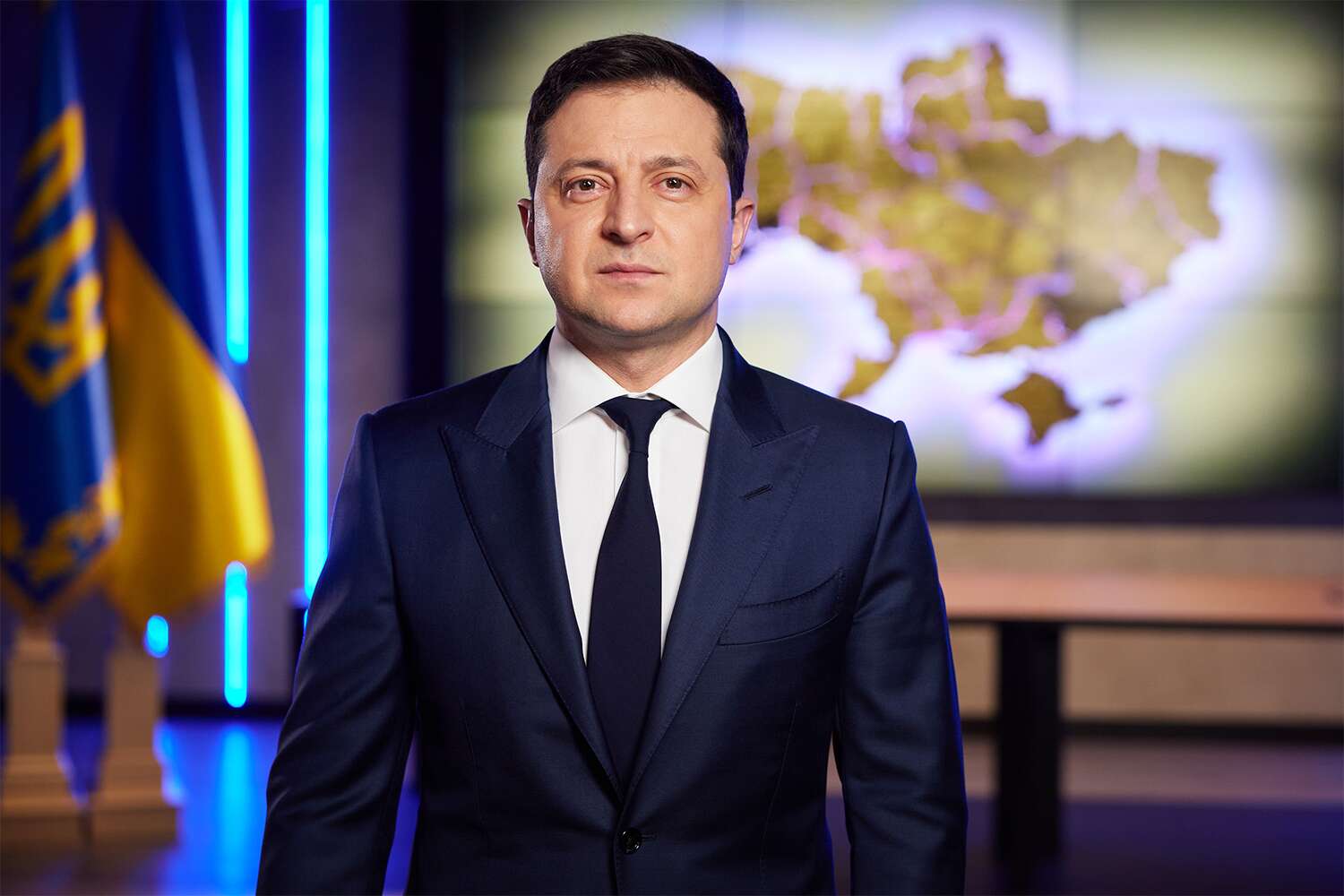
KIEV, UKRAINE - FEBRUARY 22: (----EDITORIAL USE ONLY â MANDATORY CREDIT - "UKRAINIAN PRESIDENCY / HANDOUT" - NO MARKETING NO ADVERTISING CAMPAIGNS - DISTRIBUTED AS A SERVICE TO CLIENTS----) Ukrainian President Volodymyr Zelensky addresses the nation after Russiaâs decision to recognize the Donetsk and Luhansk regions as independent states, on February 22, 2022, in Kiev, Ukraine. (Photo by Ukrainian Presidency / Handout/Anadolu Agency via Getty Images)

Since the invasion of Ukraine by Russia on February 24, 2022, many Ukrainians have died and their property has been destroyed. On the side of Russia, a number of soldiers have also died in the main escalation of the Russo-Ukrainian War, which started in 2014. Different narratives from both parties and their allies have continued to follow the invasion and define it in various ways, using various discourses. Laurent Olivier, the Chief Heritage Curator at the National Archeology Museum of Saint-Germain-en-Laye, France, is one of the academics who have expressed their feelings about the invasion. Olivier recently wrote and published a letter on Academia.edu, an online academic platform that allows academics to upload and share their research works.

The letter is full of positive and negative feelings of pain, sorrow, fear and determination expected from the people of both countries. In this analysis, I would like to respond to the ways Olivier expresses these feelings by identifying how he contests and constructs people on both sides in order to reveal his ideological interactions and the radical contingency of the identified ideologies, as well as the discourses he articulates and disarticulates (Prasad, 2020).

Olivier uses the Russian and Ukrainian people as nodal points for establishing his political hegemony, populism, anti-essentialism, essentialism, structuralism and social hegemony ideologies and radically constructing them (the Russians and Ukrainians) towards making fixed meanings for his invasion, domination, powerlessness, motivational, friendship and collaboration, choice and consequence and demonisation discourses. This aligns with the view of Jørgensen & Phillips (2002), while referring to Laclau & Mouffe (1985), that a nodal point is a privileged sign around which the other signs are ordered; the other signs acquire their meaning from their relationship to the nodal point.

At the beginning of the letter, Olivier interpellates ordinary Russians with political hegemony and populism ideologies, positioning them within social and political fields, before making Russian creators and thinkers as ideological subjects as well, while articulating friendship and collaboration, motivational, choice and consequence, and demonization discourses. Olivier’s movement from one ideology to another reveals his intention of being radical about constructing and contesting “the people” by developing floating signifiers at some point in establishing his discourses and establishing fixed signifiers at another point.

This suggests possible antagonisms that emerge through the radical contingency of discourse (Howarth, Standring & Huntly, 2020) to discern the social, political and ideological logics that Olivier uses to create linkages between different discursive struggles and demands from the Russian people towards rescuing their soldiers as well as Ukrainians who are being killed unjustly (Howarth et al., 2020) through the needless invasion of Ukrainian territory.

Olivier’s political hegemony ideology starts manifesting in the first sentence, “A war of invasion is fought in your name in Ukraine,” where Russians are positioned as ideological subjects and hailed as being part of the soldiers being used for killing powerless Ukrainians. By saying “it is easy to see that the millions of people who are fleeing to save their lives are not your enemies: they are ordinary people—families, women with children,” Olivier infuses domination discourse with powerlessness discourse with the intention of making Russian people, who are his ideological subjects, think about the ordinary Ukrainians who are being subjected to inhuman treatments by the Russian soldiers.

The hailing is further substantiated with his populism ideology, in my view, when he says that “it is clear as well that the bombs and shells which are falling down on the Ukrainian cities are killing the same kind of people: these families haven’t done anything to deserve to die or have someone killed.” In this regard, ordinary Russians need to deploy their inner capacities to save Ukrainians.

Not only the Ukrainians, “And your own people who have been sent there as soldiers, and who are killed as well in this war don’t deserve to die for this.” At this point, Olivier articulates motivational discourse within populism ideology with the intention of making ordinary Russians see their political leaders as anti-ordinary Ukrainians, as well as subjecting their relatives, family members and colleagues (soldiers) to unnecessary death.

With the invasion of Ukraine, Olivier further diffuses the essentialism ideology of Russian political leadership through his anti-essentialism stance, arguing that Russian people do not have enemies in Europe despite the political leaders’ hegemony ideology towards Ukraine. While explaining his anti-essentialism, Oliver aptly positions Russians who have travelled to different parts of Europe, attending academic events and teaching, as his ideological subjects who need to be the vanguards for ending the invasion (Althusser, 2014).

This, in my opinion, is a positive identity construction aimed at attracting the attention of scientists. However, the introduction of essentialism ideology in the midst of political hegemony and populism ideologies, while furthering the articulation of motivational discourse by encouraging scientists to be vanguards, creates multiple identities for the scientists. It positions them as possible subjects who would be used by Russian political leaders to rebuild Ukraine in order to further Russia’s political hegemony. Following Laclau & Mouffe’s (1985) view, I would like to argue that having the ideology (essentialism) and interpellating the scientists further with populism ideology do not have a necessary relation to each other (p. 105). In other words, the scientists are between the undecidable structure and Olivier’s decision to consider them political subjects (Laclau, 1990).

The undecidability and the struggle with the continued articulation of motivational discourse based on the earlier meanings reemerge when Olivier further interpellates the scientists with his structuralism and populism ideologies using inclusionary and exclusionary approaches for articulating choice and consequence discourses. Olivier says, “Today, the issue is not about choosing a camp against another one: Russia against Europe, or Europe against Russia.

The challenge you are facing is much more simple and harder: it is to know what kind of person you are choosing to be and what kind of people you are choosing to belong to. This choice is yours; you have to know that we don’t judge you.” This statement is inherent in the principles of structuralism. Olivier consciously or unconsciously positions the scientists into two camps and expects them to choose where they want to belong if, truly, they want to rescue the Ukrainians and their people from the invasion.

His inability to determine where to position the scientists in the motivational and choice discourses is further compounded (Laclau, 1990) when he says, “But the consequences of your choice are huge and long-lasting—for yourselves and your descendant.” Demonization of the scientists emerges when Olivier constructively leverages his experience with one of the old German people, who says “the most terrible thing was not fighting…” and is reinforced by Olivier while saying “don’t become the zombies of the 21st century; stay with us.” This is a means of hailing the scientists with populism ideology.

“All over, in any places, we just saw, in everyone’s eyes, fear, aversion and disgust for what we were. It was just unbearable. And today, I still see these eyes, everywhere. I am haunted by these people, he said; I am still alive, but I have died there.” This further attenuates the scientists he wants to be the vanguards for saving the Ukrainians and their people and it reproduces his essentialism as well as social hegemony ideologies.

Overall, the ways in which Olivier contests and constructs his demands that ordinary Russians and scientists come to the aid of Ukrainians and Russian soldiers are waved into a chain of equivalence that later results in demonising the same people whom he considered social and ideological subjects by dividing them into different camps and viewing them as political subjects.

Music Rights in Nigerian, African Music

0

Music rights are not properly talked about in Nigeria and Africa. I believe Nigerian music makers do not even know that there is a type of intellectual property rights called music copyright which they own in every piece of music they have created. That right is transferable, i.e. it can be transferred from the creator (the Licensor)  to another person (the Licensee).

When a musician creates an original work of music, that song becomes his intellectual property; he now owns an intellectual property right called copyright over that song. By law, that property cannot be used by anyone other than the copyright owner without written consent or permission from the owner; if anybody dares use any part of the song without obtaining written consent from the original owner it becomes theft which is called intellectual property theft or copyright infringement.

That written consent is called a Licence or assignment of copyright which can either be exclusively or non-exclusively given to the licensee.

Exclusive License means that the owner of the song has outrightly assigned or transferred every right in the song to the licensee and he is not legally permitted to grant the same right to another party on the same song either for life or for a fixed number of years.

Non-exclusive right means that though the owner of the song has assigned the right of usage to a licensee that right is not exclusive to that particular purchaser, the song owner is at the liberty to assign the right to the song to another fellow or different other people as well.

An exclusive license costs more than a non-exclusive license. For instance, some artistes have assigned the mechanical Licence of their songs to a particular digital streaming platform. It means that you can only get to see or play that particular song only from that digital platform, this means the digital platform has acquired an exclusive mechanical license over that song but when an artiste’s song is on different streaming platforms, each of those platforms owns non-exclusive mechanical Licence over that song.

There are basically three kinds of rights a licensor can grant the licensee in music. Please note that a Licensor is the music creator who made, sang and owns the song while the licensee is another party whom right has been given by the owner of the song to use the song for any purpose:

1. Synchronization Licence: When a movie producer wants to dub a song or synchronize a part or all parts of the song as a soundtrack in the movie he is making (ie harmonize music into a movie), he needs to first obtain a kind of license called the synchronization Licence from the owner of the song before he can use it on his movie.
For instance, In Nollywood movies, Stanley Okorie has come to become the most famous soundtrack maker for Nollywood movies. He is the one that sang a particular song that is currently trending; “Billionaire Onye Ji cash”, that particular song was made for a movie.

The Nollywood movie producers that have ever used any song made by Stanley Okorie need a kind of license to be able to legally use his songs in their movies and that kind of right is called a synchronization Licence.

Second example: There is a deal I worked on last year where I represented a client who is a musician. Amazon prime needed to obtain a Licence for the song “Ku lo sa Dancehall Afro Cover by Keasungs” to be used for their television production of the Savage X Fenty volume 4 launch, they obtained a kind of license known as a synchronization Licence from us for them to be able to legally do that.

  1. Mechanical license: For digital streaming platforms like Spotify, Audiomack, Apple Music, Boomplay, Mkito, UduX, Mziki or even YouTube etc to have any song on their digital platforms they need to first obtain a kind of Licence known as the Mechanical license from the music owners. Mechanical Licence is therefore the kind of license granted by a music owner to digital streaming platforms, granting them rights to have the song on their platform which can either be exclusive to one digital streaming platform or non-exclusively issued to different music streaming platforms.

  2. Performance Licence or broadcast rights. This is the kind of rights radio stations, television stations or public domains need to obtain first from a music creator before they can be able to play the artiste’s song on their airwaves. If an artiste makes a song and that song is adopted and used as a song played in airports or malls or other public places, the Airport operators or mall owners need to first obtain a kind of Licence from the music owner and that Licence is called performance Licence or broadcast right.

The other kind of music Licences includes; Master’s licence, Print Licence and Theatrical Licence.

Now that you know the kind of different licenses that exist in a music you made, do not get ripped off, get a lawyer, you need to get well paid for your crafts.


Hedera Network faces Sophisticated Smart Contract Exploit

0

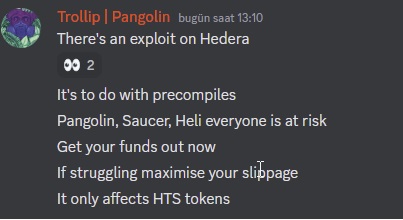
Hedera Network faces an ongoing exploit targeting the decompiling process in smart contracts. The decentralized exchange (DEX) SaucerSwap Labs has asked users to withdraw their liquidity.

Hedera Foundation wrote on Twitter;

We’ve noticed network irregularities that are impacting various Hedera dApps and their users. The Foundation is in communication with impacted partners. We’re monitoring and working to help resolve the issue.

Consequently, SaucerSwap Labs, a DEX on the Hedera Network, encouraged users to “withdraw the liquidity” immediately as an alleged ongoing exploit hit the blockchain. The Total Value Locked (TVL), according to DefiLlama, has dropped nearly 25% in 24 hours as of writing.

SaucerSwap Labs wrote on Twitter;

An ongoing exploit have hit the Hedera network this morning. The exploit is targeting the decompiling process in smart contracts. At time of writing attackers have hit Pangolin and HeliSwap pools containing wrapped assets. We are unsure if other HTS tokens are at risk too. We are actively investigating and are in talks with the other dexes on the network and trying to look for ways to mitigate the vulneribility. There have been no reports of SaucerSwap users getting funds stolen yet, but as a precaution we would encourage everyone to withdraw liquidity immediately – safety first.

There have been no reports of SaucerSwap Lab users getting funds stolen yet, but as a precaution, I encourage everyone to withdraw their liquidity immediately – safety first. All Hedera dApps using Hedera Token Service (HTS), like LP tokens or wrapped tokens are affected. The exploit is targeting the decompiling process in smart contracts.

However, bridged tokens have been frozen by Hashport so users can’t bridge to other chains now. Hashport wrote; “Hashport bridge has been temporarily paused as we have noticed some smart contract irregularities on Hedera. While we look into it further, we want to ensure user safety. We thank you for your patience and will provide updates as they come.”

Hashpack Wallet appears not to be affected as it wrote on Twitter; “We have become aware of an ongoing exploit with some DeFi projects on Hedera. The situation is still unfolding but it seems like it has to do with smart contracts and wrapped/bridged assets and possibly liquidity pools on DEXs. We have gotten confirmation from Hedera that wallets are not affected – neither are native tokens simply being held in your wallet. HashportNetwork has frozen bridged assets. It is suggested to remove your tokens from LP’s on tokens back into your wallets – you may need to increase slippage on swaps if you are encountering errors.”

It is currently unclear why Hashport website (hashport.network) is offline. It’s possible that they are performing server maintenance or addressing a security vulnerability, but more information is needed to determine the cause.

Despite the fact that HBAR isn’t exposed directly to the exploit but the tokens built using HTS are — many have claimed the glory days of Hedera are set to end as its claim of being a secure and trusted network is now being questioned.

The persistently negative sentiment surrounding Hedera has resulted in an exodus of users unstaking their HBARs in order to sell them on the open Crypto market. However, Stader labs, the largest staking platform for Hedera, has announced a temporary pause on the unstaking process. This indicates that users won’t be able to withdraw their staked HBAR for some time until the issue is resolved.

DefIn addition, as summarised by the moving averages, HBAR’s technical analysis (TA) indicators also reveal a sell position for the Altcoins, advising a “sell” at level 12 and a “buy” at level 3. In response to this recent HBAR crypto news, the price of Hedera is presently exchanging hands at $0.060, which represents a decrease of 2.5% over the past 24 hours, compared to a drop of 10.71% recorded over the preceding seven days.