This is my playbook: Rwanda, Gambia and most less populated African countries are not great places to launch a business to consumer (B2C) startups except in healthcare and broad food areas. In those countries, I only get interested if the company is in the business to business (B2B) space. I do think the population is small to provide numbers which can enable leverageable factors to compound towards scaling a business. In other words, in those countries, B2B could work but B2C will struggle as the scalable advantages are severely limited.
But when it comes to Nigeria, Kenya, and South Africa, anything is possible. You can launch a B2C or B2B because they have the numbers.
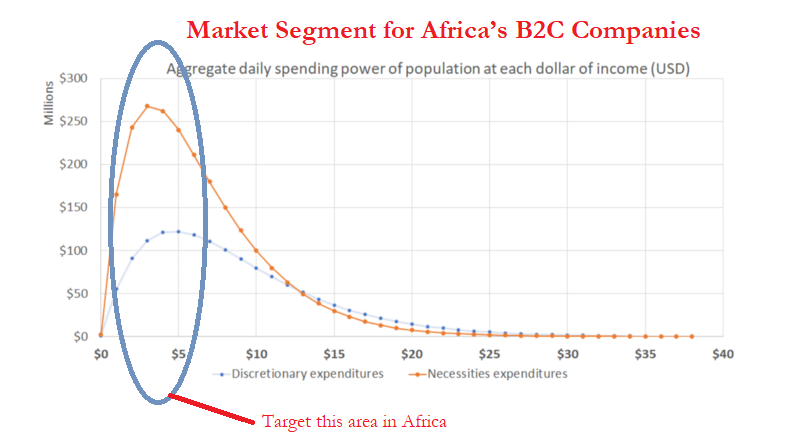
Now, you want to do business in the B2C space in Nigeria, the question is “where do you position the company”? From multiple data, the best range and the most promising is to target people making $4 — $8 per day. That income band holds the highest concentration of discretionary spending power in the nation. That is where Ariel, Cowbell, Bigi Cola, La Casera, and other resilient brands in Nigeria operate.
Interestingly, that is also where I see a big percentage of my popular 30 million people who earn relatively decent income in Nigeria; those 30 million are the core of the consumer market.
Now what if my product optimally should be in the range of $10 per day-consumer? Solution, go sachetization where you break the pricing in bands, making it easier for people to pay for what they can afford. We practice this; explore that in your business as Nigeria continues to recover from economic paralysis.
That is why you have Tekedia Mini-MBA (N90,000); with Homework review (add N10k), with Capstone (N20k), etc. We practice what we teach! Pricing-democracy, you come in at the size of your purse!
This may not be far from what The New York Times called premiumization.
Comfort Plus. Fast pass. Main cabin extra. Most of us are familiar with a corporate lexicon that gently coerces us to shell out for a little more legroom, free shipping or lower wait times. But the trend is now growing voraciously beyond airlines, The New York Times reports. A broad swath of America’s biggest companies want to exploit a buzzy new corporate catchphrase: “premiumization.” The paper notes that with soaring inflation testing many people’s spending levels, companies are aggressively targeting their affluent customers with the means to pay more.
The current earning season was dominated by talk of “premiumization,” The Times notes, with almost 60 earnings calls and investor meetings mentioning it over the past three weeks.
As more products become prohibitively expensive to more people, it’s more likely that “poorer consumers will be increasingly underserved.”
I run the largest business school in Africa. More learners will graduate here in 2023 than any university in Africa. We have learners from 41 countries. From CEOs to catholic priests, from professors to carpenters, from engineers to medical doctors, and beyond, we continue to thrive on how we can help people understand the physics of business.
Our learners out of Lagos, Nairobi, etc have gotten jobs in Microsoft, Google, and leading companies in the world. I am humbled when executives from global companies openly share their feedback. This is a public service and we will keep improving.
I invite you to register for Tekedia Mini-MBA; we just opened registrations for the next edition. Go here and begin a journey of transformation https://school.tekedia.com/course/mmba11/
Regarded as one of the fastest growing sectors in Nigeria, the contribution of the Information and Communication Technology (ICT) sector to the gross domestic product (GDP), grew by 9.76 percent in 2022, from 6.55 percent reported in 2021.
According to the executive secretary of the association of telecommunication companies of Nigeria (ATCON) Ajibola Olude, he stated that the ICT sector is reported to have grown significantly due to several factors. One of the reasons he mentioned is the steady awareness to move all services rendered by both the government and private sector online, which he believed led to an increased usage of more data by the organization.
In his words,
“With the central bank of Nigeria on the quest to promote a cashless policy economy, more individuals and organizations are gradually embracing the use of USSD, mobile, and internet banking, and many others, this also tends to improve the ICT sector.
“More money coming into the country via foreign direct investment in capital importation in the ICT sector, this also accounts for the growth in the Nigerian economy”.
According to Data reported by the industry, it indicates that the telecommunication and information sector reported the highest growth rate compared to other ICT sectors in the economy. On a year-on-year basis, the sector growth rate increased by 10.72 percent in 2022, higher than the 7.28 reported in 2021.
The ICT sector has provided 3 unprecedented contributions to the Gross Domestic Product (GDP) of the country in the last three years, which are 14.07 percent in Q1 2020, 17.92 percent in Q2 2021, and 18.44 percent in Q2 2022. It is interesting to note that each time, that has been the highest-ever contribution of the ICT sector to Nigeria’s GDP.
The growth recorded in the industry in the fourth quarter (Q4) of 2020, made it the fastest-growing sector of the Nigerian economy and the only sector to have grown by double digits. It was reported to have played a critical role in enabling Nigeria to exit the recession.
Operators in the ICT Industry disclose that the sector growth can be attributed to the increasing number of internet service subscribers, mobile service subscribers, and the growth in broadband penetration.
In 2020, while speaking at the Digital Nigeria Day (DND) with the theme “Digital Transformation: A Path To Sustainable Digital Economy”, Nigeria’s Minister of Communication and Digital Economy, Prof. Isa Ali Pantami emphasized that the implementation of a digital economy policy accelerates digitalization and this, in turn, enhances the digital economy.
The minister highlighted that digital platforms have engendered the digitization of business processes and led to significant savings. He, therefore, tasked stakeholders to persist in supporting the ministry to further accelerate the development of the digital economy sector.
Looking ahead into 2023, increased adoption of cloud computing is one of the potential trends that may shape the development of ICT. As businesses in Nigeria find means to reduce costs and improve efficiency, many citizens will turn to cloud computing solutions to store and process data.
Yesterday, a learner in Tekedia Mini-MBA program asked me to provide an example where a Nigerian company implemented the One Oasis and Double Play Business Strategy which I had postulated in Harvard Business Review. In my response, I used Tekedia Institute, the home of Tekedia Mini-MBA.
My thesis is that in the digital age where supply is unbounded and unconstrained, you cannot win via just supply (there is no business-focused video you cannot find a substitute free on YouTube or somewhere online). If that is the case, focusing on influencing demand becomes strategic. Tekedia.com is the one oasis while school.tekedia.com is our double play!
What is your one oasis? And what is your double play? Shine ya eyes because where people make money may not come from their most popular or visible products. Ask Amazon (ecommerce is popular, but money comes from AWS); Samsung (Galaxy is popular, but money comes from chip business); etc. If you focus on copying that visible and popular product without the supporting double play elements, success may not come.
In the past, business was about controlling supply to move prices. Manufacturers had control of supply but they had limited direct control on the consumers [you can control how many newspapers you produce but you have no definite control on how many people would buy]. So, winning markets was really about managing and controlling distribution as most businesses were bounded and constrained by geography, creating advantages which were largely localized [the largest newspaper in a region controlled the top news of the day].
But today, the game has shifted from control of supply to control of demand for web-anchored consumer firms. And only companies with capabilities to control demand are going to win big. Indeed, most of the greatest internet companies are simply controlling demand and that means controlling how supplies reach users and consumers.
If you plan to run an internet business, think about how you can control demand. You have already lost the power and capacity to control supply. Through tekedia.com, we influence demand which now opens the doors for the school.tekedia.com supplies.
Demand Chain Is Key
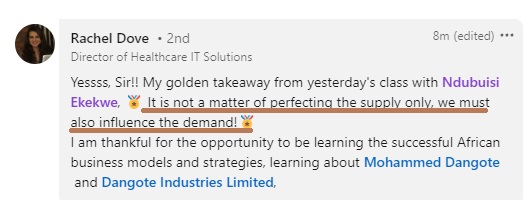
Rachel Dove provided the summary of yesterday’s lecture, in a comment: “Yessss, Sir!! My golden takeaway from yesterday’s class with Ndubuisi Ekekwe, ? It is not a matter of perfecting the supply only, we must also influence the demand!?” Indeed, most times, we invest all efforts to perfect the supply chain, while we neglect the demand chain. Yes, it cannot be only the supply chain, we need to work on the demand chain! Lol.
Later in the program, I will explain how demand chain efficiency improves marginal cost and unit economics, and advances the capacity of firms to grow and thrive. The fundamental thing is to find the mechanics on how to build category-king companies through innovation, growth and top-grade operational execution.
I run the largest business school in Africa. More learners will graduate here in 2023 than any university in Africa. We have learners from 41 countries. From CEOs to catholic priests, from professors to carpenters, from engineers to medical doctors, and beyond, we continue to thrive on how we can help people understand the physics of business.
Our learners out of Lagos, Nairobi, etc have gotten jobs in Microsoft, Google, and leading companies in the world. I am humbled when executives from global companies openly share their feedback. This is a public service and we will keep improving.
Comment: “I was taken aback with that answer last night. Considering that in focusing on demand you undermined the importance of the content of the course over visibility of the school.”
My Response: We have the best content and our program quality is the best. I hope I can make that point before you. Yet, even if we have the best content and no one knows about it, we will fail. There is no topic in business that someone has not provided FREE on YouTube. The deal now is How Do You Break Through for people to pay attention? That is where the strategy comes in because in digital, supply of quality content is unbounded (many of them) and if you do not help demand narrow down, you fail.
If you need a paytech fintech, there are more than 200 companies that can help you collect money online in Nigeria. The one which influences you will get your attention. You will not have enrolled in Tekedia if not that you have read a post I wrote or watched my video. By doing that, I am influencing you, giving you confidence to go ahead and pay, trusting that quality will be high. That is influencing demand.
Open your mind because Tekedia is structured to bring new perspectives to our learners.
Of course as that happens, we expect questions/exploratories from our learners. But our goal is not to just teach the boring standard things. That is why we work hard to develop new frameworks. More than 15 companies have cloned Tekedia Mini-MBA, but all failed. Why? They do not have tekedia.com which makes it very hard for them to even tell people what they have.
But tekedia.com is not required in all businesses; my point is that you need to understand what drives your strategy. Elon Musk’s reputation is more than 50% of Tesla’s value. If he resigns from Tesla, the company will lose more than 50% of its value in 5 days. So, he has used his genius perception to influence demand even though other car companies may be closing on on Tesla car quality.
Comment 2: Unbounded opportunities abound to those who can look deeper beyond what is visible.
Like I said yesterday afternoon that for every lecture at Tekedia Institute one will not want to miss the next one. It was an awesome experience yesterday at the lecture.
Comment 3: I started thinking deeply after last night meeting, on how to implement such efficacious strategy in my space. Another good example of the one Oasis and double play is McDonald’s fast food.
While its restaurant serve food and is popular, they make most of their earning in real estate.
Thanks alot Prof.
Comment 4: How about MTN? Its key products have to decide amongst themselves which should be the oasis: voice, data, mobile mobile? They are on a march to reach an unbeatable self reinforcing equilibrium. Something to watch out for…
My Response: Yes, the greatest of companies can have many oases, not just an oasis. Microsoft has Windows, Office Suite as oases as those are money-makers.
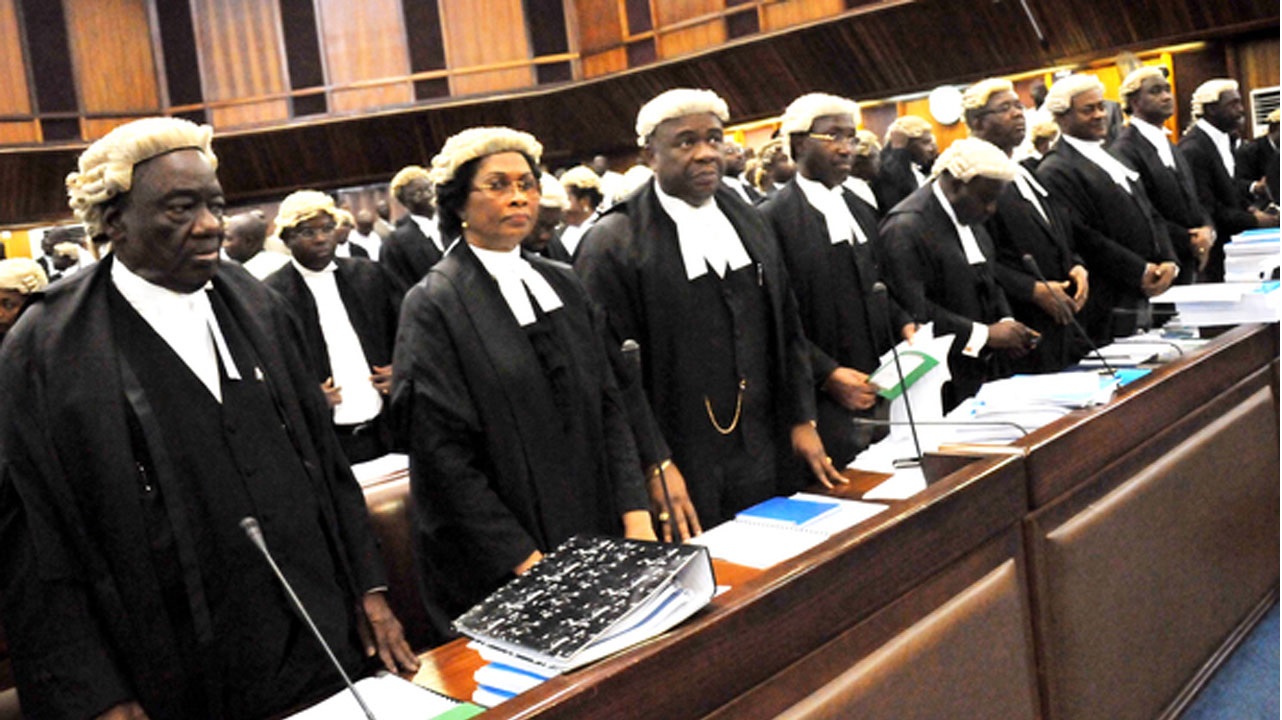
It’s been an interesting time in our legal system. For the past week since the conduct of the presidential election on the 25th of February, a lot of events have opened up the legal loopholes which lawyers are currently in courts of law trying to figure out amongst themselves.
During and after the elections, there were clear indications of electoral malpractice and broad daylight election rigging. (I personally believe that it was the worst election that has ever been conducted in the history of Nigeria), but INEC threw caution to the wind and went ahead to declare a winner of the election despite the protests and grievances from the nooks and crannies of the nation.
Firstly, six states of the federation including; Adamawa, Akwa-Ibom, Bayelsa, Delta, Edo and Sokoto which are all PDP states dragged the federal government and INEC before the Supreme Court of Nigeria over the conduct, collation and announcement of the February 25, 2023, presidential and National Assembly elections. They asked the court to void the announcement of Bola Tinubu as the president-elect by the INEC on the ground that the process by which he was purportedly elected was questionable. Although they have withdrawn the case, maybe because it’s now a post-election matter and they want to bring it before a proper court that has jurisdiction over the matter which is the election tribunal and not the supreme court.
More so, the Labour Party joining as a co-plaintiff to Mr Peter Gregory Obi has taken INEC, Bola Ahmed Tinubu and the APC to court over electoral malpractices. The Labour party strongly believes that they won the presidential election conducted on the 25/26 of February 2023 but only came third through electoral malpractices hence why the court should look into it and rectify the anomalies.
Also, some lawyers and social interest groups have gone to court asking the court to mandate INEC under the Freedom of information act 2011 to make public how the 305 billion nairas that were appropriated to them for the execution of the 2023 election has been expended so far and also for them to account for all the expenses they have incurred for the preparation of the election since 2019 up till date.
Finally, the fact that the APC did not win the FCT is currently a subject of controversy in the court of law. Some lawyers have approached the court to declare that the APC has not met the constitutional threshold to be declared the winner of the 2023 election due to the fact that they did not win the FCT.
On the good side, the Supreme Court while reversing the directives of the CBN/ presidency has declared that the validity of the old naira notes still subsists and should be brought back into circulation by the CBN and should still be in use till the 31st December 2023. The Supreme court agreed with the plaintiffs that the presidency never consulted with the state governors and other relevant stakeholders in the council of state before taking the unilateral decision for currency redesign and that act has caused a lot of unimaginable hardship for the masses.
It has so far been an interesting legal year already for every Nigerian and many Nigerians have been transfixed on knowing what the laws say and what the courts will do. I suggest that at this point, Nigerian judges should consider permitting video recording gadgets in their courtrooms to transmit live court sessions for interested persons to stream from their homes, especially this ongoing election appeal trial since it appears that the whole Nigeria is interested.
Be sure that I will always come back with updates as the events unfold and you will always get to read them first here on Tekedia.