DD
MM
YYYY

PAGES

DD
MM
YYYY

spot_img

PAGES

Home Blog Page 4364

Controversy Behind new Ordinal Bitcoin NFTs

0

Ordinal Bitcoin NFTs have two key features that distinguish them from others. Firstly, they are made up of on-chain data, meaning the actual image for the NFT is stored directly on the blockchain, rather than being linked to an external website like most NFTs on Ethereum.

This makes them unique and more secure, as the data cannot be lost or altered without affecting the blockchain itself. Eric Wall, a Swedish researcher and former Arcane Assets CIO, believes that storing fully on-chain NFTs is now seven times cheaper on Bitcoin compared to Ethereum.

Secondly, NFTs are linked to individual satoshis, unlike Ethereum NFTs, which have their own token. This creates a connection between the NFT and the underlying asset, Bitcoin.

However, it can be challenging to maintain this connection because Bitcoins are fungible, meaning each one is interchangeable and can only be differentiated through a complex transaction input-output system.

To solve this issue, Ordinals uses a shared numbering system that assigns every satoshi an ordinal number based on the order in which it was mined. This numbering system, along with other details, is used to maintain continuity for NFTs.

It’s important to note that Bitcoin does not natively support these features, and NFT holders may accidentally spend their NFTs on transaction fees if they are not careful.

The world of crypto, DeFi, blockchain, NFTs etc is a very community-focused space. And with every new development, the community ferociously discusses their opinions of it.

The supporters of the project suggest that it will have an overall favourable impact on the Bitcoin ecosystem. They believe that the integration of NFTs on the Bitcoin blockchain is a positive development that will bring more fees and use cases to the chain. This view is held by prominent Bitcoin influencer Dan Held, who argues that every transaction paying its fee is not spam and that the Bitcoin blockchain is open and accessible for anyone to build upon.

Some individuals believe that incorporating NFTs on the Bitcoin blockchain will negatively impact its financial and transactional use case. The CEO of Blockstream Adam Back, who is rumoured to be Satoshi Nakamoto, is a part of this group. He supports this argument and has suggested that Bitcoin users must “educate and encourage developers who care about bitcoin’s use-case to either not do that, or do it in a prunable space-efficient e.g. time-stamp way.”

He also took to Twitter to express his views on the project. He said that “”you can’t stop them” well of course Bitcoin is designed to be censor resistant. doesn’t stop us mildly commenting on the sheer waste and stupidity of an encoding, at least do something efficient. Otherwise it’s another proof of the consumption of block-space thingy.”

On the other hand, Casey Rodarmor responded to the criticism with the following arguments,

I actually love the haters,” he said. “I mean, they do more to drive people to find out about the project than anybody else. I don’t know what they think when they have these massive audiences, and they go, ‘This is an attack on Bitcoin’—it seems like you don’t want to do that if you don’t want people to use the thing.

He also added counterpoints that stated

“My design goal, from the beginning, was to create something that would strike people as being Bitcoin native. That means it can’t have a token, and it can’t be a sidechain. One thing that people don’t understand is that in order for Bitcoin to be secure, blocks must be full—that is part of the Bitcoin security model,” he said. “If blocks are not full, nobody has any reason to pay more than the minimum fee rate to have their transactions included. So, as a result, blocks must be full.”

The hype surrounding the Ordinals NFT has driven the price of the Stacks cryptocurrency (STX) up nearly 200% as of February. Ordinal NFTs, which are similar to Ethereum and other smart contract-based NFTs, use the smallest unit of bitcoin, the satoshi, to encode digital art, profile pictures, videos, audios and images directly on the bitcoin blockchain.

“The full potential of the Stacks network is beginning to be recognized which could drive the STX token rally even further,” Thielen said.

The NFT craze has faded in recent months amid the bitcoin, ethereum, and crypto price crash that wiped off nearly $2 trillion from the combined crypto market. The merger of NFTs and the bitcoin network provides greater security, transparency, and traceability, opening up more use cases and rekindling interest around NFTs.
The Central Bank of Nigeria’s Tenure Limits for Banking Executives

1

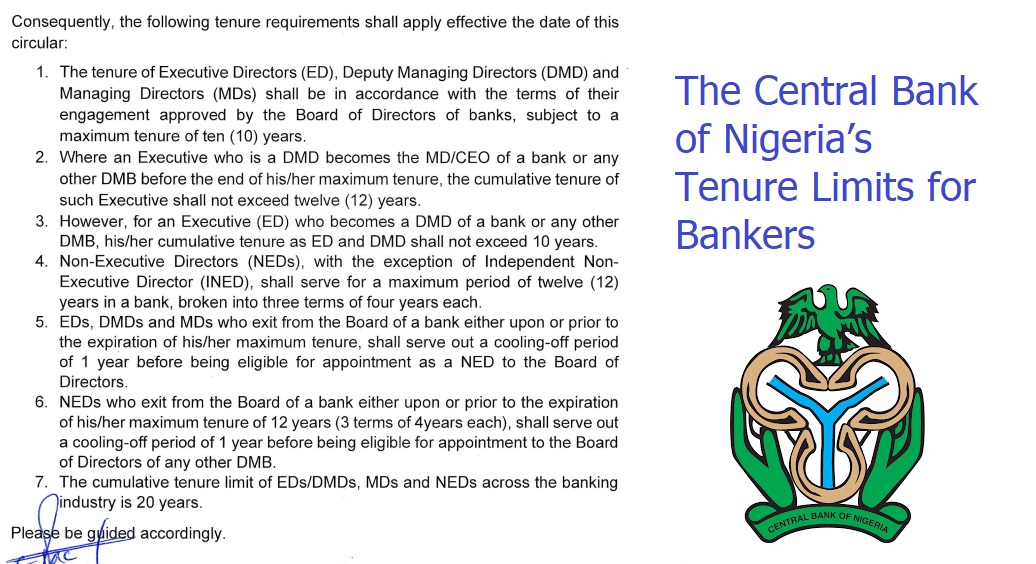
Simply, Nigerian bank executives can only serve a cumulative tenure of 20 years across the banking industry: “The tenure of executive directors (ED), deputy managing directors (DMD) and managing directors (MDs) shall be in accordance with the terms of their engagement approved by the board of directors of banks, subject to a maximum tenure of ten (10) years.”

Good People, that is an earthquake and changes are already happening, in First Bank and  Zenith Bank where the deputy managing directors have retired. But those are the easy fishes; expect the real shake-ups in the next few weeks.

Personally, I find this very fascinating and unfortunate at the same time. On the fascinating part, absolute power could corrupt and capping the tenure may help on corporate governance and succession. Yet, punishing brilliant minds for just rising fast would be painful. In other words, we can see stars being cut early in their careers.

In a gala night party a few years ago, I delivered the evening oratory (the academic version of what comedians do), and when I was done, a lady came and handed me her business card, saying “I am Lady Rothschild…and my family business has been operating for more than 200 years… I enjoyed your presentation and please connect”. I did and she made some connections in New York and Zurich. Like the Agnelli Family of Italy (owners of Juventus FC club), the Rothschild Family is a family empire – and they run the shows.  By this rule, the Central Bank of Nigeria does not want that model in the nation.

Please read this explanation by Premium Times

The Central Bank of Nigeria has announced a revision of the tenure limit for executive management and non-executive directors of banks and financial institutions.

According to the review, the executives can only serve a cumulative tenure of 20 years across the banking industry.

In a circular addressed to all deposit money banks, signed by the director of financial policy and regulation department, Chibuzor Efobi, the bank said the review is part of measures aimed at strengthening governance practices in the banking industry.

“The tenure of executive directors (ED), deputy managing directors (DMD) and managing directors (MDs) shall be in accordance with the terms of their engagement approved by the board of directors of banks, subject to a maximum tenure of ten (10) years,” the central bank said in the circular, dated 24 February.

“Where an executive who is a DMD becomes the MD/CEO of a bank or any other DMB before the end of his/her maximum tenure, the cumulative tenure of such executive shall not exceed twelve (12) years.

“However, for an executive (ED) who becomes a DMD of a bank or any other DMB, his/her cumulative tenure as ED and DMD shall not exceed 10 years.”

“EDs, DMDs and MDs who exit from the board of a bank either upon or prior to the expiration of his/her maximum tenure, shall serve out a cooling-off period of 1 year before being eligible for appointment as a NED to the board of directors.

“NEDs who exit from the board of a bank either upon or prior to the expiration of his/her maximum tenure of 12 years (three terms of four years each), shall serve out a cooling-off period of 1 year before being eligible for appointment to the board of directors of any other DMB,” he CBN said.

Affected bank executives

Checks by PREMIUM TIMES showed that top executives affected by the new directive included Segun Agbaje of GTB, Tony Elumelu of UBA, Jim Ovia of Zenith and Herbert Wigwe of Access.

My Comment on Feed

Comment 1: I don’t see the similarity with the Rothchilds example.

My Response: I will not waste time asking you how or why or not. But if you care, you can explain. I respect your style of commenting, saying a lot but not helping anyone. The Agnelli family has a holdco which manages all their empires. There are many interests across industrial sectors. That holdco is run by a scion from the family.

In Nigeria, we have holdcos now managed or run by owners or sit-tight executives; right there, they control. Why the Nigerian version is young (3 decades vs hundreds of years), the pattern is the same. In one bank, the son picked from the father in Nigeria in the holdco and it is likely a family member will keep that holdco even as people are changed in the banks, etc. That is the similarity, from my angle. My note that CBN does not want that is that CBN is going all the way to holdco, not just the banks, meaning it does not want the scions to exclusively run the holdco.

Comment 2: I think that the comparison of CBN’s new guidelines with a supposedly endless tenure of private held non financial services business is not quite the same. Most Banks in Nigeria are supposedly public companies in name, in reality they’re set up to collect and collate money to be lent to favored friends and cronies. They suffer from high capital inadequacy and are mostly on the life support of the CBN. So entrenching goons as leaders of these institutions for a long term will injure the national economy. Even businesses like Rothschild have not been managed by same executives for the 200 years. CBN isn’t divesting ownership by its guidelines. It’s only making sure that management tenures don’t become too long to the injury of the institutions. Jack Welch and GE is a good example.

My Response: “private held non financial services business ” – how do you know there are non-financial? “The Rothschild family is the most famous of European banking dynasties”. “He [Agnelli] created his own bank, enabling people to purchase his cars on credit. In order to manage this empire, he founded IFI in 1927, a holding company he controlled, now known as Exor.” So, they were involved in financial services.

“Even businesses like Rothschild have not been managed by same executives for the 200 years.” – not sure since none is doing that in Nigeria for 200 years. The families do have scions run the shows for decades though!

I am not really for or against CBN policy, I only said it does not want the same playbook.

Comment 2R: Ndubuisi Ekekwe I said ‘even Rothschild hasn’t been managed by the same executives for its long life’ . It’s more common to have elongated tenure or even life tenure in privately held non financial services business.Please differentiate ownership of shares in financial services like Rothschild or Bakeshire Hathaway does from direct banking franchise like Chase and Bank of America.

My Response: ” It’s more common to have elongated tenure or even life tenure in privately held non financial services business.” I used the Rothschild and Agnelli because they have financial services under them -and they run the holdco most times exclusively by family members.

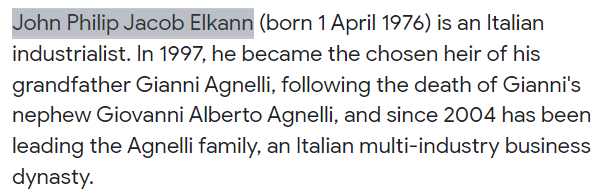
I understand your point but I want you to agree that these families do have control and command. John Elkann was about 21 when he was chosen by the Agnelli and at 28, he assumed the top job. From there, he hired the CEOs of Fiat, and financial services firm within the holdco. (See below and you can trace it back decades).

I understand Berkshire Hathaway, but I did not give it as an example; it was never a family business.

Winning the Game With Great Business Models

0

The boards of companies do one important job: hire a CEO. And the CEO does also one important thing: commit a company to a business model. In the market system, your business model determines significantly how successful you would be, because the business model is about how a firm could capture value in the market. So, a business model is supreme, and you need to understand the best across market territories and business sectors.

From the great Oriendu Market in Ovim, Abia State, to the banking halls of Lagos, to the trading desks of Goldman Sachs in New York, the greatest companies run the most relevant business models. Data supports that: more than 80% of finest digital/online companies have one business model in common.

I will be teaching business models at 7pm WAT today in the African business temple, Tekedia Institute mini-MBA. What is your business model? How do you plan to capture value? I asked that question in Harvard and posited that companies which create value for customers but fail to capture value will die. Read here at Harvard.

Register and let’s master how to do business and invest in this world

0

An Igbo proverb says that “uwa bu ahia” and a simplistic translation is that the world is a market. And in Harvard Business Review, I proclaimed “Africa is open for business” in a well-received piece (read here ).

Good People, Tekedia Institute Investment and Portfolio Management program is for you. Join us and let us master how to do business and invest in this world.  Go here and register for the weeks-long program.

Tekedia Investment and Portfolio Management program is designed to provide learners with hands-on experience in performing investment research, investing capital, and managing a portfolio.  The program runs for 8 weeks and it is  completely virtual. Besides some pre-recorded courseware developed by eminent capital market experts, the program includes live Zoom sessions.

In the academic component, the program prepares learners to master the institutional structure, and fundamental concepts of asset valuation, in financial markets, using analytical tools to study the valuation of different types of securities.  Fundamentally, learners are equipped to understand investment theory, portfolio development and management.

In the practical laboratory component, learners evaluate existing portfolio compositions and past performances, generate new investment ideas, research new opportunities, and make recommendations, based on quantitative and qualitative analyses. Subsequently, the recommended securities are recorded, dated and later used to evaluate the efficiency of the picks (in Nigeria and US capital markets).

The NFT market is soaring back to its highest point since May 2022

0

The trading of Non Fungible Tokens [NFTs] is skyrocketing upwards, according to DappRadar’s February industry report. In fact, NFT trading hit $2 Billion in February. Moreover, this represents a 117% increase from the previous month.

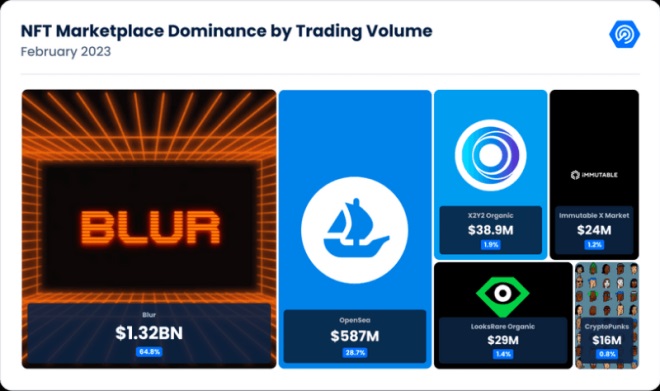
Indeed, one of the main reasons for the spike is Blur – the new NFT marketplace and OpenSea’s main rival. Blur is competing directly with OpenSea and is seizing control of the market share. At present, Blur has 64.8% of the entire NFT market trading volume, with $13 Billion in February. By comparison, OpenSea is trailing behind with $587 Million, and 28.7% of the market share.

As the competition between the two leading marketplaces intensifies, NFT traders are back in full force.

Blur is inspiring much activity in the NFT market, with its focus on serving professional traders and NFT whales. However, Blur’s 96,856 traders in February still falls well short of OpenSea’s 316,199.

In summary, Blur offers significant financial rewards to its top traders, who bid for and sell NFTs in high volume. In addition, the marketplace now offers a minimum royalty fee of 0.5% while rewarding its loyal users who don’t list NFTs on other secondary marketplaces.

Therefore, we’re seeing incredible surges in NFT trading volume on Blur. However, in terms of user base, OpenSea remains the king for now.

Credit DappRadar

Yuga Labs still on top

Yuga Labs retains NFT trading volume dominance, with numbers 1,2 and 3 in the charts. The most traded NFT collection in February was Mutant Ape Yacht Club (MAYC) with $157 Million, followed by Otherdeed for Otherside, and Bored Ape Yacht Club (BAYC). After that, the best of the rest include Azuki, Moonbirds, and Doodles V4 to name a few. Despite the increase in trading volume for NFTs, the sales of NFTs dropped to 6.3 Million in February – down from $9.2 Million in January.

Credit DappRadar

Top blockchains for NFTs

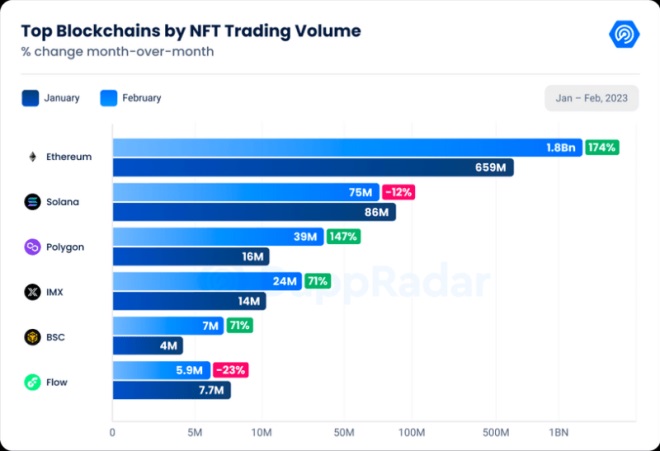
Finally, Ethereum remains the dominant force with 83.36% of the market share for NFT trading volume. However, Polygon is improving with a 147% increase for January, and so is Immutable X and BSC Chain, both with a 71% increase from the previous month. All in all, things are looking up for NFTs after a severe dip in 2022.