DD
MM
YYYY

PAGES

DD
MM
YYYY

spot_img

PAGES

Home Blog Page 4365

Music Rights in Nigerian, African Music

0

Music rights are not properly talked about in Nigeria and Africa. I believe Nigerian music makers do not even know that there is a type of intellectual property rights called music copyright which they own in every piece of music they have created. That right is transferable, i.e. it can be transferred from the creator (the Licensor)  to another person (the Licensee).

When a musician creates an original work of music, that song becomes his intellectual property; he now owns an intellectual property right called copyright over that song. By law, that property cannot be used by anyone other than the copyright owner without written consent or permission from the owner; if anybody dares use any part of the song without obtaining written consent from the original owner it becomes theft which is called intellectual property theft or copyright infringement.

That written consent is called a Licence or assignment of copyright which can either be exclusively or non-exclusively given to the licensee.

Exclusive License means that the owner of the song has outrightly assigned or transferred every right in the song to the licensee and he is not legally permitted to grant the same right to another party on the same song either for life or for a fixed number of years.

Non-exclusive right means that though the owner of the song has assigned the right of usage to a licensee that right is not exclusive to that particular purchaser, the song owner is at the liberty to assign the right to the song to another fellow or different other people as well.

An exclusive license costs more than a non-exclusive license. For instance, some artistes have assigned the mechanical Licence of their songs to a particular digital streaming platform. It means that you can only get to see or play that particular song only from that digital platform, this means the digital platform has acquired an exclusive mechanical license over that song but when an artiste’s song is on different streaming platforms, each of those platforms owns non-exclusive mechanical Licence over that song.

There are basically three kinds of rights a licensor can grant the licensee in music. Please note that a Licensor is the music creator who made, sang and owns the song while the licensee is another party whom right has been given by the owner of the song to use the song for any purpose:

1. Synchronization Licence: When a movie producer wants to dub a song or synchronize a part or all parts of the song as a soundtrack in the movie he is making (ie harmonize music into a movie), he needs to first obtain a kind of license called the synchronization Licence from the owner of the song before he can use it on his movie.
For instance, In Nollywood movies, Stanley Okorie has come to become the most famous soundtrack maker for Nollywood movies. He is the one that sang a particular song that is currently trending; “Billionaire Onye Ji cash”, that particular song was made for a movie.

The Nollywood movie producers that have ever used any song made by Stanley Okorie need a kind of license to be able to legally use his songs in their movies and that kind of right is called a synchronization Licence.

Second example: There is a deal I worked on last year where I represented a client who is a musician. Amazon prime needed to obtain a Licence for the song “Ku lo sa Dancehall Afro Cover by Keasungs” to be used for their television production of the Savage X Fenty volume 4 launch, they obtained a kind of license known as a synchronization Licence from us for them to be able to legally do that.

  1. Mechanical license: For digital streaming platforms like Spotify, Audiomack, Apple Music, Boomplay, Mkito, UduX, Mziki or even YouTube etc to have any song on their digital platforms they need to first obtain a kind of Licence known as the Mechanical license from the music owners. Mechanical Licence is therefore the kind of license granted by a music owner to digital streaming platforms, granting them rights to have the song on their platform which can either be exclusive to one digital streaming platform or non-exclusively issued to different music streaming platforms.

  2. Performance Licence or broadcast rights. This is the kind of rights radio stations, television stations or public domains need to obtain first from a music creator before they can be able to play the artiste’s song on their airwaves. If an artiste makes a song and that song is adopted and used as a song played in airports or malls or other public places, the Airport operators or mall owners need to first obtain a kind of Licence from the music owner and that Licence is called performance Licence or broadcast right.

The other kind of music Licences includes; Master’s licence, Print Licence and Theatrical Licence.

Now that you know the kind of different licenses that exist in a music you made, do not get ripped off, get a lawyer, you need to get well paid for your crafts.

 

Hedera Network faces Sophisticated Smart Contract Exploit

0

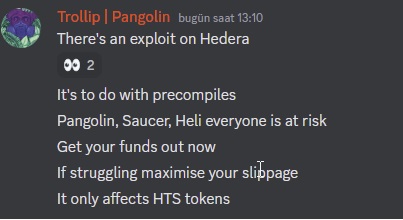
Hedera Network faces an ongoing exploit targeting the decompiling process in smart contracts. The decentralized exchange (DEX) SaucerSwap Labs has asked users to withdraw their liquidity.

Hedera Foundation wrote on Twitter;

We’ve noticed network irregularities that are impacting various Hedera dApps and their users. The Foundation is in communication with impacted partners. We’re monitoring and working to help resolve the issue.

Consequently, SaucerSwap Labs, a DEX on the Hedera Network, encouraged users to “withdraw the liquidity” immediately as an alleged ongoing exploit hit the blockchain. The Total Value Locked (TVL), according to DefiLlama, has dropped nearly 25% in 24 hours as of writing.

SaucerSwap Labs wrote on Twitter;

An ongoing exploit have hit the Hedera network this morning. The exploit is targeting the decompiling process in smart contracts. At time of writing attackers have hit Pangolin and HeliSwap pools containing wrapped assets. We are unsure if other HTS tokens are at risk too. We are actively investigating and are in talks with the other dexes on the network and trying to look for ways to mitigate the vulneribility. There have been no reports of SaucerSwap users getting funds stolen yet, but as a precaution we would encourage everyone to withdraw liquidity immediately – safety first.

There have been no reports of SaucerSwap Lab users getting funds stolen yet, but as a precaution, I encourage everyone to withdraw their liquidity immediately – safety first. All Hedera dApps using Hedera Token Service (HTS), like LP tokens or wrapped tokens are affected. The exploit is targeting the decompiling process in smart contracts.

However, bridged tokens have been frozen by Hashport so users can’t bridge to other chains now. Hashport wrote; “Hashport bridge has been temporarily paused as we have noticed some smart contract irregularities on Hedera. While we look into it further, we want to ensure user safety. We thank you for your patience and will provide updates as they come.”

Hashpack Wallet appears not to be affected as it wrote on Twitter; “We have become aware of an ongoing exploit with some DeFi projects on Hedera. The situation is still unfolding but it seems like it has to do with smart contracts and wrapped/bridged assets and possibly liquidity pools on DEXs. We have gotten confirmation from Hedera that wallets are not affected – neither are native tokens simply being held in your wallet. HashportNetwork has frozen bridged assets. It is suggested to remove your tokens from LP’s on tokens back into your wallets – you may need to increase slippage on swaps if you are encountering errors.”

It is currently unclear why Hashport website (hashport.network) is offline. It’s possible that they are performing server maintenance or addressing a security vulnerability, but more information is needed to determine the cause.

Despite the fact that HBAR isn’t exposed directly to the exploit but the tokens built using HTS are — many have claimed the glory days of Hedera are set to end as its claim of being a secure and trusted network is now being questioned.

The persistently negative sentiment surrounding Hedera has resulted in an exodus of users unstaking their HBARs in order to sell them on the open Crypto market. However, Stader labs, the largest staking platform for Hedera, has announced a temporary pause on the unstaking process. This indicates that users won’t be able to withdraw their staked HBAR for some time until the issue is resolved.

DefIn addition, as summarised by the moving averages, HBAR’s technical analysis (TA) indicators also reveal a sell position for the Altcoins, advising a “sell” at level 12 and a “buy” at level 3. In response to this recent HBAR crypto news, the price of Hedera is presently exchanging hands at $0.060, which represents a decrease of 2.5% over the past 24 hours, compared to a drop of 10.71% recorded over the preceding seven days.

Flutterwave Partners With The Africa Fintech Summit to Host Upcoming Summit

0

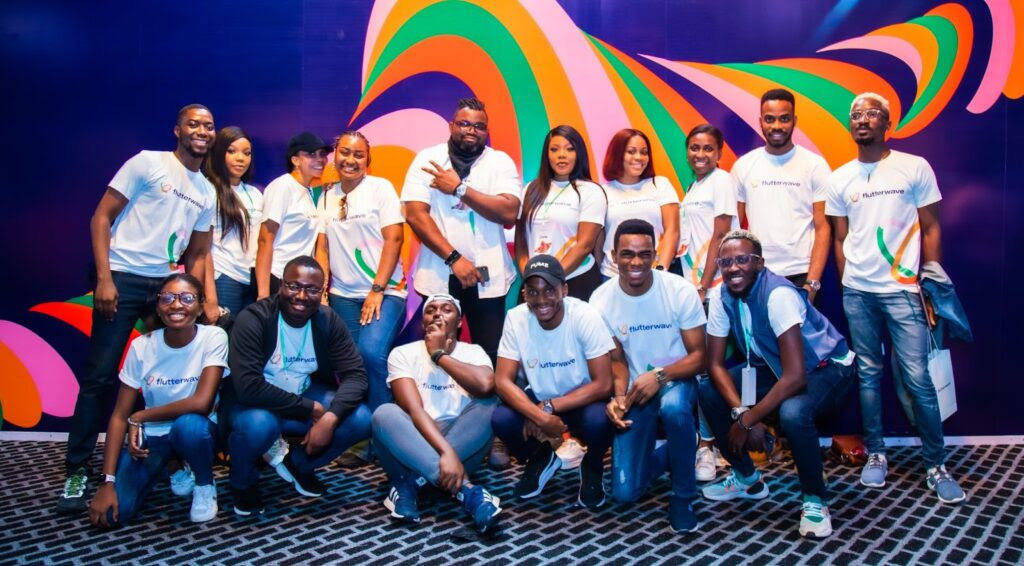
Nigerian Fintech company Flutterwave has partnered with the Africa Fintech Summit as the lead fintech sponsor for the summit which will be held in Washington, D.C. on the 12th of April 2023.

The summit is also backed by the strategic sponsorships of numerous prominent fintech firms such as Mojaloop Foundation, FonBank, Paxful, and several others.

Flutterwave’s founder Olugbenga Agboola, popularly known as ‘GB’, expressed gratitude for his startup being the lead sponsor at the prestigious AFTS event. He added that flutterwave is always enthusiastic to work with the African fintech summit.

In his words,

Once again, we’re happy to be a lead sponsor at this year’s AFTS event. We believe that the AFTS network has been instrumental in developing and shaping the fintech industry in Africa and Flutterwave has been an active enabler of the ecosystem growth.

“We’re always enthusiastic to work with the Africa Fintech Summit team in engaging stakeholders and partners who help us create endless possibilities. We’re excited about all this opportunity provides as we continue on our vision to connect African countries through payments”.

Also speaking on Flutterwave being the lead sponsor of the summit is the Co-Founder of AFTS Zekarias Amsalu who said, “It is with immense gratitude and great pleasure we are welcoming back Flutterwave as our Lead Fintech Sponsor for both our April & November summits this year. Flutterwave has been – and continues to be an impactful, progressive, and innovative Fintech that enables the wide Fintech ecosystem in Africa and beyond and demonstrates the Africanization of Tech in its global growth trajectory”.

He further stated that following the theme of globalization of African tech, the summit will provide a platform for stronger US-Africa fintech investment ties and collaborations.

Since its first summit in 2018, the Africa Fintech Summit has become the largest bi-annual financial technology gathering on the African continent. The African fintech summit will attract the presence of policymakers, regulators, financial and technology industry executives, fintech founders, investors, leading innovators, and government representatives from around the world.

The summit is the premier global initiative dedicated to financial technology growth in Africa, that  provides an ideal opportunity for key stakeholders to share knowledge, and zoom in on trends, and opportunities shaping perspectives, and the future of fintech in Africa.

The event will focus on policy and regulation, US-Africa Fintech connections, Diaspora Finance, Remittance & Cross border payment, tech talent, the future of banking, powering African fintech via VC, intra-Africa trade & payment infrastructure, blockchain, mobile money growth and integration, Embedded Fintech, and financial inclusion among others.

This time for Bitcoin and Cryptos as Slivergate Turns Wooden

0

It was a red session this morning. This is not an easy game for the hodlers! With FTX, and now Silvergate, the United States governments must step up and help the citizens of the world: “Silvergate Capital is reportedly shutting down operations and liquidating its Signature Bank following its inability to process transactions and the underlying bank run as a result of a boycott by top Crypto Exchanges— Coinbase, Kraken, Binance, among others. On March 9, 2023, Silvergate Capital announced that it would wind down the business and liquidate Silvergate Bank.”

The crypto meltdown isn’t over: Silvergate Capital says it’s liquidating its bank and shutting down. The crypto firm cited “recent industry and regulatory developments” for the move, which comes days after it delayed filing its annual report in order to determine the “viability” of its business. Once Silvergate announced its future was in doubt, other major crypto firms, including Coinbase and Galaxy Digital, quickly severed ties. Silvergate was also hit hard by FTX’s collapse, since FTX was both a client and a backer of the bank. (LinkedIn News)

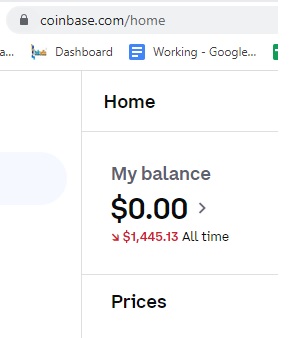
I lost $1,400 today . I received Bitcoin payment from a startup board in London (I delivered an expert opinion on microelectronics for mining) and was distracted that I did not cash out as I do (if you pay me in BTC, I cash out upon settlement, no hodling here), and waking up, the money has dropped. How do you get money and within days, it loses this type of value  . My strategy has been: pay this teacher, and the teacher cashes out to USD immediately.

This is indeed a new world; shine ya eyes people.

Silvergate is Shutting Down Operations and Voluntarily Liquidating Signature Bank

0

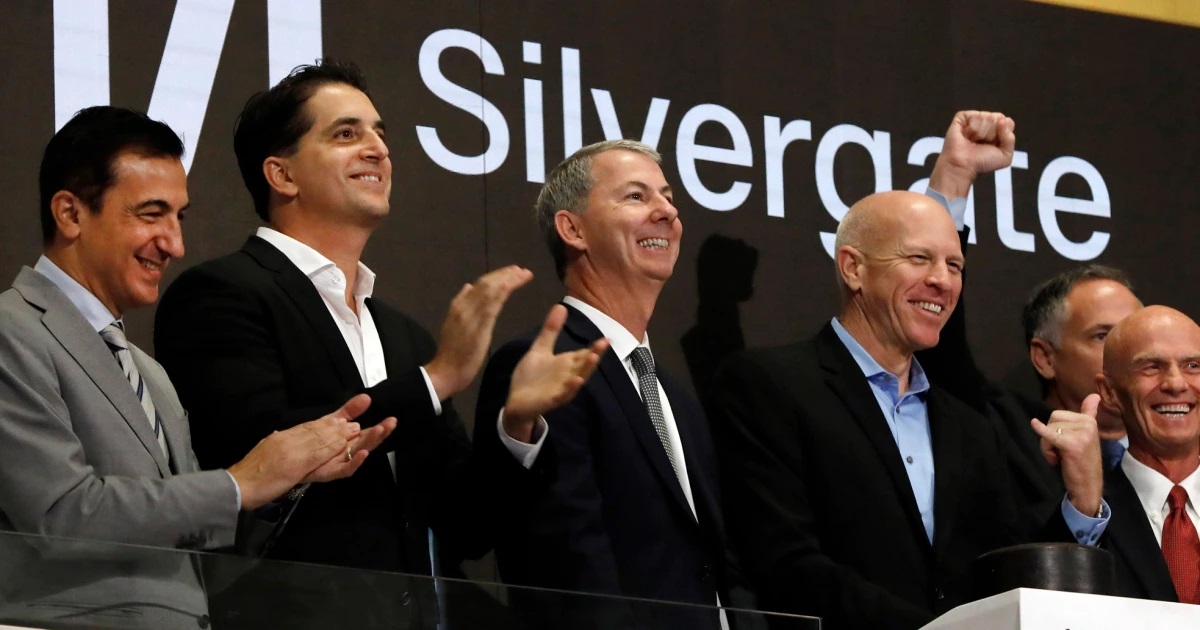
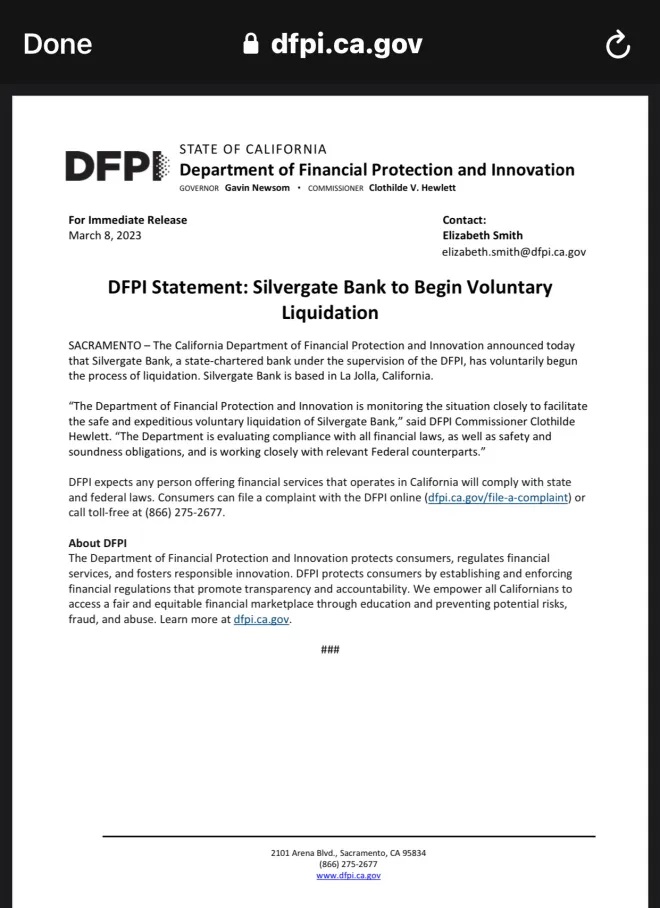
Silvergate Capital is reportedly shutting down operations and liquidating its Signature Bank following its inability to process transactions and the underlying bank run as a result of a boycott by top Crypto Exchanges— Coinbase, Kraken, Binance, among others. On March 9, 2023, Silvergate Capital announced that it would wind down the business and liquidate Silvergate Bank.

Silvergate is one of the two major digital banking giants in the United States, with $11 billion in assets. The drama ended quickly, Silvergate decided to liquidate the banking business, and the capital behind it was hindered by the US regulatory environment which did not help.

Silvergate Capital promised to repay all deposits in full, while still considering how best to resolve claims and preserve its assets Residual value, including its know-how (acquired Diem technology) and tax assets. This is the first US bank to fail since 2020.

The collapse in the stock price of crypto bank Silvergate marks the decline of yet another industry giant since the FTX debacle. Crypto watchers hoping it can’t get any worse may have one market trend on their side.

”Bankruptcy and fraud enforcement – people tend to see those potentially as bottom signs,” a hedge fund manager and short seller Alan Lane noted. The fund investor has been watching market developments, but does not have any positions in crypto names.

“On one hand, from a classic perspective, this is a time when you’re looking at what and how to buy,” the hedge fund manager said. And yet, on the other hand: “If I’m an American, I would not want any crypto exposure that has any nexus in the US.”

The investor is referring to the US regulatory crackdown, which has mounted in recent weeks with Securities and Exchange Commission Chair, Gary Gensler slapping actions on Kraken Exchange and Paxos, issuer of Binance stablecoin— BUSD, fears are spreading that such watchdog moves are only the beginning.

Silvergate: Crypto Bank Accounts for 50% of USD Deposits and Withdrawals Liquidity. The bankrupt liquidation of this bank is a devastating blow to the liquidity of the currency circle. Lack of liquidity will lead to a large number of sharp rises and falls. To put it bluntly, the money in the currency circle is flowing out of the banker. It is easier to pull and smash the market, and good liquidity is the basis of a bull market.

Senator Elizabeth Warren wrote on microblogging platform Twitter that; “As the bank of choice for crypto, Silvergate Bank’s failure is disappointing, but predictable. I warned of Silvergate’s risky, if not illegal, activity—and identified severe due diligence failures. Now, customers must be made whole and regulators should step up against crypto risk.”

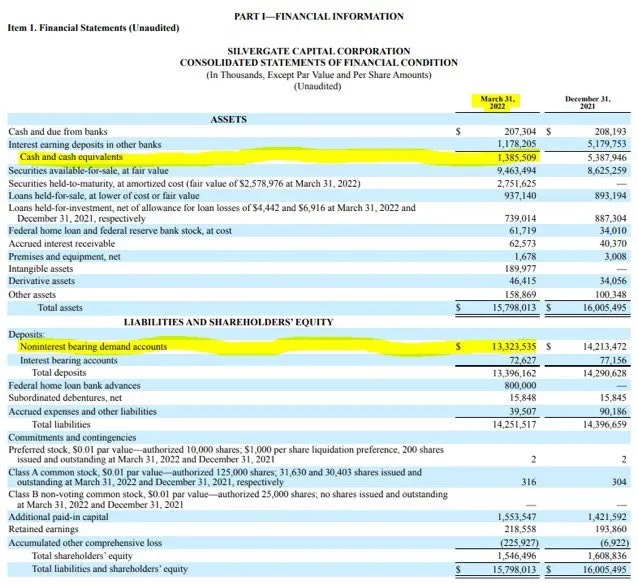
Silvergate was an EXTREMELY illiquid bank going by its balance sheet. Probably the worst illiquid bank in the United States. Other crypto friendly banks are not nearly as illiquid. If they face a run, they likely will not be able to honor withdrawals. Do you know where your exchange banks?

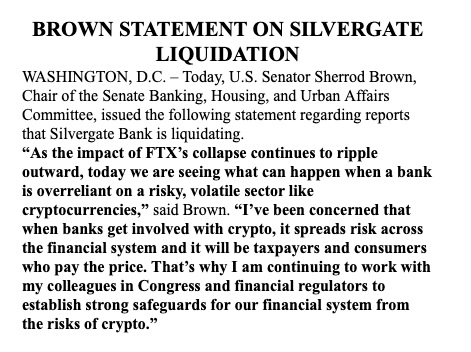
Sen. Sherrod Brown on Silvergate’s failure:

Silvergate is closing because of general bad financial management; crypto and US treasuries exposure, which both decreased in 2022. Crypto exposure plus better financial management would have prevented this. But now it’s an example of “toxic crypto” narrative, ignoring other stuff.

The issue with Silvergate isn’t that they dealt in crypto, it was taking on risks that banks should not be taking on, specifically lending out of customer assets and playing around on leverage without customer’s permission.

Crypto and particularly blockchain had little to do with FTX’s fall. It was significantly the result of straight-up fraud—can happen in any industry. Governments should institute a workable framework or make use of the existing Digital Asset laws we already have so the financial sector doesn’t create another SBF conman as a result of lack of oversight enforcement.