Nigeria’s Gross Domestic Product (GDP) grew by 3.52 percent in the fourth quarter of 2022 on a year-on-year basis, according to latest report released by the National Bureau of Statistics (NBS) in Abuja on Friday.
The NBS Nigerian Gross Domestic Product Report Q4 2022 said the growth is as a result of 2.25 percent increase recorded in the third quarter of 2022 and 3.98 percent in the fourth quarter of 2021.
The growth was spurred by increased performance in the non-oil sector – where agriculture put up a notable performance despite being heavily impacted by flood.
According to the report, published by NAN, the performance of the GDP in the fourth quarter of 2022 was driven mainly by the services sector, which recorded a growth of 5.69 percent and contributed 56.27 percent to the aggregate GDP.
It said although the agriculture sector grew by 2.05 percent in the fourth quarter, its performance was significantly hampered by severe incidences of flood experienced across the country.
“This accounted for lesser growth relative to the fourth quarter of 2021 which was 3.58 per cent.’’
The report, however, said the Industry sector was still challenged, recording -0.94 per cent growth and contributing less to the aggregate GDP relative to Q3 2022 and Q4 2021.
It said overall, the annual GDP growth rate in 2022 stood at 3.10 per cent, from the 3.40 per cent reported in 2021.
“Thus, the performance of agriculture and industry reduced in 2022 relative to 2021, while the performance of the services sector improved in 2022,’’ the NBS said.
The report said in Q4 of 2022, aggregate GDP stood at N56, 757,889.95 million in nominal terms.
“This performance is higher when compared to the fourth quarter of 2021 which recorded aggregate GDP of N49,276,018.23 million, indicating a year-on-year nominal growth of 15.18 per cent,’’ it said.
A breakdown by sector showed that crude oil production in the fourth quarter of 2022 recorded an average daily oil production of 1.34 million barrels per day (mbpd).
“This was higher than the third quarter of 2022 production volume of 1.20mbpd by 0.14mbpd,’’ the report added.
The NBS said the oil sector contributed 4.34 per cent to the total real GDP in Q4 2022.
The report said this showed a decrease from the figures recorded in Q4 2021 and Q3 2022, where it contributed 5.19 per cent and 5.66 per cent.
It said the total annual contribution of oil to aggregate GDP in 2022 was 5.67 per cent.
The NBS said the non-oil sector grew by 4.44 per cent in real terms during the reference quarter (Q4 2022).
The report said the non-oil sector in Q4 2022 was mainly driven by activities in Information and Communication (Telecommunication), Trade, and Agriculture (Crop Production).
“Others are Financial and Insurance (Financial Institutions), Manufacturing (Food, Beverage and Tobacco), Real Estate and Construction, all accounting for positive GDP growth.’’
It said in real terms, the non-oil sector contributed 95.66 per cent to the nation’s GDP in the fourth quarter of 2022.
The NBS said this was higher than the share recorded in Q4 2021 which was 94.81 per cent and higher than Q3 2022 recorded at 94.34 per cent.
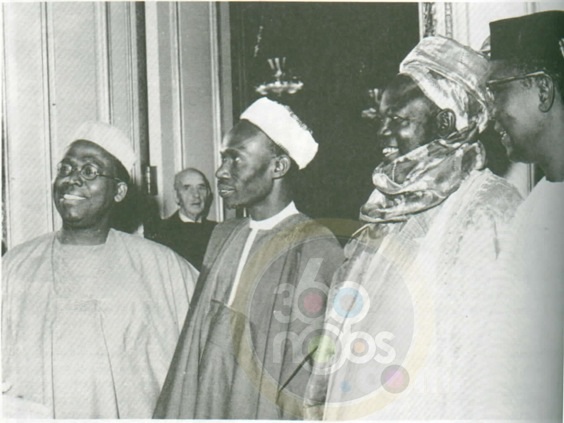
The ant-hills are not built by the elephants but by the collective efforts of the little ants. Nothing can stop a team of highly motivated people who have a defined purpose and a mission. Years to 1960, some Nigerians began a project, and the project was to liberate the nation out of colonialism. They came together, and executed: Nigeria became an independent country, politically.
Political independence is the first phase of true independence. The greatest liberation of a people is when that political independence transmutes into economic independence. Today, with high unemployment, vagaries of insecurity, and other vices, Nigeria needs that new dimension of independence.
Tomorrow, a new project can begin to execute that economic independence – and you’re trusted as a voter in Nigeria to assemble the team. When Nigeria does well, we all win. I challenge you to #vote and help to assemble this team, to bring that ascension into true independence. It will be #open as I noted here.
A new protocol service has been issued which allows digital assets to be minted to the Bitcoin Blockchain. It is called ‘Ordinal’
It declares itself NOT an NFT, and yet, it probably embodies more about what an NFT should be, than any token protocol we have had yet!
To talk about what Ordinal is, and isn’t we will probably first need to recap on what actually an NFT is.
NFTs are a type of token that give ownership title or ‘deed’ to a digital asset through minting on a blockchain. They are not the asset itself. For example: They are not a Cryptopunk or a Bored Ape.
As a token, to be considered an NFT, it has to be minted according to a specific protocol. That protocol needs to explicitly show that it has been designed to tokenize digital NFAs (Non Fungible Assets).
Tokens minted according to a protocol which describes itself as simply a ‘Token Standard’, ‘Multipurpose Token Standard’ or ‘Fungibility Agnostic Standard’ are NOT NFTs.
The processes involved in authoring a new NFT protocol for the creation of NFTs is as follows:
Declaration of intent.
The author(s)/designer(s) set out an abstract which demonstrates clear intention of creating a protocol best suited to tokenizing digital NFAs (Non Fungible Assets).
Execution and Testing
The author(s)/designer(s) design the protocol in compliance with the abstract’s expectations with sequential design iterations and testing to establish it improves on both performance and vulnerabilities of existing protocols in the same ecosystem.
Documentation
The author(s)/designer(s) produce end-to-end documentation recording 1-2 above, and publish it for public view. The protocol documentation explicitly announces itself as an ‘NFT’ protocol. It should also document any reference implementation.
An aside on Satoshis
Every once in a while, I will get some bright spark trying to claim that because a Satoshi is an indivisible atomic unit, then the currency must be an NFA. There are 100 million satoshis (sats) in one bitcoin, meaning each satoshi is worth 0.00000001 BTC.
This is just a distraction to derail any sense of clarity around when the blockchain token of a digital asset is an NFT, and when it’s not.
Firstly, the fungibility isn’t about being infinitely sub-divisible. It is about how practical sub divisibility is in value exchange. Does subdividing preserve value?
For a tangible example, as a mass commodities trader in water, there may be a prevailing price of 0.245721 litres water to the dollar. If somebody wants to digitally purchase $150.57 worth of water, they can. The transaction will go through exchanging a holding that has an obscure decimal. It will not all be whole litres.
This is fungibility demonstrated. The fact that the smallest unit in water is a molecule with one oxygen atom and two hydrogen atoms is irrelevant. The functional unit of exchange is the litre.
A tangible example of a ’Non-Fungible’ asset would be an antique ‘Ming’ dynasty vase. Though it may be worth $100m, if you owe someone $1m, you cannot smash it on the floor, find a piece roughly 100th the size and pay them. Once broken all the pieces are worthless.
However, all of these justifications are a further distraction as the overriding issue is that the tokens entitlement to be considered an NFT is ONLY about the protocol in use. Does that protocol meet a standard intended as ‘NFT’ in line with the 3 point processes –
Declaration of intent. 2. Execution and Testing and 3. Documentation.
Ordinal lay out their position on their token in the context of what an NFT is. Only one other token protocol does this – ERC/EIP 721 on Ethereum.
And finally on to Ordinal.
Ordinal describes its tokenization protocol (if it can even be considered so) as creating ‘Digital Artefacts’ through inscribing on a Satoshi.
It also claims to be the most ‘NFT’ non NFT. Yes, this may seem confusing, but if we unpack it, we can understand why they say something like that in the Ordinal documentation.
Here, Ordinal are eluding to what happens on the Ethereum ecosystem without directly saying so.
After all, their job is to talk about what Ordinal is, not talk about Polygon, The Binance ecosystem, and other Eth L2’s, scaling systems or EVMs.
One of the things about scaling solutions and EVMs is that they are commercially owned structures, and they don’t release all, and sometimes don’t release any of their protocol and architecture details.
There is a limited amount to be achieved by writing from the perspective of not having a full deck of cards. So I am selective of when I decide to talk in detail about the architecture of corporate actors.
The higher-level description is that tokenization becomes a split key, with a major part of the key being held in the scaling system off chain, while only a small bit, called ‘meta data’ makes it to the eth core.
When this happens, it undermines the security and privacy credentials in the concept of blockchain tokenization – NFT or not.
This discounts their contribution to ‘Web 3’ as there is no route for the user to have an end-to-end decentralized UX.
The only way to really establish if an ‘0x’ token is an NFT or not, is to look at the asset listing on a market like OpenSea, Rarible or Hashgreed etc.
If it says ERC/EIP 721, it is an NFT. If it says ERC/EIP 20, or 1155, it’s not. Because of gas fee cost and performance, majority of the assets visible to the public, have tokens that are not NFTs at all.
Again, just to reiterate, if the asset is visually represented by a piece of digital art, this has no bearing on whether the token is an NFT or not.
Quite the contrary, internal utility assets in different parts of the eth ecosystem are more likely to be NFTs than digital art collectibles, because they are not pushed out to a shop front, so scaling may be less important, and other factors of the ‘Blockchain Trilemma’ may be more relevant.
Because an Ordinal token is an inscription on a Satoshi at the Bitcoin Core, then notionally, it possesses properties that reflect the ‘vision’ of what an NFT should be, while L2, EVMs and Scaling systems off Ethereum have been rapidly marching away from that with reckless abandonment.
Expect to see the ‘Digital Artefact’ model to expand.. Three days ago, Github user ynohtna92 forked from Bitcoin Ordinals to mint the first-ever Litecoin Ordinal.
9ja Cosmos is here…
Get your .9jacom and .9javerse Web 3 domains for $2 at:
For several minutes, hours, days, weeks and months, candidates and their political parties engaged Nigerians, especially those who are eligible to vote on February 25, 2023, electing a new president, on different platforms at different places. Both the candidates and parties disseminated messages that substantiated programmes stated in their manifestos. While presidential candidates in 1999, 2003, 2007, 2011, and 2019 had opportunities to reach 54 million to 84 million voters, the 18 political parties that fielded candidates for the 2023 presidential election had the same chance of canvassing votes by reaching over 93 million voters. This is basically from the supply side of the political economy of campaigning. From the demand side, voters agreed and disagreed with the messages using different approaches towards understanding who should be voted for.
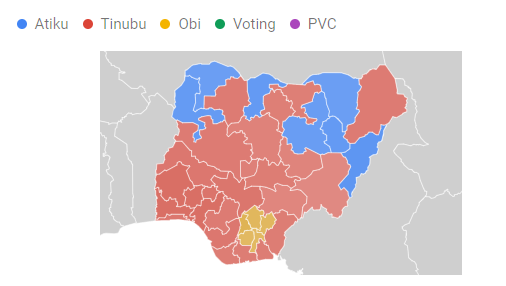
In this special piece, our analyst examines the last 7 days (February 18 to February 24, 2023) of the public’s interest in the three dominant candidates, their readiness to vote and their curiosity about collecting their permanent voter card. Our first-level analysis reveals that out of 14,989 searches during the period, Senator Bola Ahmed Tinubu, the candidate of the All Progressives Congress, had the highest percent (41.09%), followed by Mr. Peter Obi (32.47%), while Alhaji Atiku Abubakar had 16.51%. Voting had 4.55%, while PVC received 5.36%.
Public interest in the three candidates in connection with interest in voting and PVC was strong during the period. Over 70% of the interest in the candidates was found in the public’s interest in voting. However, there are differences in the percentage of interest the public had in voting and knowing the status of their PVCs after developing significant interest in each candidate. According to our findings, one unit of interest in Alhaji Atiku Abubakar translates to 21.1% interest in voting.It was 63% for Mr. Peter Obi and 5.1% for Senator Bola Ahmed Tinubu. These findings indicate that Nigerians who use the Internet are more likely to vote on February 25, 2023, based on the information they obtained from various platforms or sources.
Our analysis also reveals that the public interest in the candidates resonated with understanding of PVC by 64.6%. This is less than what our analyst found for voting and suggests the public’s greater aggressiveness in voting than in picking up their PVC. Meanwhile, when the public developed interest in the candidates in relation to having information about PVC, Mr. Peter Obi was more searched in connection with PVC than other candidates, especially Senator Bola Ahmed Tinubu. In our analysis, we found that one unit of interest in Mr. Peter Obi resulted in seeking information about PVC by 51.3%, while Alhaji Atiku Abubakar had 33.2%. However, one unit of interest in Senator Bola Ahmed translated to -10.1% interest in PVC, indicating insignificant interest in PVC as the public developed interest in the ruling party’s candidate.
Exhibit 1: Interest in candidates, voting and PVC by state
Source: Google Trends, 2023
Candidates and Public Concerns
While the public developed interest in the candidates using different search terms and names, they were mostly directed to various sources that revealed different information about the candidates and their political parties. In our analysis, we found that the three candidates were better understood through non-issue-based campaign messages than issue-focused ones. For instance, the public was more concerned about the five governors of the People’s Democratic Party who have been making different submissions about endorsing or not endorsing the candidature of Alhaji Atiku Abubakar. Nigerians, as evidenced by those who frequently use the Internet, were interested in whether Mr. Peter Obi would abandon his bid to become the next president by withdrawing from the race and supporting Alhaji Atiku Abubakar. This was also discovered for Senator Rabiu Kwankwaso. Nigerians were interested in whether he had joined the PDP’s candidate.
Senator Bola Ahmed Tinubu was more understood throughout the days examined by our analyst, based on a false report that his house had been raided by the Economic and Financial Crimes Commission. Some Nigerians expressed great concern about his primary school on various digital platforms. Some of the concerns the public had about the PDP’s candidate were discovered for Mr. Peter Obi as well. For example, the public had a significant interest in knowing about smaller political parties that had adopted him as their presidential candidate. Information about how ADC and SDP adopted him was vigorously sought in this regard. Apart from this, how or whether individuals such as Danjuma endorsed him was of great concern to some Nigerians. Like understanding some of the achievements of the APC’s candidate, Nigerians also sought information about the performance of Mr. Peter Obi as governor of Anambra State. Some even inquired about the number of years he served as governor of the state. As they searched for this information, according to our analyst, they did not forget to make inquiries about the Independent National Electoral Commission in relation to Mr. Peter Obi’s polling unit, his political party and how to vote for him on February 25, 2023. Surprisingly, the public equally sought information about other candidates while developing interest in these concerns.
Concerns Regarding Voting and PVC
What types of concerns did Nigerians have about voting and PVC in the last 7 days? In the first instance, our analyst discovered that learning how to locate polling units, check PVC online, and identify polling unit codes occupied their minds. In the second instance, they mostly focused on whether their PVC could be used at any polling unit without forgetting whether they could vote without it. One of the surprising concerns was the public’s interest in where to collect PVC. Our analyst found this surprising because the electoral body had made provision for the collection several days ago. So, why was this question still on their minds?
The Nigerian Communications Commission (NCC) has advised Nigerians to ignore messages that insinuate deliberate shutdown of all telecom networks and online bank transactions, as Nigeria holds its 2023 presidential election on Saturday.
In a statement by the NCC Director of Public Affairs, Reuben Muoka, he described such claims being circulated as fraudulent and misleading.
He further added that such malicious messages are being circulated by unscrupulous elements in society with the intent to cause chaos and panic among the populace.
The statement read in full,
“The attention of the Nigerian Communications Commission, NCC, has been drawn to fraudulent and misleading information circulating in some social media platforms, insinuating there is a planned shutdown of all telecom networks and relevant ICT units, including online transfer facilities of the banks, with effect from 23 February 2023.
“The Nigerian public, consumers of telecommunications services, and all bank customers are advised to ignore these or similar messages that insinuate deliberate network shutdown or disruption of services in the Nigerian telecom network.
“These malicious and subversive messages originated and are being circulated by fraudsters and unscrupulous elements in the society with the intent to cause chaos and panic among the populace.
“The Commission has received unequivocal assurances from all the service providers to the effect that all the network services are currently in optimal performance, and will not witness any deliberate shutdown or disruptions, especially at this very crucial period of general elections in the country.
“Therefore, all users of telecommunications and banking services utilizing network facilities are assured of continued optimal service delivery before, during, and after the general elections in Nigeria.”
In its patriotic commitment towards the conduct of hitch-free elections in Nigeria, the NCC has rolled out its consumer toll-free number 622, to serve in the 2023 presidential election to enable voters and members of the public in Nigeria to report any issue that needs to be resolved during the election.
The 622 Election Incident Monitoring Centre will be manned by top Management officials of the Nigerian Communications Commission, and the hotline will be open to the public from 8:00 am to 6:00am during the presidential and National Assembly elections. The NCC, therefore, urged the members of the public to take advantage of the election incident monitoring center hotline.
Meanwhile, the Nigeria Civil Society Situation Room has informed the Nigeria Communication Commission (NCC) that it will be held responsible for any network issues and internet outages on the day of election.