DD
MM
YYYY

PAGES

DD
MM
YYYY

spot_img

PAGES

Home Blog Page 4403

Best Crypto Stocks to Hold For the Bull Market— Big Eyes, Sandbox, and Cardano

0

Almost everything in the cryptocurrency market is undervalued, and it has been boring. To prevent some coins from being overrated, patience is necessary. The crypto assets you’ll be looking at the need to display their strength. Cryptocurrencies with a respectable rebound at the bull market are good prospects to watch for in the bull market.

There is a significant market for cryptocurrency projects with long-term roadmaps and practical applications. This is the only factor for the sustained rise of Sandbox (SAND) and Cardano (ADA). In this article, we’ll examine three tokens to see what makes them special. Sandbox (SAND) and Cardano (ADA) are two top picks for highly discounted cryptocurrencies. On the other hand, Big Eyes Coin (BIG) is a fresh cryptocurrency worth considering for massive profit during the next bull run. Keep reading to learn more. 

Sandbox (SAND)

The Sandbox (SAND) is a blockchain gaming cryptocurrency that powers a virtual reality (VR) environment where users may produce, play, and sell content. The Sandbox (SAND), one of the best metaverse projects in the crypto sector, gives developers access to resources for making play-to-earn (P2E) games. Users can participate in gameplay and social activities while earning, purchasing, and selling assets through The Sandbox (SAND) project.

Sandbox (SAND) holders are eager to participate in the expanding NFT market because they are a part of the ecosystem that is causing the NFT expansion. They can construct and install buildings on their LANDs and hold lucrative events. By leasing or selling their LAND tokens to other users for a price, LAND owners can also make money.

Many crypto market professionals believe The Sandbox (SAND) will orbit the moon. The best time to purchase this cryptocurrency is before the bull market resumes. 

Cardano (ADA)

Cardano is a cryptocurrency that employs the “ouroboros” proof-of-stake (POS) technique. A mechanism called “Ouroboros” enables users to use cryptocurrencies as collateral to authorise transactions. With predictions of Cardano being 47,000x more efficient than other cryptos employing “proof-of-work” mining, this is a more sustainable way than the “proof-of-work” method employed by other coins.

Cardano was the first peer-reviewed blockchain developed by scientists and academics, and it was developed by a co-founder of the well-known cryptocurrency “Ethereum”. This indicates that it can be scaled up globally without compromising sustainability or security. Compared to larger coins, this money can handle 1000 transactions every second. Cardano thus offers an effective and environmentally friendly alternative to several other cryptocurrencies. 

Big Eyes Coin (BIG)

Big Eyes is a community whose success is dependent on the actions of its members. The real strength of Big Eyes Coin (BIG) rests inside its neighbourhood. The momentum increases as the scope, intensity, and number of participants do. Consistent gift, NFT, and token distribution will benefit the community the greatest. The neighbourhood’s go-to place for the most recent information is Big Eyes Coin (BIG). This is a commitment Big Eyes Coin (BIG) has made to its customers.

Big Eyes Coin promises its users a completely community-run network as part of its goal to communicate with its users and become the most significant cryptocurrency. Big Eyes was created to move money into the Decentralised Finance (Defi) system to safeguard a crucial component of the world’s ecology. When Big Eyes tokens (BIG) are released, it will be easy for prospective members to obtain some because 90% of all BIG will be made available to the general public. A tax-free token exchange and purchase system is in place for Big Eyes as well.

Big Eyes Coin, the amiable cat, is concerned about the environment and donates 5% of the tokens to charity. By selling their goods, these charitable wallets generate funding for marine sanctuaries. Big Eyes Coin considers ways to increase profits while also protecting the environment. Members of the Big Eyes community are eager to take any possible part in fields that are advantageous to both the economy and the environment.


Big Eyes Coin (BIG)

Presale: https://buy.bigeyes.space/

Website: https://bigeyes.space/

Telegram: https://t.me/BIGEYESOFFICIAL

Avalanche (AVAX) expands horizons with new decentralized exchange, Polkadot (DOT) launches 2nd phase of blockchain academy in Argentina, TMS Network (TMSN) launches with a price of $0.0047

0

The cryptocurrency market is in a state of constant flux, with new projects and initiatives launching on a daily basis. While this can be overwhelming for some, it also presents a unique opportunity for savvy investors to be a part of promising new ventures. One such project is TMS Network (TMSN), which is poised to scale better than Avalanche (AVAX) and Polkadot (DOT) tokens due to its revolutionary concept. In this article, we will give an overview of the market performance and updates of Avalanche (AVAX), Polkadot (DOT), and TMS Network (TMSN), and explain why TMS is a project worth watching.

Avalanche (AVAX) trades near its lowest prices

The recent integration of decentralized exchange, Dexalot, shows that Avalanche (AVAX) is continuing to make progress. Avalanche’s (AVAX) platform seeks to compete with traditional centralized exchanges by providing a trading environment that is open and transparent. Dexalot is a platform built on the C-Chain network that supports EVM, and allows for the direct exchange of ERC-20 tokens for Avalanche (AVAX). On the price front, in the past week, the value of Avalanche (AVAX) has dropped by 13.09%. In the past day, the cost has fallen by 8.56%. The recent price analysis suggests that in the coming months, the price of Avalanche (AVAX) could range from $18 to $45. As of right now, the price of an Avalanche (AVAX) token is very close to its lowest point. Whether or not Avalanche (AVAX) recovers to anywhere near its highest price forecast is something that only time can tell.

Polkadot (DOT) declines by 70% in a year

The Polkadot Blockchain Academy, an educational venture run by Polkadot (DOT), will soon begin teaching blockchain technology to students at the University of Buenos Aires. According to a recent tweet on Polkadot’s (DOT) page, the goal of the Program is to help train engineers to create superior Web3 products. Despite the positive developments on the Polkadot (DOT) network, the price action is bearish as indicated by the technical indicators.

As per analysts, it is not recommended to invest in Polkadot (DOT) at the moment, and the pricing data from the past supports the statement. Since last February, the cost of Polkadot (DOT) has dropped by over 70%. Additionally, Polkadot (DOT) has also seen a price drop of 7.53% over the past week. In just the past day, the price of Polkadot (DOT) has fallen by 8.05%. Polkadot’s (DOT) price forecast indicates a gradual decrease. By 2024, experts predict that Polkadot (DOT) will be worth just $0.443.

TMS Network (TMSN) generates massive market interest

TMS Network (TMSN) is a new cryptocurrency exchange whose ICO has been launched recently with a price of $0.0047 per token. TMS Network (TMSN) is designed to be totally decentralized, with no central authority controlling the platform. This makes TMS Network (TMSN) different from other exchanges in the space, which are often subject to regulations. With TMS Network (TMSN), all transactions are processed on the blockchain, ensuring that they are transparent and efficient. Furthermore, TMS Network (TMSN) makes use of smart contracts to make trading completely secure.

TMS Network’s (TMSN) ICO launch marks a major milestone for the cryptocurrency industry, as it is expected to skyrocket in terms of prices and popularity. Additionally, TMS Network (TMSN) offers a number of features that are designed to appeal to both experienced traders, and those new to the world of cryptocurrency. For investors looking for the most reliable token to invest in with massive future prospects, TMS Network (TMSN) is the perfect investment, especially considering that token holders will benefit from the incentives that come with the commission revenue model.


Find out more below here:

Presale: https://presale.tmsnetwork.io

Website: https://tmsnetwork.io

Telegram: https://t.me/tmsnetwork

Twitter: https://twitter.com/tmsnetworkio

Nigeria Must Fix The Public Sector To Advance Economically

1

When an industry cannot attract some of the finest young people in a nation, that industry fades over time. In the 1960s and 1970s, the public sector in Nigeria attracted some of the brilliant young people in the country – and those minds architected a vision for the nation. By the 1990s, the banking and oil & gas sectors had taken over, sapping the public sector dry as they cornered the bests. In the 2010s, the telecom sector finished the game.

Today, you will struggle to see most top 5% graduating students from  any major university in Nigeria working in the public sector. Check your graduating class and compare!

Our challenges are multifaceted. Do not think we can just overcome them with new policies. Nigeria has great policies but we struggle on implementation and execution. And the reason is clear: the government does not have the capacity to execute most of its policies because the government does not have A-teams.

Have you visited your local government headquarters? What of the state secretariats? Can those offices compete for top talent? If they cannot, the implication is that your roads, clinics, and everything they’re to supervise will underperform.

I maintain this position: until Nigeria can elect a leader who can inspire young people to see a future in working for the government, we will not reverse this fading trajectory. You do not abandon the bottom of the class for the government, and tomorrow complain that nothing is working (this is not to say that the government does not have brilliant minds; I am using statistics here: the bulk of the workers do not offer value).

Get the point: Nigeria needs a leader who will inspire the future and attract that future to execute the right policies.

Comment on Feed

Comment 1: Unfortunately, for me, it was the A team in the 70s that ruined this country. The system trained them to feel entitled to public resources, they wanted more and more until everyone was hustling for his/her own shares. Nigeria produces one of the worst educated people on earth.

The same A team started sending their children abroad to get education, seeing it cost more, and wanted more public funds to fund the fees. These children get educated and refuse to come back, except of course they see opportunity here to continue to milk the system.

The A team of the 60s and 70s killed the country and blamed the GenZ for not being successful.

Given, they were smart individuals but morally bankrupt. They ripped a system that was innocent. I know a bank that went bankrupt in this country because the executives stole it dry and started their own bank that still exists till today. I know this because my father worked in the bank that went bankrupt. He was without a job for years.

Same way this generation is also making victims of innocent Americans and will make it difficult for future ones to even relate easily with them. The difference was that Nigeria was green then with so much potential.

It was a generation that got education basically to survive and not to provide solutions, or impact their world positively.

They got into the public sector and crippled it.

Leadership, as you have opined, is desired now to manage the not so educated ones who at least can be manipulated to achieve desired results.

My Response: The 1970s did not destroy Nigeria. What destroyed Nigeria is that Nigeria is unable to attract its smartest people to the public sector. In a graduating class of electrical and mechanical engineering from Ife, UNN and ABU, the Nigerian Railways was sure of getting quality 80% ready to serve -and the corporation was sure of attracting the top 5%. From Nitel to Waterboard to NEPA, etc those guys delivered. And we ran rail systems which worked.

But later, those agencies could not attract the best and suddenly those systems could not be maintained and they collapsed. Without picking your comments one by one, statistically, less than 0.1% could afford to send their kids abroad because Nigerian universities were just good and the money required was not there (one director sending a son to the UK when 1,000 staff under him had kids studying in Nigeria). When I was in FUTO (1998), I had schoolmates who were Indians, Europeans, etc. So, while some sent their kids abroad, that was insignificant.

There is no doubt that coups distorted the equilibrium system. There is no doubt that the next generation could not maintain systems manned by the former (see railway, roads, etc). Over time, there was an inflection point: the best went into banking, oil & gas and telecom. The implication is that Nigeria still produces great people. The issue is that most have no interest in the public sector. In my class in FUTO, none of the top 5% is working for the public sector (check your own class); that is the issue. Yes, I am not saying we’re not producing smart guys, my point is that most are not working for the public!

Comment 2:You don’t need the best minds. You need the best systems.
Public sector need consistent and stable administration.
You don’t have to best accountant to teach in a universtiy.
But, the university must be the place where you can create good accountants.
If you focus your strategy on getting the best talent. Especially in Nigeria, you would lose out on the competition because the public sector is not designed for top performers.
That is like putting gifted children in a regular school, it’s a disservice to not only the student but to the school as a whole.

My Response: you point is convoluted. Your assumption is that the systems are static. Understand that every generation has to build its systems, including supporting already existing ones. The public sector cannot build great systems without talent. When the public sector was attracting the best, banking, etc struggled. But when the inflection happened, those minds went to build the banks, telcoms and oil & gas systems. And with the public sector left without A-teams, it folded. Nigerian Railways did not collapse because of lack of train cars; it collapsed because the best engineers left!

Check the top 5% of your class, check where they work today. It is unlikely that more than 50% of them work for the public. If that is the case, building the systems for today will become challenging for public.

Yes, I am not saying we’re not producing smart guys, my point is that most are not working for the public!

Comment 3: Prof Ndubuisi We’re yet to see your analysis on Nigeria election.

My Response: We decided not to make it public. So, I am not making it public. But those in our private client services have copies already to drive their business decisions and risk modeling. Largely, I have realized that sharing intellectual things here may not help many. Unlike in the past where people asked for clarifications on things they did not understand, Nigerians have changed: they just curse, abuse, etc.

Comment 3R:  It is true. I remember you promised to make your prediction open and to be made opened around December. Is there any hint for us here that we can just run with as a guide? We will appreciate it. ?

My Response: I stopped sharing deep intellectual things on Facebook because most of the users surprise! I deleted the post where I “apologized” to Buhari for my non-understanding of his political philosophy. I shared the same post on LinkedIn and there are close to 416 comments (close to 90,000 impressions) and largely 100% are constructive even though some do not agree with me (but no abuse on the President).

But on Facebook, 29 commented and more than 16 were abusing the president: “you did not live in Nigeria to understand our suffering”, “Buhari is evil”, “Buhari is wicked”, “you support evil on people”, etc. I deleted the post because the comments made no sense. Buhari demands respect and people cannot use my feed to abuse the president. If you have issues with him, handle those on your feed and none mine.

Our progress in Blockchain and Web3, and why we are not nearly as ‘still early’ as we like to say we are.

0

A mellow ramble for a Friday Evening (from where I sit) that isn’t going to break any brains!

Increasingly, I am becoming bemused by a common construct that proponents of Blockchain and Web 3 follow, when creating content.

Usually a shallow few lines, thin on detail ending ‘We are still early’.

So, I started to think about that a bit, because it doesn’t get a hammering or meet criticism, so it must be a fairly commonly held view.

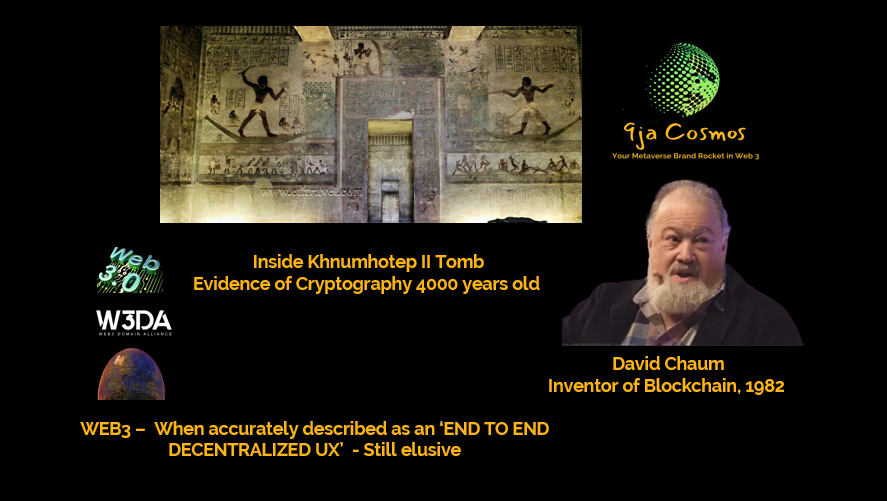
Blockchain was invented by a University of California at Berkeley doctoral candidate named David Chaum.

He outlined a blockchain database in his dissertation, “Computer Systems Established, Maintained, and Trusted by Mutually Suspicious Groups.” That was in 1982: 27 years before Bitcoin.

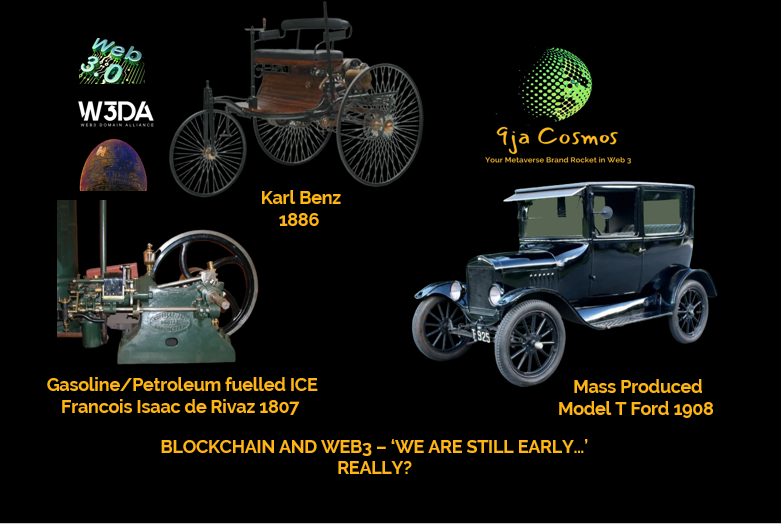
In my feature illustration, you will notice there is nothing about blockchain at all. I’ve depicted a few significant milestones in the development of the ‘automobile’.

The building block of the automobile was the Internal Combustion (Gasoline) Engine. So we have three steps of progression – from the engine, through to a handmade car, (Karl Benz) and on to the first mass produced car, the Ford Model T.

The equivalent trajectory to Web 3 is first Cryptography – sort of the ‘engine’ of Blockchain, then Blockchain, and on to Web 3.

Bear in mind that this comparison is enormously slanted to benefit Web 3. Automobiles manufacture is an energy intensive, space intensive, material intensive physical process. Web 3 infrastructure is achieved through computing and virtual networks.

It is a little bit like trying to compare the lifespan of a human with the lifespan of a fly. The significance of a day in the life of a fly profoundly exceeds the significance of a day in the life of a human.

Its conservative to say we should expect 10 years worth of development advance in blockchain technology in each one year of development advance of automobile.

The first known evidence of the use of cryptography was found in an inscription carved around 1900 BC, in the main chamber of the tomb of the nobleman Khnumhotep II, in Egypt.

An exasperating factor is there were no supporting technologies in the early part of automobile development. Between Chaum 1982 and Bitcoin 2009 we have seen the arrival of PCs, The Internet, and the Smartphone.

We have seen the appearance of ‘higher level’ (particularly ‘OO’ and scripting) languages making coding a lot easier, which has included C, C++, Visual Basic, C#. Java. Javascript, PHP, Swift, Python, Ruby and Objective -C.


Newer languages have grown from them post Bitcoin, but it is clear Blockchains didn’t miraculously arise amidst a technology vacuum.

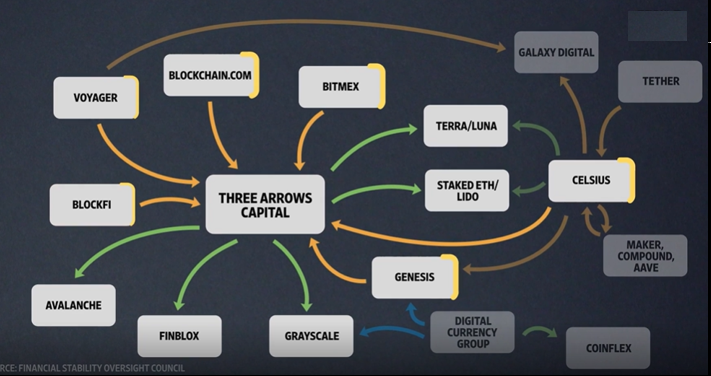
CEXs in particular have shown us the dangers of centralism in the mix… the problems  with FTX, Luna, Celcius, Three Arrows Capital etc, and now the SEC is taking interest in Binance.

Chart shows the contagion and vulnerability dynamic in the wake of the collapse of Three Arrows Capital

So what is supposed to deliver us ‘Web 3’ has an excess of 4000 year development path, and a 10/1 minimum time value advantage over the automobile trajectory. The automobile has got from ICE invention to Mass Production in 101 years (10/1 adjustment = 10.1 ‘Blockchain’ years!)

4000 years vs. 10.1 years, Web 3 as an ‘end to end decentralized UX’ nowhere in sight and probably more hurt to come from points of centralization in user journey.

Perhaps if the combination of ‘communities’ and corporate actors can’t get in agreement and get things done, we will have to bring in Chat GPT and finish the job!

Because…No…. We are ANYTHING BUT still early!


9ja Cosmos is here…

Get your .9jacom and .9javerse Web 3 domains  for $2 at:

.9jacom Domains

.9javerse Domains


All reference sites accessed between 17/02/2003

redhat.com/en/blog/brief-history-cryptography

kriptomat.io/blockchain/history-of-blockchain

www.timetoast.com/timelines/119691

i.pinimg.com/originals/75/66/14/756614b545c0a0b7da65910bf18dd223.jpg

mark-havens.medium.com/the-top-programming-languages-of-the-2000s-a-retrospective-a14c894f1d42

Tekedia Capital Works With Many Financial and Investing Clubs; Join Through Them

0

We get this question a lot: I do not have the minimum  required amount to invest  in startups via Tekedia Capital, how can I still participate? Answer: many investment clubs, financial clubs, angel clubs, etc pool resources from members, and invest as a unit via Tekedia Capital Syndicate. Through that process, even with $500 or Naira equivalent, you can participate, and co-own a piece of Africa’s finest startups. There are many of these entities in our business; ask.

We are starting the next cycle very soon; learn more about Tekedia Capital here .

Tekedia Capital provides a trusted and secure platform for individuals, institutions and investment groups anywhere in the world to invest in technology-anchored companies with focus on Africa.