DD
MM
YYYY

PAGES

DD
MM
YYYY

spot_img

PAGES

Home Blog Page 4404

Our progress in Blockchain and Web3, and why we are not nearly as ‘still early’ as we like to say we are.

0

A mellow ramble for a Friday Evening (from where I sit) that isn’t going to break any brains!

Increasingly, I am becoming bemused by a common construct that proponents of Blockchain and Web 3 follow, when creating content.

Usually a shallow few lines, thin on detail ending ‘We are still early’.

So, I started to think about that a bit, because it doesn’t get a hammering or meet criticism, so it must be a fairly commonly held view.

Blockchain was invented by a University of California at Berkeley doctoral candidate named David Chaum.

He outlined a blockchain database in his dissertation, “Computer Systems Established, Maintained, and Trusted by Mutually Suspicious Groups.” That was in 1982: 27 years before Bitcoin.

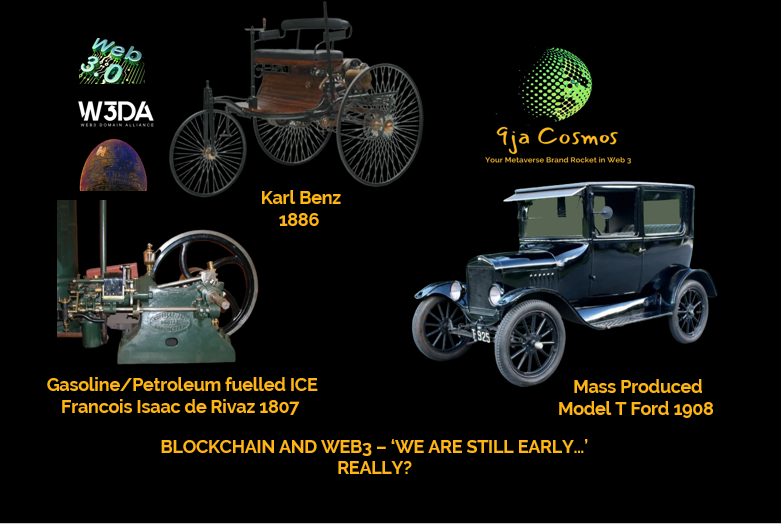
In my feature illustration, you will notice there is nothing about blockchain at all. I’ve depicted a few significant milestones in the development of the ‘automobile’.

The building block of the automobile was the Internal Combustion (Gasoline) Engine. So we have three steps of progression – from the engine, through to a handmade car, (Karl Benz) and on to the first mass produced car, the Ford Model T.

The equivalent trajectory to Web 3 is first Cryptography – sort of the ‘engine’ of Blockchain, then Blockchain, and on to Web 3.
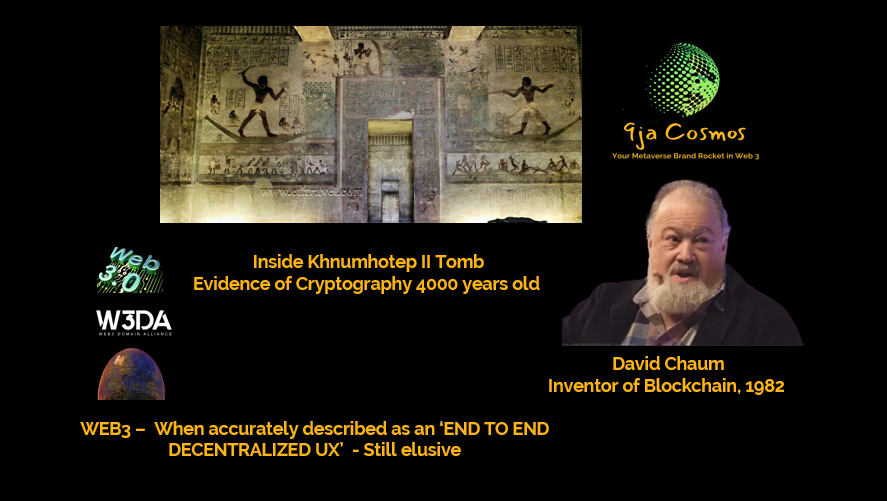
Bear in mind that this comparison is enormously slanted to benefit Web 3. Automobiles manufacture is an energy intensive, space intensive, material intensive physical process. Web 3 infrastructure is achieved through computing and virtual networks.

It is a little bit like trying to compare the lifespan of a human with the lifespan of a fly. The significance of a day in the life of a fly profoundly exceeds the significance of a day in the life of a human.

Its conservative to say we should expect 10 years worth of development advance in blockchain technology in each one year of development advance of automobile.

The first known evidence of the use of cryptography was found in an inscription carved around 1900 BC, in the main chamber of the tomb of the nobleman Khnumhotep II, in Egypt.

An exasperating factor is there were no supporting technologies in the early part of automobile development. Between Chaum 1982 and Bitcoin 2009 we have seen the arrival of PCs, The Internet, and the Smartphone.

We have seen the appearance of ‘higher level’ (particularly ‘OO’ and scripting) languages making coding a lot easier, which has included C, C++, Visual Basic, C#. Java. Javascript, PHP, Swift, Python, Ruby and Objective -C.


Newer languages have grown from them post Bitcoin, but it is clear Blockchains didn’t miraculously arise amidst a technology vacuum.

CEXs in particular have shown us the dangers of centralism in the mix… the problems  with FTX, Luna, Celcius, Three Arrows Capital etc, and now the SEC is taking interest in Binance.
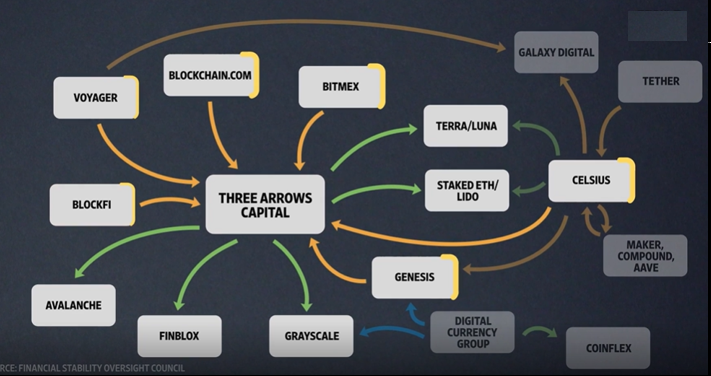
Chart shows the contagion and vulnerability dynamic in the wake of the collapse of Three Arrows Capital

So what is supposed to deliver us ‘Web 3’ has an excess of 4000 year development path, and a 10/1 minimum time value advantage over the automobile trajectory. The automobile has got from ICE invention to Mass Production in 101 years (10/1 adjustment = 10.1 ‘Blockchain’ years!)

4000 years vs. 10.1 years, Web 3 as an ‘end to end decentralized UX’ nowhere in sight and probably more hurt to come from points of centralization in user journey.

Perhaps if the combination of ‘communities’ and corporate actors can’t get in agreement and get things done, we will have to bring in Chat GPT and finish the job!

Because…No…. We are ANYTHING BUT still early!


9ja Cosmos is here…

Get your .9jacom and .9javerse Web 3 domains  for $2 at:

.9jacom Domains

.9javerse Domains


All reference sites accessed between 17/02/2003

redhat.com/en/blog/brief-history-cryptography

kriptomat.io/blockchain/history-of-blockchain

www.timetoast.com/timelines/119691

i.pinimg.com/originals/75/66/14/756614b545c0a0b7da65910bf18dd223.jpg

mark-havens.medium.com/the-top-programming-languages-of-the-2000s-a-retrospective-a14c894f1d42

Tekedia Capital Works With Many Financial and Investing Clubs; Join Through Them

0

We get this question a lot: I do not have the minimum  required amount to invest  in startups via Tekedia Capital, how can I still participate? Answer: many investment clubs, financial clubs, angel clubs, etc pool resources from members, and invest as a unit via Tekedia Capital Syndicate. Through that process, even with $500 or Naira equivalent, you can participate, and co-own a piece of Africa’s finest startups. There are many of these entities in our business; ask.

We are starting the next cycle very soon; learn more about Tekedia Capital here .

Tekedia Capital provides a trusted and secure platform for individuals, institutions and investment groups anywhere in the world to invest in technology-anchored companies with focus on Africa.


Ojebode, UI Foremost Communication Don, Retires from the University After 23 Years

7

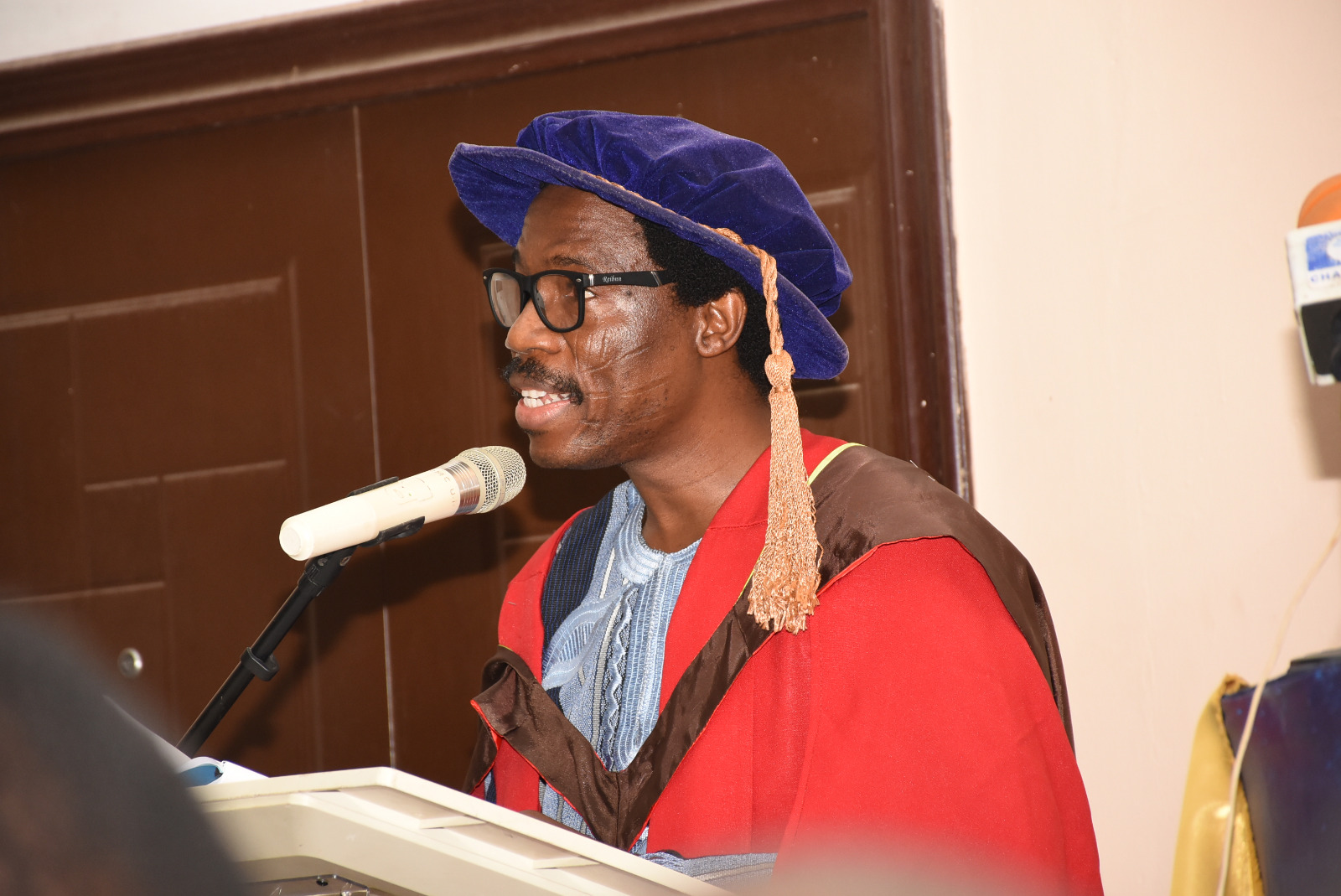
Professor Ayobami Ojebode, the University of Ibadan’s foremost development communication scholar, has retired from the university. Professor Ojebode communicated his voluntary retirement after 23 years of service to a group of past students and mentees who are members of the African Early-Career Researchers’ Academy. Professor Ojebode established the Academy for the purpose of scouting early-career academics and independent researchers for sustainable mentorship.

“On 15 February this year, I clocked 23 years on my job in the University of Ibadan. Roughly ten of these 23 years I had the privilege of spending as full professor, and 9 of it I spent heading my department,” Professor Ojebode said.

Professor Ojebode added that “In November 2022, I notified the University of Ibadan authorities of my intention to voluntarily retire from the university, thus commencing the mandatory 6-month notice I had to give my employers.”

During his tenure as the head of the Department of Communication and Language Arts, 41 PhD graduates were produced while 13 undergraduate students graduated with a First Class.

On September 5, 2019, Professor Ayobami Ojebode delivered his inaugural lecture titled “In search of muted voices for the mirage named development.” Our analyst reported the lecture and established his academic life from 2000.

Apart from his significant contributions to the academic community, Professor Ayobami Ojebode won individual and group grants for the conduct of research that led to significant impacts in Africa and other continents. Professor Ojebode was part of a team of researchers that won a £150,000 grant for the production of reports that enhance Africans’ digital rights.

“When I picked up the job in 2000, I realised I had around 40 years of working life ahead of me. And I started nursing this quiet ambition of splitting my career in two: spending the first half in UI and the second half elsewhere. As time grew, the ambition took root and momentum, and I started sharing it with some of you – sometimes in the form of jokes.”

“For now, I will be working as a researcher and research manager in the development sector and will be based in East Africa,” he announced.

“I am grateful to you all for being part of my story and to God for all I accomplished. I surveyed the last 23 years and what stand out is not publications, salaries, trips, public lectures but faces – faces of people who enriched me and sharpened me in diverse ways – especially my students. And suddenly the things we thought mattered no longer do; only humans last.

I want to apologise to anyone on whose toes I stepped while I literally hurried my way through the university and academic system. The trespass, most likely, was not deliberate.”

Select Encomiums from Past Students and Mentees

Gifty Appiah- Adjei, Ghana

Coming from Ghana to study at Ibadan, I was filled with many uncertainties. However, my first encounter with you erased lots of my “unfounded ” uncertainties. I can’t thank you enough for making me a “Ghagerian”.

Abiodun Adefioye, Nigeria

This is a double on tongue, as they say! But one cannot but be happy that your moving on is to chart a new course, which will help make the grazing field wider, broader, and richer for the many budding scholars you’ve been mentoring over the years. And so, for the sake of us, we can only bid you God’ speed in this new endeavour, while we revel in the fact that you’re only an email, a phone call or a WhatsApp message away! Congratulations, Sir!

Ogunlade Steve, Nigeria

People like you are mobile academia. You can’t just remain at a point. You’ve got to move. Our paths crossed when I came for Master’s at UI. You made research methodologies so simple that up till now, I still consult my CLA 701 for further research. You are a teacher per excellence. Human relations, superb. To you, giving out fish is never in the best interest of students but teaching how to fish. When i first met you during our CLA class, I was attracted to your class and was always looking forward to the next.

Congratulations as your plans are working out. It is indeed good to plan. May God make your second half of your career more glorious than the first.

Larissa Schulte Nordholt, Holland

Congratulations on this new and important journey! Very grateful to have been a part (albeit a very small one) of your time at Ibadan – you certainly made my PhD journey that much more enjoyable.

The end of an era and the beginning of another incredibly exciting journey. Which I have no doubt will be filled with astonishing success, breaking down barriers, and blazing a trail of empathy and competence.

Nwachukwu Egbunike, Nigeria

Many thanks, Professor Ayo Ojebode for being a fantastic human being. A man who has consistently nurtured and built others, by bringing out the very best in them. Thank you for being a quite dependable and witty mentor. A man with a large heart. God’s speed, grace and ineffable blessings on your new career path. Only God almighty can reward you for investing a great portion of your life in moulding many generations of communication students in Ibadan.

Oba Amoyinmade Aikurawo Aniyi, Obaleo, Nigeria

Congratulations, Professor. I have always feared we will lose you to the global community some day because it has always been clear Nigeria can’t contain the magnitude of your essence.

I thought I could see you yesterday after about five years but you had moved.  God bless your new endeavour.  The good legacy is that, for all of us your mentees, we are all Ojebodes because you are etched in our hearts forever.

Thank you for your humanity, humility and honour.

Platypusdefi Hacked on a $41.5M Smart Contract Exploit

0

Platypusdefi new stablecoin has been hacked for approximately $8.5 million dollars plus another $33 million $USP today. In the two hour old Platypus hack, the attacker deposited 44 million, borrowed 42 million, and then used the emergencyWithdraw() function which happily gave the attacker the full original deposited funds back – no deductions for the borrow.

However, PlatypusDefi confirmed the hack on a recent Twitter post. Platypus Defi offers two main products:

AMM where users can deposit stable coins and receive LP tokens.

Algorithmic stablecoin that’s pegged to the US dollar.

In 2021, bEarn Fi on the BSC chain lost $11M dollars on exactly same function emergencyWithdraw(pid). It’s a pity that people made the same mistake again in 2023. However, on chain sleuth ZachXBT posted on microblogging platform Twitter, that he’s traced the recent Platypusdefi hack funds to Retlqw a known scammer.

Hi retlqw since you deactivated your account after I messaged you.

I’ve traced addresses back to your account from the Platypusdefi exploit and I am in touch with their team and exchanges.

We’d like to negotiate returning of the funds before we engage with law enforcement.

ZachXBT was able to trace this hack exploits with ENS ‘retlqw.Eth address linked to Opensea and Twitter. Apparently, following intense community calls— Tether USDT blacklisted the stolen Platypusdefi funds with many degens asking how truly decentralized is the USDT stablecoin. In my honest opinion Tether is trying to secure the space and redeem itself from various allegations of auditing imbalances in the past and also not to have a face off from regulators for not taking appropriate measures to securing investors funds.

OxCygaar, a Software and Blockchain Engineer explains in-depth how the scammer exploited the USDC pair, he wrote “The hack starts by taking a flash loan out from Aave for 44 million USDC. For those that don’t know, a flash loan is a temporary loan that needs to be paid back in the same txn.

The exploiter then deposits this $44M into the Platypus USDC pool. This is one of the pools that makes up the Platypus AMM. In return, they receive $44M of Platypus’ LP token called LP-USDC”.

They then take the 44M LP-USDC and deposit that into a staking contract called MasterPlatypusV4 (based of Sushi’s MasterChef contract). Platypus allows LPs to borrow against their staked LP tokens (docs below).

The hacker used their deposit to borrow ~41.8M USP tokens. The 41.8M figure is the max amount they’re allowed to borrow against the 44M LP-USDC they put up. So the exploiter now holds 41.8M USP tokens and has 44M LP-USDC staked in the MasterPlatypus contract.

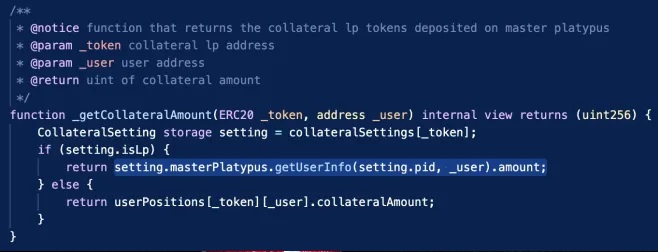
Everything up to this point has worked as intended. However, the hacker then calls the emergencyWithdraw function in the MasterPlatypus contract. This is where things break. You’ll notice on line 583 that the master contract calls PlatypusTreasure to see if the user is solvent and allowed to withdraw their staked LP-USDC.

The PlatypusTreasure code will in turn call MasterPlaytpus to get the amount of tokens staked to determine solvency. However, because the user’s staked amount is not yet set to 0 (line 599 of master), it appears that the user will still have 44M LP-USDC staked. This makes the PlatypusTreasure contract think that the user is solvent, which allows the emergency withdrawal to go through.

The rest of the exploit is straightforward: they swapped the LP-USDC back to USDC and returned the 44M USDC back to Aave. They then swapped as much of the 41.8M USP token for other stable coins as they could ($8.5M USDC/USDT/BUSD/DAI). The hacker still has 33M USP tokens.

SEC Sues Do-Kwon and TerraForm Labs for Running Crypto Pyramid Scheme

0

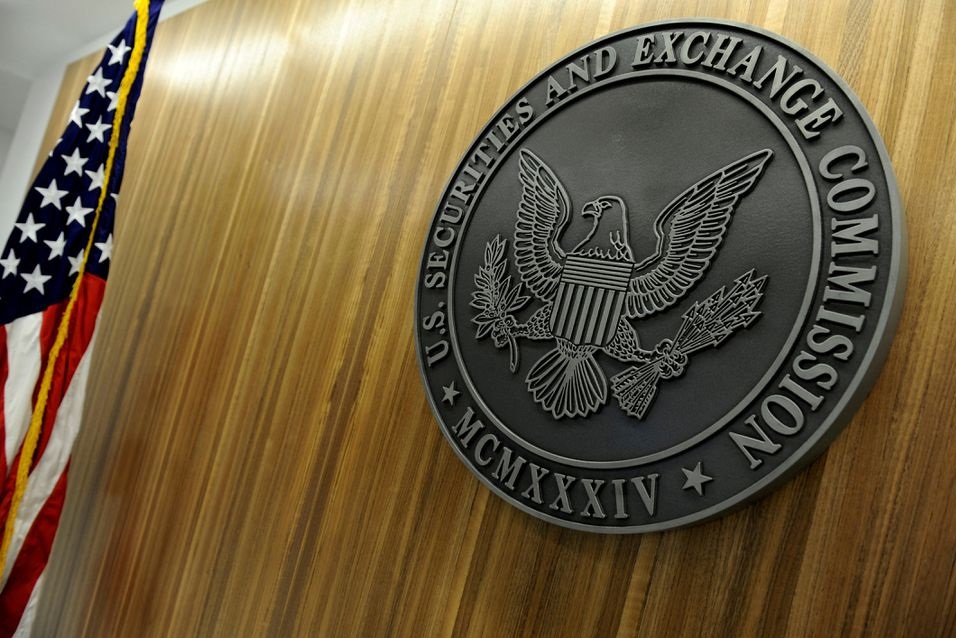
The Security and Exchange Commission [SEC] is suing Do Hyeong Kwon and Terraform Labs, the issuer of collapsed algorithm stablecoin UST and Crypto tokens, LUNA now LUNC Blockchain for instituting Crypto pyramid schemes. A very interesting fact is that the SEC is being more thorough than usual, specifically running through the Howey Test for various assets (UST, LUNA, and wLUNA).

The Luna crypto crash was caused by its connection to TerraUSD (UST), the algorithmic stablecoin of the Terra network. On May 7, over $2 billion was wiped from the global Cryptocurrency market. When the Luna crypto network collapsed, it’s estimated that $60 billion got wiped out of the digital currency space in general. But the ‘Steady lad, deploying Capital’ crooner couldn’t salvage the deteriorating situations.

Algorithmic stablecoins (UST) are not the same as Tether or USD Coin, which are backed by actual dollars or assets stored in a bank. Terraform Labs created the UST coin to be an algorithmic stablecoin on the Terra network. While other stablecoins (USDC or Tether) are fiat-backed, the UST would not be backed by real assets. Instead, the value of UST would be backed by its sister token, Luna. Once Luna plumage the support level for UST Depegged leaving many investors in oblivion.

An arrest warrant was issued on Do Kwon by the South Korean government around November 2022, but the co-founder of Terraform Labs where the sister tokens Luna and TerraUSD were held absconded seeking asylum in Seychelles.

Apparently a new twist has surfaced, the US Security and Exchange Commission is suing Do-Kwon and Terraform Labs, SEC tweeted on 16th February, 2023 “Today we charged Singapore-based Terraform Labs PTE Ltd and Do Hyeong Kwon with orchestrating a multi-billion-dollar crypto asset securities fraud involving an algorithmic stablecoin and other crypto asset securities.”

We allege that Terraform and Do Kwon failed to provide the public with full, fair, and truthful disclosure as required for a host of crypto asset securities, most notably for LUNA and Terra USD,” said SEC Chair Gary Gensler. “We also allege that they committed fraud by repeating false and misleading statements to build trust before causing devastating losses for investors.”

Read SEC’s official Press Release

The Securities and Exchange Commission today charged Singapore-based Terraform Labs PTE Ltd and Do Hyeong Kwon with orchestrating a multi-billion dollar crypto asset securities fraud involving an algorithmic stablecoin and other crypto asset securities.

According to the SEC’s complaint, from April 2018 until the scheme’s collapse in May 2022, Terraform and Kwon raised billions of dollars from investors by offering and selling an inter-connected suite of crypto asset securities, many in unregistered transactions. These included “mAssets,” security-based swaps designed to pay returns by mirroring the price of stocks of US companies, and Terra USD (UST), a crypto asset security referred to as an “algorithmic stablecoin” that supposedly maintained its peg to the U.S. dollar by being interchangeable for another of the defendants’ crypto asset securities, LUNA. The complaint further alleges that Terraform and Kwon offered and sold investors other means to invest in their crypto empire, including the crypto asset security tokens MIR—or “mirror” tokens—and LUNA itself.

The SEC’s complaint alleges that Terraform and Kwon marketed crypto asset securities to investors seeking to earn a profit, repeatedly claiming that the tokens would increase in value. For example, they touted and marketed UST as a “yield-bearing” stablecoin, which they advertised as paying as much as 20 percent interest through the Anchor Protocol.

The SEC’s complaint also alleges that, while marketing the LUNA token, Terraform and Kwon repeatedly misled and deceived investors that a popular Korean mobile payment application used the Terra blockchain to settle transactions that would accrue value to LUNA. Meanwhile, Terraform and Kwon also allegedly misled investors about the stability of UST. In May 2022, UST depegged from the U.S. dollar, and the price of it and its sister tokens plummeted to close to zero.

“We allege that Terraform and Do Kwon failed to provide the public with full, fair, and truthful disclosure as required for a host of crypto asset securities, most notably for LUNA and Terra USD,” said SEC Chair Gary Gensler. “We also allege that they committed fraud by repeating false and misleading statements to build trust before causing devastating losses for investors.”

“I commend the SEC’s hard-working staff who remained vigilant in such an important investigation, even when the defendants attempted to prevent us from obtaining important information about their business,” Chair Gensler added. “This case demonstrates the lengths to which some crypto firms will go to avoid complying with the securities laws, but it also demonstrates the strength and commitment of the SEC’s dedicated public servants.”

“Today’s action not only holds the defendants accountable for their roles in Terra’s collapse, which devastated both retail and institutional investors and sent shock waves through the crypto markets, but once again highlights that we look to the economic realities of an offering, not the labels put on it,” said Gurbir S. Grewal, Director of the SEC’s Division of Enforcement. “As alleged in our complaint, the Terraform ecosystem was neither decentralized, nor finance. It was simply a fraud propped up by a so-called algorithmic “stablecoin” – the price of which was controlled by the defendants, not any code.”

The complaint, filed in the U.S. District Court for the Southern District of New York, charges the defendants with violating the registration and anti-fraud provisions of the Securities Act and the Exchange Act.