DD
MM
YYYY

PAGES

DD
MM
YYYY

spot_img

PAGES

Home Blog Page 4420

Data Analytic Startup, Stears, Calls Nigeria’s Presidential Contest for Peter Obi

1

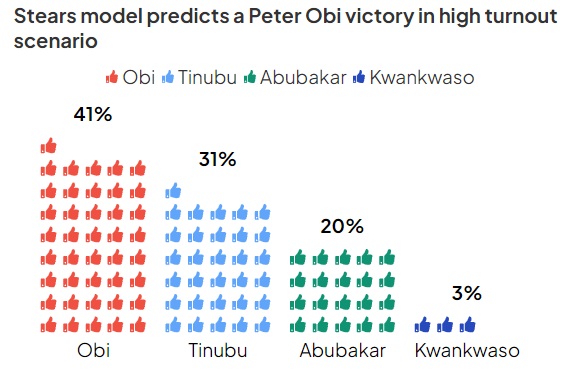
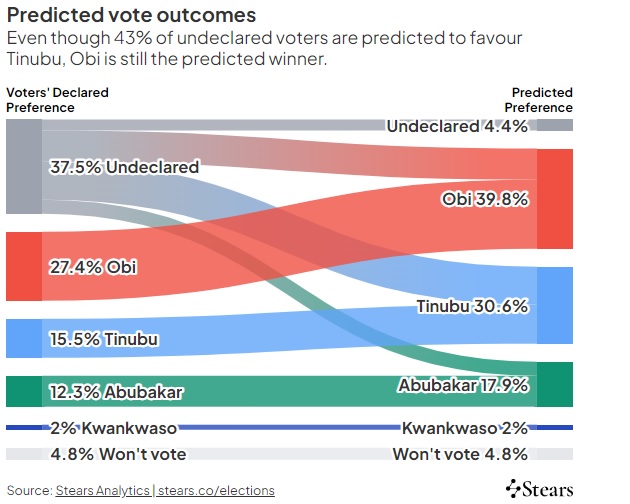
Stears, an African data and intelligence company, founded by Preston Ideh, Abdul Abdulrahim, Foluso Ogunlana, and Michael Famoroti, who met at the London School of Economics and Imperial College in the UK, has called it for Peter Obi: “Even after including silent voters, Peter Obi holds a comfortable lead. In essence, the Stears electoral poll and prediction model affirms that Peter Obi is by far the most popular and desired candidate for the 2023 Presidential Elections” .

Nairametrics provided a deeper insight: “Labour Party’s presidential candidate, Peter Obi, has been named the most universally accepted candidate amongst the list of aspirants for the 2023 national presidential elections. This is according to a recent poll by Stears, an African data and intelligence company. According to the findings of the survey, Peter Obi is the only candidate amongst the lot to achieve at least 25% of the vote in most geopolitical regions, that is five out of six, based on the responses of the voters that declared their candidate preference.”

Good People, if you have any poll  which any of Premium Times, Nairametrics, and top-6 newspapers (Guardian, Punch, Vanguard, Sun, Vanguard, BusinessDay) have found useful to publish, share with me, even if Tinubu, Atiku, Obi, etc is leading by 100%. Because I do not break news, focusing on broken ones, do not accuse me of publishing polls which Obi seems to be leading. Get it: I am only educating our community. Hold that insult; just share the poll – and I will run it. 

Remember, the smarter people in this business must have published the poll for me to use it; if not, do not bother. I depend on those experts because they’re trained journalists and have the tools to make better decisions so that we do not spread fake news and polls.

Of course, the best poll is the election; #vote.

Relevant Provisions of the Dishonoured Cheques Act, Letters of Credit in Nigeria

0

The Dishonoured Cheques Offences Act (Amended in 2017) was passed as a designated framework for prosecuting acts constituting the financial crime of purporting to settle lawful payment obligations by the use of cheques which are monetary instruments (typically post-dated) issued by a drawer asking his bank to make a payment to a 3rd party.

This article will be dealing with the topics of :-

– What constitutes a dishonoured cheque.

– When presenting or drawing a dishonoured cheque becomes a crime under the Dishonoured Cheques Act.

– The means of commencing prosecution of offences under the Dishonoured Cheques Act.

– The punishments applicable for offences under the Act.

When is a cheque deemed to be dishonoured under the Act?

The act defines a cheque as being dishonoured when presented for payment within a reasonable time and is rejected on the following grounds of :-

– No funds or insufficient funds standing to the credit of the drawer of the cheque.

– The account of the drawer is dormant or non-existent.

– The mandate on the cheque being irregular.

– The drawer countermands the payment of a cheque without prior notice of such stoppage to the payer. 

When exactly is an offence deemed to be committed under the dishonoured cheques act?

The act states that a party will be guilty of an offence under the act when :-

– He deliberately obtains for himself or any other person by means of a cheque which when presented for payment not later than 6 months after the stated date of the cheque is dishonoured.  

– When a cheque is deliberately presented for the satisfaction of a contractual obligation by a drawer who knows that the cheque will be dishonoured on any of the grounds highlighted by the Act.

When will a person be deemed not guilty under the Act?

A person shall not be guilty of an offence where he proves in court that he had reasonable grounds to believe that it would be honored upon presentation for payment within the time period specified by the Act.

What are the prescribed punishments or sanctions for offences under the Act?

For individual offenders, the act prescribes a maximum 2 year imprisonment and a 500 Thousand Naira fine option,  a 5 Million Naira fine for big companies, a 1 Million Naira fine for small companies, and and a 1 Million Naira fine or twice the value on the dishonoured cheque (whichever is higher) for statutory corporations.

Who or which agency has the original jurisdiction to prosecute and adjudicate on offences under the Dishonoured Cheques Act?

The High Court of a State and the Federal High Court of Nigeria have the jurisdiction to hear and adjudicate on matters involving alleged offenses under the dishonoured cheques act and the primary power to commence prosecution of offences under the act resides in the Attorney-General of the Federation.

Letters of Credit in Nigeria

International commerce is heavily dependent on timely and foolproof payments made across borders and sometimes without face to face meetings of any sort. This has necessitated the use of a wide range of payment instruments, one of them being letters of credit.

Letters of Credit are payment instruments in support of International trade transactions based on bank guaranteed-payments between the bank of buyer and an exporter of goods.

This article will be looking at the provisions of Nigerian law on letters of credit.

What makes up the main Regulatory Framework for letters of credit in Nigeria?

Letters of Credit are regulated by the Central Bank of Nigeria by virtue of its Trade and Exchange Department Circular of February 24,2016 as well as the international Uniform Customs and Practice for documentary credits (UCP 600) published by the International Chamber of Commerce in July 2007.

Are letters of credit revocable?

No they are not.

Can letters of credit be used in domestic transactions?

In practice, no.

When are Letters of Credit required?

Letters of Credit are required when there’s no certainty of the representations made by contracting parties in International transactions.

Are Letters of Credit convertible?

Yes, letters of credit can be converted into loan agreements between the buyer and his bank.

Are banks statutorily required to provide foreign exchange for letter of credit transactions?

No they are not. This is the reason for a type of letter of credit known as “Non-valid for foreign exchange Letters of Credit” used by applicants that have to source required foreign exchange for their international transactions from the parallel market.

Bitcoin NFTs Trades for Six Figures amid OTC Trading on Spreadsheet

0

Lately there has been buzz on the Ordinals Bitcoin NFTs. Rodarmor, a prolific blockchain developer created the ‘Ordinals’ on Satoshi script a week ago on the Bitcoin network, presumably many believed Bitcoin is meant for processing payments and not as fungible tokens but through this new discovery, NFTS can now be inscribed on the chain with many notable derivatives such the original CryptoPunks and Bored Apes launching on the Ordinals protocol with high trading volumes, floor and bidding price.

The average price of a floor CryptoPunks NFT on the Ethereum mainnet is around 60 Eth or $90,000 but it is way more expensive on the Bitcoin chain, with Bitcoin Punks trading around six figures as most trades are executed on Spreadsheet via OTC trading.

Interestingly, Leonidas an NFT Historian wrote an extensive Twitter thread explaining why he ventured into the Bitcoin NFTs narrative and what prompted him in spending 3.2 BTC (45 ETH) or $73,600 on Bitcoin Jpegs.

To put it simply, I’ve fallen in love with the ordinals protocol. It’s elegant, opinionated, and strives to bring digital objects to Bitcoin in a way that honors its ethos and values. I got to meet the founder back in September and am so proud of him. For those who don’t know, every Bitcoin can be subdivided into 100,000,000 satoshis.

Recently, Rodarmor found a way to associate a unique number with every satoshi so that they can be individually tracked and transferred. Then he took it a step further by developing a method for inscribing arbitrary data onto a satoshi. When you put all of this together it means that you can store any content that you want directly on Bitcoin and then transfer it to others. Want your art on Bitcoin? Just inscribe the JPEG. What about a song? Just inscribe the MP3. A website? Just inscribe the HTML. A video game? No problem, somebody already inscribed a fully functional game of Doom which you can play.

So far there are ~38,000 inscriptions and this number has been roughly doubling every day for the past week. However, interacting with the ordinals protocol is currently cumbersome as you need to run a full Bitcoin node and have minor technical skills.

But this is changing quickly, which is part of the reason why I’m so excited about the future of ordinals. An organic ecosystem is forming and IMO it is inevitable that the infrastructure needed to onboard several orders of magnitude more people will get built out. Explorers, collections, inscription tools, wallets with a GUI (currently only has a CLI), and trustless marketplaces with a GUI (currently all trades are OTC) are all actively being developed.

This brings me to the Bitcoin Punks. As a Historical NFT collector, my thesis is that value will accrue asymmetrically to the collections that are early. I’m not interested because they are punks (they could be anything) rather I care because they are low number inscriptions. Bitcoin Punks are 10,000 of the first 34,400 ordinal inscriptions. As a collector, this narrative resonates strongly with me.

My theory is that the more successful the ordinals protocol becomes, the more inscriptions there will be and thus the more rare and desirable the earliest inscribed collections will become. I think some people are missing the point by paying attention to the art/collection. In the future, quality will matter a lot more, just like it does for Ethereum, however, the ordinals market is currently predicated on low inscriptions having long-term collectible value. I believe that collectors will value the permanence of having art backed up forever to the Bitcoin blockchain, and think the high-end cryptoart market will eventually come to value what the Bitcoin brand adds to a collection but for now it’s all about low inscription numbers.

However, Davis KOL an ardent Bitcoin and Crypto Experimentalist at BasedKarbon, is not really happy with the Bitcoin NFT meta currently buzzing Twitter, he noted Bitcoin NFTs priced in eth, based on eth NFTs, and being wrapped in emblem vaults to sell on opensea has to be the stupidest nft meta we’ve had so far;

Priced in eth and emblem wrapped wouldn’t be that dumb if the projects were original. I’d understand the need to make the experience accessible and familiar. But copies of punks, a ripoff of a failed punk derivative, moonbird, Clones kinda clear which group is doing these gifts.

Bitcoinooooors have spent the last years alternately mocking NFTs and trying to get ETH regulated out of existence ex-post facto as a security, and now they want all the ETH NFT folks to basically seed them on their development of a Bitcoin NFT architecture.

Polygon Surpasses Dogecoin on Market Capitalization

0

Polygon [MATIC] is continuing to increase in value despite the ongoing crypto bear market. The project’s native token MATIC has surpassed Dogecoin (DOGE) in terms of market cap and is now the ninth largest crypto token.

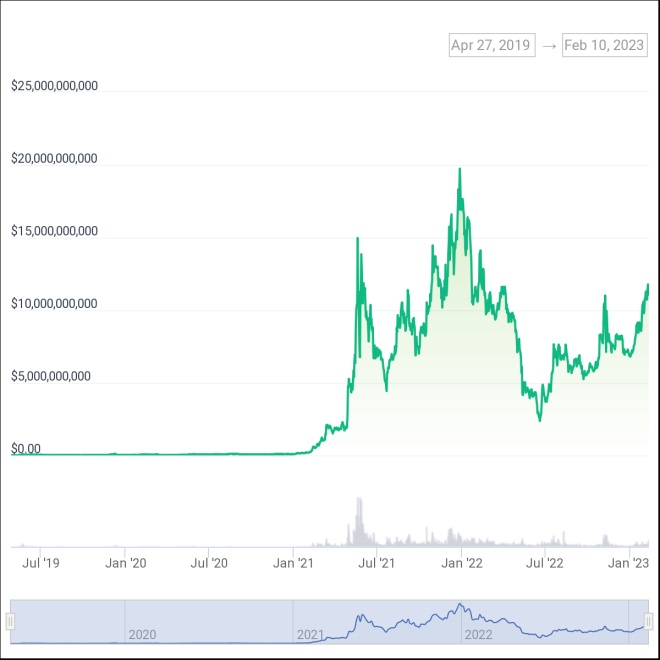
MATIC’s market capitalization is currently at $11.52 billion, according to data from CoinGecko. That’s higher than Dogecoin’s (DOGE) with a $11.33 billion market cap. This the highest market capitalization MATIC has seen since March of last year.

Polygon is also not far away from taking over Cardano (ADA), which currently has a $12.72 billion market cap. MATIC’s all-time high market capitalization is almost $19 billion, which it reached at the height of the last crypto bull market in December of 2021. Despite the harsh crypto winter that saw multiple tokens reach their all-time lows, MATIC is still up over 40,000%, from its all-time low of $0.003, and is currently trading at $1.28.

While there are lots of reasons why MATIC has been so successful in holding its value over the past year’s, the rumors of its zkEVM scaling solution launching soon on Ethereum mainnet have probably contributed to Polygon’s recent success the most.

Polygon has been recently hyping up its zkEVM scaling solution, something that very few teams are currently working on. That’s because zkEVMs are notoriously hard to develop. ZkEVM stands for zero-knowledge Ethereum Virtual Machine and is considered to be the holy grail of Ethereum scaling. zkEVMs improve throughput and decrease gas prices by computation and storage off-chain and generating zero-knowledge proofs to verify the validity of off-chain transaction batches. There are currently no zkEVMs that are deployed on Ethereum mainnet but Polygon’s co-founder Sandeep Nailwal tweeted on January 17 that the team developing Polygon’s zkEVM has set a launch date and that it’s “soon.”

On top of that, Eduardo Antuña, Polygon zkEVM’s core developer, on Thursday said that Polygon has managed to increase its zkEVM’s proving time and costs. Really excited about our results on the Polygon zkEVM Prover, Batchproof 2:30 (2min soon) ~500 or ~250 ERC20 tx/batch On a spot m6id.metal prover’s cost: $0.064/proof ($0.0001/tx) The fastest ZK tech and the first production-ready zkEVM. The prover is no longer a bottleneck. All of this indicates that Polygon’s zkEVM, at least in theory, will soon be deployed on Ethereum mainnet. That would be an achievement like none other and potentially take MATIC to new highs.

The Next Two Pillars for Success in Africa’s Fintech Sector

0
Fintech community will have some adjustments

Africa is moving into the next phase of the fintech universe. Yes, merely building products and services to enable people and companies to receive and send money, will not deliver outperforming-value to stakeholders (investors, merchants, communities, users, etc). The future of African fintech will be anchored on two pillars, besides the requirements of seamless transfer of funds: ecosystems for merchants and partnerships.

On the ecosystems, you must offer, besides the ability to receive/send funds, tools to help your customers run their business operations. And those tools include bookkeeping, invoicing, domain training, and other adds-on. Indeed, besides helping them move money, you need to help them also make money!

For partnerships, it is hopeless to think you can do it alone. To thrive as a fintech, you must partner with others in your sector and outside your sector. For example, you can partner with a payroll company to integrate its APIs so that your merchant can also do payroll within your platform. The same goes with specialized training which can help the merchants do better in the market. Of course, there is another dimension of partnership which involves integrating with companies in other countries to expand your reach.

In my keynote during  an Africa Fintech Festival, in Uganda, I explained fintech as “the new growth operating system in Africa” because at the end of all in the market, it is about money, with the ability to pay and be paid.

The destination: this video explains.

n this videocast, I discuss the need to build a truly pan-African digital remittance/transfer banking product which is agnostic of location or currency in Africa. None of the products we have today meets that standard. Largely, I envisage a situation where all you need to buy and sell across Africa is one bank account in just one African Union country. With that, you do not have to even think about the specific currency of that account as technology will seamlessly make it possible to access other African markets for payments, transfer, etc. The banks or fintech companies must still comply with all regulations related to international transfers, forex, etc. The only difference is that customers will not see them as they will be hidden with technology.