DD
MM
YYYY

PAGES

DD
MM
YYYY

spot_img

PAGES

Home Blog Page 45

Meta Signs Real-Time News Deals, as Wikipedia Seeks Compensation on Data

0

Meta has struck new commercial agreements with major news publishers to feed its Meta AI chatbot with real-time global, entertainment, and breaking news, marking a sharp pivot from the company’s retreat from news distribution in recent years.

The tech giant said on Friday that users who ask Meta AI news-related questions will now get responses that surface information and links drawn from partner outlets. Those links point directly back to publishers’ websites, which Meta says will help those partners reach new audiences.

The initial group includes CNN, Fox News, Fox Sports, Le Monde Group, the People Inc. portfolio of media brands, The Daily Caller, The Washington Examiner, and USA Today. Meta plans to add more partners over time.

The shift reverses years of deliberate scaling-back: Meta killed Facebook’s News tab in 2024 and stopped compensating publishers as far back as 2022. Now it is paying again — not to revive news feeds inside its apps, but to supercharge Meta AI’s accuracy, speed, and usefulness by giving it real-time access to professional reporting.

“We’re committed to making Meta AI more responsive, accurate, and balanced,” the company said.

It noted that rapid live-event coverage is especially hard for current AI systems to handle, and argued that onboarding multiple news sources would help balance viewpoints and deliver more timely information.

The move comes amid rising pressure for Meta to stay competitive in the AI race. Llama 4’s controversial early-year rollout drew complaints of weak performance, at a time when rivals are pushing out increasingly powerful models. Meta AI is already available in more than 200 countries across Facebook, Instagram, WhatsApp, Messenger, and a standalone app, but user adoption remains a key metric.

The Great Scramble for Quality Data

Meta’s new deals land in a world where the entire AI industry is straining under a “content crunch.” Large language models are trained on enormous quantities of text, much of it scraped freely from the open internet, but several of the highest-value information sources have begun to push back.

That backlash is driven by two forces:

  1. Big Tech’s model-training habits impose steep costs on the sites being scraped, especially when nonstop automated crawlers hammer the servers.
  2. Publishers argue that AI companies are now commercializing products built on datasets they never paid for, even as newsrooms themselves face declining revenue and heavy layoffs.

That tension is now visible everywhere, and the latest flashpoint is Wikipedia.

Wikipedia’s Costs Are Rising — and It Wants Compensation

Wikipedia co-founder Jimmy Wales said at the Reuters NEXT summit that the online encyclopedia is negotiating more deals with Big Tech to recover the financial burden created by AI companies training on its open-licensed content.

“The AI bots that are crawling Wikipedia are going across the entirety of the site,” Wales said. “So we have to have more servers, we have to have more RAM and memory for caching that, and that costs us a disproportionate amount.”

While Wikipedia’s text remains free for individual use — as required by its license — Wales drew a distinction between volunteers donating to keep the site running and multibillion-dollar corporations using Wikipedia as a backbone for commercial AI systems.

“Those people are donating money to support Wikipedia, and not to subsidize OpenAI costing us a ton of money. That doesn’t feel fair,” he said.

Wikipedia already signed a paid training-data deal with Google in 2022, and Wales confirmed that talks with other firms are ongoing. He didn’t rule out legal action against companies that continue training on Wikipedia without paying, saying that “soft power” shaming could be effective, but technical measures could also be deployed.

He mentioned Cloudflare’s AI Crawl Control, which allows websites to restrict how often and how deeply AI bots scrape their content. But that raises an ideological dilemma: limiting access contradicts Wikipedia’s long-standing commitment to free knowledge.

Still, Wales bluntly stated that the financial burden needs to be addressed.

Content Owners Strike Back

Between Meta’s new paid-news pipeline and Wikipedia’s push for licensing revenue, a new pattern is emerging in the AI ecosystem:
The era of “free training data” is ending.

Publishers — bruised by years of platform dominance over traffic and monetization — now see leverage in the AI boom. Professional newsrooms offer what models desperately need but cannot simulate:

• real-time reporting
• legally vetted information
• high-quality text at scale

That scarcity gives publishers negotiating power they didn’t have during the social-media era, when platforms controlled distribution and advertisers controlled revenue.

Nonprofits like the Wikimedia Foundation are now making the same argument: professional, volunteer-maintained knowledge bases are not cost-free inputs for trillion-dollar AI firms.

Why Meta’s Move Matters for the Industry

Meta’s new agreements signal three realities in the AI landscape:

  1. AI chatbots cannot stay competitive without reliable, real-time information.
    Users expect AI systems to answer breaking-news questions with human-grade accuracy. Without licensing deals, models remain weeks or months behind real events.

  2. Training-data scarcity is becoming an existential threat.
    As more websites block AI crawlers or demand payment, AI companies face a limited supply of high-quality material — especially news, science, medical content, and reference works.

  3. Big Tech is quietly moving toward a “paid knowledge economy.”
    The model is shifting from scraping everything for free to selective licensing, with newsrooms and knowledge institutions charging for access.

This dynamic could reshape model training for years. The open-web era gave AI its early fuel; the next phase may look more like traditional media licensing — and more expensive.

What It Means Going Forward

Meta’s partnerships, arriving alongside Wikipedia’s hardening stance, highlight a deeper negotiation over who owns digital knowledge and how AI companies should pay for it. The industry’s biggest models have already devoured most freely available high-quality text online. From here on, AI companies seem to have two choices:

• pay for professionally published material
• or risk quality decline in their models

Meta’s decision suggests that Big Tech knows which way the wind is blowing.

And as AI adoption accelerates, the pressure will only grow. Publishers want a cut of the value their work generates for AI firms. Nonprofits want compensation for the cost of being mined. Regulators are asking who profits from public knowledge.


Investors Are Loading Up on This Crypto Below $0.0025 Expected to Hit $0.45 Before XRP’s $10 Pump

0

The crypto community is buzzing again, but this time it isn’t about DOGE, SHIB, or even the recently revived PEPE surge. The spotlight has shifted to Little Pepe (LILPEPE), a meme coin that’s flipping the narrative and drawing in both seasoned investors and fresh degens looking for the next big move. At its current presale price of $0.0022, many believe LILPEPE could rally as high as $0.45 before XRP even begins its anticipated run toward $10. And honestly, when you look at what’s happening behind the scenes, it’s not hard to see why investors are jumping into this presale before it closes.

Presale Momentum: Stage 13 Is Almost Sold Out

At Stage 13 of its presale, LILPEPE tokens are currently priced at $0.0022. Stage 13 is already 96.93% full due to the unrelenting demand, indicating that investors are racing to enter while the opportunity is still open. With over 16.7 billion tokens sold and over $27.6 million raised thus far, this is a huge accomplishment for a meme coin that is still in the presale stage. Investor FOMO has been exacerbated by the price’s recent 10% spike from $0.0021 to $0.0022. Early buyers from Stage 1 are already sitting on around 120% gains, but even Stage 13 buyers still have an estimated 36.36% upside if LILPEPE launches at its projected price of $0.0030. That’s the kind of early-stage energy that makes even the most cautious frens consider aping in.

Growing Visibility: From ChatGPT Trends to Major Listings

One of LILPEPE’s biggest strengths is its rapid gain of mainstream visibility. Beyond the usual Telegram and X (Twitter) hype, LILPEPE achieved a massive milestone by being listed on CoinMarketCap, thereby establishing the project’s legitimate presence among global crypto trackers. Additionally, LILPEPE has undergone a security audit by CertiK, one of the most trusted auditing organizations in the blockchain space. This combination of visibility and security reassurance has pulled in investors who prefer projects backed by proper validation. Perhaps the most eye-opening development was LILPEPE’s surge in search interest. LILPEPE outperformed even the industry titans, PEPE, DOGE, and SHIB, achieving a flawless 100 score on the ChatGPT 5 Memecoin Question Volume Trend between June and August of 2025. Such interest usually indicates that the general public, not just cryptocurrency enthusiasts, is taking notice.

Price Potential: Can LILPEPE Really Hit $0.45?

Crypto prices are unpredictable, but investors aren’t dismissing the $0.45 target as unrealistic. LILPEPE boasts a potent mix of early-stage traction, substantial presale funding, a growing holder base, and a Layer-2 roadmap designed for meme tokens. The team is developing its own EVM-compatible Layer 2 with zero trading tax, fast speed, and anti-bot protection – features that attract builders, traders, and degens alike. If everything continues to scale as it has, it wouldn’t be shocking to see LILPEPE rally from presale levels into the multi-cent range and potentially aim higher. And with XRP’s $10 target still months away, many investors believe LILPEPE could move long before major blue-chip coins begin their next cycle pump.

Conclusion: A Closing Window of Opportunity

Investors are increasingly viewing this as one of the final opportunities to participate before the token listing, as LILPEPE is still priced at $0.0022, the presale is nearly sold out, and the hype cycle is intensifying. The blend of strong traction, community hype, massive giveaways, major visibility milestones, and impressive presale numbers puts LILPEPE in a rare position, the kind of setup that meme coin history has rewarded many times. If you’re considering joining the wave, this may be the moment before Stage 13 closes and prices begin moving upward again. As always, DYOR, manage your risk, and only invest what you’re comfortable with. But if you’ve been waiting for that one meme coin that feels early yet explosive, many believe LILPEPE might just be that play.

For more information about Little Pepe (LILPEPE) visit the links below:

Website: https://littlepepe.com

Whitepaper: https://littlepepe.com/whitepaper.pdf

Telegram: https://t.me/littlepepetoken

Twitter/X: https://x.com/littlepepetoken

$777k Giveaway: https://littlepepe.com/777k-giveaway/

Flipping Just $1,500 Into Ozak AI Could Build a Six-Figure Portfolio by 2026

0

Crypto market momentum is shifting rapidly toward early-stage AI projects as traders and analysts focus on where the next major parabolic wave will originate. Among all emerging tokens, Ozak AI has become the standout name—repeatedly appearing in analyst forecasts as one of the few projects capable of delivering life-changing multipliers in the 2025–26 cycle.

With its AI-native architecture, early-phase valuation, and accelerating demand from the Ozak AI Presale, investors are running scenarios that show how even modest entries could grow into extremely large returns. According to these projections, a strategic flip of just $1,500 into Ozak AI today could potentially transform into a six-figure portfolio if the project hits the 50x–100x range many analysts believe is realistic based on its fundamentals and early traction.

Why Ozak AI Is Being Viewed as a High-Probability 100x Project

The first reason Ozak AI is drawing massive attention is the strength of its utility. Unlike many early-stage tokens that launch without clear technology or product direction, Ozak AI begins with a complete AI-native infrastructure blueprint.

Its ecosystem features millisecond-speed prediction engines capable of reading market conditions instantly, cross-chain analytics modules that interpret multiple blockchain environments at once, and ultra-fast signal flows delivered through its partnership with HIVE that return insights in just 30 milliseconds. On top of this, Ozak AI integrates with SINT’s autonomous AI agent technology, enabling real-time on-chain execution, workflow automation, voice-responsive commands, and intelligence-driven decision-making.

This places Ozak AI at the center of the next major Web3 transformation: AI automation. Analysts repeatedly emphasize that the projects merging artificial intelligence with blockchain infrastructure stand to outpace traditional altcoins over the next several years—and Ozak AI enters the market from the perfect position: early, affordable, and technologically advanced.

How a $1,500 Allocation Could Grow to Six Figures

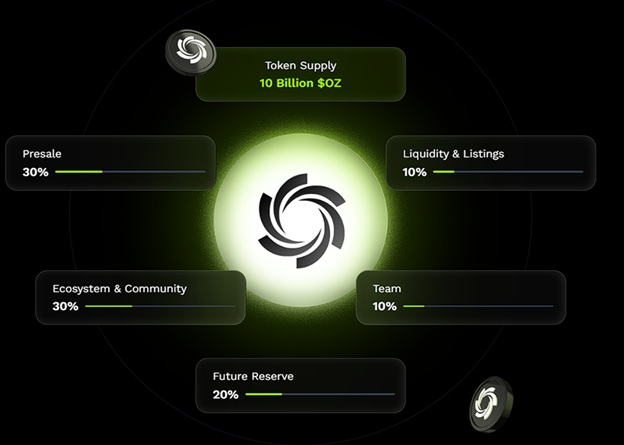
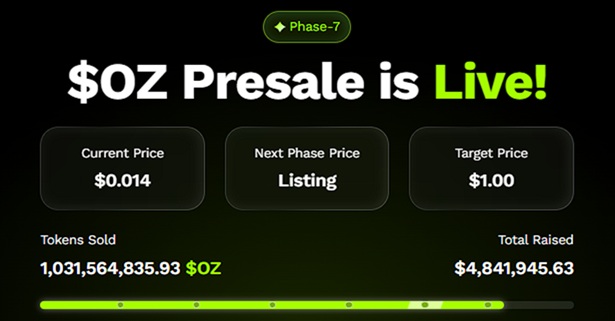
Because Ozak AI is still in the OZ presale phase and priced at an early-stage market cap, even small investments have significant upside potential. With over $4.8 million raised and more than a million tokens sold through the Ozak AI Presale, the project shows the same early adoption curve that characterized previous cycle winners that later surged 50x–100x.

  • At a 50x multiple, a $1,500 allocation becomes $75,000.
  • At a 100x multiple, the same allocation becomes $150,000.

These projections aren’t based on speculation alone—they’re grounded in Ozak AI’s strong partnerships with Perceptron Network’s 700K node ecosystem, HIVE’s ultra-fast signal infrastructure, and SINT’s autonomous AI agent layer. This gives Ozak AI real-world functionality that can scale immediately upon launch, making its long-term value potential far more tangible than hype-driven meme coins or single-utility projects.

Why Smaller Investments Can Outperform Large Caps

The reason analysts highlight Ozak AI over major assets like Bitcoin, Solana, or Ethereum is rooted in market structure. Large-cap tokens grow steadily, but they rarely produce 50x–100x moves due to their valuations. Early-stage AI tokens, however, sit at small market caps where exponential expansion is possible—especially when backed by real utility and early network effects. Ozak AI fits precisely into this category, which is why traders are labeling it a generational opportunity.

The Next Big Wealth-Building Window May Be Opening Now

With AI-driven projects expected to dominate the 2025–26 cycle, Ozak AI is emerging as the strongest candidate for explosive returns. Its early-stage pricing, real AI infrastructure, rapid adoption curve, and powerful partnerships all point toward long-term scalability—making it a prime contender for six-figure wealth creation from even modest initial contributions.

A $1,500 allocation won’t change anything overnight—but with Ozak AI’s current trajectory, it could be the smartest early move for building a six-figure portfolio by 2026.

About Ozak AI

Ozak AI is a blockchain-based crypto project that provides a technology platform that specializes in predictive AI and advanced data analytics for financial markets. Through machine learning algorithms and decentralized network technologies, Ozak AI enables real-time, accurate, and actionable insights to help crypto enthusiasts and businesses make the correct decisions.


For more, visit:

Website: https://ozak.ai/

Telegram: https://t.me/OzakAGI

Twitter: https://x.com/ozakagi

OpenAI Poised to Unveil GPT-5.2 as Early as Next Week in Accelerated Bid to Counter Google’s Gemini Surge

0

OpenAI could publicly reveal its next-generation model, GPT-5.2, as early as next week, according to a report by The Verge, signaling one of the fastest deployment cycles the company has attempted since ChatGPT debuted two years ago.

The potential release date—moved up from mid-December to possibly December 9—comes at a moment of intense pressure inside OpenAI as it tries to keep pace with Google after the rollout of the Gemini 3 family.

Sources cited by The Verge said GPT-5.2 is expected to narrow the widening performance gap between GPT and Google’s flagship models. Gemini 3 has drawn wide acclaim across the tech sector, prompting OpenAI CEO Sam Altman to issue a rare companywide “code red” memo earlier this month. In the message, Altman told employees they must accelerate work on improvements to ChatGPT, urging a “surge” effort that would put off other projects, including autonomous AI agents and new advertising initiatives.

That level of internal urgency highlights how forcefully Gemini 3 has disrupted competitive dynamics in the AI industry. Since its release, Alphabet shares have climbed sharply as analysts praised the model suite’s performance. Leading tech figures have also offered public endorsements. Altman himself said Gemini 3 performed impressively, and Musk, the CEO of xAI, added his own nod after benchmarking it against his in-house models. Salesforce chief Marc Benioff took it even further, saying he would not return to ChatGPT after using Google’s newest system.

Those reactions have fed into stock market shifts that investment firm Coatue has been tracking closely. Coatue observed that companies tied to OpenAI’s ecosystem, including Nvidia and AMD, faced steep price corrections in the wake of Gemini 3’s arrival. Meanwhile, firms positioned inside Google’s ecosystem have benefited from the momentum surge. Still, Coatue co-founder Philippe Laffont argued that the selloff affecting Nvidia, AMD, and similar companies is unlikely to last, saying the broader ecosystem around OpenAI will rebound.

The pressure on OpenAI is not simply market chatter. Gemini 3 landed at a moment when the industry felt OpenAI was slowing the tempo of its major version releases. GPT-4.1 and GPT-4.2 brought incremental upgrades, but many developers complained about latency and reliability swings. Google capitalized on that moment by positioning Gemini 3 as a stable, high-capacity workhorse capable of powering agents, enterprise workflows, and multimodal tasks at scale. Early benchmarks from independent labs echoed that message, suggesting meaningful gains in reasoning, long-context comprehension, and coding.

Against that backdrop, GPT-5.2 is now viewed as a crucial test of whether OpenAI can regain narrative advantage. Internally, Altman’s “surge” directive has meant reallocating personnel away from moonshot projects toward rapid refinement of model behavior, memory consistency, content generation quality, and infrastructure reliability. People familiar with company discussions say teams were urged to cut experimental features and focus instead on lifting core performance.

The accelerated release makes sense in light of OpenAI’s broader challenges. Tech leaders who once championed ChatGPT as the industry’s pace-setter are now experimenting more frequently with alternative systems. Enterprise buyers are also expanding evaluations as Google deepens partnerships with cloud clients and pushes Gemini across its entire software ecosystem. Gemini 3 has already found its way into Workspace, Android, Search, and Chrome, giving Google a distribution channel that OpenAI cannot match without partners.

At the same time, OpenAI still benefits from one of the most influential developer communities in the world. Many researchers argue that GPT-5.2 does not have to surpass Gemini 3 outright; it only needs to close the distance and restore confidence among developers who are currently running split-stack setups that combine OpenAI, Google, and Anthropic models. Much also depends on how quickly OpenAI can convert model improvements into practical upgrades for ChatGPT, which remains the most recognised AI product globally.

If GPT-5.2 does land next week, it will arrive during one of the most volatile market phases the AI sector has seen since 2023. Investor enthusiasm is high, but so are competitive stakes. Google is riding a wave of endorsements, Anthropic is scaling Claude expansion plans, and Musk’s xAI has poured billions into training cycles for its upcoming models. The OpenAI release would immediately become a focal point for every player in the ecosystem.

However, all signs for now point to the company racing the clock. Whether GPT-5.2 resets momentum or simply buys OpenAI time until the larger GPT-6 arc is ready will be clearer once the model reaches the public domain. But the sudden rush to move the launch window from mid-December to early December speaks volumes: OpenAI wants to be back in contention, and it wants that shift to happen fast.

U.S. Appeals Court Hands President Trump Unilateral Power to Fire Labor and Employment Board Officials

0

In a landmark decision that significantly expands the scope of presidential authority, a federal appeals court ruled Friday that President Donald Trump may remove members of the National Labor Relations Board (NLRB) and the Merit Systems Protection Board (MSPB) at will, without requiring cause.

The 2-1 decision from a panel of the U.S. Court of Appeals for the D.C. Circuit reverses lower-court rulings that had blocked Trump’s attempts to fire members of the key labor and employment panels, including Biden appointees like NLRB member Gwynne Wilcox and MSPB Chair Cathy Harris. The ruling is a major victory for the administration’s long-standing effort to challenge the independence of federal agencies and consolidate executive power.

The Constitutionality of “For-Cause” Removal

The majority opinion, penned by Trump appointees Judges Gregory Katsas and Justin Walker, rests on the principle that the President must have the power to remove executive officers who wield substantial executive power on his behalf.

The judges cited the Supreme Court’s 2020 ruling, Seila Law LLC v. Consumer Financial Protection Bureau, which stated, “Congress may not restrict the President’s ability to remove principal officers who wield substantial executive power.” In that case, the Court found the single director of the CFPB lacked constitutional protection from at-will removal.

The majority determined that the NLRB (which adjudicates private-sector labor disputes and influences federal labor law) and the MSPB (which handles complaints from federal workers with civil service protections) “wield substantial powers that are both executive in nature” and are fundamentally “different from the powers” that were historically deemed independent.

Crucially, the ruling argues that the 90-year-old precedent set by Humphrey’s Executor v. United States—which has long protected the heads of certain independent agencies from unilateral removal—does not apply to the NLRB and MSPB. That 1935 case had carved out an exception for agencies that performed merely “quasi-legislative” or “quasi-judicial” functions.

“So, Congress cannot restrict the President’s ability to remove NLRB or MSPB members,” the majority concluded.

A Warning of Executive Overreach

The decision drew a strongly worded dissent from the third judge on the appellate panel, Biden appointee Florence Pan, who warned that the ruling dramatically increases the President’s authority and threatens the foundation of the administrative state.

“Today, my colleagues make us the first court to strike down the independence of a traditional multimember expert agency,” Pan wrote.

She cautioned that the majority’s reasoning essentially “redefine[s] the type of executive power that must be placed under the exclusive command of the President, and effectively grant him dominion over approximately thirty-three previously independent agencies.” Pan further warned that the determination that the MSPB, which is largely adjudicatory, cannot be independent, “suggests that no agencies can be independent.”

Broad Implications Across Government

The ruling is part of a broader legal effort by the administration to chip away at removal protections for independent agency heads.

The Supreme Court is already set to hear oral arguments on Monday in the case of Trump v. Slaughter, which could determine whether the Federal Trade Commission (FTC)—the very agency at the center of the Humphrey’s Executor precedent—is likewise subject to at-will removal, potentially overturning the landmark 1935 ruling altogether.

The D.C. Circuit majority explicitly noted that its opinion does “not address whether Congress may restrict the President’s ability to remove members of the Board of Governors of the Federal Reserve System.” However, the ruling highlights the ongoing legal battle over the central bank, as the administration is currently challenging the tenure of Fed Governor Lisa Cook, a Biden nominee, while pressuring the Fed to slash U.S. interest rates. The Supreme Court is set to hear oral arguments in Cook’s case on January 21.

The D.C. Circuit’s decision clears the way for the administration to install its own appointees and fundamentally reshape the policy direction of the NLRB and MSPB. The ultimate breadth of the President’s removal power now hinges on the highly anticipated decisions from the Supreme Court.