DD
MM
YYYY

PAGES

DD
MM
YYYY

spot_img

PAGES

Home Blog Page 4507

PROLOGUE: Mass Communication Programme and Media Concentration in Nigeria

0

Mass communication as a course of study in Nigeria has a relatively short history. The first department of mass communication was established in the 1970s at the University of Nigeria, Nsukka. Since then, several universities, polytechnics and monotechnic in have established their own departments of mass communication. The course of study usually includes classes on journalism, advertising, public relations, television and radio production, and film studies. The introduction of mass communication as a course of study in Nigeria was a response to the growing importance of the media in shaping public opinion and the need for trained professionals to work in the rapidly expanding media industry in the country.

In 2020, the National Universities Commission unbundled the programme into seven separate programmes and placed them under the Faculty/ School/College of Communication and Media studies. The programmes include Journalism and Media Studies, Public Relations, Advertising, Broadcasting, Film and Multi-media studies, Development Communication studies, Information and media studies. According to the Commission, “the unbundling of the programme which is among the recent major reforms by the Commission, is to meet current demands in university education in line with global development and best practices.”

Out of the 103 higher education institutions in Nigeria offering mass communication programme, the majority, 71 institutions (68.93%) are located in the southern region, while 32 (31.07%) are in the northern region. When considering the National Open University, which has study centers across the country, our analyst discovered that Kano state and the Federal Capital Territory (Abuja) have the highest concentration of study centers, followed by Lagos state with 8 centers.

Exhibit 1: Number of schools offering Mass Communication programme
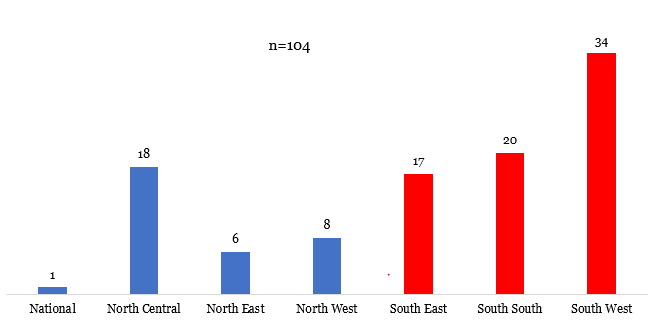
Source: Myschoolgists, 2023; Infoprations, 2023

Exhibit 2: National Open University Study Centres
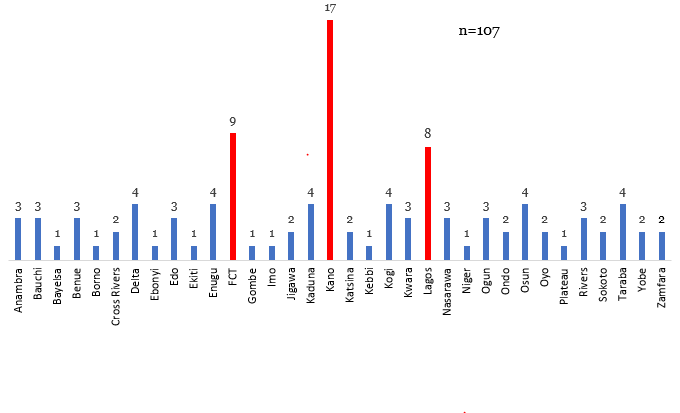
Source: National Open University, 2023; Infoprations Analysis, 2023

A deeper examination by geographical regions shows that the South-West and South-South have a greater number of educational institutions offering mass communication programmes compared to the other four regions. In the Northern region, the North-Central and North-West have more schools offering the program than the North-East. Without taking into account the country-wide presence of the National Open University, it is evident that the North-East and South-East regions fall short in comparison to the other regions.

These insights have aroused curiosity in the correlation between mass communication programmes and media concentration in Nigeria. In a forthcoming piece on the political economy of media, our analyst will explore the divergent and converging perspectives derived from analyzing different databases on the establishment of media organizations. Which region has the strongest media presence due to its institutions offering the programme? What benefits this has brought to the region and the country as a whole in recent years?

Twitter Introduces New Features on Timeline Feeds For Users

0

Microblogging platform Twitter has introduced two new features on its timeline feeds for users.

The social media company recently launched “for you” and “following” to “users’ timelines, which is coming after it renamed the”Home ” and”Latest features”.

Users will have to click on the timeline tabs to switch between these features on the web.

On the web version, users’ choices are remembered, which implies that when they close the tab and reopen Twitter, they will see whatever timeline they had earlier selected.

These features will be pinned to the top of the timeline of users so that they can easily switch between them. Users can further swipe to switch timelines instead of tapping the star icon.

“For You” is powered by an algorithm that makes personalized recommendations based on several metrics, including viewing behavior and interactions with videos.

On the other hand, the “Following tab” shows tweets from accounts users follow in reverse chronological order, with those most recently posted at the top. 

The feature which is already updated on the iOS app will soon be released on the Android app, the company said.

It wrote on its Twitter support handle; “See the Tweets you want to see. Starting today on iOS, swipe between tabs to see Tweets recommended “For you” or Tweets from the accounts you’re “Following.”

The “For you” and “Following” tabs replace “Home” and “Latest” and will be pinned to the top of your timeline so you can easily switch between them. Swipe to switch timelines instead of tapping the icon. You can now easily switch between “For you” and “Following” on the web. Android coming soon”.

Twitter CEO Elon Musk who bought the social media company for $44 billion back in October had previously hinted that this change would be coming. 

Recall that last year, Musk disclosed that Twitter will make it easier for users to switch between topics they follow and the trending ones.

Main timeline should allow for an easy sideways swipe between top, latest, trending, and topics that you follow. Twitter search nav already sorta does this after you search,” Musk tweeted.

Reports reveal that Twitter’s latest feature is quite similar to what TikTok has. TikTok has the same “For You” feature, which shows content on basis of what people have seen, liked, and more.

In other words, what the TikTok algorithm fetches for users, “For You” on Twitter will work similarly.

It is interesting to know that Musk who acquired the company for $44bn in October 2022, ever since his position as the CEO, has been carrying out a serious revamp on the platform.

In December 2022, he had announced a newly added feature, the “view count” feature that would enable Twitter users to see how their tweet is performing.

Musk made this known in a Tweet in which he explained that the new feature will allow users to see how many people have seen and engaged with their tweets just like YouTube videos. 

A Look at Force Majeure Clauses under Nigerian Law

0

In contracts, one of the most common ways of limiting a party’s vulnerability to liability is the use of a Force Majeure clause – ‘contract provisions that excuse a party’s nonperformance when “acts of God” or other extraordinary events prevent a party from fulfilling its contractual obligations’.

But what is Force Majeure as a concept? The strength of Force Majeure clauses was seriously tested in the wake of the Covid-19 pandemic that led to a worldwide rash of contractual disputes, Nigeria not being an exception.

This article will be looking at Force Majeure contractual clauses in-depth, with a focus on the topics of :-

– The definition of Force Majeure.

– A comparative analysis of Force Majeure, Acts of God, and Frustration.

– Limitations of Force Majeure clauses.

What is a “Force Majeure” exactly?

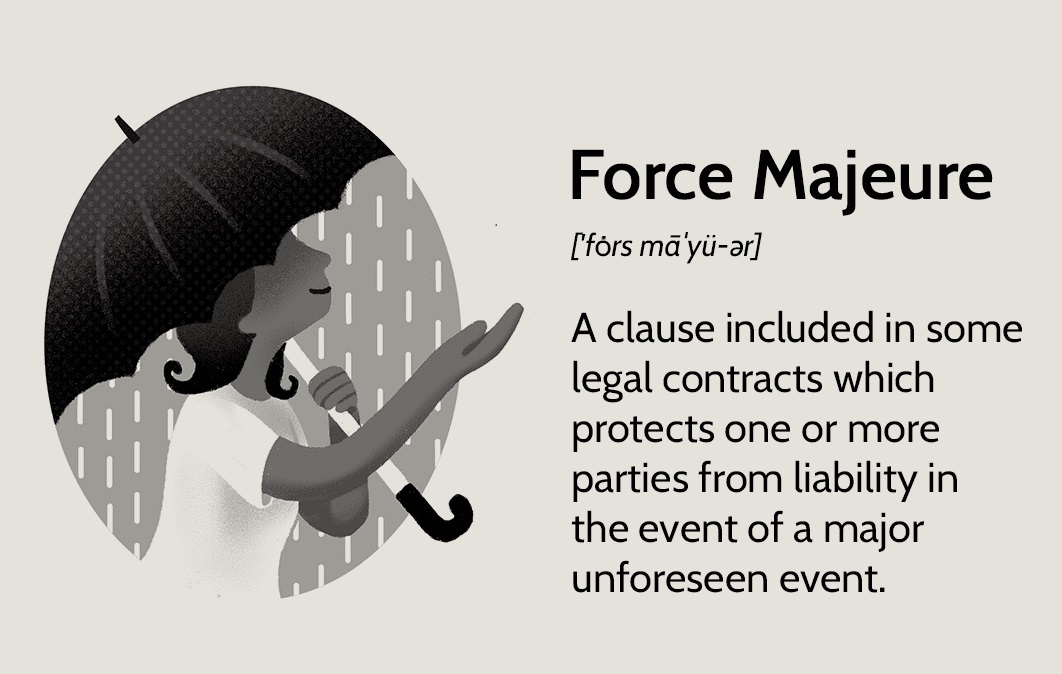
“Force Majeure” is a term used to describe any unavoidable event beyond the reasonable control of a contracting party leading to an inability to furnish consideration under the terms of a contract regardless of the reasonable care applied by that party.

To classify as Force Majeure, an event has to be :

– Unforeseen.

– Unavoidable.

– External in nature (unconnected to either of the parties to a contract).

A Force Majeure event can be described interchangeably as an Act of God as a result of occurring beyond the scope of the reasonable contemplation of all contracting parties, but not in all circumstances.

What then is Frustration under Contract laws in Nigeria?

Frustration is a contract law concept used in Common Law jurisdictions like Nigeria and England and it is defined as an occurrence which makes the contract physically or commercially impossible to perform or make, in this case radically different from what was contemplated at the time the contract was entered into.

What are strict examples of Force Majeure events

Some of the events that would classify as Force Majeure include the following:-

– War .

– Strikes or protests.

– Crime.

– Epidemics.

– Sudden legal changes/voiding legislation.

What are the examples of events that cannot classify as Force Majeure events under Nigerian Contract laws?

Force Majeure events will not apply to or include events within the scope of reasonable contemplation and control of a contracting party such as :-

– An event resulting from the negligence or malfeasance of a party having a negative effect on the ability of such a party to perform its obligations under a contract.

– Particularly anticipated occurrences expressly mentioned in a contract e.g slower work paces during rainy seasons or gas flaring .

– Any resulting event qualifying as the usual and/or natural effect of external forces e.g predictable bad weather.

Do Force Majeure clauses automatically eliminate obligations due under a contract?

No, they do not. They only suspend contractual obligations for as long as Force Majeure events last.

AI Race Begins As Microsoft/ChatGPT and Google/DeepMind Sparrow Take Positions

4

It seems the first AI race has started, after Microsoft noted that ChatGPT, and other technologies from OpenAI, would be part of its future. Google, understanding that its future is a click away, is planning a high-voltage reaction to ensure no one does to it what it did to Yahoo. As I wrote after using ChatGPT, Google is on a collision to an existential threat because ChatGPT serves the meal while Google Search tells you where to buy the groceries to make the food. Yes, Google provides links while ChatGPT which can also provide links in future, gives a summary. With that summary, most users will be happy, and stop clicking, shifting their expectations from search technologies.

Time had an interview with the CEO of DeepMind , a category-king AI company, which Google parent company Alphabet acquired a few years ago, and which has been known to be playing games and beating the best gamers. Time wrote:

‘[Demis Hassabis] says that DeepMind is also considering releasing its own chatbot, called Sparrow, for a “private beta” some time in 2023. (The delay is in order for DeepMind to work on reinforcement learning-based features that ChatGPT lacks, like citing its sources. “It’s right to be cautious on that front,” Hassabis says.) But he admits that the company may soon need to change its calculus. “We’re getting into an era where we have to start thinking about the freeloaders, or people who are reading but not contributing to that information base,” he says. “And that includes nation states as well.” He declines to name which states he means—“it’s pretty obvious, who you might think”—but he suggests that the AI industry’s culture of publishing its findings openly may soon need to end.’

The race begins and the winner will take the castle. There could be extrapolatory alignments since AI will seed the technology startups of the future. Indeed, if Amazon AWS does not have an answer, this redesign can distort and disintermediate its marketing positioning, since it is evident that Google Cloud and Microsoft Azure have set their ladders into that near future. Simply, most startups may integrate to use these cloud providers for access to these artificial brains!

If you are looking for comparisons, go here: OpenAI GPT-3 v/s DeepMind Gato: Destructing AGI

The hi-tech companies such as OpenAI and DeepMind are fully focused on robust AI systems with artificial general intelligence (AGI) but the tech market considers that they are not capable of AGI. They may be so determined on AGI that they are killing the hopes of experiencing AGI. Both OpenAI and DeepMind are working on the AGI through GPT-3 and Gato for a long period of time. But these companies are not capable of addressing the first problem in solving complex problems of AGI that includes artificial intelligence models learning new things without any training data. Gato can consist of the potential to perform better in the consumer market but there are no viable entry points for AGI.

AGI does not need the pre-trained data for learning new things. But one can reap the benefits of Gato— playing 600 different games in a video game console. GPT-3 and Gato both need hard filters to eradicate faults and flaws like bias, racism, and abusive language to put the outcome consistently. Meanwhile, AGI is known for powering intelligent machines to mimic human tasks— understand, learn, as well as perform intellectual tasks. It can study the human mind and solve any complex problem with cognitive computing functionalities.

Both of these tech companies are facing key challenges of AGI such as issues in learning human-centric capabilities such as sensory perception, motor skills, problem-solving, human-level creativity, etc., lack of working protocol, reducing universality, lacking business alignment, and lacking AGI direction.  

Comment on Feed

Comment 1: As the world shifts to AI technology, ironically more and more issues around the humane, ethical aspects of AI technology would become front-burner issues. For instance, to what extent should AI furnish us with information on requests that may portend harm to others?

I posed a question on ChatGPT and I liked how it called my attention to the ethical considerations around the question. And even after engaging it further to explain my perspective, it still maintained its position in its subsequent responses.

Of course, there are also reports where the AI allegedly gives incorrect information or misrepresents the true meaning of texts in its original source.

In Google, some sites are even flagged as not to be trusted. Some we already know we shouldn’t trust by experience. In open AI, how do we tell the difference?

In the age of open AI, what would governance around protecting the vulnerability of humans in situations like this look like? And who will make the call on what is white, black, or grey? AI?

AI needs to be developed with these in the minds of the programmers even before being tested, otherwise we would create serious unintended consequences in the future.

I love this new age, it’s more fun than I anticipated!

Comment 2: I cannot agree any less sir. I am wondering what the Chinese are cooking as well. This is indeed the era of AI.
AWS will definitely come out with their solution as well, they have so much to loose should they fail to respond with their own technology.

The big question I have though is can Africa find thier way into the map of AI superpowers?

My Response: We just need to have 24/7 electricity. That is our AI race right now, from Nigeria to South Africa and beyond!

Ghana Tax Agency Imposes US$773m Tax Fine on MTN

0

The Ghanaian government has imposed a $773 million fine on MTN Ghana for ‘deceitfully’ underpaying its taxes in four years, a move that has been widely seen as a ploy to generate revenue by the cash-strapped country.

MTN said the back-tax bill, which includes penalties and interest charges, covers between 2014 and 2018, when the company allegedly under-declared its revenue in Ghana by 30%, according to the notice it received this week.

Africa’s largest wireless network said it believes the taxes were paid and intends to contest the penalties.

“MTN Ghana believes that the taxes due have been paid during the period under assessment and has resolved to vigorously defend MTN Ghana’s position on the assessment,” the company said.

It added that the Ghana Revenue Authority used a third-party consultant as well as a new methodology.

“MTN Ghana strongly disputes the accuracy and basis of the assessment, including the methodology used in conducting the audit,” the company said.

But MTN has been here before. In 2018, Nigeria’s Attorney General, Abubakar Malami, accused MTN Nigeria of failing to pay $2bn in taxes and penalties. MTN contested and won the case after it was withdrawn in 2020.

However, the tax bill from the Ghanaian tax authority is believed to be born from desperate need to fill its empty treasury. Ghana’s economy took a drastic downturn with its currency, cedis, ranking as the world’s worst-performing currency last year. The West African country’s inflation rate has risen 54.1%, making means of living unaffordable.

In December, Ghana announced it’s suspending payments on most of its external debt, including its Eurobonds, commercial loans and most bilateral loans, in a decision the country described as an “interim emergency measure.” This is despite securing a $3 billion financing agreement with the International Monetary Fund.

Other measures the nation has adopted to tame its economic crisis include a strategy it announced in November, that will see the nation buy oil products using gold rather than U.S. dollar reserves. The plan is to protect Ghana’s foreign exchange reserve from declining further due to intense pressure from dollar demand by oil importers.

Ghana’s economic outlook is projected to slow in 2023, compounding its challenges. Against this backdrop, there is belief that MTN Ghana is being scapegoated with the back-tax bill.

MTN said in the statement that it is working with GRA to resolve the matter. It said the tax agency had begun an audit of its Ghanaian business in 2019 to look into the “reliability and completeness” of the revenue it declared during the five-year period, according to Bloomberg.

“The GRA hadn’t issued the unit with any guidelines or standards relating to its new audit methodology,” MTN said.