
DD
MM
YYYY

PAGES

DD
MM
YYYY

spot_img

PAGES

Home Blog Page 451

Shiba Inu (SHIB) and Dogecoin (DOGE) Snubbed as Investors Spot Meme Coin With 17827% Growth Prospects

0

Investors are shifting attention from Shiba Inu (SHIB) and Dogecoin (DOGE) to the new meme token, Little Pepe, where early participants have already enjoyed substantial gains. The token’s price is on a strong upward trend, with analysts projecting potential growth of over 17,827%. With presale prices increasing stage by stage and multiple giveaways boosting engagement, Little Pepe is establishing itself as a utility-driven meme coin, while investors are actively securing tokens to avoid missing out on future gains.

Shiba Inu Price Holds Support Amid Resistance

Shiba Inu (SHIB) has shown steady movement over the past week. The token trades at $0.00001353, up 2.89% in seven days. Market data shows a capitalization of $7.97 billion, with 589.24 trillion SHIB already circulating out of its maximum supply. SHIB peaked at nearly $0.0000145 in the second week of September before retreating. It then settled between $0.0000131 and $0.0000133 and then rose to $0.0000135. The $0.0000130 level remains strong support, while $0.0000145 acts as key resistance.
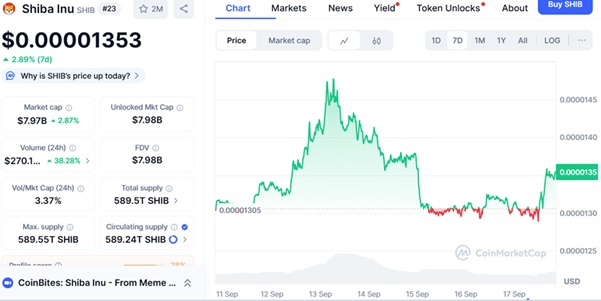
SHIB depends on the adoption drivers, including Shibarium, DeFi integrations, and token burns, to support long-term growth. Short-term movements are still linked to the larger market tendencies, and any further gains may still face resistance at around $0.0000145.

Dogecoin Maintains Momentum Despite Volatility

Dogecoin (DOGE) also posted strong gains this week. It is trading at $0.2822, marking an 11.56% rise over seven days. The token reached a peak above $0.30 on September 13 before falling back to a low near $0.26. Buyers later stepped in, driving the price above $0.28 again.
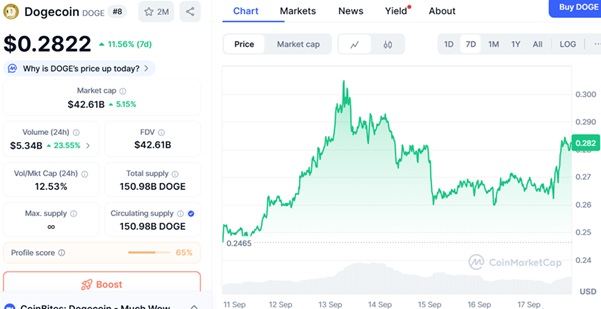
DOGE holds a market capitalization of $42.61 billion, which supports its first U.S.-listed ETFs. The product will allow spot exposure to Dogecoin, making long-term growth reliant on adoption and utility.  Analysts point to the strong support level of $0.26 and the nearest resistance of $0.30. Sustained trading at higher than $0.30 might lead to the potential surge to $0.35, but further volatility is likely to occur because Dogecoin has no real utility.

Little Pepe Presale Captures Market Attention

While SHIB and DOGE retain strong communities, investor attention has shifted to Little Pepe (LILPEPE). The project has its own Layer-2 blockchain, which makes it a meme coin and an infrastructure protocol. Unlike most meme tokens, LILPEPE is an EVM-compatible meme coin with practical utility that integrates scalability, “0% buy and sell tax,” “anti-sniper bot,” and “lightning-fast fees.”

LILPEPE’s early investors have already seen staged pricing benefits. The LILPEPE presale at Stage 13 has raised $25.92 million of its $28.77 million target. At the current stage, tokens sell for $0.0022, with the next stage price set to increase to $0.0023. More than 15.95 billion tokens have already been sold, leaving only about 1.3 billion tokens before the next price rise.

The tokenomics of Little Pepe depict a fixed supply of 100 billion tokens. Distribution will consist of 26.5% to the presale participants, 13.5% to the staking rewards, 10% to the liquidity, 10% to the exchange listing, 30% to the chain reserves, and 10% to marketing. However, no allocation was reserved for team wallets, which emphasizes a community-first strategy.

More importantly, the team runs a $777,000 presale giveaway, where 10 winners will get $77,000 worth of tokens each, with a $100 minimum contribution requirement. A separate Mega Giveaway selects big and random buyers from Stages 12–17 and offers 15+ ETH prizes. Project posts describe these as engagement campaigns that reward presale participation and broaden reach.

Meme Coins Growth Prospects and Market Outlook

The design of Layer-2 by Little Pepe provides fast and cheap transactions, addressing Ethereum’s long-standing concerns with gas fees and scalability. Other opportunities in the project are staking, governance via a DAO, NFT integration and a new meme token launchpad. All these aspects make it more than a speculative meme coin.

Market estimates point to the token’s potential growth, and presale investors are eyeing returns of over 17,827% if adoption momentum continues and exchange listing occurs. Planned listings on decentralized and centralized platforms will be crucial in establishing liquidity and broader access.

In contrast, SHIB and DOGE continue to rely heavily on community momentum and external adoption narratives. As investors search for higher growth potential, Little Pepe stands out by merging meme appeal with blockchain utility.


For More Details About Little PEPE, Visit The Below Link:

Website: https://littlepepe.com

Bitcoin Price Faces Key Test as Bulls Struggle to Hold $112K Amid Market Shake-Up

0

Bitcoin’s price extended losses after slipping below the critical $114,000 level. Bears took control and pushed the asset toward a key support zone at $110,500.

The recent drop in the crypto asset price follows the largest single-day liquidation of long positions this year, signaling growing uncertainty in the market.

The sell-off accelerated as BTC has continued to plunge, now trading at $112,468 as of the time of writing this report. If Bitcoin fails to close above $114,000, a renewed decline toward  $111,750 could occur, with deeper support lying near $110,500.

Massive Liquidations Shake the Market

The crypto market recently experienced a sharp sell-off, with $1.62 billion in long positions liquidated in a single day. According to Glassnode, Bitcoin may now be entering a “late-cycle phase,” historically seen before major market tops.

Data shows that despite bulls defending the $112,000 level, sellers are dominating the market. Heatmaps reveal significant bid liquidity near $107,000, suggesting a potential deeper correction if current supports fail.

Glassnode’s on-chain data highlights similarities between Bitcoin’s current cycle and previous runs (2015–2018 and 2018–2022).

Key observations include: BTC has dropped 9% since reaching its all-time high (ATH) of $124,000. Realized cap growth has slowed to 6% per month, down from 13% during the $100,000 breakout. Profit-taking volumes remain weaker than in past cycle peaks at $70K, $100K, and $122K.

Analyst Michaël van de Poppe identified $111,900 – $113,000 as a short-term demand zone. “If Bitcoin can hold this range, we could see a push toward $114,700 – $116,800, with $115,000 as the key resistance,” he noted. If BTC fails to maintain this area, the next major support lies between $106,000 – $108,000, with a deeper “max buy zone” at $103,000.

Retail Optimism vs. Market Reality

The recent 8% correction has sparked “buy the dip” chatter on social media, reaching its highest level in 25 days.

However, Santiment warns that this surge in optimism may precede further downside, as markets often move opposite to crowd sentiment.

While short-term holders (STHs) have aggressively accumulated 159,098 BTC, offsetting sales from long-term holders, analysts caution against expecting an immediate rebound. Retail traders’ eagerness to call a bottom has historically signaled further market shakeouts before a sustained recovery.

Meanwhile, large investors continue to quietly build their positions. Wallets holding between 10 and 10,000 BTC have accumulated a total of 56,372 coins since August 27. This steady accumulation by big holders often provides a floor for prices, even when retail sentiment wavers.

Data from the Bitcoin Exchange Liquidation Map shows that if $106,127 is breached by the BTC, approximately $12.45 billion worth of long positions will get liquidated, including $44.9 million on Binance, $38.9 million on OKX, and $27.3 million on Bybit.

Bitcoin and Ethereum ETFs Bleed $244 Million

On September 23, both spot Bitcoin and Ethereum ETFs recorded a second straight day of net outflows. Report shows Bitcoin ETFs lost $103.61 million, while Ethereum ETFs saw outflows of $140.75 million.

Bitcoin ETF Breakdown 

Bitcoin ETFs posted a total outflow of $103.61 million. Fidelity’s FBTC led withdrawals at $75.56 million. Ark & 21Shares’ ARKB followed with $27.85 million, and Bitwise’s BITB shed $12.76 million.

Only two products managed to attract inflows. Invesco’s BTCO added $10.02 million, while BlackRock’s IBIT brought in $2.54 million.

Trading activity in Bitcoin ETFs reached $3.16 billion, with total net assets of $147.17 billion, representing about 6.6% of Bitcoin’s market cap. This reflected a decline from the prior day.

Ethereum ETF Breakdown 

Ethereum ETFs recorded heavier outflows at $140.75 million. Fidelity’s FETH led selling pressure with $63.40 million. Grayscale’s ETH fund withdrew $36.37 million, followed by Bitwise’s ETHW at $23.88 million and Grayscale’s ETHE at $17.10 million.

None of the nine Ethereum ETFs reported inflows. Total trading volume dropped to $1.61 billion, while net assets fell to $27.48 billion, equal to 5.45% of Ethereum’s market cap.

Outlook

For Bitcoin to regain momentum, bulls must defend the $112,000 level and push prices above $114,000. Failure to do so could lead to a retest of $107,000, with the risk of even deeper declines if selling pressure intensifies.

As BTC’s cycle shows late-stage characteristics, remain cautious, focusing on key support and resistance zones while preparing for heightened volatility in the weeks ahead.

FTC Sues Amazon For Tricking And Trapping Customers into Prime Subscription

0

The Federal Trade Commission (FTC) has begun its courtroom battle with Amazon this week over what it calls deceptive practices surrounding the company’s moneymaker Prime subscription program, Gizmodo reports.

The trial, expected to last about a month, could redefine the boundaries of consumer protection in the digital subscription economy, with implications extending well beyond Amazon.

The FTC alleges that Amazon “tricked millions of customers” into signing up for Prime and then made cancellation deliberately complex. In court filings earlier this month, the regulator accused the company of refusing to address a “known problem,” which employees internally described as an “unspoken cancer,” fearing that simplifying the process would lead to fewer paying subscribers.

Central to the case is Amazon’s internal “Iliad” system—the cancellation flow that, according to the FTC, deters or confuses users attempting to quit Prime. The FTC says the labyrinthine mechanism misled some consumers into believing they had successfully canceled when they had not.

The lawsuit, originally filed two years ago under Biden-era FTC Chair Lina Khan, marks Amazon’s first major showdown with the agency, though another high-stakes trial is already looming. In a separate case, the FTC has filed antitrust charges against Amazon, with proceedings scheduled to begin in early 2027.

Prime remains Amazon’s golden goose. In 2023, the company earned more than $44 billion from subscriptions, which include audiobooks and music, though Prime leads the pack. Beyond that revenue, Prime members also spend heavily across Amazon’s marketplace, making them doubly valuable.

Details of the case

The FTC argues that Amazon concealed critical terms—like pricing and automatic renewals—deep in the fine print when users signed up for free trials. Shoppers lured by free shipping at checkout, for example, might not realize they were enrolling in a free Prime trial that renews automatically after 30 days.

Cancellation, too, became an ordeal. The multi-step process—internally dubbed “the Iliad,” a nod to Homer’s decade-long Trojan War—was designed to discourage cancellations. Consumers had to navigate multiple pages, with Amazon dangling exclusive offers and Prime Video teasers along the way.

In some cases, the FTC says, users were shown a banner thanking them for their membership and offering a “look back at your journey with Prime,” several steps before the cancellation was final. The FTC contends this tricked users into believing they had successfully opted out.

These practices, the FTC alleges, violate Section 5 of the FTC Act, which bans “unfair” commerce practices, and the Restore Online Shoppers’ Confidence Act (ROSCA), which requires companies to disclose all terms upfront, obtain explicit consent, and allow simple cancellation.

Amazon executives in the crosshairs

Amazon itself is not the sole defendant. Three executives—Prime Vice President Jamil Ghani, Amazon Health Services Senior Vice President Neil Lindsay, and Senior Vice President of International Consumers Russell Grandinetti—are also named.

The FTC says Ghani and Lindsay approved clarity improvements to Prime’s enrollment flow but rolled them back when sign-ups dipped. Grandinetti allegedly dismissed internal concerns about unintentional enrollments in favor of boosting Prime’s subscriber base.

Judge John H. Chun of the U.S. District Court for the Western District of Washington has already delivered a preliminary win to the FTC, ruling that Ghani and Lindsay would automatically be liable if Amazon is found guilty.

Amazon denies wrongdoing. “The bottom line is that neither Amazon nor the individual defendants did anything wrong – we remain confident that the facts will show these executives acted properly and we always put customers first,” a spokesperson told Gizmodo.

Dark patterns under fire

The FTC characterizes Amazon’s tactics as “dark patterns”—deceptive design choices crafted to manipulate user behavior. These range from confusing enrollment buttons to misleading cancellation steps.

Dark patterns are increasingly drawing global scrutiny. The European Union is preparing to address such practices through the upcoming Digital Fairness Act. Meanwhile, in the United States, the FTC under Khan pushed for a “click to cancel” rule to simplify cancellations, but the effort was struck down under the Trump administration.

Implications beyond Amazon

The FTC notes that Amazon is far from alone in complicating subscription cancellations. Many platforms—from streaming services to digital newspapers—use similar tactics to reduce churn. But Amazon, as one of the world’s largest subscription services, represents the highest-profile test case yet.

If the court sides with the FTC, it could ripple across the digital economy, forcing companies to rethink how they present sign-ups and cancellations. Consumer advocates say such a ruling could finally standardize practices and limit manipulative design.

A comparative lens

The Amazon trial echoes similar disputes unfolding globally. In Europe, regulators have taken aim at companies like Apple and Google for “dark pattern” practices around app store subscriptions, while India’s Consumer Protection Authority has begun cracking down on opaque renewal terms across e-commerce platforms.

Netflix and Spotify have also faced criticism in markets like Germany and France, where regulators required clearer cancellation processes. Compared to these cases, Amazon’s alleged tactics stand out not only for their scale—affecting millions of Prime users—but also for the internal acknowledgment that the practices amounted to a systemic issue.

That global context highlights the stakes of the Washington courtroom battle. If the FTC prevails, it would bring U.S. standards closer to those now emerging in Europe, potentially setting a new benchmark for digital subscriptions worldwide.

Manufacturers Warn Proposed Tax Stamp Could Trigger Inflation and Weaken Nigeria’s AfCFTA Competitiveness

0

The Manufacturers Association of Nigeria (MAN) has cautioned that government plans to introduce a Tax Stamp System for excisable goods may compound Nigeria’s economic pressures, warning it could fuel inflation, suppress consumer demand, and undercut the country’s ability to compete under the African Continental Free Trade Area (AfCFTA).

In a statement signed by its Director General, Segun Ajayi-Kadir, on Tuesday, the association said the extra compliance costs from tax stamps would inevitably be passed on to consumers, many of whom are already struggling with high prices of essential goods.

“This will further shrink demand and push more people toward cheaper, illicit alternatives,” MAN said.

The group stressed that the measure would raise production costs for local manufacturers, placing them at a disadvantage against imports from other African economies. With AfCFTA seeking to create a level playing field for intra-African trade, MAN said Nigeria risks losing ground if domestic manufacturers are forced to operate under a heavier cost burden than their continental peers.

Gains of the 2025 Tax Act Under Threat

MAN acknowledged that the Nigeria Tax Act 2025 had delivered some relief to businesses by consolidating multiple levies, simplifying compliance, and lowering the cost of doing business. But it argued that tax stamps could unravel those gains by creating a “hidden tax burden” inconsistent with the spirit of the reforms.

“The 2025 reforms were meant to ease the cost of doing business and encourage investment. Introducing tax stamps risks reversing these achievements and discouraging industrial growth,” the statement said.

The association also questioned the effectiveness of tax stamps as a tool for combating smuggling and counterfeiting. It argued that global evidence shows limited success, with vendors supplying stamp technology often emerging as the biggest beneficiaries, while industries and governments see little impact.

According to MAN, instead of curbing illicit trade, higher product prices could push more consumers toward unregulated markets, while the risk of counterfeit stamps entering circulation could further complicate enforcement.

Although no official announcement has been made, MAN said it has reliable information that the government is considering the policy based on vendor proposals linking tax stamps to the fight against illicit trade.

The association reminded policymakers that a similar proposal was first floated in 2018 but was unanimously rejected by stakeholders across the board, a precedent it believes the government should not overlook.

Digital Solutions Already Exist

The group pointed out that Nigeria already operates digital systems capable of providing transparency and traceability in excise operations. Among them are the Nigeria Customs Service’s B’Odogwu Automated Excise Register System (ERS) and the Federal Inland Revenue Service’s e-invoicing platform.

“These home-grown systems give government the real-time visibility that tax stamps promise, without the additional costs and disruptions,” MAN noted.

It warned that layering a tax stamp regime on top of existing systems would only create bottlenecks and escalate compliance costs.

Lessons from Other Countries

MAN highlighted case studies from Kenya, Uganda, Tanzania, and Ghana, where tax stamp systems triggered high compliance costs, legal disputes, and complaints from industries. Despite these burdens, illicit trade persisted.

Even in advanced economies, the model has faced challenges. The United Kingdom recently reformed its stamp-based system after concluding that it was costly, ineffective, and confusing for businesses—an outcome that MAN urged Nigeria to consider before proceeding.

Considering Nigeria’s Fragile Business Climate

The warning from MAN comes against the backdrop of already mounting challenges for Nigerian manufacturers, who face some of the highest operating costs in Africa. The industry has long complained of rising energy prices, high borrowing costs from elevated interest rates, foreign exchange shortages, and multiple taxation at the federal, state, and local levels.

While manufacturers in peer African economies such as Egypt, South Africa, and Morocco are benefiting from lower financing costs and more stable energy supply, Nigerian firms have had to battle power shortages and diesel prices that make production significantly more expensive.

Adding tax stamps to this fragile operating environment, MAN argued, would not only weaken local players in regional competition but could also discourage new investments at a time Nigeria is seeking to attract foreign capital through AfCFTA.

While reiterating its willingness to contribute excise revenues, MAN called on the government to strengthen border controls, boost enforcement, and optimize existing digital platforms rather than adopt tax stamps. It further urged broad consultations with stakeholders and a transparent impact assessment before any final decision is taken.

Champion Breweries to Raise N58bn for Bullet Acquisition and Expansion Drive

0

Champion Breweries Plc has unveiled plans to launch a N58 billion capital raise programme, a bold move aimed at funding its acquisition of the Bullet brand assets and intellectual property, working capital needs, market expansion, and sustainability-focused investments.

The announcement was made during the company’s “Facts Behind the Figures” session at the Nigerian Exchange (NGX) on Monday, September 22, 2025. Company Secretary, Chief Tosan Aiboni, disclosed that the programme will be executed through a N42 billion public offer and a N16 billion rights issue.

According to the Managing Director, Inalegwu Adoga, proceeds will not only support the Bullet acquisition but also be channeled into technology upgrades such as Enterprise Resource Planning (ERP) systems, returnable packaging solutions, renewable energy adoption, and logistics transformation.

Growth Ambitions Anchored on Bullet

Champion Breweries is projecting a more than fivefold increase in revenue and a tenfold growth in profit after tax once the Bullet ready-to-drink (RTD) alcoholic brand is integrated into its operations. Management noted that the deal is expected to contribute over 70% of Champion’s topline while significantly expanding its foreign currency earnings across 14 African markets.

In H1 2025, the brewer had already recorded impressive momentum with a 111% surge in revenue and a 692% rebound in profit after tax, reflecting disciplined execution and a stronger market position even before the acquisition.

“This is a transformative moment for Champion Breweries,” Adoga said. “Bullet gives us scale, high-margin growth, and international reach. With this acquisition, we are evolving from a strong regional brewer into a multi-market, multi-category growth platform with international relevance.”

Champion’s majority shareholder, enJOYcorp, reinforced the ambition. Its Managing Director, David Butler, noted that the Bullet deal was a landmark in building African beverage brands capable of competing globally.

“Bullet expands Champion’s reach across Africa, diversifies its earnings into foreign currencies, and strengthens its portfolio with trend-driven products,” Butler said.

Performance Track Record

Champion’s financial performance in recent quarters underscores its confidence. The brewer posted a pre-tax profit of N1.7 billion in Q2 2025, a 268.95% rise compared to N465.4 million in the same period of 2024. For H1 2025, pre-tax profit stood at N3.4 billion, a major turnaround from a N333 million loss in H1 2024. Revenue from beer and malt sales climbed to N7.4 billion in Q2, up 44.18% year-on-year.

The company, incorporated in 1974 and headquartered in Uyo, Akwa Ibom State, has built a reputation over five decades of brewing excellence. Listed on the NGX, it produces a portfolio of beer and malt brands, and is now positioning itself as a continental player through the backing of enJOYcorp, its parent company.

Comparative Look

The strategy mirrors moves seen in Africa’s beverage industry over the past decade, where acquisitions and capital raises have become pathways to market dominance. For instance, AB InBev’s multi-billion-dollar consolidation of SABMiller in 2016 reshaped the African beer market, while Nigerian Breweries and Guinness Nigeria have both turned to capital raises in the past to strengthen balance sheets and fund expansion.

Champion’s approach differs in its focus on trend-driven RTD beverages and energy drinks, categories that are rapidly gaining share among younger consumers across Africa. By acquiring Bullet, it is not just competing with established brewers on beer but positioning itself in segments that global majors are also targeting for growth.

The timing is also notable as Nigeria’s brewing sector has been under pressure from rising input costs, inflation, and currency volatility. Champion’s recent profitability and its ability to attract shareholder backing for such a large raise suggest growing investor confidence in the company’s strategy.

What Lies Ahead?

Once completed, the Bullet acquisition will immediately boost Champion’s financials through foreign exchange earnings, a wider distributor network, and a stronger continental presence. Over the longer term, supply chain integration, ERP-led efficiencies, and sustainability investments could provide competitive advantages in a crowded market.

The N58 billion raise is more than a financing exercise for Champion, as many believe it is the springboard for transforming from a Nigerian regional brewer into an African beverage powerhouse.